 WORXMATE
Summary
As hybrid work models become the norm, aligning remote and in-office teams is more crucial than ever. OKRs (Objectives and Key Results) offer a clear and measurable framework that helps organizations drive focus, accountability, and collaboration across distributed teams. When implemented thoughtfully, OKRs improve transparency, streamline communication, and boost overall productivity. They also help overcome challenges like misalignment, communication gaps, and lack of ownership in hybrid setups.
In today’s dynamic work landscape, organizations are increasingly adopting Objectives and Key Results (OKR) as a strategic framework for setting goals and managing performance and output.
With the rise of hybrid work environments, where teams operate both remotely and in-office, defining and mapping OKRs for teams has become paramount. However, successfully executing this alignment requires selecting the best okr software to eliminate operational silos and automate progress tracking across distributed workflows.
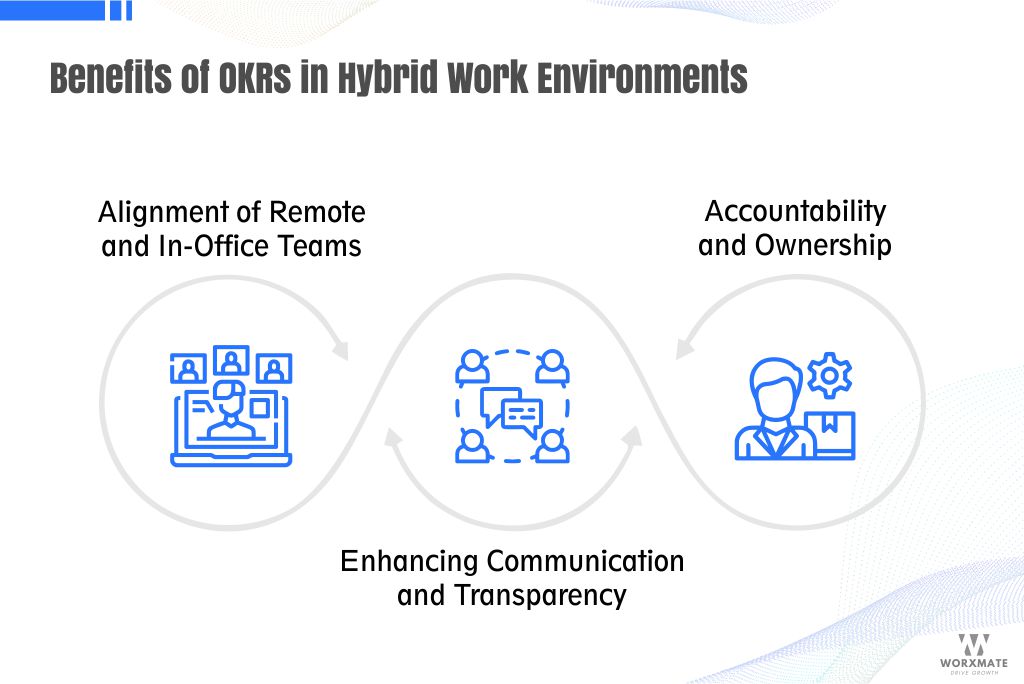
Benefits of OKRs in Hybrid Work Environments
-
Alignment of Remote and In-Office Teams
In hybrid work environments, achieving alignment within the team can be challenging. OKRs serve as a powerful tool for aligning the efforts of remote and in-office teams toward common objectives.
By clearly defining objectives and measurable key results, OKRs provide a shared understanding of priorities and expectations, regardless of physical location.
This alignment ensures that all team members are working towards the same overarching goals, promoting cohesion and collaboration across distributed teams.
With OKRs in place, all team members can coordinate their efforts effectively, leading to increased productivity and streamlined operations.
-
Enhancing Communication and Transparency
Clear and transparent communication is essential for the success of any organization, especially in hybrid work environments where face-to-face interactions may be limited.
OKRs facilitate communication by providing a structured framework for setting and sharing goals. By articulating objectives and key results, organizations create a simplified understanding of the tasks, that promote clarity and understanding among team members, irrespective of their physical location.
This transparency not only fosters open communication but also reduces the likelihood of misunderstandings and misalignments.
Team members can easily track progress, share updates, and collaborate on tasks, leading to improved efficiency and teamwork.
-
Accountability and Ownership
In hybrid work environments, maintaining accountability can be a challenge. OKRs address this challenge by assigning specific key results to individuals or teams, thereby promoting accountability and ownership over tasks and outcomes.
Each team member knows precisely what is expected of them and understands how their contributions effort to the broader objectives of the organization.
This clarity of purpose encourages employees to take ownership of their responsibilities and strive for excellence in their work.
Moreover, OKRs provide a framework for regular performance evaluations and feedback, further reinforcing accountability and driving continuous improvement.
By fostering a culture of accountability and ownership, organizations can empower their employees to deliver their best work, regardless of their location or working arrangements.

Challenges of Implementing OKRs in a Hybrid Work Environment
-
Communication Barriers in Remote Settings
Remote work can pose communication challenges, making it essential for organizations to leverage technology and establish clear channels for collaboration.
Video conferencing, instant messaging platforms, and workflow management tools such as Worxmate.ai can facilitate seamless communication and mitigate the impact of physical distance.
-
Balancing Autonomy and Collaboration
Hybrid work environments require striking a balance between granting autonomy to remote workers and fostering collaboration across distributed teams.
Organizations must provide guidelines and frameworks for collaboration while empowering individuals to work independently and take ownership of their tasks.
-
Inclusivity and Equal Participation
Ensuring equal participation and inclusion of all team members, regardless of their location, is critical for the success of OKRs in hybrid settings.
Organizations must proactively seek input from remote team members, encourage diverse perspectives, and create opportunities for virtual participation in meetings and decision making processes.
Achieve Your Goals Faster
See how Worxmate can help your team set clear goals and achieve faster results. Book your free demo today and experience the power of AI-driven OKRs in action.
Strategies for Successful Implementation
-
Establishing Clear and Measurable Objectives
Clear and measurable objectives provide a roadmap for success, guiding teams toward meaningful outcomes. Organizations should articulate objectives that are ambitious yet attainable, ensuring alignment with the overall vision and mission of the company.
-
Creating Adaptable Key Results
Flexibility is key in hybrid work environments, organizations should create adaptable key results that can be adjusted based on changing circumstances and evolving business needs. Regular review and refinement of key results ensure that teams remain focused and responsive to emerging challenges.
-
Check-ins and Progress Tracking
Regular OKR check ins and progress-tracking sessions are essential for monitoring OKR performance and providing feedback. Organizations should establish a cadence for check-ins, whether it be weekly, bi-weekly, or monthly, to review progress, discuss challenges, and realign priorities as needed.
-
Using Worxmate to Facilitate OKR Management
Leveraging the best okr software platforms, such as Worxmate, can streamline OKR management, enabling seamless collaboration and tracking across distributed teams. Worxmate provides a centralized hub for setting, tracking, and updating OKRs, facilitating communication, transparency, and accountability in hybrid work environments.
Overcoming Common Pitfalls
-
Resistance to Change
Addressing resistance to change requires clear communication, leadership support, and emphasizing the benefits of OKRs for individuals and the organization. Organizations should provide training and resources to help team members adapt to the new framework and address concerns or misconceptions.
-
Modifying OKRs for Evolving Work Dynamics
OKRs should be dynamic and responsive to changing business needs, allowing for adjustments as necessary. Organizations should encourage flexibility and adaptability, empowering teams to modify OKRs as work dynamics evolve and priorities shift.
-
Balancing Individual and Team Goals
Striking a balance between individual and team goals ensures that both personal growth and collective success are prioritized. Organizations should encourage collaboration and alignment between individual OKRs and broader team objectives, fostering a culture of mutual support and accountability.
Tips for Maximizing Productivity
-
Foster a Results-Oriented Culture
Cultivate a culture that prioritizes outcomes and celebrates achievements, fostering motivation and accountability. Recognize and reward individuals and teams for their contributions towards OKR attainment, reinforcing a culture of excellence and continuous improvement.
-
Recognizing and Celebrating Achievements
Regularly acknowledge and celebrate progress and accomplishments, whether it be through team meetings, company-wide announcements, or rewards and incentives. Recognizing achievements boosts morale and motivation, inspiring teams to strive for excellence and pursue ambitious goals.
-
Provide Training and Support
Offer training and support to help team members adapt to hybrid work dynamics and effectively utilize the OKR framework. Provide resources, workshops, and mentorship opportunities to enhance understanding and proficiency in setting, tracking, and achieving OKRs.
Conclusion
OKRs offer a structured approach to goal setting and achievement in hybrid work environments. By overcoming implementation challenges and leveraging strategies for success, organizations can maximize productivity and drive success in the hybrid era. Consider integrating the best okr software like Worxmate into your strategy to streamline processes and facilitate collaboration across distributed teams.
Try Worxmate OKR Tracking Software today and align your teams for measurable success.


Written by
An OKR Coach with 20+ years of implementation experience, Madhusudan has guided over 50 organisations through successful OKR transformations, training more than 500 leaders. Learn more about Worxmate.