 WORXMATE
Quick Answer
The best OKR software for small businesses is one that balances a real feature set with a fast setup – Worxmate, Lattice, and Weekdone lead the pack in 2026. Worxmate is the strongest overall pick for scaling startups because it pairs OKR tracking with three built-in AI models – Orbit, Axis, and Nexus – under a single DEEP AI framework, so a 10-person team gets enterprise-grade visibility without enterprise-grade admin work. Jump to the ranked comparison table below or read on for the full breakdown.
Why You Need Dedicated OKR Software for Small Businesses
Small businesses often start by tracking goals in Excel or Google Sheets. However, as teams grow beyond 10 employees, these manual systems inevitably break down. Information becomes siloed, version control issues arise, and the lack of real-time updates leads to “set it and forget it” syndrome, where goals are only reviewed at the end of a quarter.
Implementing OKR software for small businesses solves these challenges by creating a “single source of truth.” When everyone from the CEO to the newest intern can see how their work contributes to the organizational growth, engagement increases. Research by McKinsey suggests that organizations with clearly communicated and aligned goals are 2.4 times more likely to outperform their competitors.
-
Eliminate Silos
Ensure that marketing, sales, and product teams are not working toward conflicting priorities by providing a transparent view of the company’s hierarchy.
-
Real-Time Visibility
Automated dashboards allow leadership to identify stalled Key Results before they become critical failures, enabling proactive course correction.
-
Reduced Meeting Fatigue
When progress is updated asynchronously within the software, weekly status meetings can focus on strategy and problem-solving rather than rote reporting.
- AI-Powered Early Warnings – This is where most spreadsheet-era small businesses fall behind: Orbit AI flags attrition or burnout risk 4-8 weeks before it shows up in a review, and Axis AI isolates the single fastest lever to pull when revenue execution slips-insight a 12-person team simply cannot generate by staring at a spreadsheet.
- Getting alignment right isn’t just a software feature – it’s a discipline. If you want the step-by-step method before you shop for tools, our goal alignment guide and goal setting strategies: 7 steps guide both walk through it in more depth than we have room for here.
OKR vs KPI for Startups: What to Track First
Before you buy OKR software for small businesses, it’s worth confirming you actually need OKRs and not just cleaner KPI dashboards. The short version: KPIs measure ongoing health (churn rate, MRR, response time); OKRs set a time-boxed, ambitious direction on top of that health data. Most seed and Series A startups need both – running them side by side, as covered in using OKR and KPI together, rather than choosing one framework and discarding the other.
If your team is under 10 people and every metric is still visible to the founder daily, a lightweight KPI sheet may be enough for now – the full breakdown of when to make the switch is in OKR vs KPI for startups and when to use KPI vs OKR. Once you cross roughly 10-15 employees or raise a priced round, the coordination cost of not having a shared objective framework starts to outweigh the setup effort of adopting one.
A related trap: Teams write OKRs that measure activity (an output) instead of the business result that activity was supposed to create (an outcome). “Ship 12 features” is an output; “reduce onboarding time to under 5 minutes” is an outcome. Our output vs outcome guide has a worked example for founders writing their first cycle.
Achieve Your Goals Faster
See how Worxmate can help your team set clear goals and achieve faster results. Book your free demo today and experience the power of AI-driven OKRs in action.
Key Features to Look for in OKR Software for Small Businesses
Not all goal-tracking tools are built equally. For a small business, the focus should be on “time-to-value”- how quickly the team can adopt the tool without extensive training. The best OKR software for small businesses should offer a clean interface that mimics the simplicity of modern productivity apps like Notion.
Integration capabilities are equally vital. Your OKR software should ideally connect with your existing tech stack, such as Jira, Asana, or Microsoft Teams. This ensures that goal tracking becomes a natural part of the daily workflow rather than an additional chore for employees to complete.
| Feature Category | Must-Have Capability | Benefit for Small Teams |
|---|---|---|
| Alignment Mapping | Visual Goal Hierarchies | Shows exactly how individual work supports company-wide objectives. |
| Automation | Progress Roll-ups | Automatically updates Objectives based on Key Result progress. |
| Engagement | Check-ins and Feedback | Integrates performance management software features into the goal cycle. |
| Usability | Mobile Accessibility | Allows teams to update progress on the go, increasing data accuracy. |
On that last row: most small teams score OKRs manually at quarter-end, by which point it’s too late to course-correct. Worxmate’s OKR scorecard software (the Evaluate stage of DEEP AI) forecasts where each Key Result is trending mid-cycle, which is the single biggest gap we see in spreadsheet-based okr tracking.
6 Best OKR Software for Small Businesses (Ranked)
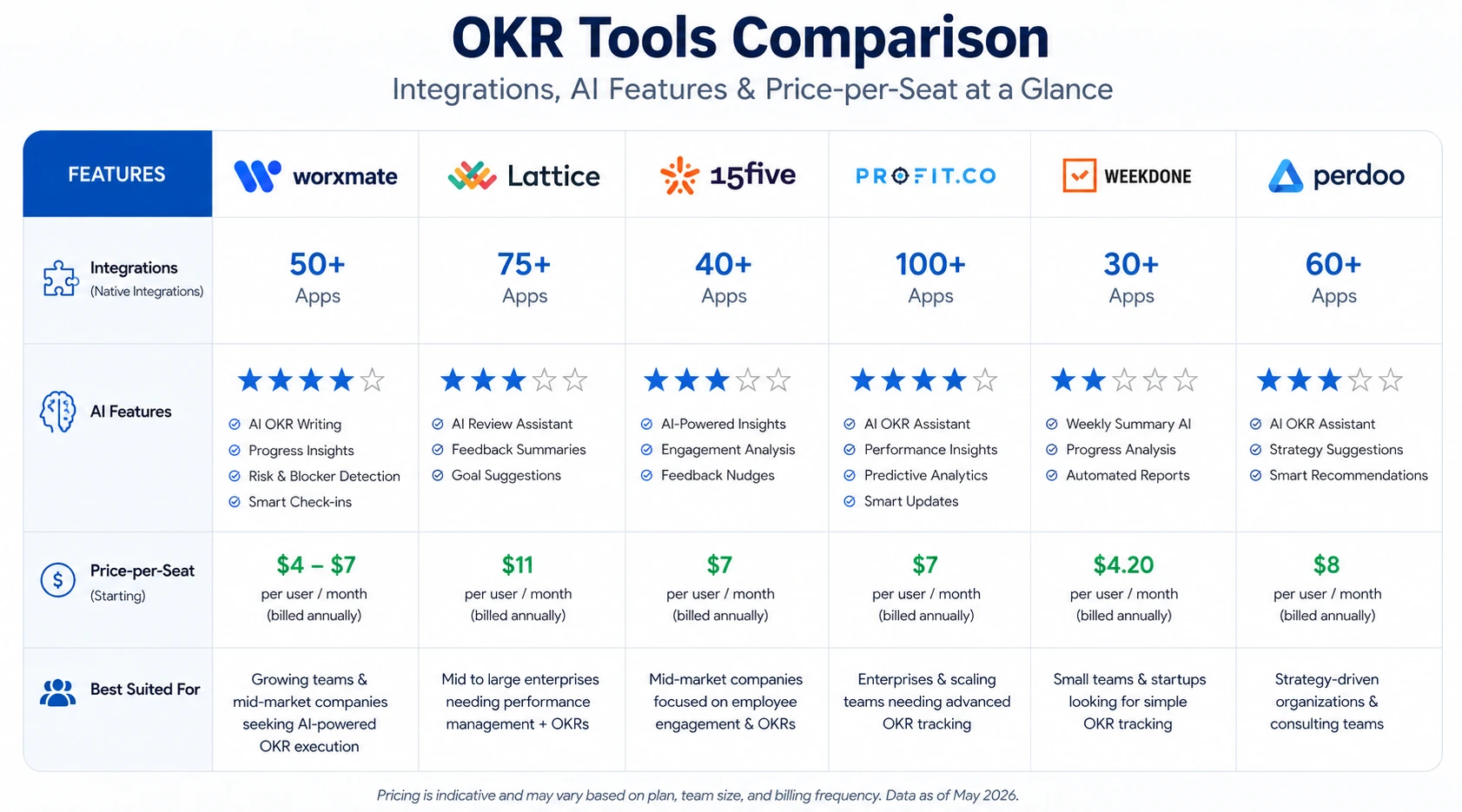
Selecting the right platform requires balancing functionality with budget. Here are the top six options for OKR software for small businesses in 2026, ranked by their suitability for lean teams and scaling startups.
1. Worxmate
Worxmate stands out as a comprehensive solution that blends OKRs with continuous performance management. It is designed specifically for mid-market and scaling firms that need OKR consulting-grade structure without the complexity of enterprise software. Its AI-driven insights help managers identify alignment gaps automatically.
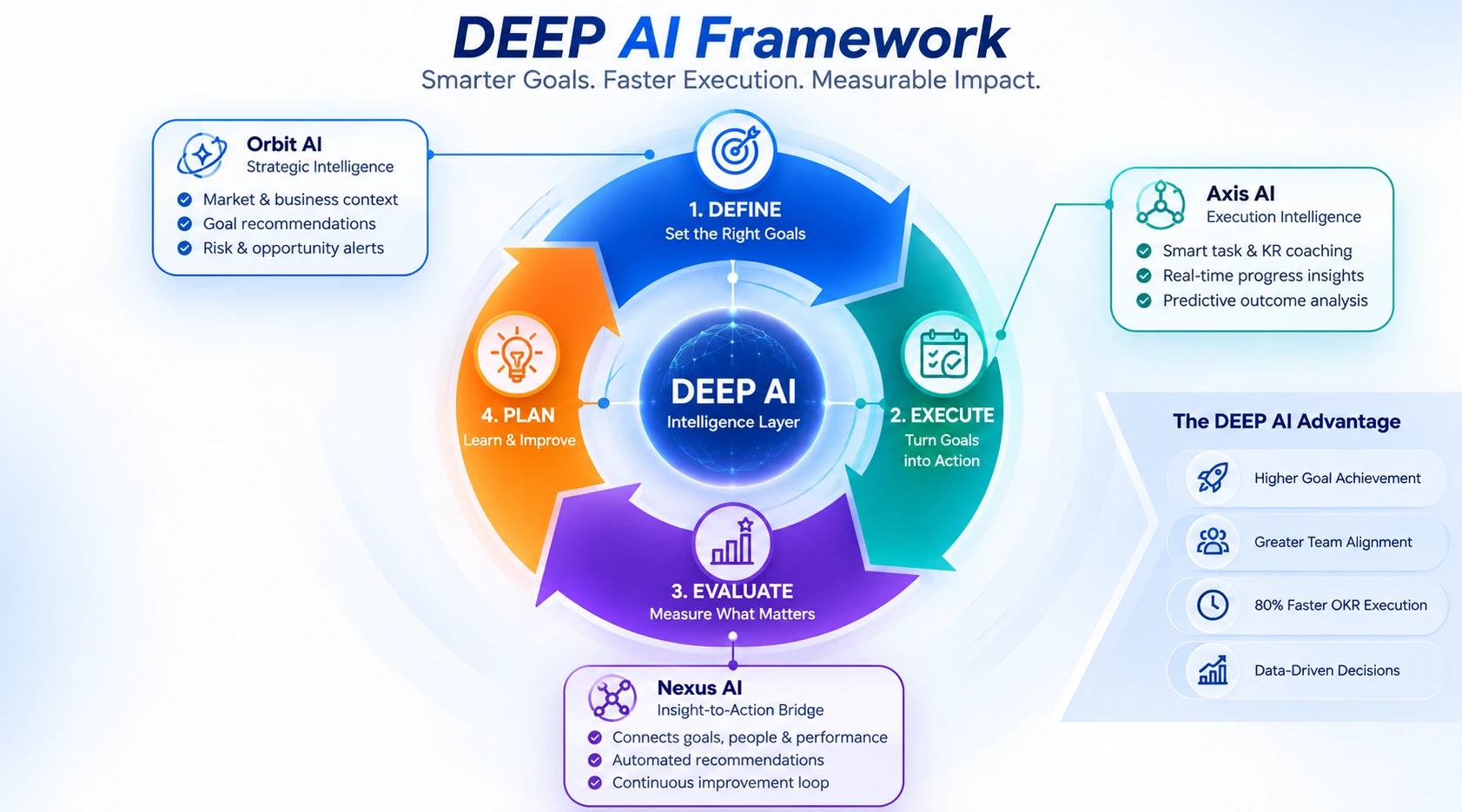
What the original ranking doesn’t mention: this is powered by three named AI models rather than one generic “AI insights” label – Orbit for people risk, Axis for revenue levers, and Nexus for structural misalignment – each mapped to a stage of the DEEP AI framework (Define, Execute, Evaluate, Plan).
2. Lattice
Lattice is a popular choice for startups that want to combine performance reviews and OKRs in one place. While powerful, it can be expensive for very small teams and may offer more features than a seed-stage company requires.
3. 15Five
Focusing heavily on employee engagement, 15Five is excellent for businesses that prioritize culture alongside goal achievement. It uses a “check-in” model to keep OKRs top-of-mind for every team member.
4. Profit.co
For those who want deep customization and over 400 integrations, Profit.co is a strong contender. Its complexity can be a double-edged sword, requiring more setup time than simpler alternatives.
5. Weekdone
Weekdone is built on the weekly reporting methodology. It is highly effective for teams of 10-50 people who need a structured way to report progress and plan the week ahead in alignment with OKRs.
6. Perdoo
Perdoo offers a “freemium” model that is attractive to very small teams. It focuses on the distinction between “Strategy” and “OKRs,” helping companies map out their long-term vision alongside quarterly goals.
If you’re evaluating tools specifically from India, our dedicated OKR tools for startups India comparison covers INR pricing and GST-friendly billing, which the six global tools above don’t always offer cleanly.
Comparing Pricing: Finding an Affordable OKR Solution
Budget is often the primary constraint when selecting OKR software for small businesses. Most vendors use a “per-user, per-month” pricing model, which can scale quickly as your headcount grows. It is important to look beyond the sticker price and evaluate the ROI of features like automated reporting and strategic planning support.
According to a study by Harvard Business Review, 95% of employees do not understand their company’s strategy. (Source: Harvard Business Review) Investing in a tool that clarifies this strategy can save hundreds of hours in wasted effort, making even a premium software choice more affordable in the long run than a “free” spreadsheet that no one uses.
For a line-by-line breakdown of what drives the per-seat number up or down, see OKR software cost per user. Worxmate’s own tiers – Vital, Proficient, and Enterprise – are listed on the OKR software pricing page, with savings of up to 25% on yearly plans, which matters more at seed stage than almost any feature comparison.
How to Transition from Spreadsheets to OKR Software
Moving your data from Excel to a dedicated OKR software for small businesses should be a phased process. Start by auditing your current OKR examples to ensure they are high-quality and measurable. Many startups fail because they simply move “bad” goals from a spreadsheet into a new tool.
Once your goals are refined, appoint “OKR Champions” within each department. These individuals will be the first to master the software and can provide peer-to-peer support during the rollout. This bottom-up adoption strategy is often more effective than a top-down mandate in small, agile environments.
If you’re still deciding whether the switch is worth it, our side-by-side spreadsheet vs OKR software comparison quantifies the hidden cost of an OKR tracking spreadsheet – version conflicts, stale check-ins, and the meeting time spent re-explaining status that a dashboard would show automatically.
Achieve Your Goals Faster
See how Worxmate can help your team set clear goals and achieve faster results. Book your free demo today and experience the power of AI-driven OKRs in action.
Benefits of OKR Software for Startups You Can’t Get from a Spreadsheet
It’s worth spelling out, plainly, what you’re actually paying for. The core benefits of OKR software for startups break down into four areas:
- Speed of course correction – a stalled Key Result is visible the week it stalls, not the week the quarter ends.
- Objective scoring you can trust – automated roll-ups remove the “we all graded ourselves a 0.9” problem common with okr grading for startups done manually.
- Founder time back – less time compiling status updates for the board deck, more time spent building.
- A framework that scales with headcount – the same system that works for 8 people still works at 80, so you avoid a painful how to migrate from Viva Goals (or any other tool) migration later.
On that last point – companies that started on Microsoft Viva Goals should note Microsoft’s own Viva Goals retirement announcement; picking a platform built for long-term goal management (not a bundled feature that can be discontinued) is now a real evaluation criterion, not a hypothetical one.
Case Study: Luminal AI – 95% Transparency in 90 Days
-
The Challenge
Luminal AI, a seed-stage startup with 25 employees, struggled with massive meeting fatigue. The leadership team spent four hours every Monday in “sync meetings” just to understand what different departments were working on. Their Excel-based goal tracker was frequently outdated and ignored by the engineering team.
-
The Solution
The company implemented Worxmate as their primary OKR software for small businesses. They integrated it with their Jira boards to automate progress updates and moved all status reporting into the platform’s asynchronous check-in feature.
-
Results and Impact
Within three months, Luminal AI achieved 95% goal transparency across the organization. Meeting times were reduced by 60%, allowing the team to reinvest that time into product development. Strategic alignment scores, measured via internal surveys, rose by 40% as employees finally understood how their daily tasks moved the needle.
What isn’t in the original write-up: Luminal AI’s engineering lead also credits Orbit AI with catching early burnout signals in two senior engineers during the crunch before launch – both were retained, which the team estimates saved 6+ weeks of re-hiring and onboarding.
Why Worxmate is the Strategic Choice for Scaling Startups
While there are many options for OKR software for small businesses, Worxmate is uniquely positioned for companies that plan to scale. It provides the essential structure required for performance management without the overwhelming complexity of enterprise legacy systems. By combining goal tracking with real-time feedback, it creates a culture of accountability that is vital for early-stage success.
Choosing Worxmate means more than just buying a tool; it means adopting a methodology that has helped companies like Google and Adobe scale to global dominance. For a small business, this strategic foundation is the difference between stagnant growth and market leadership. Using OKR software for small businesses that evolves with you ensures you never have to undergo a painful platform migration as your team expands.
Ready to accelerate your growth journey? Start your free trial with Worxmate today and discover how our Performance Management software can transform your strategy into measurable results. Implementing the right OKR software for small businesses is the first step toward building a high-performance culture that lasts.
How Worxmate’s DEEP AI Framework Powers Small-Team OKRs
Most “AI-powered” OKR tools bolt a chatbot onto an existing tracker. Worxmate structures its AI around the actual OKR lifecycle instead, which is why it holds up as a company scale past founder-led management:
- Define – the AI OKR writing tool uses an AI co-pilot and OKR Studio to write precision OKRs with built-in quality scoring, so a first-time OKR writer doesn’t submit a vague objective.
- Execute – the OKR check-in software runs AI-guided task coaching and structured check-ins so Key Results stay on track between quarterly reviews.
- Evaluate – the OKR scorecard software uses AI forecasts to separate real progress from vanity metrics before the quarter closes.
- Plan – the OKR retrospective tool runs AI-facilitated retrospectives, turning each cycle’s data into next-cycle recommendations automatically.
Layered on top, Orbit AI, Axis AI, and Nexus AI read across all four stages to flag people, revenue, and structural risk respectively. As the company grows past the founder-can-see-everything stage – often the point where HR ownership shifts to a dedicated hire – the same data set feeds directly into OKR software for CHROs, so nothing has to be rebuilt.


Written by
An OKR Coach with 20+ years of implementation experience, Madhusudan has guided over 50 organisations through successful OKR transformations, training more than 500 leaders. Learn more about Worxmate.