 WORXMATE

Bell Curve Performance Management: How It Works: Bell curve performance management evaluates employees against a normal distribution model, categorizing them into fixed top, average, and bottom tiers. Modern organizations replace rigid stack ranking with the performance management system to drive continuous alignment and objective growth.
Introduction: Why the Bell Curve Matters in Today’s Workplace
Imagine walking into your performance review only to discover that regardless of your achievements, you might be labeled as “average” simply because your organization follows a predetermined distribution.
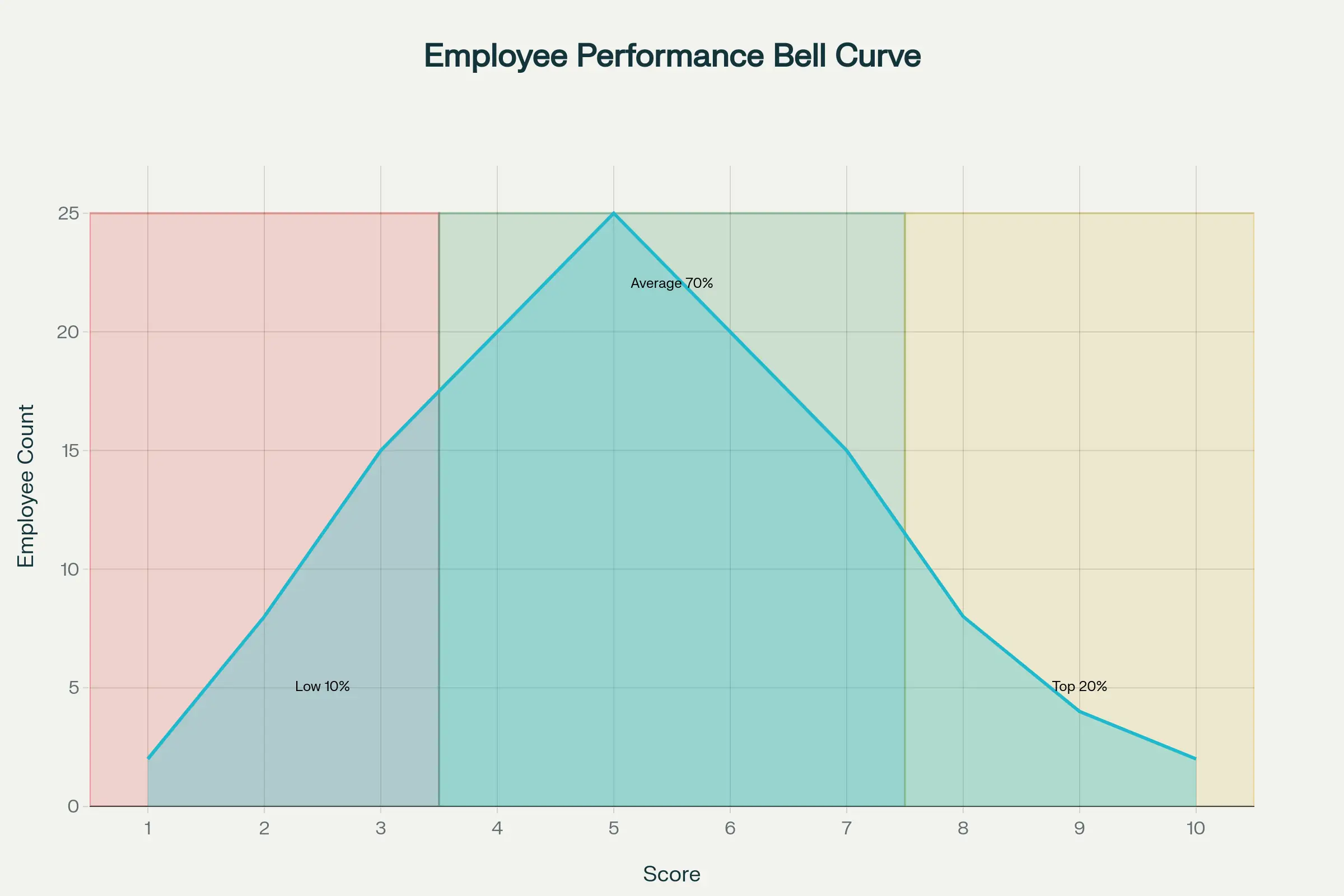
This scenario illustrates the complex reality of bell curve performance management systems that continue to influence millions of employees worldwide.
The bell curve approach to performance evaluation has shaped corporate culture for decades, but 2025 brings new challenges and alternatives that every HR professional and business leader must understand.
As companies like Microsoft, Adobe, and General Electric have moved away from traditional forced ranking systems, the question isn’t just how does a bell curve work in performance management, but whether it still serves modern organizational needs.
This comprehensive guide examines the current state of bell curve performance management, its practical applications, and the emerging trends reshaping how we evaluate employee performance in today’s collaborative workplace.
What Is the Bell Curve in Performance Management?
Understanding the Bell Curve Framework
The bell curve in performance management, also known as forced ranking or stack ranking, represents a statistical approach to employee evaluation that categorizes workers based on a normal distribution pattern. This methodology assumes that employee performance naturally follows a bell-shaped curve when plotted on a graph.
In practice, the bell curve system typically distributes employees across three main categories:
- Top Performers (20%): Exceptional contributors who exceed expectations
- Average Performers (70%): Employees who meet standard expectations
- Low Performers (10%): Workers requiring improvement or intervention
The Statistical Foundation
The bell curve methodology draws from the normal distribution principle, where most data points cluster around the average with fewer outliers at the extremes.
When applied to performance management, this creates a structured framework for comparing employees against their peers rather than against absolute performance standards.
Unlock Goal Clarity & Accelerate Employee Growth
Looking to drive goal clarity and employee growth? Discover how Worxmate’s AI-powered Performance Management Software can help.
How Does a Bell Curve Work in Performance Management?
The Implementation Process
Understanding how does a bell curve work in performance management requires examining its step-by-step implementation:
1. Performance Evaluation Phase
Managers assess individual employee performance using predetermined criteria such as:
-
- Goal achievement and target completion
- Demonstration of core competencies
- Contribution to team objectives
- Innovation and problem-solving capabilities
2. Relative Ranking System
Unlike absolute performance measurement, the bell curve ranks employees relative to their peers within the same department or organization. This comparative approach determines placement within the distribution curve.
3. Forced Distribution Application
The system mandates that a specific percentage of employees fall into each performance category, regardless of actual team performance levels. This creates the characteristic bell shape when performance ratings are plotted.
4. Outcome Determination
Based on their curve placement, employees receive:
-
- Top performers: Bonuses, promotions, and recognition
- Average performers: Standard compensation adjustments and development opportunities
- Low performers: Performance improvement plans or potential termination
5. Modern Adaptations
Contemporary applications of the bell curve often incorporate technology platforms and data analytics to enhance accuracy and reduce bias in the evaluation process. Many organizations now use performance management software that automates curve calculations and provides visual representations of team distributions.
Advantages of the Bell Curve System
Standardization and Fairness
The bell curve provides a structured approach that standardizes performance evaluations across different departments and managers. This consistency helps eliminate subjective bias and ensures comparable evaluation criteria throughout the organization.
Clear Performance Differentiation
Organizations benefit from clear identification of high-performing employees who merit additional investment, recognition, and advancement opportunities. Similarly, the system highlights underperformers who require targeted support or potential role reassignment.
Budget Control and Resource Allocation
The predetermined distribution model allows companies to:
- Control compensation and bonus budgets more effectively
- Allocate training resources to specific performance groups
- Plan succession strategies around identified top talent
Competitive Culture Development
When implemented thoughtfully, the bell curve can foster a performance-oriented culture that encourages continuous improvement and healthy competition among team members.
Criticisms and Limitations
The Collaboration Dilemma
Modern workplace success often depends on teamwork and collaboration, but the bell curve can undermine these essential dynamics by creating artificial competition between colleagues who need to work together effectively.
Forced Differentiation Problems
The system’s requirement to categorize a fixed percentage of employees as low performers can be problematic when:
- Teams are uniformly high-performing
- External factors affect group performance
- Small team sizes make statistical distributions meaningless
Employee Morale Impact
Research indicates that forced ranking systems can significantly damage employee morale, particularly among those classified as average performers who represent the majority of the workforce.
Innovation Constraints
The fear of being ranked poorly may discourage employees from taking necessary risks, experimenting with new approaches, or pursuing innovative solutions that could benefit the organization long-term.
Unlock Goal Clarity & Accelerate Employee Growth
Looking to drive goal clarity and employee growth? Discover how Worxmate’s AI-powered Performance Management Software can help.
Case Study: The Evolution Away from Bell Curves
Microsoft’s Transformation Journey
Microsoft’s departure from its traditional stack ranking system provides valuable insights into the limitations of bell curve performance management. The company’s previous system, implemented for over a decade, required managers to distribute their teams across performance categories using a forced curve.
The Challenge:
Microsoft discovered that their bell curve system was creating several unintended consequences:
- Reduced collaboration between team members
- Decreased innovation due to risk aversion
- High turnover among talented employees
- Difficulty attracting top talent from competitors
The Solution:
In 2013, Microsoft eliminated its forced ranking approach and introduced a more flexible performance management system focused on:
- Continuous coaching conversations
- Individual goal setting and achievement
- Regular feedback without forced distributions
- Emphasis on collaboration and team success
Results Achieved:
According to internal reports and industry analysis, Microsoft’s transition resulted in:
- Improved employee satisfaction scores
- Increased collaboration metrics
- Enhanced innovation indicators
- Better talent retention rates
General Electric’s Bell Curve Legacy
General Electric, under Jack Welch’s leadership, became synonymous with the bell curve approach through their “20-70-10” system. This methodology differentiated employees into top performers (20%), vital contributors (70%), and bottom performers (10%).
Key Insights:
-
- The system initially drove significant performance improvements
- Long-term implementation revealed limitations in fostering collaboration
- Current GE leadership has softened the rigid distribution requirements
- The company now emphasizes development over forced rankings
Modern Alternatives to the Bell Curve
Continuous Performance Management
Organizations increasingly adopt continuous feedback systems that replace annual bell curve evaluations with ongoing performance conversations. This approach emphasizes:
- Regular Check-ins: Monthly or quarterly performance discussions
- Real-time Feedback: Immediate recognition and improvement suggestions
- Goal Flexibility: Adaptable objectives that respond to changing business needs
- Development Focus: Emphasis on growth rather than ranking
Absolute Performance Standards
Rather than comparing employees against each other, absolute performance systems evaluate individuals against predetermined standards and expectations. This methodology:
- Eliminates artificial competition between team members
- Allows multiple employees to achieve top performance ratings
- Focuses on objective goal achievement
- Supports collaborative work environments
360-Degree Feedback Systems
Comprehensive evaluation approaches gather input from multiple sources including peers, subordinates, customers, and supervisors. This holistic method provides:
-
- Multiple Perspectives: Diverse viewpoints on employee performance
- Bias Reduction: Balanced assessment from various stakeholders
- Development Insights: Specific areas for improvement identification
- Collaborative Enhancement: Improved working relationships through mutual feedback
Technology’s Role in Performance Management Evolution
AI-Powered Analytics
Modern performance management software incorporates artificial intelligence to:
- Identify performance patterns and trends
- Provide predictive insights for employee development
- Reduce unconscious bias in evaluations
- Suggest personalized improvement strategies
Real-Time Performance Tracking
Contemporary platforms enable:
- Continuous goal monitoring and adjustment
- Immediate feedback delivery and receipt
- Performance data visualization and analysis
- Integration with daily workflow tools
Mobile-First Solutions
Mobile technology transforms performance management through:
-
- On-the-go feedback submission and review
- Push notifications for important milestones
- Easy access to performance data and insights
- Seamless integration with communication platforms
Best Practices for Modern Performance Management
Designing Flexible Systems
Successful performance management systems in 2025 incorporate:
- Customization: Tailored approaches for different roles and departments
- Scalability: Systems that grow with organizational needs
- Integration: Seamless connection with existing HR technologies
- User Experience: Intuitive interfaces that encourage regular use
Focusing on Development
Effective modern systems prioritize:
- Individual growth planning and support
- Skill development recommendations
- Career pathway guidance
- Learning resource integration
Maintaining Fairness and Transparency
Organizations should ensure:
-
- Clear performance criteria communication
- Consistent evaluation processes across teams
- Regular system audits for bias detection
- Employee understanding of evaluation methods
The Future of Performance Management
Emerging Trends for 2025 and Beyond
- Personalized Development Plans: Customized growth strategies based on individual strengths and career aspirations
- Predictive Analytics: Using data science to forecast performance trends and identify development opportunities
- Employee Well-being Integration: Incorporating mental health and work-life balance into performance evaluations
- Skills-Based Assessment: Focus on competency development rather than traditional performance metrics
Industry Predictions
Performance management experts anticipate:
-
- Continued movement away from forced ranking systems
- Increased emphasis on team-based performance evaluation
- Greater integration of employee feedback in system design
- Enhanced use of data analytics for performance insights
How Worxmate Revolutionizes Performance Management
Beyond the Bell Curve
Worxmate’s AI-Powered performance management software represents the evolution beyond traditional bell curve limitations. Our platform addresses the core challenges of modern performance evaluation through innovative features designed for today’s collaborative workplace.
Key Worxmate Advantages:
- Flexible Evaluation Framework: Unlike rigid bell curve systems, Worxmate allows organizations to customize performance evaluation criteria that align with specific business objectives and team dynamics.
- Continuous Feedback Integration: Our platform facilitates ongoing performance conversations that replace the artificial constraints of forced ranking distributions with meaningful development discussions.
- Data-Driven Insights: Advanced analytics provide managers with actionable intelligence about team performance without the limitations of predetermined curve requirements.
- Collaborative Performance Tracking: Worxmate supports team goals and collaborative achievements that traditional bell curve systems often overlook or undervalue.
This directly accelerates measurable key results across the entire organization. Tracking a real-time confidence score helps identify at-risk targets before quarter-end. Surfacing operational blockers early ensures leadership can clear obstacles quickly. Seamless cascading ensures department milestones stay synchronized with company strategy. Strong goal alignment eliminates siloed efforts and connects daily work to strategic outcomes.
Book a Demo Today and see the difference that flexible, development-focused performance management can make for your organization.
Performance Management Framework Comparison
When evaluating performance evaluation methodologies, organizations must balance statistical standardization with operational agility. Below is a comparative breakdown of traditional forced ranking versus modern continuous frameworks.
| Evaluation Pillar | Traditional Bell Curve | Modern Continuous Framework |
|---|---|---|
| Core Philosophy | Relative peer ranking and fixed distribution quotas | Absolute goal achievement and continuous feedback |
| Review Cadence | Annual or bi-annual high-stakes appraisal | Weekly check-ins and quarterly retrospective reviews |
| Team Collaboration | Creates internal competition and silos | Encourages cross-functional strategic alignment |
| Implementation Cost | High enterprise license fees and mandatory platform bloat | Agile, cost-effective SaaS with combined OKRs and reviews |
Conclusion
The bell curve in performance management continues to evolve as organizations recognize the need for more flexible, development-oriented evaluation systems.
While the traditional forced ranking approach served its purpose in previous decades, the collaborative nature of modern work requires performance management Software that support both individual growth and team success.
As we progress through 2025, the most successful organizations will be those that abandon rigid bell curve constraints in favor of continuous feedback, personalized development, and technology-enabled performance tracking.
The future belongs to systems that recognize human potential rather than forcing it into predetermined statistical distributions.
The transition away from bell curve methodology represents more than a change in evaluation process—it signals a fundamental shift toward valuing collaboration, innovation, and individual contribution in ways that traditional forced ranking simply cannot accommodate.


Written by
An OKR Coach with 20+ years of implementation experience, Madhusudan has guided over 50 organisations through successful OKR transformations, training more than 500 leaders. Learn more about Worxmate.