7 Best HR Tech Tools in India to Scale Mid-Market Firms (2026)
Actionable insights to align your OKRs with everyday performance management-from proven frameworks to the tools that power them.
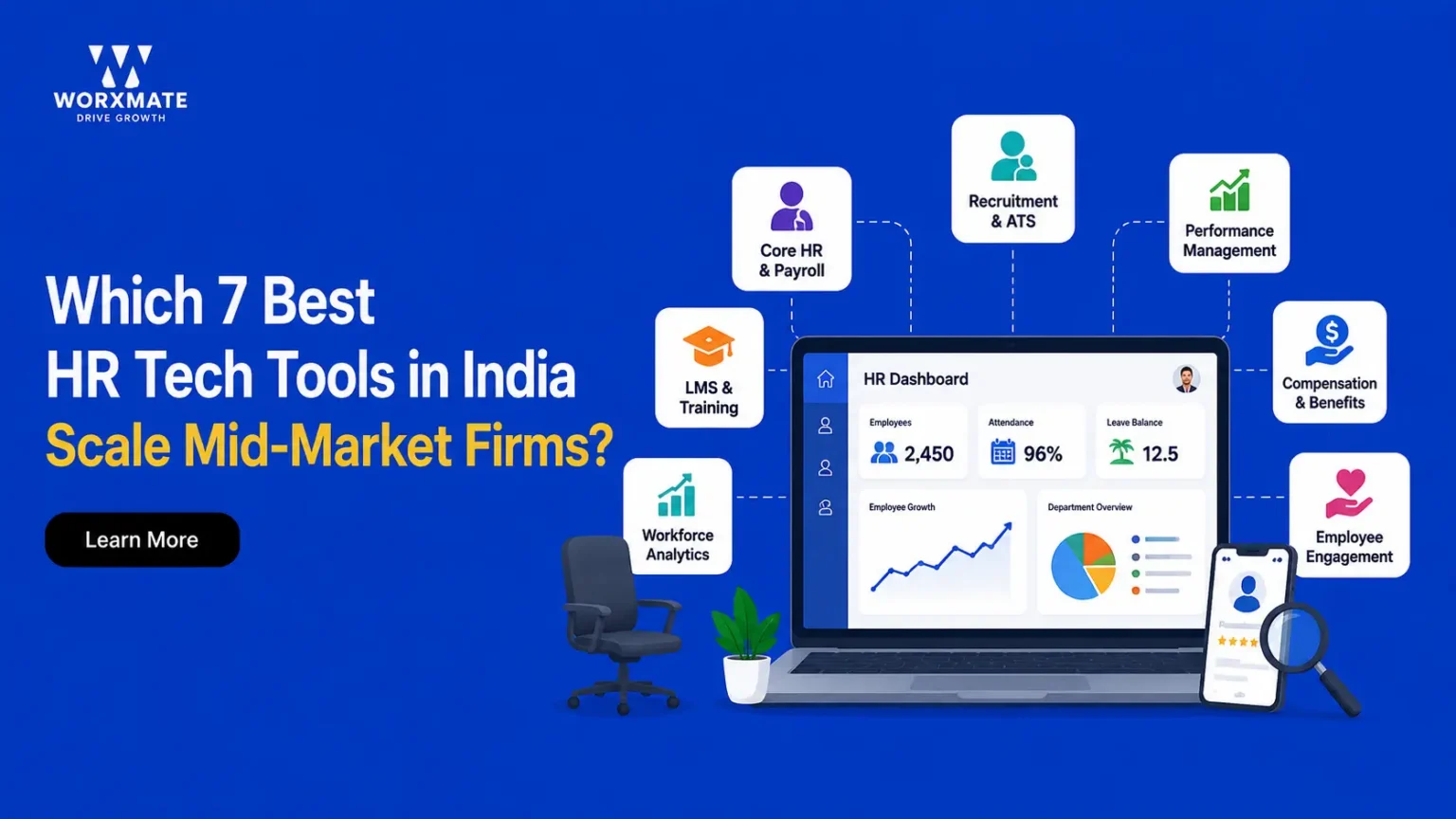
HR Tech Tools in India: Selecting the right top performance review tools and statutory compliance platforms enables mid-market firms to eliminate tool sprawl, automate Provident Fund filings, and align talent objectives with scalable performance management approaches.
This article reviews the leading software solutions designed for the unique regulatory and cultural landscape of the Indian market to help leaders drive organizational efficiency.
Which 7 Best HR Tech Tools in India Scale Mid-Market Firms?
The best HR tech tools in India are software platforms that automate statutory compliance, streamline recruitment, and align employee performance with strategic business objectives. According to Statista, the Indian HR tech market is experiencing a compound annual growth rate of over 15%, driven by the need for digital transformation in mid-market companies. Selecting the right stack requires balancing local compliance requirements, such as PF and ESI, with global best practices in talent management.
As Indian companies scale, the complexity of managing a diverse workforce—often spread across multiple states with varying labor laws—demands robust automation. The best HR tech tools in India offer localized modules for payroll, while also providing sophisticated analytics to track employee engagement and productivity. For a VP of People or a CHRO, the goal is to move away from fragmented spreadsheets toward an integrated ecosystem that supports both operational excellence and strategic growth.
The Evolution of the Indian HR Tech Landscape
The journey toward finding the best HR tech tools in India has shifted from basic digitisation to AI-driven intelligence. Historically, software in the Indian context was limited to punch-in, punch-out systems and basic payroll calculators. However, a McKinsey report on India’s digital future highlights that enterprise technology adoption has accelerated by nearly five years due to the shift toward hybrid work models. Today, platforms are expected to handle everything from complex tax declarations to real-time sentiment analysis.
Modern Indian enterprises are no longer satisfied with legacy ERPs that feel clunky and unintuitive. There is a clear demand for consumer-grade experiences in workplace software. This evolution has led to the rise of homegrown SaaS giants that understand the nuances of the Indian workforce, such as the importance of mobile-first interfaces for field employees and the necessity of WhatsApp integrations for recruitment. When evaluating solutions, one must consider how these platforms have adapted to the India Stack, leveraging Aadhaar and UPI-based infrastructures for faster onboarding and payments.
Furthermore, the focus has moved from mere record-keeping to talent-optimizing. Mid-market firms are increasingly looking for ways to foster organizational growth through better data visibility. The best tools now incorporate advanced modules for strategic planning, ensuring that every hire and every appraisal is tied back to the company’s long-term vision. This shift is critical as Indian startups and SMEs compete on a global stage for top-tier talent, demanding seamless continuous performance management and frequent employee engagement cadences.
Unlock Goal Clarity & Accelerate Employee Growth
Looking to drive goal clarity and employee growth? Discover how Worxmate’s AI-powered Performance Management Software can help.
Critical Features to Look for in Indian HR Software
Identifying the right technology requires a checklist that prioritizes local relevance alongside global scalability. While many international platforms offer excellent features, they often fail to address the specific statutory requirements of the Indian Ministry of Labour and Employment. A high-quality hr strategy must be supported by tools that can handle statutory compliance automation, flexible payroll structures, and mobile-first employee self-service.
At a Glance: The Key Differences
| Feature | Legacy Systems | Fragmented Point Solutions | Unified Platforms (Worxmate) |
|---|---|---|---|
| Primary Philosophy | Static record keeping | Siloed functional tasks | Strategic alignment & execution |
| AI Capabilities | None (Manual data entry) | Basic reactive reporting | Predictive execution & flight-risk detection |
| Performance Management | Annual paper reviews | Disconnected feedback modules | Continuous OKRs & check-ins |
| Goal-to-Task Line of Sight | None | Fragmented third-party APIs | Native end-to-end alignment |
| Ease of Use | Low (Clunky ERP interface) | Moderate (App switching required) | High (Consumer-grade intuitive UI) |
| Pricing Model | Hidden implementation fees | Per-module subscription creep | Transparent per-user tiers |
| Best For | Legacy conglomerates | Single-function departments | Scaling mid-market enterprises |
Architectural Foundation: Unified Workflows vs Fragmented Modules
Mid-market organizations often struggle with tool sprawl. When core functions like payroll, applicant tracking, and performance reviews live in disconnected databases, human resources leaders lose visibility into workforce productivity. True operational scalability depends on an architectural foundation where data flows seamlessly between performance appraisal system modules and statutory tax engines without requiring fragile custom integrations.
When goal alignment is physically separated from daily tasks, strategic drift occurs. Teams execute projects that do not contribute to top-level quarterly objectives. Modern architectures eliminate this gap by uniting target-setting, continuous performance management software, and feedback loops into a single pane of glass.
Operational Integration and Workflow Friction
Implementing software across geographically distributed Indian teams introduces significant friction if the underlying platform lacks localized design. The best tools minimize administrative burden through automated data synchronization. For instance, managing payroll adjustments alongside performance management system implementation ensures that variable pay incentives reflect objective achievement data.
The operational reality of high-growth Indian firms requires immediate mobile responsiveness. Employees expect to submit tax declarations, check leave balances, and review best okr software in india dashboards directly from smartphones. Platforms that rely on desktop-only legacy frameworks introduce adoption bottlenecks that severely restrict organizational agility.
Unlock Goal Clarity & Accelerate Employee Growth
Looking to drive goal clarity and employee growth? Discover how Worxmate’s AI-powered Performance Management Software can help.
Strategic Alignment and Goal Execution
Execution failure rarely stems from a lack of effort; it typically results from poor strategic clarity. As organizations adopt a robust how to implement okrs in india framework, leaders must ensure that department milestones cascade effectively down to individual contributors. This transparency transforms subjective appraisals into objective, data-driven evaluations.
Furthermore, understanding okr software pricing india models helps procurement teams evaluate long-term return on investment. Transparent licensing structures ensure that as headcount expands, the platform scales cost-effectively without unexpected per-feature add-on charges.
Case Study: Zomato and Performance Alignment
As Zomato grew from a local food directory to a global delivery giant, they faced significant challenges in maintaining employee alignment across diverse teams. Their legacy performance systems were too slow for their fast-paced day-zero culture, leading to fragmented goals and inconsistent feedback cycles across their offices.
Zomato transitioned to an integrated OKR-based performance framework. They moved away from annual reviews to a continuous feedback model that prioritized transparency and speed. This involved setting ambitious quarterly objectives that were visible to everyone in the organization, ensuring that every team understood their contribution to profitability and market share goals.
The shift to an agile performance framework contributed to a significant increase in operational efficiency. By aligning individual output with strategic business outcomes, Zomato saw a marked improvement in execution speed, demonstrating exceptional revenue growth following their framework overhaul.
When to Choose Alternative Competitor Tools vs Worxmate
Evaluating point solutions versus a unified ecosystem depends entirely on your organizational maturity and strategic goals. Standard competitor tools are often built for basic administrative record-keeping and standalone applicant tracking. They excel when an organization only requires localized payroll processing and simple attendance logs without deeper strategic execution frameworks. This directly accelerates measurable key results across the entire organization. Regular check-ins maintain momentum and keep strategic priorities front of mind. Tracking a real-time confidence score helps identify at-risk targets before quarter-end. Surfacing operational blockers early ensures leadership can clear obstacles quickly.
Conversely, Worxmate is engineered specifically for mid-market enterprises that need to bridge the gap between administrative HR and high-impact talent alignment. If your leadership team requires native predictive execution, continuous OKR cascading, and deep performance analytics without maintaining expensive middleware connectors, Worxmate provides the complete architectural solution.
Bottom Line
Choosing the right HR technology stack is one of the most critical decisions a mid-market leader will make. By moving beyond fragmented point solutions and embracing a unified architecture that couples compliance with continuous performance management, organizations unlock unprecedented operational speed. Ready to evaluate modern alternatives? Schedule a personalized demo with Worxmate to see how unified OKRs and talent alignment transform your workforce.


Written by
An OKR Coach with 20+ years of implementation experience, Madhusudan has guided over 50 organisations through successful OKR transformations, training more than 500 leaders. Learn more about Worxmate.
Frequently Asked Questions
Mid-market firms require an integrated stack covering automated payroll, statutory compliance (PF, ESI, PT), applicant tracking, and a robust OKR and continuous performance management platform to ensure strategic alignment.
Indian labor laws require automated calculations and direct ECR file generation for Provident Fund, Employee State Insurance, and Professional Tax. Software must adapt to changing tax regimes and the Digital Personal Data Protection Act.
Legacy ERPs are clunky, desktop-bound, and lack consumer-grade mobile experiences. They fail to support modern hybrid work models, real-time employee feedback, or agile OKR tracking.
Point solutions solve isolated problems like payroll or recruitment but require third-party APIs that create data silos. Unified platforms combine core HR, OKRs, and continuous performance management into a single database.
OKRs cascade top-level company goals down to individual contributors, establishing clear line-of-sight and replacing subjective annual reviews with transparent, agile quarterly checkpoints.
Look for automated tax updates, digital investment proof verification via OCR, loan and advance management, and streamlined Full and Final exit settlement processing.
High mobile penetration in India makes mobile apps essential for employees to download payslips, apply for leave, and submit tax proofs on the go, significantly boosting platform adoption rates.
AI drives predictive execution, candidate dropout prediction, resume screening across local job boards, and automated sentiment analysis to detect flight risks before turnover occurs.
TCO encompasses subscription fees, implementation costs, training overhead, and ongoing customer support. Transparent pricing tiers prevent unexpected module-add-on costs as headcount scales.
Continuous performance management increases productivity by up to 12% through frequent check-ins, real-time feedback, and agile goal adjustments rather than lagging yearly appraisals.