 WORXMATE

7 Powerful Reasons Why Functional Strategy Matters: Functional strategy serves as the vital operating bridge connecting boardroom vision to day-to-day departmental execution. Using the OKR platform, modern enterprises align cross-functional teams, eliminate operational silos, and track execution cadence with precision.
In today’s complex business environment, organizations need a comprehensive approach to strategy at every level to drive success.
While corporate and business strategies set the overall direction, functional strategies serve as the critical operational blueprints that translate high-level objectives into actionable department-specific plans.
Understanding the role of functional strategy in achieving business goals is essential for organizations seeking to maintain competitive advantage and operational excellence.
This blog explores how effective functional strategies align departmental activities with broader organizational objectives, ultimately contributing to business success.
What is Functional Strategy?
Functional strategy refers to the specific plans and actions that a business unit or department undertakes to support the overall corporate strategy.
It is a detailed approach that outlines how various functions within an organization-such as marketing, finance, human resources, and operations-will contribute to achieving the broader objectives of the company.
By focusing on maximizing resource productivity within specific business areas, functional strategies create a framework for departmental decision-making that aligns with organizational goals.
These strategies operate at the tactical level, dealing with day-to-day operations and specific performance targets that collectively support higher-level strategic objectives.
For instance, a marketing functional strategy might focus on increasing brand awareness through targeted advertising campaigns, while a human resources strategy could aim to improve employee retention through enhanced training programs.
Key Characteristics of Functional Strategies
Functional strategies share several important characteristics that distinguish them from other strategic levels: For teams seeking execution excellence, using OKR tracking software provides structured visibility and measurable outcomes.
- They are more specific and detailed than corporate or business strategies
- They focus on short to medium-term objectives
- They directly guide operational activities within departments
- They translate broader strategic directions into implementable action plans
- They optimize resource allocation within functional units
Achieve Your Goals Faster
See how Worxmate can help your team set clear goals and achieve faster results. Book your free demo today and experience the power of AI-driven OKRs in action.
Strategic Alignment Framework: Corporate vs Functional Strategy
To master strategy execution, leaders must understand how functional plans differ from overarching corporate priorities. Below is our diagnostic framework mapping out these distinctions for effective annual planning. For teams seeking execution excellence, using best OKR software comparison provides structured visibility and measurable outcomes.
| Strategic Dimension | Corporate Strategy | Functional Strategy |
|---|---|---|
| Scope & Focus | Entire organization, portfolio management, and multi-market expansion. | Specific department (Marketing, HR, Finance, Operations) and tactical execution. |
| Time Horizon | Long-term (3 to 5 years). | Short to medium-term (Quarterly to annual milestones). |
| Core Responsibility | C-suite executives and board of directors. | Department heads, functional leaders, and team managers. |
| Execution Cadence | Annual reviews and strategic realignment sessions. | Weekly check-ins, monthly retrospectives, and quarterly OKR scoring. |
The Importance of Functional Strategy in Business Success
Why is functional strategy important in business? The answer lies in its ability to bridge the gap between high-level vision and day-to-day operations.
Functional strategies ensure that every department understands its role in achieving company objectives and has a clear roadmap for contributing to organizational success.
Effective functional strategies prevent departments from operating in silos by creating alignment across the organization.
This alignment is crucial, as it allows for the effective allocation of resources and minimizes conflicts between different departments, ultimately leading to enhanced organizational performance.
Without well-defined functional strategies, departments might pursue objectives that don’t support or even conflict with the organization’s broader goals.
Benefits of Well-Developed Functional Strategies
- Enhanced Operational Efficiency: Functional strategies streamline operations within departments by focusing resources on activities that directly support business goals.
- Improved Coordination: When all departments have clear strategies aligned with organizational objectives, cross-functional collaboration improves.
- Better Resource Allocation: Resources are directed to activities with the greatest strategic impact.
- Clearer Performance Metrics: Functional strategies establish concrete metrics for measuring departmental performance.
- Increased Adaptability: Well-defined strategies at the functional level enable departments to respond more effectively to changes in the business environment.
What Are Functional Strategies Used to Accomplish?
The primary role of a functional strategy is to support and enable the successful execution of business-level strategies by optimizing departmental operations. Functional strategies accomplish several critical objectives:
Translating Strategic Direction into Action
Functional strategies transform abstract corporate objectives into concrete actions that departments can implement. They provide the operational roadmap that connects high-level goals to day-to-day activities.
Maximizing Departmental Effectiveness
By establishing clear objectives and methodologies for each department, functional strategies ensure that functions operate at peak efficiency, making the best use of available resources to deliver maximum value.
Aligning Departmental Goals with Business Objectives
Perhaps most importantly, functional strategies ensure that every department is working toward common organizational goals. When the marketing, finance, human resources, and operations departments all have strategies aligned with the company’s direction, the organization moves forward cohesively.
Driving Competitive Advantage
Well-crafted functional strategies help departments develop specialized capabilities that contribute to the organization’s competitive advantage. For example, an operations functional strategy focused on lean manufacturing can reduce costs and improve quality, creating market advantages.
Achieve Your Goals Faster
See how Worxmate can help your team set clear goals and achieve faster results. Book your free demo today and experience the power of AI-driven OKRs in action.
Functional Level Strategies Across Key Departments
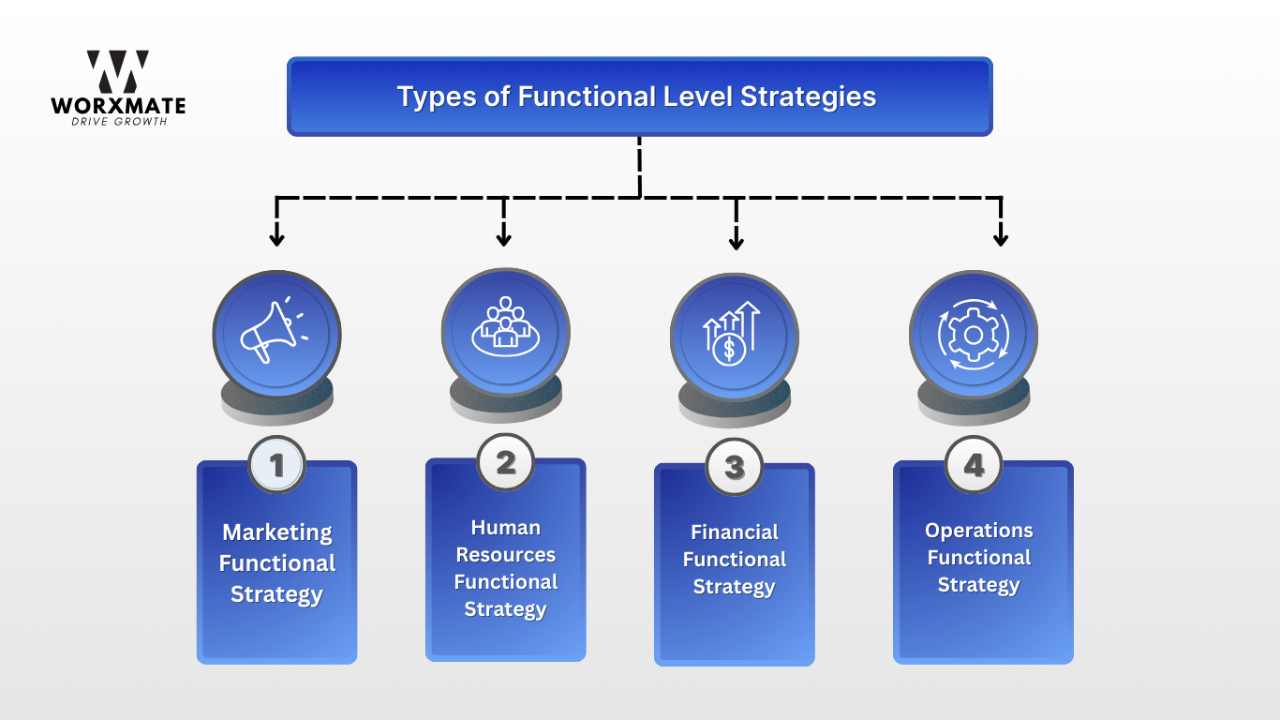
Different functional areas develop distinct strategies that address their unique contributions to organizational success:
Marketing Functional Strategy
Marketing strategies focus on product positioning, promotion, pricing, and distribution channels that effectively reach target markets. Marketing functional strategies determine how to create customer awareness, generate leads, and build brand loyalty that drives sales and market share.
Human Resources Functional Strategy
HR strategies address workforce planning, recruitment, training, compensation, and performance management to ensure the organization has the talent needed to execute its business strategy. An effective HR functional strategy aligns the organization’s people capabilities with its strategic needs.
Financial Functional Strategy
Financial strategies outline approaches to capital structure, investment decisions, risk management, and financial reporting. They ensure the organization has the financial resources needed to pursue its strategic initiatives while maximizing shareholder value.
Operations Functional Strategy
Operations strategies focus on production methods, quality control, supply chain management, and continuous improvement. They determine how the organization will create and deliver products or services while maintaining quality and cost-effectiveness.
Case Study: Gartner’s Approach to Functional Strategic Planning
A compelling example of functional strategy implementation comes from Gartner’s work with a newly appointed CFO at a private equity-acquired organization. The CFO was tasked with developing comprehensive capital allocation and M&A strategies within just six months to present to the board.
-
Gartner provided crucial support by:Presenting best practices from leading “efficient growth” companiesIntroducing guides for midcycle CAPEX review and capital investment screeningProviding customizable tools for M&A, tax, and cultural due diligenceOffering feedback on draft strategies and recommending improvementsThe result was a comprehensive strategy that addressed M&A approach, targets, pipeline, and internal capability development. With Gartner’s support, the CFO completed the plan in half the expected time, and it received full board approval.This case demonstrates how effective functional strategy development-in this case within the finance function-can align with broader organizational growth objectives and deliver tangible business impact.
Introducing guides for midcycle CAPEX review and capital investment screening
Scaling Strategy Execution: Lessons from the Field
The pattern we saw when coaching a High-growth APAC Retail enterprise in aggressive multi-market expansion revealed a common trap: rapid hiring caused severe leadership misalignment. In our initial alignment session, the CEO struggled to compress his vision into concise, measurable outcomes.
The Intervention: We ran a 2-day executive war room followed by structured 1:1 coaching sessions, grilling each departmental leader on their thinking process to derive departmental OKRs directly from executive priorities. This directly accelerates measurable key results across the entire organization. Regular check-ins maintain momentum and keep strategic priorities front of mind. Tracking a real-time confidence score helps identify at-risk targets before quarter-end. Surfacing operational blockers early ensures leadership can clear obstacles quickly. Seamless cascading ensures department milestones stay synchronized with company strategy. Strong goal alignment eliminates siloed efforts and connects daily work to strategic outcomes.
Key Takeaway: Cross-functional dependencies were mapped in advance rather than mid-cycle, budgets linked directly to revenue models, and leadership team cohesion reached an all-time high, proving the power of a rigorous organizational strategy framework.
Conclusion
The role of functional strategy in achieving business goals is pivotal. By aligning departmental activities with broader organizational objectives, functional strategies ensure that every part of the organization is working towards a common purpose.
Effective implementation of these strategies requires not only a clear understanding of their importance but also the right tools to support their execution.
Worxmate’s OKR solution offers a comprehensive approach for aligning functional strategies with business objectives. This ensures that departments operate efficiently and contribute meaningfully to overall success. By leveraging such tools, organizations can seamlessly


Written by
An OKR Coach with 20+ years of implementation experience, Madhusudan has guided over 50 organisations through successful OKR transformations, training more than 500 leaders. Learn more about Worxmate.