 WORXMATE
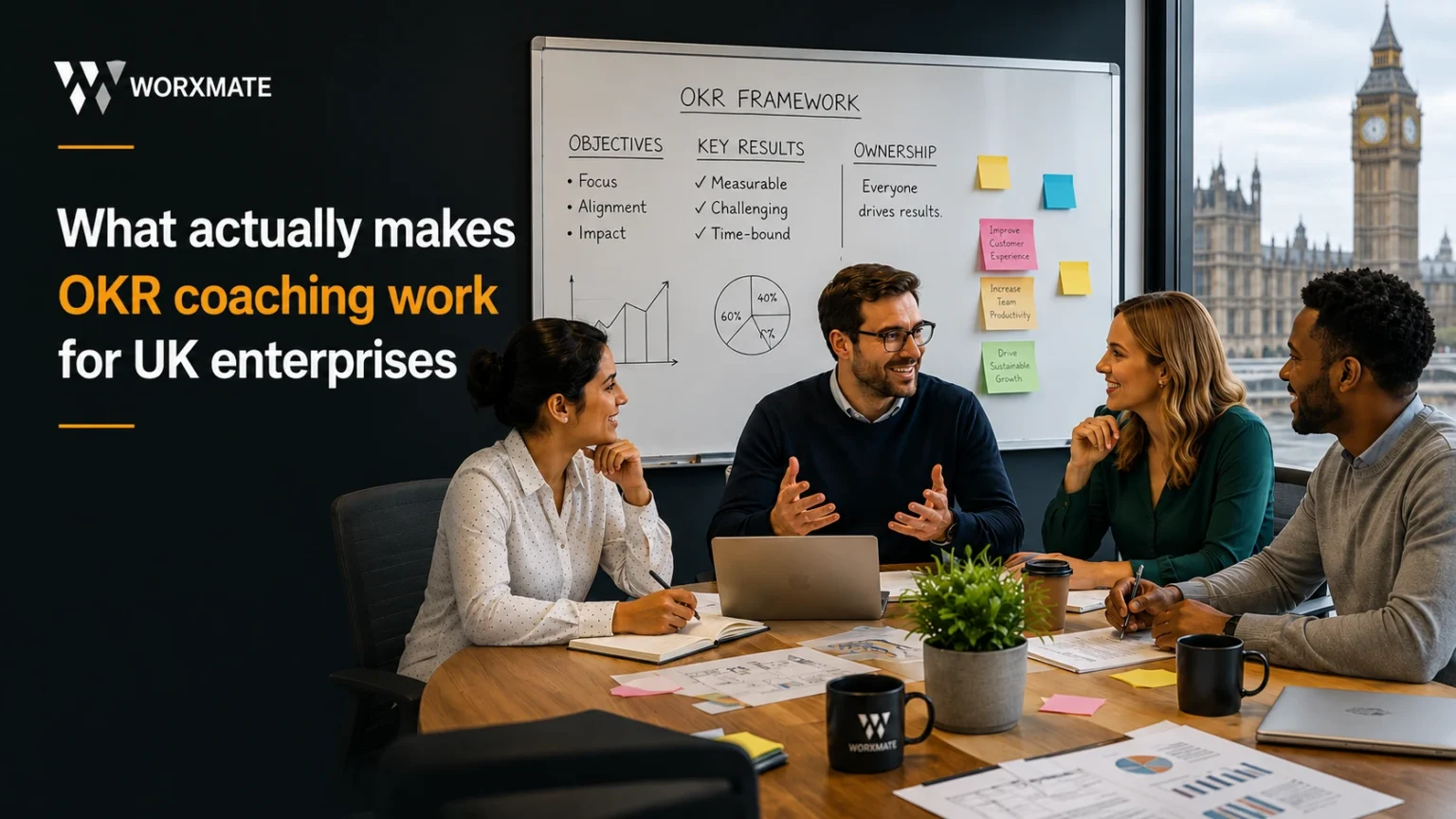
Enterprise OKR Coaching & Execution: Effective OKR coaching requires rigorous implementation depth, cross-functional alignment below the C-suite, and a modern OKR tool to sustain execution velocity across distributed teams.
Most conversations about choosing an OKR consultant in the UK focus on the wrong variable. Is the coach local. Do they fly in. Is the team in the same time zone. None of that is what actually determines whether OKR coaching UK enterprises invest in will change how they execute. What determines it is the depth of the coaching itself: whether it reaches below the C-suite, whether it is built from real implementation experience rather than a generic curriculum, and whether the coach can read what is actually happening in a room, not just what gets reported in a status update.
Worxmate serves UK and European clients from a team based in Altrincham, and we travel to a client’s site whenever an engagement calls for it, workshops, cross-functional alignment sessions, the moments that genuinely benefit from being in the room. Location is a logistics decision made around what the work needs. It is not, on its own, what makes the coaching good.
This distinction matters more than it might first appear, because it changes what a buyer should actually be evaluating. A procurement conversation built around “is the coach local” optimises for the wrong variable and can end up screening out genuinely strong coaches who happen to be based elsewhere, while waving through a locally based consultant who’s coaching never gets past the leadership offsite. The better question is not about geography at all.
What Quality OKR Coaching Actually Requires
| Evaluation Dimension | Traditional Spreadsheet Approach | Worxmate AI Execution Model |
|---|---|---|
| Primary Philosophy | Static annual cascading scorecards | Dynamic weekly alignment rhythms |
| AI Capabilities | None / Manual data entry | Deep AI™ authoring & predictive scoring |
| Performance Management | Detached annual reviews | Continuous check-ins & people intelligence |
| Goal-to-Task Link | Disconnected status reports | Direct frontline tactical linkage |
| Ease of Use | Complex spreadsheet bloat | Intuitive modular enterprise interface |
| Pricing Model | Opaque consultant retainers | Transparent enterprise SaaS tiers |
| Best For | Small teams needing static tracking | UK enterprises scaling execution velocity |
Three things separate coaching that changes an organisation’s execution from coaching that produces a well-received workshop and nothing more. This is where most OKR coaching UK organisations receive falls short not on curriculum content, but on how far it actually reaches. First, it has to reach below the C-suite. Leadership offsites are where most engagements start and, too often, where they also end. Coaching that stops at the top is the single biggest predictor of a program quietly failing, regardless of whether the coach was in the building or on a screen when it happened.
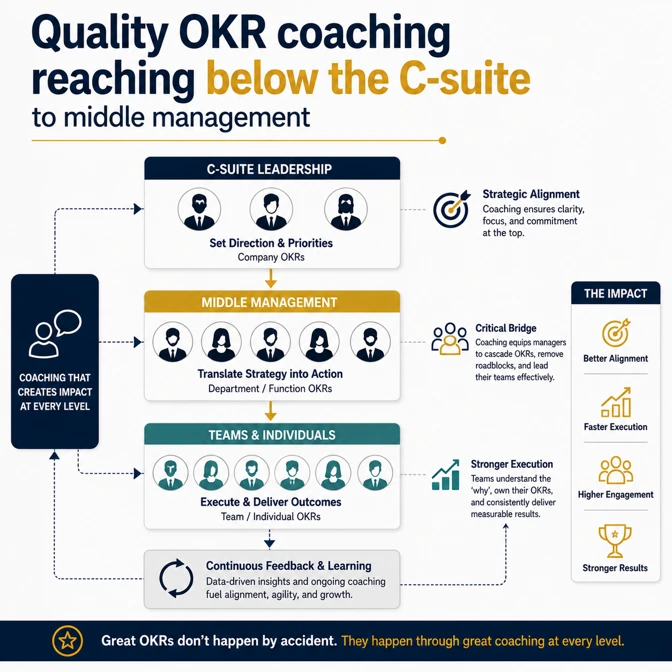
Second, it has to be built from real implementation experience, not a generic body of knowledge. A curriculum assembled from OKR literature produces coaching that sounds right in a workshop and breaks the moment it meets an organisation’s actual constraints. Coaching drawn from what has genuinely worked and failed inside real engagements holds up differently, because it was tested against reality before it was ever taught.
Third, the coach has to be reading the room accurately, not just the status report. The moments that actually shift how a leadership team thinks, the point where eight leaders are quietly avoiding the same uncomfortable number, the second a sticky-note exercise makes a misalignment visible that no one had said out loud, are moments a coach has to notice as they happen. That is a matter of skill and attentiveness more than geography. A skilled coach on a call can still catch it. An unskilled coach in the room can still miss it.
What This Looked Like Inside a UK Retail Organisation
Download the 2026 OKR Execution Maturity Framework
Benchmark your organization’s strategy execution velocity across 5 maturity stages.
A leading UK retail organisation came to us navigating the intricacies of a global supply chain that was affecting inventory management and timely product availability. Ensuring a seamless, personalised customer experience across diverse channels had become a priority for sustaining loyalty, while intense market competition demanded innovation and agility just to defend market share.
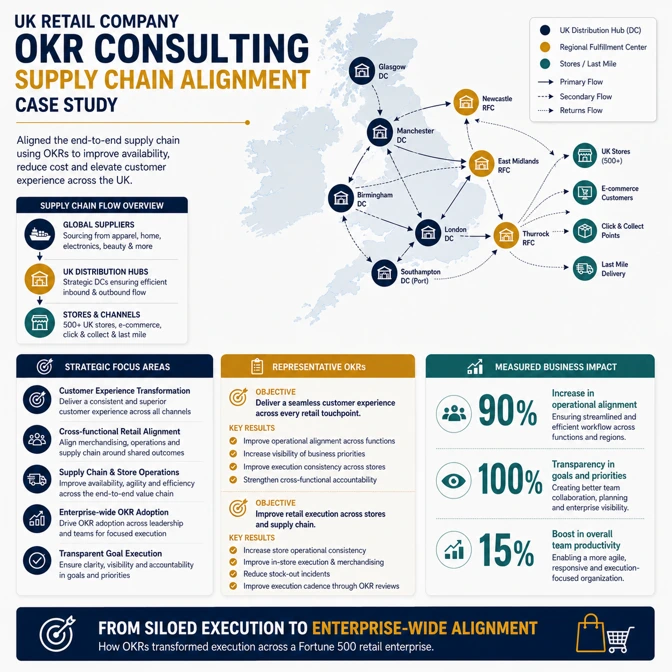
The solution was not a generic OKR rollout. Objectives were aligned specifically to optimise the supply chain, enhance the customer experience, and foster innovation and market agility, redefining supply chain processes, refining customer touchpoints, and instilling a culture of innovation across the organisation. That specificity, coaching built around this organisation’s actual supply chain and actual customer touchpoints rather than a templated framework, is what produced the result, not the particular mix of video calls and site visits used to deliver it.
The results were measurable rather than anecdotal: a 90% increase in operational alignment, ensuring a streamlined and efficient workflow. 100% transparency in goals and priorities, enabling better team collaboration and planning. A 15% boost in overall team productivity, supported by a more agile and responsive organisational structure.
| The question worth asking a prospective OKR consultant is not where they sit. It is whether their coaching has ever reached past the leadership team that hired them. |
Where Location Genuinely Does Matter
None of this means delivery format is irrelevant. Certain moments in an OKR engagement benefit meaningfully from being in the room: a live cross-functional alignment workshop where reading body language across eight department heads matters, a sticky-note exercise that works better on a physical wall than a shared screen, the first session with a leadership team that has not yet built trust with the coach.This lines up with broader coaching research: a comparison of in-person and remote coaching found no meaningful difference in how well relationships were built or solutions were reached. See the research Worxmate travels to a client’s UK or European site for exactly these moments, while running the ongoing coaching cadence, check-ins, review sessions, 1:1 coaching conversations, in whichever format actually fits the organisation’s working rhythm.
The mistake is treating delivery format as the whole answer, either direction. A coach who is only ever remote loses something real for the highest-stakes moments in an engagement. A coach who insists on being physically present for every single interaction, regardless of whether that specific interaction needs it, is optimising for a preference rather than for what the work actually requires.
In practice, this usually settles into a pattern rather than a fixed rule: an in-person kickoff and workshop to establish trust and do the first alignment work properly, a mix of in-person and remote sessions through the middle of the engagement depending on what each quarter’s priorities are, and remote check-ins once the cadence is established and the relationship no longer depends on physical presence to function well. The format follows the work. The work does not get redesigned to fit a fixed format.
My Take
I would not tell a UK organisation to filter OKR consultants by location first. I would tell them to ask about coaching depth first and treat delivery format as a logistics conversation that happens after that, not before it. Ask whether the coaching reaches below the leadership team. Ask what the curriculum is actually built from. Ask whether the consultant will travel for the sessions that need it, and stay remote for the ones that do not, rather than defaulting rigidly to one format regardless of fit. Based on Worxmate’s 2026 OKR Benchmark Report, most organisations sit at a 5% to 15% Execution Maturity Rate after a first cycle. Coaching depth is what moves that number. Delivery format is what makes the depth possible to deliver consistently, which is a real factor, just not the first one worth asking about.
Put plainly: a strong coach working remotely, disciplined about cadence and genuinely reaching below the C-suite, will outperform a weak coach who happens to show up in person for every session. Physical presence amplifies good coaching. It does not create it out of nothing, and no procurement checklist should treat it as if it does.
Where to Go from Here
If you want OKR coaching built around actual implementation depth, delivered by a team based in the UK and willing to travel for the sessions that need it, Worxmate’s OKR consulting for the UK and Europe is built around exactly this standard.
If you would rather build this capability inside your own organisation first, OKR Certification DEEP Framework is built around real submitted work, not an exam and a badge.
The best OKR coaching is not defined by where the coach happens to be sitting. It is defined by whether the coaching reaches the people who actually have to do the work.
Further Reading
Best OKR Consultants in India 2026: What to Actually Look For — the same evaluation logic, applied to a different market.
The Coaching Cliff: Why OKR Coaching Cliff: Why OKR Coaching Fails After the Workshop Ends — the single biggest predictor of coaching quality, regardless of delivery format.
How to Choose an OKR Certification Program — on what separates coaching built from real experience versus a generic curriculum.
OKR Consulting — UK & Europe — the full engagement model referenced in this piece. This directly accelerates measurable key results across the entire organization. Tracking a real-time confidence score helps identify at-risk targets before quarter-end. Surfacing operational blockers early ensures leadership can clear obstacles quickly. Strong goal alignment eliminates siloed efforts and connects daily work to strategic outcomes.
2026 OKR Execution Maturity Framework — the benchmark data behind the Execution Maturity Rate figures cited here.
Organization Performance Audit — a free, no-pitch diagnostic of where your organisation’s execution gap actually sits.
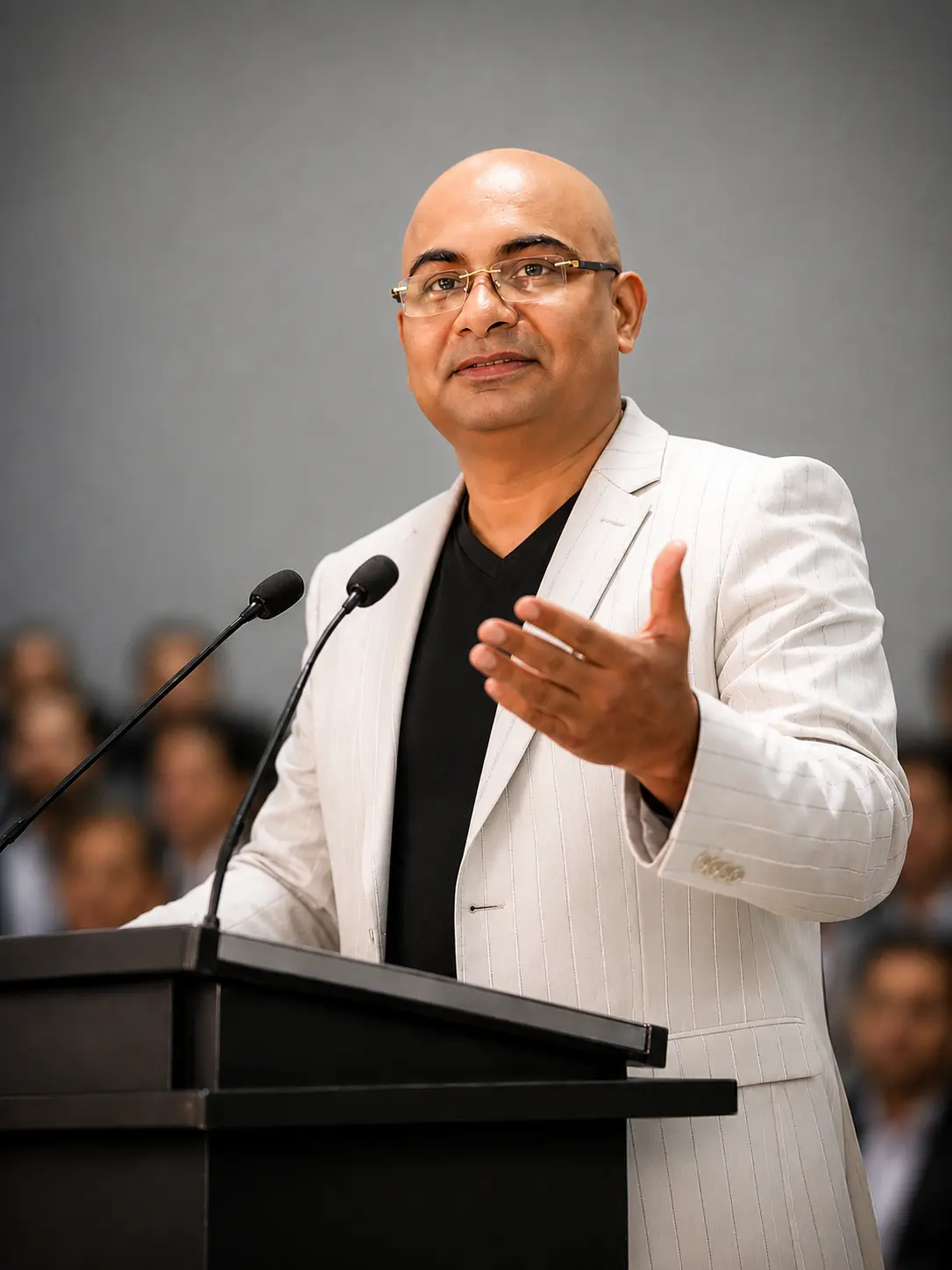
Written by
An OKR Coach with 20+ years of implementation experience, Madhusudan has guided over 50 organisations through successful OKR transformations, training more than 500 leaders. Learn more about Worxmate.