 WORXMATE
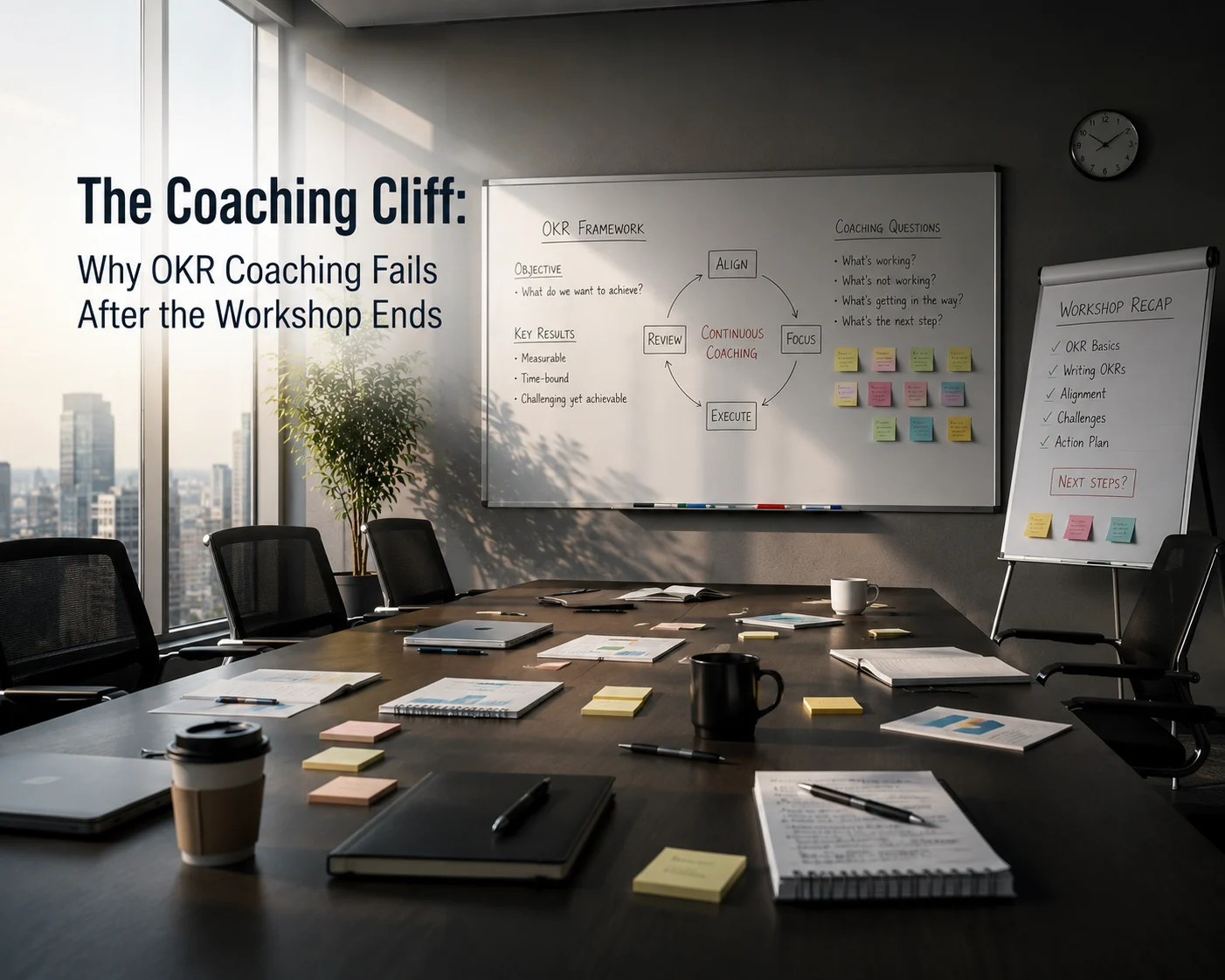
The Coaching Cliff: The dangerous drop-off in OKR adoption when external consultants leave and organizations lack internal capability or the Best OKR software to sustain alignment. Overcoming this requires continuous manager coaching and intelligent goal tracking.
I have watched this exact failure play out enough times that I gave it a name: the Coaching Cliff. It is why OKR coaching fails so consistently below the leadership layer. The moment coaching ends at the top and the organisation is expected to cascade everything on its own, the program is standing at the edge of it. Nobody plans for this moment to be a cliff. It just is one.
Here is what it looks like from the inside. A consultant runs a two-day leadership workshop. The room leaves energised. The C-suite writes ambitious, genuinely outcome-driven OKRs, often for the first time. The invoice gets paid. Everyone agrees it went well.
Six weeks later, the dashboard is green across every team. Nothing underneath has moved. The Chief of Staff is fielding the same status meetings as before the workshop, except now there is a platform showing progress that does not reflect reality. The CHRO is quietly wondering whether the program was ever going to reach below the leadership team to begin with.
Across the 50+ organisations I have coached, this is the single most common failure mode in the industry, and the one the consulting industry is most reluctant to name, because it implicates the most common engagement model: run the workshop, help the C-suite write their OKRs, leave.
Showing a leadership team how to write OKRs is showing them the path up the mountain. Teaching them to climb it is an entirely different engagement.
I have coached OKR implementations inside organisations ranging from a 70,000-person IT services company to a listed Indian fintech running a 35-leader auditorium workshop, across 10+ industries and three continents. In every one of them, some version of the Coaching Cliff showed up. The pattern is consistent enough that I no longer treat it as a risk to manage. I treat it as the default outcome, unless something is specifically designed to prevent it.
Why OKR Coaching Fails to Reach Below the C-Suite
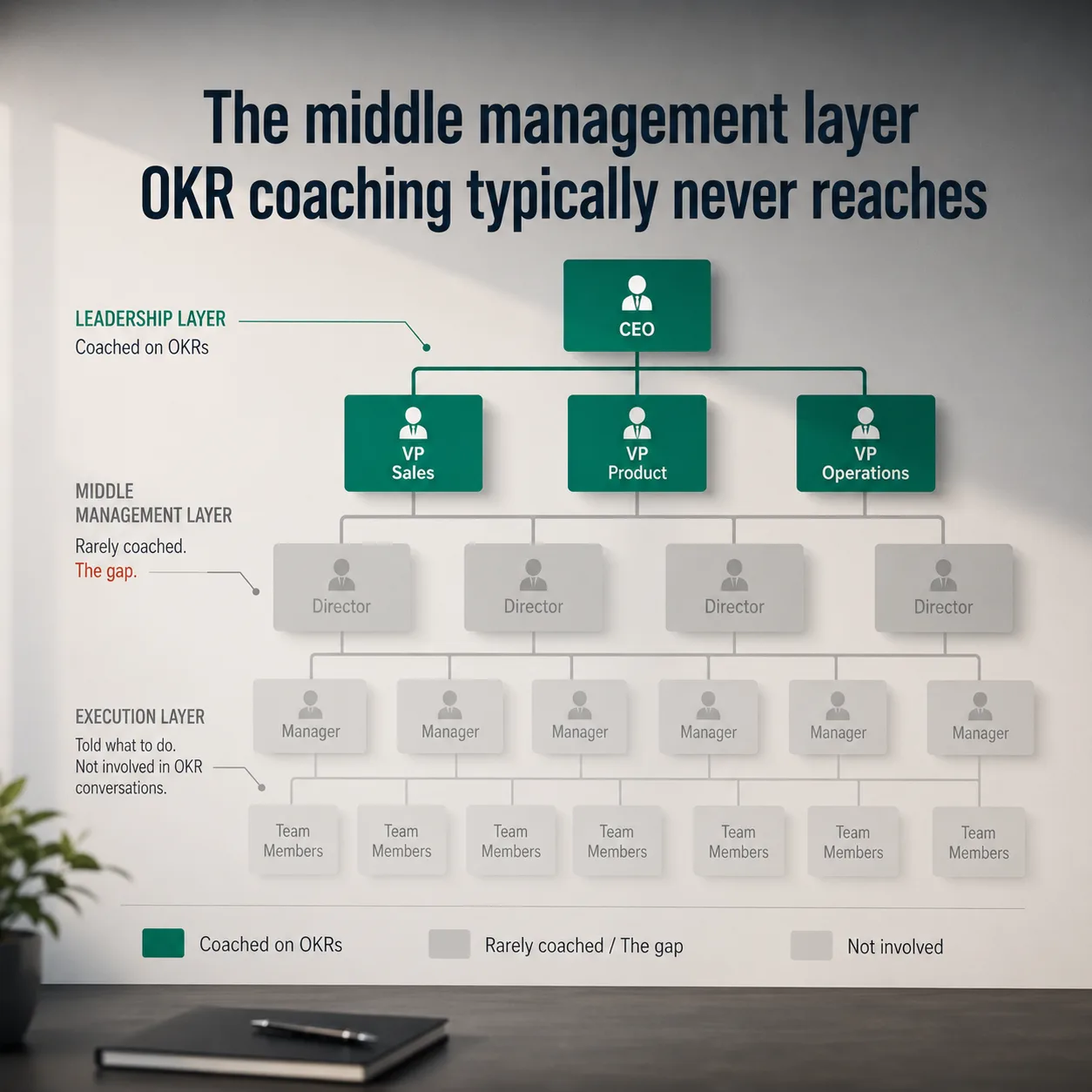
The middle management layer is where OKR programs live or die, and it is also the layer that almost never gets coached directly. Every engagement model that stops at the leadership team is making the same bet: that a two-day workshop for six or eight executives will somehow transmit itself, intact, through three or four layers of an organisation that never sat in the room.
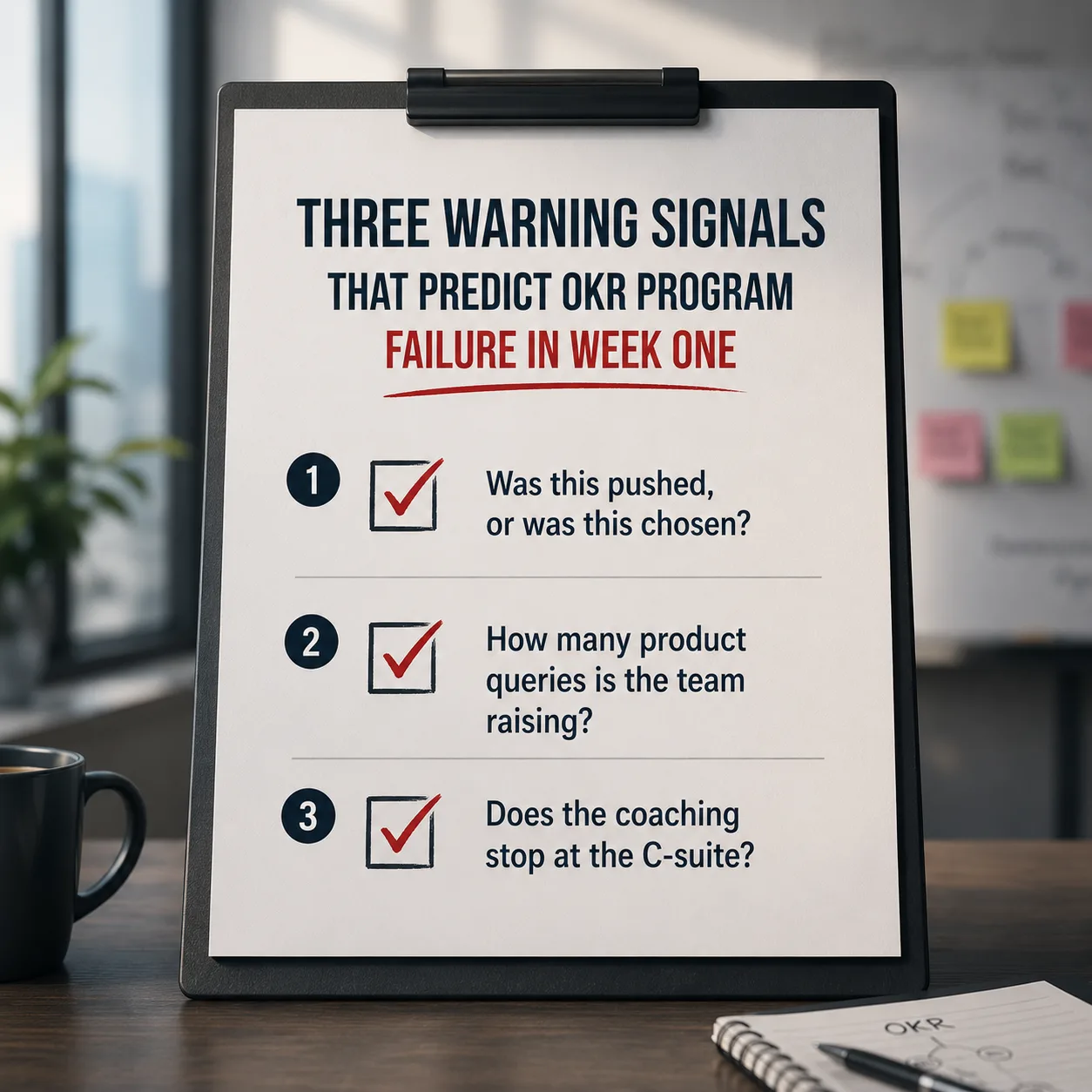
It does not. Three signals predict, in the first week of any engagement, whether a program is heading toward the cliff.
Was this pushed, or was this chosen? There is a meaningful difference between an organisation where leaders understand the why and have chosen to commit, and one where OKRs have been announced as the new operating model with a go-live date. The second scenario collapses between weeks four and six, every time. Not because people resist. Because nobody answered the question every employee is silently asking: what is in it for me?
How many product queries is the team raising? If a team is raising 15 to 20 support queries a day in week one, adoption will break within weeks. Not might. Will. High query volume signals a mismatch between the tool and the team’s current OKR literacy, and no customer success call fixes a mismatch.
Does the coaching stop at the C-suite? This is the most direct predictor of the three, and the one this article is about.
There is a second, quieter reason the cliff forms even when someone does try to coach below the leadership layer: generic coaching does not translate. Every leader arrives with a mental model built from their own career history. A finance leader thinks in budget cycles. A product leader thinks in sprint planning. A sales leader thinks in pipeline. Walk into that room and deliver the same OKR training to all of them, and each person is left to translate a new framework through a lens nobody has acknowledged. The finance leader will write KPIs and call them Key Results, not because they lack intelligence, but because nobody helped them make the translation. Real cross-functional alignment at the middle-management layer requires coaching that maps to how each function actually thinks, not a single slide deck delivered to a mixed room.
What the Coaching Cliff Actually Costs
Most organisations measure OKR program health with the wrong metric. Goal completion rate is the most visible number and the least meaningful one. A team can complete 80% of its OKRs and produce no material improvement in business outcomes, if the goals were never genuinely outcome-driven to begin with.
The metric that actually matters is what I call the Execution Maturity Rate: the percentage of leaders in an organisation who can independently write a genuine outcome-driven goal, without coaching support, without a template, without a quality review. According to Worxmate’s 2026 OKR Benchmark Report, this typically sits between 5% and 15% in a first-cycle implementation. In organisations running a well-coached program consistently over 12 months, it reaches 30% to 40%.
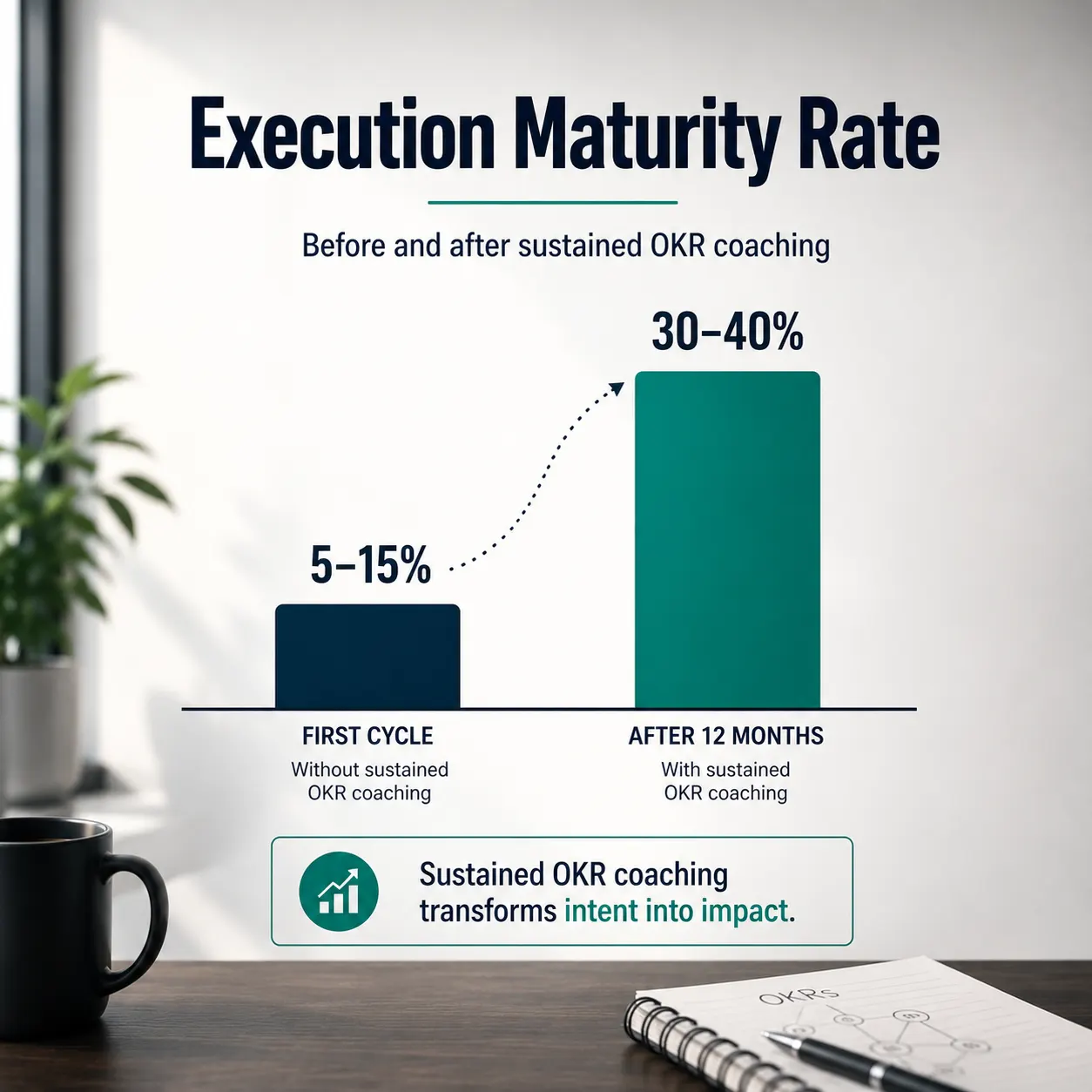
That gap, between 15% and 30%, is the Coaching Cliff measured in numbers. It is the difference between a program that produces a handful of leaders who happen to think in outcomes, and a program that has actually built the capability across the organisation.
It is worth being specific about what that gap actually contains, because it is not a gap in effort. Teams in a first-cycle implementation are usually working hard. They are completing tasks, hitting deadlines, filling in the platform every week. What they are not doing, in 85% to 95% of cases according to that same benchmark, is independently recognising the difference between an output they completed and an outcome that actually moved the business. That distinction has to be coached into existence, repeatedly, across real cycles, by someone who is still in the room three quarters after the workshop ended. A one-time training session cannot produce a habit that only forms through repetition.
One of the clearest examples I have coached through was a 70,000-person IT services organisation, inside its Media, Entertainment and Telecom business unit. The leadership team reporting to the SBU Head had no clear read on how to drive performance and growth in their own markets. Every strategic meeting produced the same frustration: no visibility into the real state of execution, no way to connect day-to-day work to what the business actually needed.
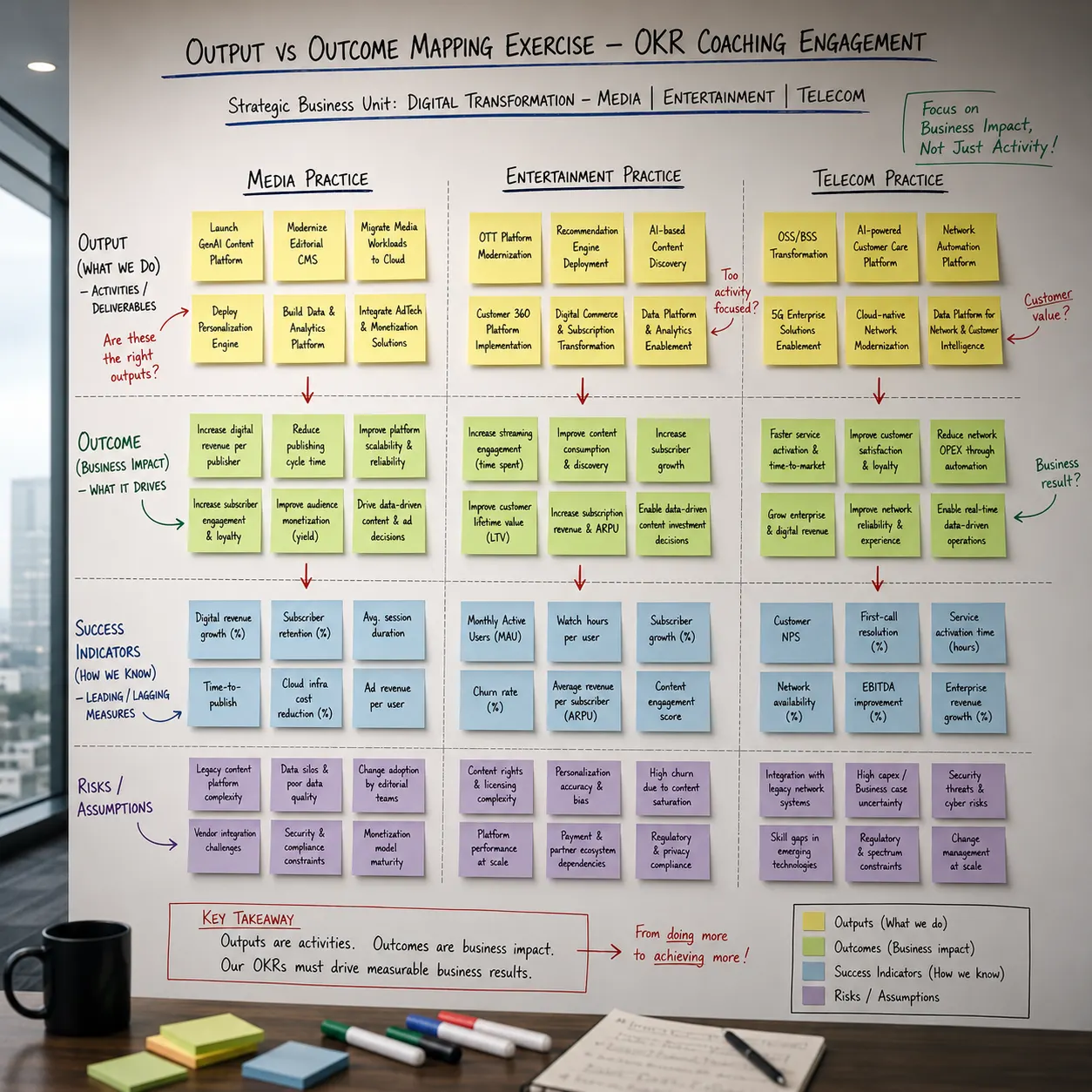
The turning point was not a framework. It was a live exercise distinguishing output-led goals from outcome-driven goals, using real scenarios from their own business rather than textbook examples. That single exercise broke a myth the leadership team had been operating under for years, and unlocked result-oriented thinking that had simply never been present before. Within two to three quarters, that same team could identify root causes needing immediate attention, gain clarity on priorities with real business impact, and cut initiatives that were consuming time without driving outcomes.
None of that happened because the C-suite wrote good OKRs. It happened because the coaching did not stop with the C-suite.
There is a structural decision that quietly determines whether an organisation ever gets the chance to prevent the cliff in the first place: who owns the program once the external engagement ends. When HR owns OKRs by default, the rest of the leadership team tends to treat the entire program as one more framework for assessing performance, rather than a strategy execution engine that happens to need HR’s support. OKRs owned by the CEO’s office get carried forward as a business priority. OKRs owned by HR alone quietly become a performance appraisal exercise, and the coaching that would have prevented the cliff never gets the mandate to reach the teams that need it.
| The Coaching Cliff is the moment OKR coaching ends at the C-suite and the organisation is expected to cascade independently. It is where most OKR programs die. |
What Actually Prevents the Fall
The instinctive fix is more training. Send more managers to more workshops. It does not work, for the same reason the original workshop did not reach the middle layer: training is a one-time transfer of information, and the Coaching Cliff is not an information problem. It is a capability problem, and capability is built through coached repetition across real cycles, not a single session.
The organisations that avoid the cliff entirely share one structural decision in common: they build the coaching capability inside the organisation itself, rather than renting it for the duration of an engagement. Someone internal, an OKR Champion, a Chief of Staff, an HR leader, is trained to carry the program past the point where an external coach would normally hand it off and leave.
This is the exact gap our OKR Certified Coach program, part of the DEEP Framework certification track, was built to close. It is not a general OKR training course. The first module is the Coaching Cliff itself, named and made addressable, followed by the full coaching methodology needed to carry a program through the point where most others die: designing the transition from top-down to bottom-up goal-setting as capability develops, coaching through the fear of failure that keeps teams writing safe, easily completable goals, and measuring what actually matters instead of goal completion theatre.
Concretely, that means someone inside the organisation leaves the program equipped to do three things an external consultant was never around long enough to do: run the 1:1 coaching conversations that translate the framework into each function’s own language, recognise the early warning signs of a team quietly reverting to output-only thinking before an entire quarter is lost to it, and design retrospectives that produce something the organisation actually carries into the next cycle, rather than a scored dashboard nobody revisits. None of that is complicated. It is simply work that has to happen continuously, and continuity is the one thing a workshop-and-leave engagement structurally cannot provide.
For organisations that need the cliff addressed immediately rather than built internally over a certification cycle, that is a different engagement entirely, and a legitimate one. Not every organisation is ready to build the capability in-house on day one. Some need the gap closed directly, by someone who has already done it fifty times, while the internal capability gets built in parallel.
My Take
I would not tell a client to avoid consulting engagements that end at the leadership layer because the workshop itself has no value. The workshop is genuinely useful. Leadership teams do need help writing their first real outcome-driven OKRs, and that work is worth doing well.
What I would tell them is to ask one question before signing anything: who is coaching my middle managers in month three, when the leadership team has moved on to the next priority and the platform is showing green while nothing underneath has changed? If the answer is nobody, the program is already standing at the edge of the cliff. It just has not fallen yet.
Where to Go From Here
Not sure which of this applies to your own organisation yet? Worxmate’s free Organization Performance Audit will tell you, in about a minute of intake, with no sales call required to receive it.
The software is the infrastructure. The coaching is the capability. You need both, and in the right order.
If you want to build this capability inside your own organisation, the OKR Certified Coach program is built specifically around surviving the Coaching Cliff, not just writing better OKRs at the top.
If your program needs the cliff closed directly, right now, rather than built internally over a certification cycle, OKR consulting engagements are structured around exactly this: coaching that continues past the leadership layer, not a workshop and an invoice.
Most organisations eventually need both. The order just depends on where you are standing right now.
Further Reading
2026 OKR Execution Maturity Framework — the full four-stage benchmark behind the Execution Maturity Rate figures in this piece.
2026 Performance Culture Maturity Framework — the manager-coaching capability gap that compounds the Coaching Cliff.
Organization Performance Audit — a free, no-pitch diagnostic of where your own organisation’s execution gap actually sits.
OKRs Explained — for readers who want the framework fundamentals before the failure modes.
Strategy Implementation and Monitoring — on the broader strategy-to-execution gap this article’s failure mode sits inside.
Organisational Alignment — on what alignment actually means when it is agreement, not a dashboard. This directly accelerates measurable key results across the entire organization. Regular check-ins maintain momentum and keep strategic priorities front of mind. Tracking a real-time confidence score helps identify at-risk targets before quarter-end. Surfacing operational blockers early ensures leadership can clear obstacles quickly. Seamless cascading ensures department milestones stay synchronized with company strategy. Strong goal alignment eliminates siloed efforts and connects daily work to strategic outcomes.
When comparing static spreadsheet setups to the Best OKR software platforms available in 2026, the difference in organizational endurance is stark. Traditional tools merely store data; modern AI-driven platforms actively predict execution bottlenecks, bridge function-specific mental models, and automate check-in rhythms before adoption stalls.
Organizations often attempt to patch middle-management engagement gaps with manual reminders or generic spreadsheets. However, sustainable execution maturity requires pairing internal coaching champions with enterprise-grade automated goal tracking.
Written by
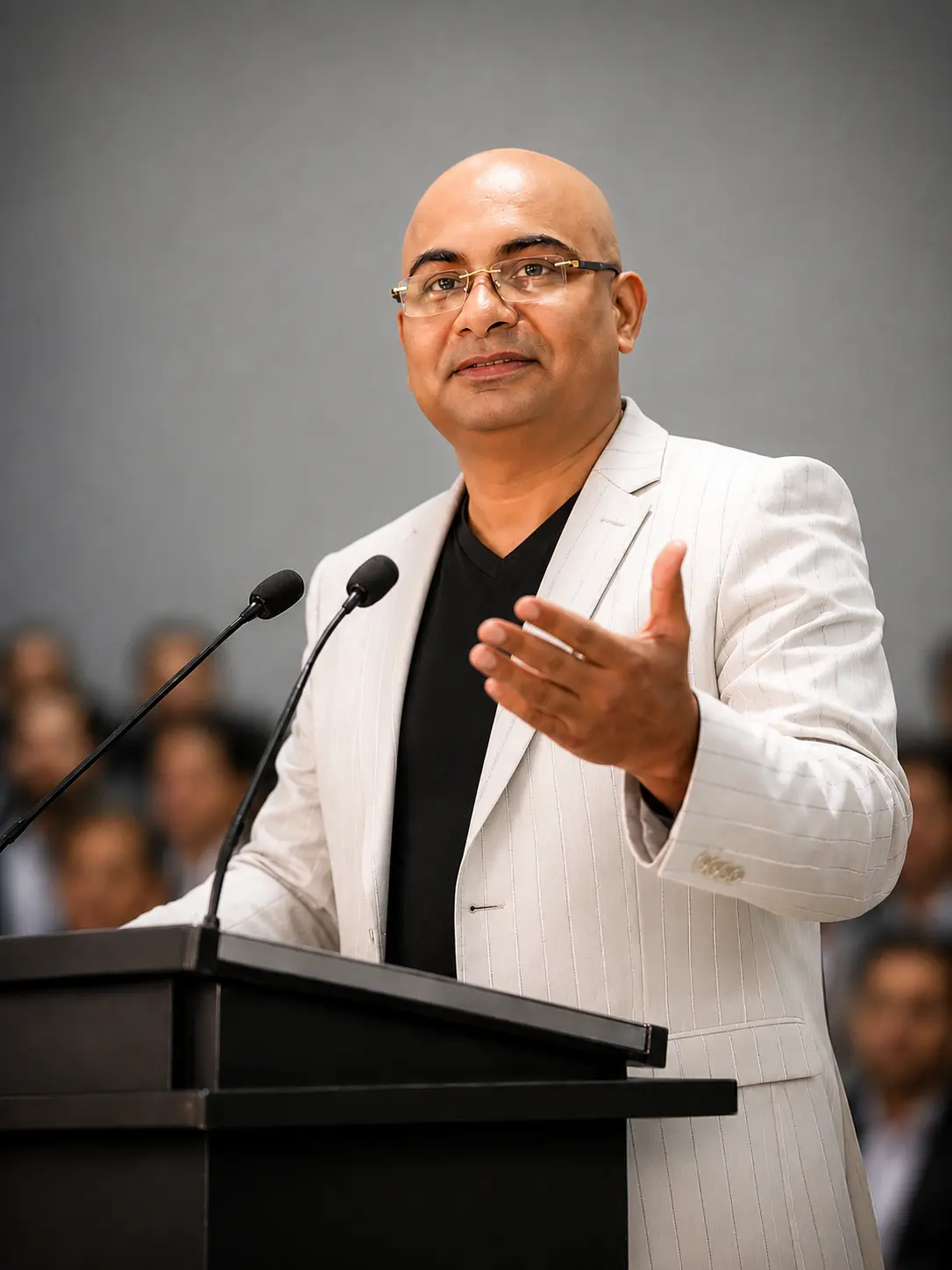
An OKR Coach with 20+ years of implementation experience, Madhusudan has guided over 50 organisations through successful OKR transformations, training more than 500 leaders. Learn more about Worxmate.