7-Step Performance Management System Implementation Guide (2026)
Actionable insights to align your OKRs with everyday performance management-from proven frameworks to the tools that power them.
Performance management system implementation: A successful rollout requires moving beyond rigid annual reviews into continuous performance management. By uniting strategic alignment, top performance review tools, and transparent weekly check-ins, organizations drive measurable business outcomes without enterprise software bloat.
Executing a sustainable performance management system requires careful attention to workforce culture, operational cadence, and change management. Effective implementation is crucial because it directly impacts employee engagement, productivity, and organizational alignment, turning a procedural tool into a catalyst for growth and development.
What is a Performance Management System (PMS)?
When planning your rollout, many mid-market leaders evaluate legacy enterprise suites like Lattice. However, heavy platform fees and rigid structures often create friction for frontline or distributed teams. Deploying an agile alternative that combines continuous performance management, OKR tracking, and intuitive 1:1 check-ins delivers twice the adoption for half the investment.
A Performance Management System is a holistic framework that aligns organizational, team, and individual goals. It moves beyond the outdated annual review to a continuous cycle of planning, monitoring, developing, and rewarding performance. Modern systems are cloud-based platforms that facilitate ongoing feedback, goal tracking (like OKRs), competency assessments, and development planning.
Why a Structured Implementation is Non-Negotiable
According to Gallup, only 29% of employees strongly agree that their performance reviews are fair, and only 26% feel they are accurate. A haphazard rollout amplifies these flaws. A deliberate, people-centric performance management system implementation is key to overcoming skepticism and fostering adoption.
Unlock Goal Clarity & Accelerate Employee Growth
Looking to drive goal clarity and employee growth? Discover how Worxmate’s AI-powered Performance Management Software can help.
The Blueprint: How to Implement a PMS Tool Successfully
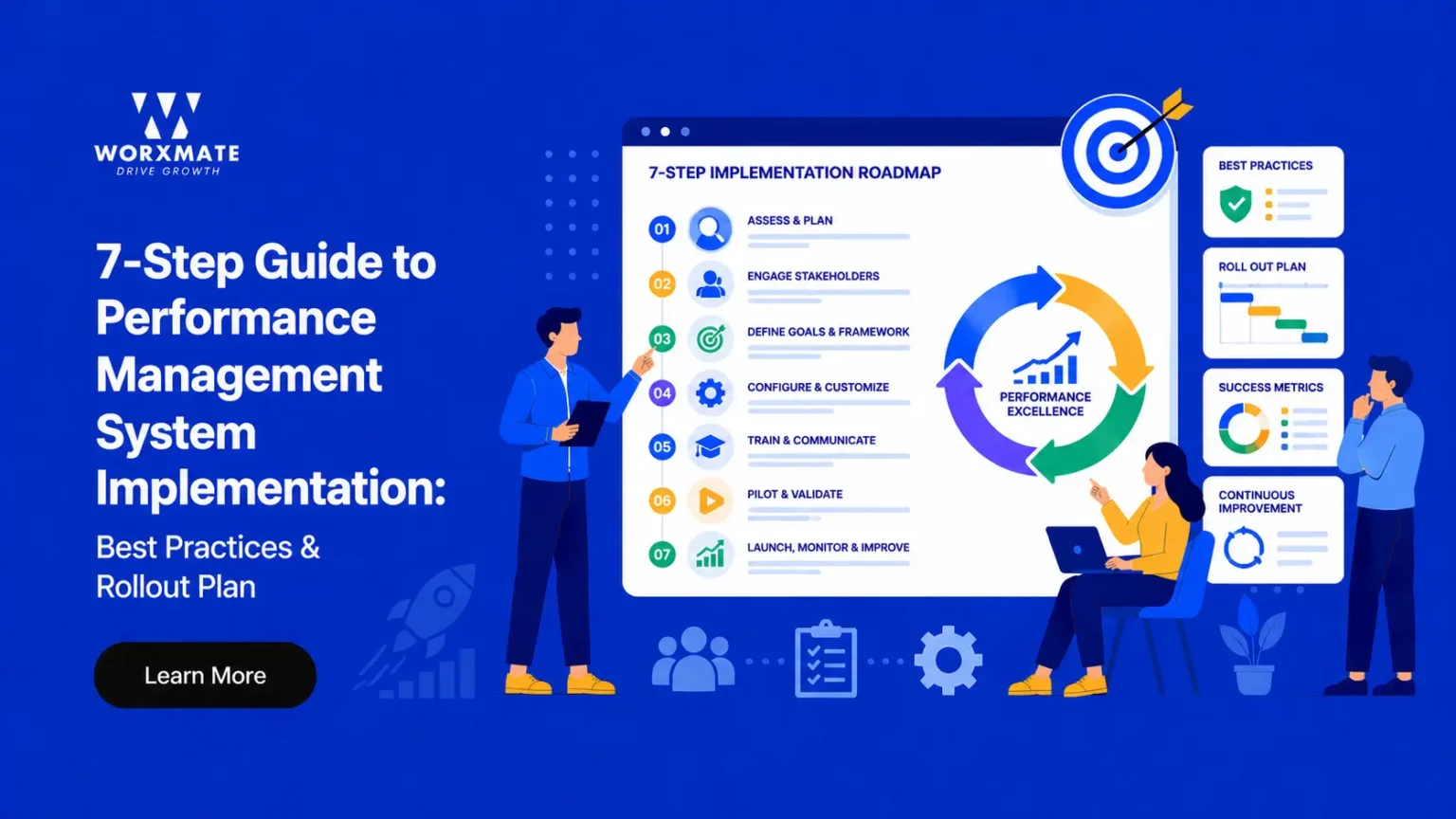
A successful implementation is a phased journey, not a single event. Evaluating different performance management approaches ensures your strategy matches team operational realities. Here is your strategic blueprint.
Phase 1: Foundation & Planning
This phase determines the entire project’s trajectory.
- Secure Executive Sponsorship: Your project needs a C-level champion. A Deloitte study emphasizes that initiatives with active executive sponsors are 40% more likely to succeed.
- Define Clear Objectives & KPIs: Why are you doing this? Is it to improve engagement, increase goal transparency, or reduce turnover? Establish measurable KPIs for the implementation itself.
- Assemble a Cross-Functional Project Team: Include HR, IT, key business leaders, and future “power users” from different departments.
- Select the Right Vendor: Choose a platform like Worxmate that aligns with your company’s size, culture, and need for agility. Prioritize user experience and integration capabilities.
Phase 2: Design & Configuration
Tailor the system to your organization, not the other way around.
- Customize Your Performance Framework: Align the tool with your existing or newly designed process. Will you use OKRs, cascading goals, or competencies?
- Design Workflows & Permissions: Map out the approval chains, feedback loops, and review cycles. Configure user roles and access levels.
- Integrate with Existing Tech Stack: Ensure seamless integration with your HRIS (like BambooHR or Workday), communication tools (like Slack or Teams), and other critical systems for a unified experience.
Phase 3: Pilot & Testing
Never roll out to the entire company at once.
- Select a Pilot Group: Choose a representative, engaged department.
- Gather Intensive Feedback: Use surveys and focus groups to identify friction points.
- Iterate and Refine: Adjust configurations, training materials, and communications based on pilot feedback. This is your chance to perfect the PMS rollout plan.
Phase 4: Communication & Change Management
This is arguably the most critical phase. A McKinsey report notes that 70% of change programs fail due to employee resistance and lack of management support.
- Develop a Compelling “Why”: Communicate the benefits for the organization, managers, and employees individually.
- Utilize Multi-Channel Communication: Use emails, town halls, intranet articles, and videos from leadership.
- Address Concerns Proactively: Create a safe space for questions and openly address fears about surveillance or unfair evaluation.
Phase 5: Training & Launch
Equip your people to succeed.
- Tiered Training Programs:
- Administrators: Deep-dive technical training.
- Managers: Specialized training on giving feedback, setting goals, and conducting check-ins within the new system.
- Employees: Focused, role-specific training on how to use the tool for their benefit.
- Create Accessible Resources: Develop quick-start guides, video tutorials, and a dedicated FAQ hub.
- Go-Live with Support: Launch with a robust support channel (e.g., a dedicated helpdesk or Slack channel) for immediate issue resolution.
Phase 6: Evaluation & Continuous Improvement (Months 6+)
Implementation doesn’t end at launch.
- Monitor Adoption Metrics: Track login rates, goal-setting completion, and feedback frequency.
- Measure Against KPIs: Revisit the objectives set in Phase 1. Are you seeing improved engagement scores or goal alignment?
- Solicit Ongoing Feedback: Conduct quarterly pulse surveys to understand user sentiment and identify areas for enhancement.
PMS Implementation Best Practices: Lessons from the Front Lines
- Treat it as a Change Initiative, Not an IT Install: Focus 70% of your effort on people, process, and communication, and 30% on technology.
- Keep It Simple at Launch: Start with core functionalities (goal setting, check-ins, reviews) before introducing advanced features like 360-degree feedback.
- Train Managers as Performance Coaches: They are the linchpin of the system. Empower them to have effective conversations.
- Foster a Culture of Continuous Feedback: Use the tool to encourage regular, informal feedback, not just scheduled reviews. Harvard Business Review research consistently shows that frequent feedback is a key driver of performance.
- Ensure Leadership Participation: When leaders actively use the system to set and update their goals, it sends a powerful message.
Case Study: How Unilever Scaled a Modern PMS Globally
Company: Unilever
Challenge: Unilever, with over 148,000 employees globally, sought to move away from a rigid, annual review process to a more agile, continuous performance development model. Their goal was to foster a growth mindset and improve employee engagement across diverse regions.
Implementation & Strategy: Partnering with advisory firms like PwC on change management, Unilever implemented a cloud-based performance management platform centered on frequent “Check-Ins.” They replaced annual ratings with regular, future-focused conversations about goals, development, and impact. A key part of their PMS rollout plan involved extensive gamified training modules and strong advocacy from senior leaders.
Results & Statistics:
-
- Increased Engagement: They reported a significant rise in employee engagement scores, directly linked to the new continuous feedback culture.
- Time Saved: Managers and employees saved approximately 200,000 hours annually by eliminating cumbersome annual paperwork.
- Strategic Alignment: The system improved visibility into goal alignment across all levels, from the CEO to shop-floor employees.
As a Unilever HR leader stated, “The shift was from assessing performance to fueling it. The tool enabled the conversation, but the real change was in our leadership philosophy.” This case, often cited in Gartner HR analyses, underscores that successful performance management system implementation is about enabling culture, not enforcing process. Structured 1:1 check-ins provide managers and reports with a dedicated space to align on priorities. This strengthens continuous feedback and team alignment throughout every review cycle. This strengthens continuous feedback and team alignment throughout every review cycle. This strengthens continuous feedback and team alignment throughout every review cycle.
Common Pitfalls to Avoid in Your PMS Rollout
- Lack of Clear Purpose: Implementing a system because “everyone else has one” is a recipe for failure.
- Over-customization: Excessive configuration can create a complex, unmanageable system that no vendor can properly support.
- Ignoring Change Resistance: Assuming “if we build it, they will come” without a robust communication plan.
- Setting and Forgetting: Failing to monitor, tweak, and improve the system post-launch.
Conclusion: Implement with Confidence, Empower with Worxmate
A successful performance management system implementation is a transformative journey that aligns your workforce, clarifies priorities, and fosters a high-performance culture. It requires meticulous planning, empathetic change management, and the right technological partner.
This is where Worxmate excels. Worxmate’s integrated OKR & PMS platform is designed to make implementation smooth and adoption effortless. With intuitive goal-setting (OKR), seamless continuous feedback tools, and powerful analytics, Worxmate turns your performance management strategy into a living, breathing engine for growth.
Ready to transform how your organization manages performance?
[Explore Worxmate’s PMS features today and schedule a personalized demo to see how we can simplify your implementation journey.]


Written by
An OKR Coach with 20+ years of implementation experience, Madhusudan has guided over 50 organisations through successful OKR transformations, training more than 500 leaders. Learn more about Worxmate.
Frequently Asked Questions
A standard rollout for mid-market organizations takes between 6 to 12 weeks, including executive alignment, pilot testing, manager training, and full launch.
Focus 70% of your effort on change management and communication. Clearly articulate the WIIFM (What’s In It For Me) for employees and train managers as supportive coaches rather than compliance officers.
Annual reviews rely on retrospective, backward-looking ratings. Continuous performance management utilizes weekly check-ins, real-time feedback, and dynamic goal tracking to drive ongoing employee development.
Traditional tools often suffer from high user fees, complex administrative bloat, and rigid annual review cycles that disconnect goals from daily operational tasks.
Yes, Worxmate seamlessly integrates with leading HRIS and collaboration tools like Slack and Microsoft Teams to ensure a unified employee experience.
OKRs provide the strategic goal-setting framework that connects individual tasks directly to overarching company milestones, ensuring transparency and alignment during reviews.
Key metrics include system login rates, check-in completion frequency, goal-setting updates, and changes in quarterly employee engagement scores.
Yes, testing the PMS configuration with a representative pilot group allows HR teams to gather intensive feedback, iron out friction points, and refine training materials.
Provide specialized manager workshops focused on active listening, delivering continuous feedback, setting measurable key results, and conducting constructive 1:1 check-ins.
Worxmate offers an agile, cost-effective alternative combining robust OKRs and continuous performance management for a fraction of enterprise software investment, complete with frontline operational support.