 WORXMATE
OKRs for Remote Teams: A strategic framework that aligns distributed employees through transparent, measurable goals. By utilizing the best okr software, remote organizations bridge communication gaps communication gaps, ensure accountability without micromanagement, and maintain high-performance culture across time zones through structured check-ins and real-time progress tracking.
OKRs provide a structured approach to setting and achieving goals, making them particularly valuable in remote work environments where clear communication and accountability are essential. When managed through dedicated OKR software, teams have seen an increase in their overall performance by 15.5% by eliminating the friction of manual tracking.
Let’s look at how OKRs work in the context of remote work.
1. Setting Clear Objectives
Remote teams start by defining clear and ambitious objectives that they want to achieve within a specific timeframe. These objectives should be ambitious yet achievable and directly contribute to the team’s overall mission and the organization’s goals.
2. Defining Key Results:
Key Results are the measurable outcomes that indicate whether the objectives have been achieved. They provide specific, quantifiable targets that remote teams can work towards. Key Results should be challenging but attainable, serving as concrete markers of progress.
3. Aligning Goals:
OKRs help align remote teams’ goals with the organization’s broader objectives. By ensuring that each team’s objectives contribute to the company’s overarching goals, OKRs create cohesion and synergy across remote teams.
4. Communicating Objectives and Progress:
Communication is crucial in remote work environments, and OKRs provide a structured way to keep everyone aligned and informed. Remote teams communicate their objectives and key results clearly to ensure that everyone understands their role and how it contributes to the team’s success. Regular updates on OKR progress help keep remote team members informed and motivated.
5. Tracking Progress:
OKRs provide a framework for tracking progress toward goals. Remote teams can regularly review their key results to assess how they’re performing and identify any areas that need improvement. This tracking process allows remote teams to stay agile and adapt their strategies as needed to achieve their objectives.
6. Promoting Accountability:
They foster accountability within remote teams by making goals visible to everyone. Remote team members are accountable not only to their managers but also to their colleagues, creating a sense of collective responsibility for achieving the team’s objectives.
7. Iterating and Learning:
OKRs encourage a culture of continuous improvement and learning within remote teams. After each OKR cycle, remote teams reflect on their progress, celebrate their successes, and identify lessons learned. This iterative process helps remote teams refine their goals and strategies over time, driving ongoing growth and success.
Practical OKR Examples for Remote Teams
To move from theory to execution, remote leaders should focus on outcomes that bridge the physical distance. Here are three examples tailored for distributed environments:
Engineering Team: Remote Velocity
Objective: Maintain high development standards while working asynchronously.
- Key Result 1: Increase documentation coverage for all new features from 60% to 100%.
- Key Result 2: Reduce average PR review turnaround time from 24 hours to 12 hours.
- Key Result 3: Achieve 95% uptime for the staging environment during core global hours.
HR Team: Distributed Culture
Objective: Enhance employee belonging in a remote-first setting.
- Key Result 1: Increase ‘Sense of Belonging’ score in quarterly surveys from 7.2 to 8.5.
- Key Result 2: Launch 3 new virtual ‘Coffee Roulette’ initiatives with 80% participation.
- Key Result 3: Ensure 100% of remote managers complete ‘Asynchronous Leadership’ training.
Best Practices for Implementing OKRs in Remote Teams
1. Alignment and Focus
OKRs are a guiding force for remote teams, aligning everyone toward common goals and objectives. When team members understand how their individual contributions contribute to larger objectives, they feel a sense of purpose and direction. This alignment fosters synergy within the team and ensures that everyone is working towards the same overarching goals.
2. Communication
Clear communication is the cornerstone of successful remote work, and OKRs play a vital role in facilitating this communication. By defining clear objectives and key results, teams can engage in meaningful discussions about progress and priorities. Regular updates on OKR status help keep everyone informed and enable teams to make necessary adjustments to stay on track.
3. Transparency and Accountability
OKRs promote transparency by making goals visible to all team members. When everyone has visibility into the objectives and key results, it fosters a culture of trust and accountability. Team members can see how their work contributes to the broader goals of the organization, which motivates them to perform at their best.
4. Regular Check-ins
These are essential for monitoring progress and ensuring that teams stay on course to achieve their goals. Weekly or bi-weekly check-ins provide an opportunity to assess what’s working well and identify any obstacles that need to be addressed. Remote teams relying on manual updates often let this habit slip our OKR platform reviews cover which tools make check-ins frictionless for distributed teams specifically. These check-ins also serve as a platform for recognizing achievements and celebrating milestones, which boosts team morale and motivation.
Challenges of Implementing OKRs in Remote Teams
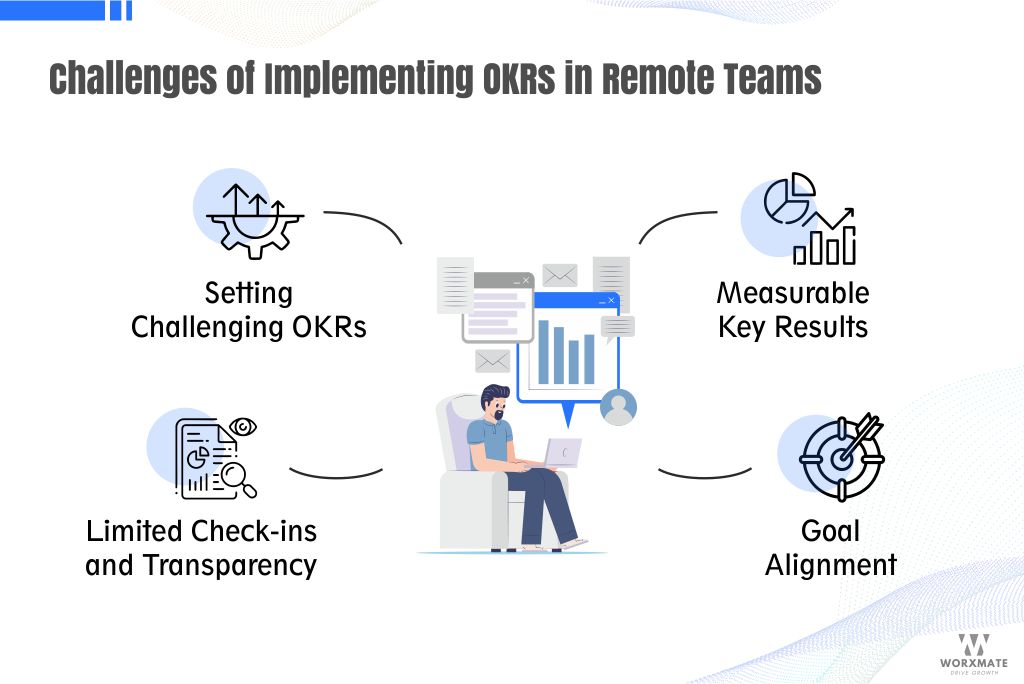
1. Setting Challenging OKRs
One of the key challenges in implementing OKRs for remote teams is finding the right balance between setting challenging goals and ensuring they are achievable. While ambitious goals can motivate teams to strive for excellence, unrealistic objectives can lead to frustration and burnout. It’s essential for team leaders to carefully consider the capabilities and resources of their remote teams when setting OKRs.
2. Limited Check-ins and Transparency
Remote work can sometimes lead to a lack of visibility and communication among team members. Maintaining transparency and accountability around OKRs can be challenging without regular face-to-face interactions. Leaders must make a concerted effort to schedule regular check-ins and create channels for open communication to ensure that everyone stays informed and engaged.
Manual Tracking vs. OKR Software for Remote Teams
Many teams struggle when moving from KPIs to OKRs because they rely on static spreadsheets. Adopting the best okr software eliminates these hurdles. Here is how specialized tools compare to manual methods:
| Feature | Spreadsheets / Manual | Specialized OKR Software |
|---|---|---|
| Visibility | Hidden in folders; easily forgotten. | Real-time dashboards for all. |
| Check-ins | Manual reminders required. | Automated Slack/Teams prompts. |
| Alignment | Difficult to see parent-child links. | Visual alignment trees. |
3. Measurable Key Results
Key results must be quantifiable and measurable to provide a clear picture of progress towards objectives. However, defining meaningful metrics can be challenging, particularly in remote work environments where performance may not always be easily quantifiable. It’s important for teams to collaborate on defining key results that accurately reflect progress and success.
4. Goal Alignment
Ensuring that team goals align with the organization’s broader objectives can be particularly challenging in remote settings. Without regular face-to-face interactions, remote teams can find it difficult to stay connected to the overarching goals and priorities of the organization. Leaders must make a concerted effort to communicate company objectives clearly and ensure that team goals are aligned accordingly.
Conclusion
Implementing OKRs in remote teams presents both opportunities and challenges. By following best practices such as alignment, communication, transparency, and regular check-ins, organizations can leverage OKRs to enhance performance and goal achievement in remote work environments.
Knowing the challenges of setting OKRs, maintaining transparency and communication, defining measurable key results, and aligning team goals with company objectives is essential. By addressing these challenges head-on, remote teams can maximize the effectiveness of OKRs and drive success in today’s increasingly remote work landscape.
💡 Ready to empower your remote team?
Explore our in-depth best OKR software guide to compare top platforms and choose the right fit for your organization.


Written by
An OKR Coach with 20+ years of implementation experience, Madhusudan has guided over 50 organisations through successful OKR transformations, training more than 500 leaders. Learn more about Worxmate.