 WORXMATE
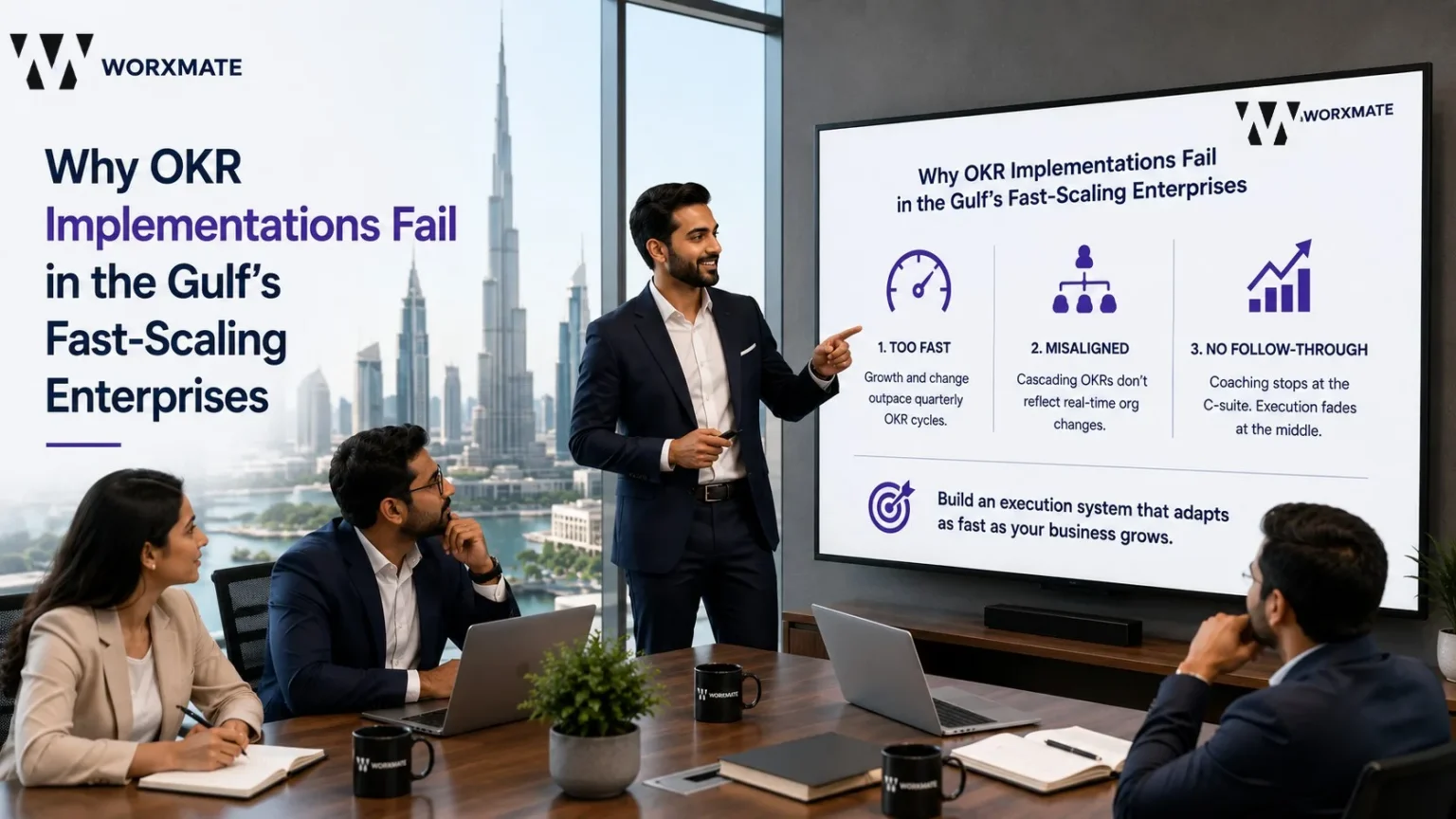
GCC Enterprise OKR Failures: Fast-scaling Gulf enterprises frequently experience OKR implementation breakdowns due to rigid quarterly cycles mismatched with rapid regional diversification. Deploying an adaptable Best OKR software with real-time AI tracking resolves structural friction and accelerates execution maturity across the UAE and Saudi Arabia.
A 2026 survey of senior GCC executives found that 88% say geopolitical developments are shaping their business decisions, and when asked about the greatest threat to their 2026 strategic roadmap, 78% pointed to supply chain and operational disruption. Read that again, and notice what it actually says: the environment Gulf enterprises are executing in is not stable enough to sit still in, and the strategic roadmap has to move anyway.
That is the exact condition most OKR implementations are not built for. Most OKR methodology, most training, most software, assumes a reasonably stable operating environment where a quarterly cycle can run its course without the ground shifting underneath it. Fast-scaling Gulf enterprises, particularly those tied to national diversification agendas across the UAE, Saudi Arabia, Oman and Kuwait, do not get that assumption. Ambition is moving faster than most organisations’ operating rhythm can absorb, and that mismatch is where implementations quietly fail.
This is not a criticism of the ambition itself. A region actively diversifying away from single-sector dependency, building new industries and new institutional capability inside a single decade, should be moving fast. The problem is narrower and more specific: the OKR frameworks and coaching models most organisations import were built somewhere else, for a different pace of change, and nobody adjusted the operating rhythm to match the actual speed of the business before rolling it out.
I have coached OKR implementations inside two of the region’s largest enterprise transformations, an 8,000-plus employee, $45 billion energy and utilities organisation, and the Middle East and Europe division of a multi-billion dollar mining and engineering group. Both engagements ran at a scale where the usual OKR advice, write clear objectives, cascade them down, review quarterly, was structurally insufficient for what the organisation actually needed. Both also shared a trait worth naming directly: leadership was not short on ambition or intelligence. What was missing was an operating rhythm built for the actual speed the business was moving at, rather than the speed the OKR framework assumed by default.
Why Speed Breaks Implementations Before Structure Does
Why Static Spreadsheets Fail Fast-Scaling Gulf Enterprises
Traditional spreadsheet tracking assumes static organizational hierarchies. In fast-scaling Gulf enterprises, where headcount and mandates shift monthly, static spreadsheets quickly decouple from actual business operations. Modern teams require agile goal tracking backed by predictive forecasting.
Deploying the Best OKR software transforms static quarterly reviews into automated check-in rhythms, ensuring your framework adapts dynamically to regional market changes.
Most OKR implementation guidance was written for organisations scaling at a predictable pace. Fast-scaling Gulf enterprises are often growing headcount, market entry, and mandate simultaneously, which means the organisational structure a quarter’s OKRs were designed for can be materially different by the time that quarter ends. A cascade built for last quarter’s org chart does not fail loudly. It fails quietly, producing goals that technically completed against a structure that no longer exists.
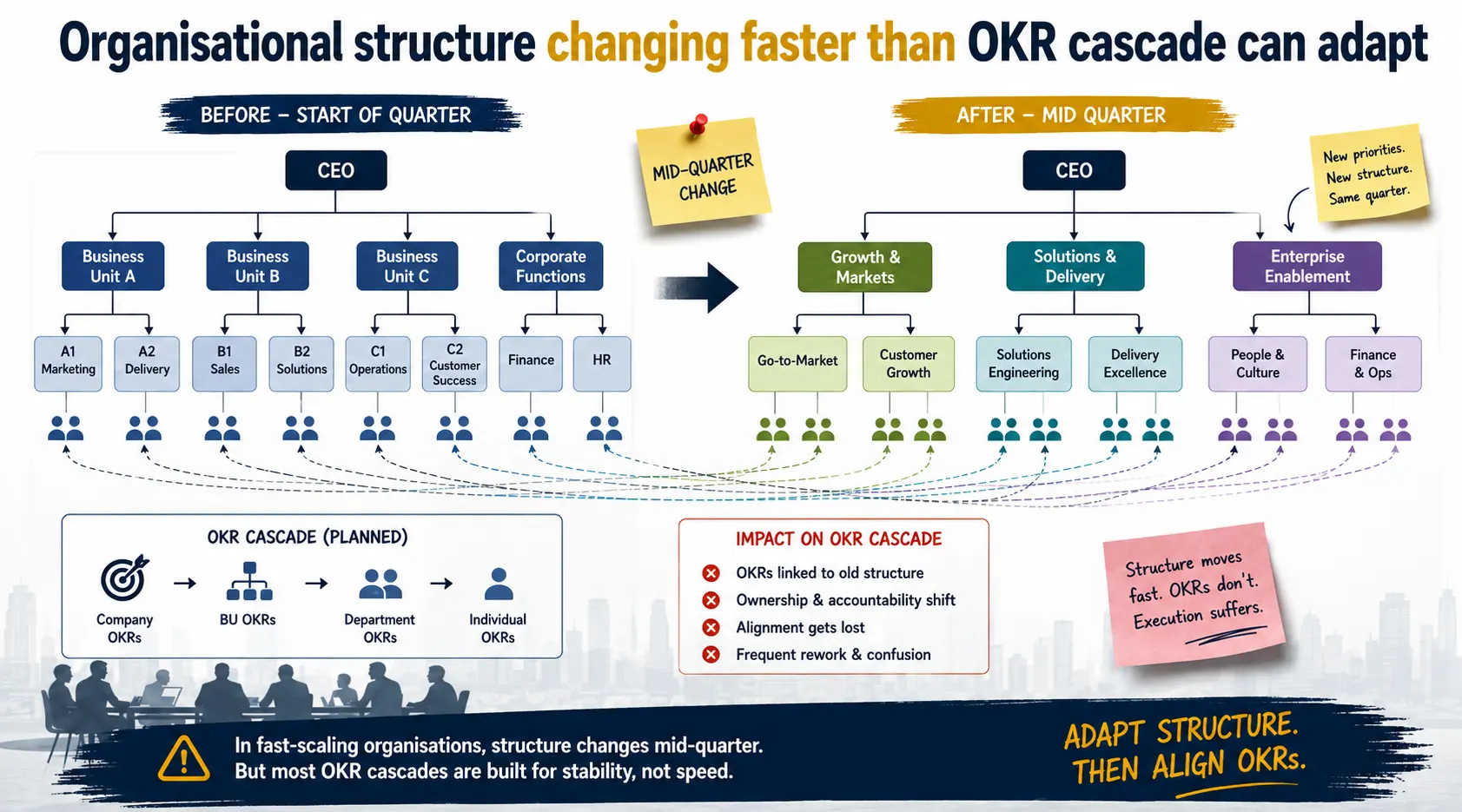
This is why the standard advice to simply write better OKRs consistently underperforms in this specific environment. The problem is rarely the quality of the objective. It is that the operating rhythm around the objective was designed for a rate of change the organisation has already outgrown by the time coaching starts.
What This Looks Like Inside a Real Gulf Enterprise
The $45 billion energy and utilities engagement is the clearest example I have coached through. I was brought in as part of a cultural and organisational transformation, working directly with the Performance Head, CPO, HR Head, OD Head and Technology Head. Six to eight senior leaders walked into the first session with strong individual conviction and no collective agreement on what mattered most. The instinct in the room, understandably, was to bring in a large consulting firm for a four to eight week SWOT exercise before touching anything.
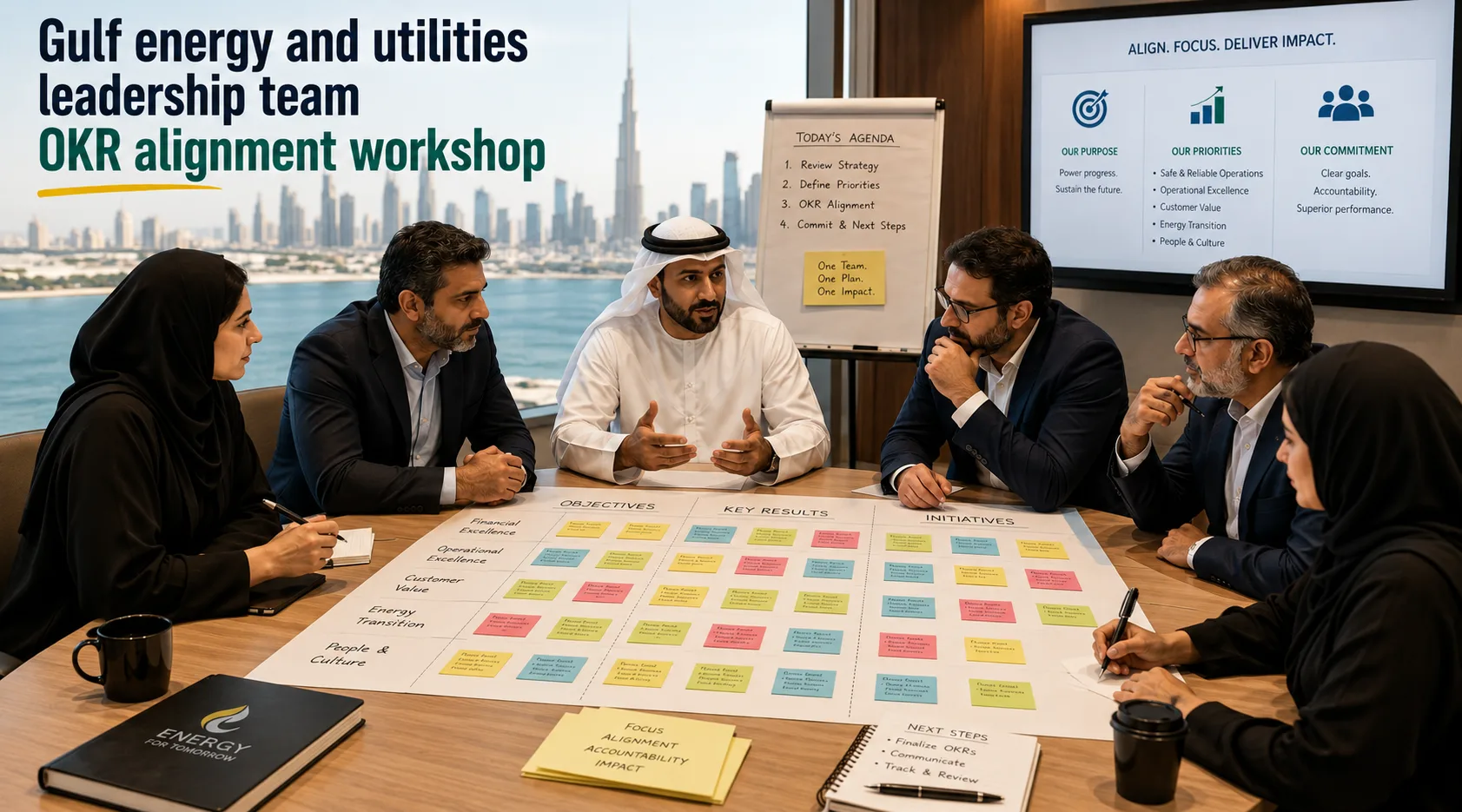
That instinct is exactly the trap fast-scaling enterprises fall into: treating strategic planning as a research problem when it is actually an agreement problem. I redirected the approach: one week, agile, agree on the two to three priorities that would move business performance the most, with the people who actually had to execute them in the room. Two to three quarters later, that same leadership team had the clarity to name exactly what was not working, and the confidence to act on it without waiting for a follow-up report.
A related engagement, the Middle East and Europe division of a multi-billion dollar mining and engineering group, showed a different version of the same underlying problem. That organisation was a market leader facing early-stage competitive threat from new entrants the leadership had not yet fully registered. The turning point came when leadership connected, for the first time, how on-time delivery and product quality directly drove renewals and regional expansion, and understood the distinction between Objectives, Outcomes, and the lagging KPIs their performance systems had always measured instead. Three quarters later: self-sustaining clarity across the leadership team, without constant intervention.
We do not teach OKRs. We build your permanent execution operating system, one that survives the pace the business is actually moving at.
What the Mismatch Actually Costs
The visible cost of implementing OKRs in a fast-scaling environment without adjusting for the pace is not failed adoption. Adoption usually looks fine on paper. Dashboards fill in. Check-ins happen. The real cost is quieter: a growing gap between what the platform reports and what the business is actually experiencing, which compounds every quarter the structure changes and the cascade does not catch up.
By the time that gap becomes visible to leadership, it usually shows up as a trust problem rather than a structural one. Teams stop taking the quarterly review seriously because it never reflects what actually happened. Leaders stop trusting the dashboard because it has been wrong before. The organisation quietly reverts to informal, verbal alignment, the exact condition OKRs were meant to replace, except now with a platform running in the background that nobody believes.
That reversal is expensive to reverse a second time, because it is no longer just a training problem. It is a credibility problem, and credibility is harder to rebuild than it is to establish the first time. This is why getting the operating rhythm right for the actual pace of the business matters more in fast-scaling environments than in stable ones: there is less room for a false start, because a false start costs more than time. It costs the organisation’s belief that the framework works at all.
The Structural Fix, Not the Motivational One
Most failed OKR implementations get diagnosed as a motivation or buy-in problem, and get treated with another town hall, another poster, another leadership offsite. That diagnosis is usually wrong. The actual fix in fast-scaling environments is structural: build the operating rhythm to expect change rather than to be disrupted by it.
Concretely, that means three things. First, shorten the distance between when structure changes and when the OKR cascade reflects it, rather than waiting for the next quarterly cycle. Second, coach the layer below the C-suite directly, since that is where a structural change actually gets absorbed or ignored. Third, measure whether leaders can independently write a genuine outcome-driven goal under current conditions, not whether last quarter’s goals technically completed against conditions that no longer apply.
That second point connects directly to a pattern I have written about before: coaching that stops at the C-suite is the single biggest predictor of OKR program failure, and it is worse in fast-scaling environments specifically, because the layer below the C-suite is also the layer absorbing the most organisational change.
There is a fourth point worth separating out, because it is the one fast-scaling organisations get backwards most often: when to hand goal-setting down to teams versus keep it centrally coached. The instinct in a fast-growing enterprise is to decentralise quickly, because centralised control feels like it will not scale to the headcount growth coming next quarter. In practice, the opposite sequencing works better. The first two quarters of any implementation need to stay top-down and actively coached, specifically because that is when the organisation is least equipped to self-correct a bad habit before it spreads. Bottom-up goal-setting only becomes safe once teams have demonstrated, under coaching, that they can distinguish an outcome from a task. Handing that down early because the organisation is scaling fast is precisely how a fast-scaling enterprise ends up with hundreds of technically-completed, business-irrelevant Key Results within two cycles.
My Take
I would not tell a fast-scaling Gulf enterprise to slow down before implementing OKRs. The pace is usually not optional, and waiting for stability that is not coming is its own failure mode.
What I would tell them is to stop evaluating OKR success by whether last quarter’s goals completed, and start evaluating it by whether the leadership team can still write a genuinely useful goal this quarter, under whatever conditions this quarter actually brings. That is a harder thing to measure than a completion percentage, and it is the only measurement that actually tells you whether the capability is real or whether the organisation just got lucky with a quarter that happened not to change much.
Based on Worxmate’s 2026 OKR Benchmark Report, most organisations sit at a 5% to 15% Execution Maturity Rate after a first cycle. In environments where the ground is also moving, that number is the one worth watching, not the completion percentage on a dashboard.
Where to Go From Here
If your organisation needs this addressed directly, our OKR consulting engagements for the Middle East are built around exactly this pattern: fast-scaling enterprises across the UAE, Saudi Arabia, Oman and Kuwait, where the standard quarterly-cycle playbook does not hold up.
If you want to build this capability inside your own leadership team rather than bring it in engagement by engagement, OKR Certified Coach is built around carrying a program past the exact point most fail, including in environments where conditions do not hold still.
Most fast-scaling enterprises eventually need both: a structural fix now, and the internal capability to keep pace with whatever changes next.
Further Reading
The Coaching Cliff: Why OKR Coaching Cliff: Why OKR Coaching Fails After the Workshop Ends — why coaching that stops at the C-suite compounds in fast-changing environments specifically.
How to Choose an OKR Certification Program — on why a body-of-knowledge credential rarely holds up under real conditions.
OKR Consulting — Middle East — the full engagement model referenced in this piece.
2026 OKR Execution Maturity Framework — the benchmark data behind the Execution Maturity Rate figures cited here. This directly accelerates measurable key results across the entire organization. Regular check-ins maintain momentum and keep strategic priorities front of mind. Tracking a real-time confidence score helps identify at-risk targets before quarter-end. Surfacing operational blockers early ensures leadership can clear obstacles quickly. Seamless cascading ensures department milestones stay synchronized with company strategy. Strong goal alignment eliminates siloed efforts and connects daily work to strategic outcomes.
Organization Performance Audit — a free, no-pitch diagnostic of where your organisation’s execution gap actually sits.
Organisational Alignment — on what alignment means when structure itself is a moving target.

Written by
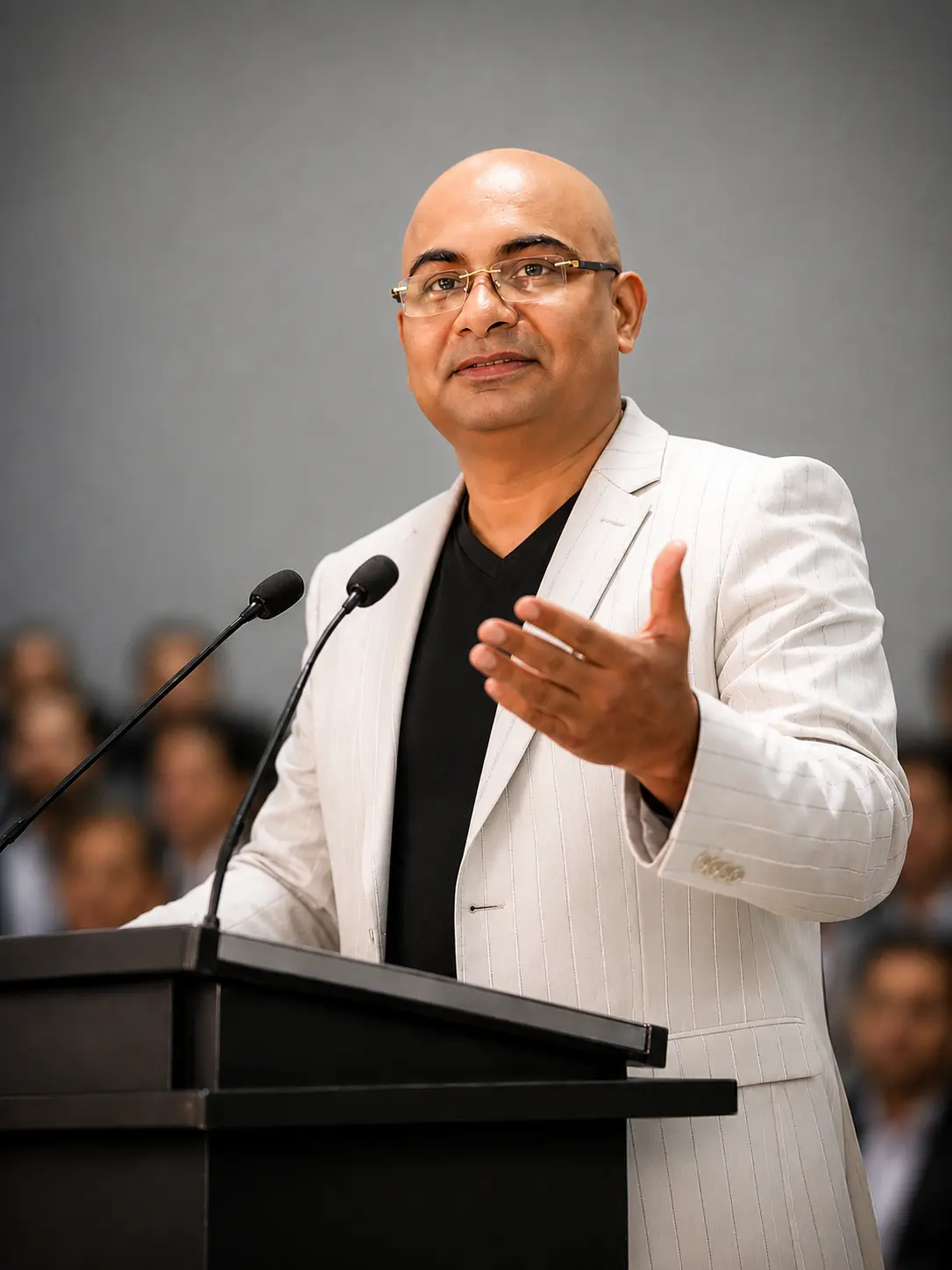
An OKR Coach with 20+ years of implementation experience, Madhusudan has guided over 50 organisations through successful OKR transformations, training more than 500 leaders. Learn more about Worxmate.