How to Implement OKRs for Indian IT Companies: 5 Proven Steps for Strategic Growth
Actionable insights to align your OKRs with everyday performance management-from proven frameworks to the tools that power them.
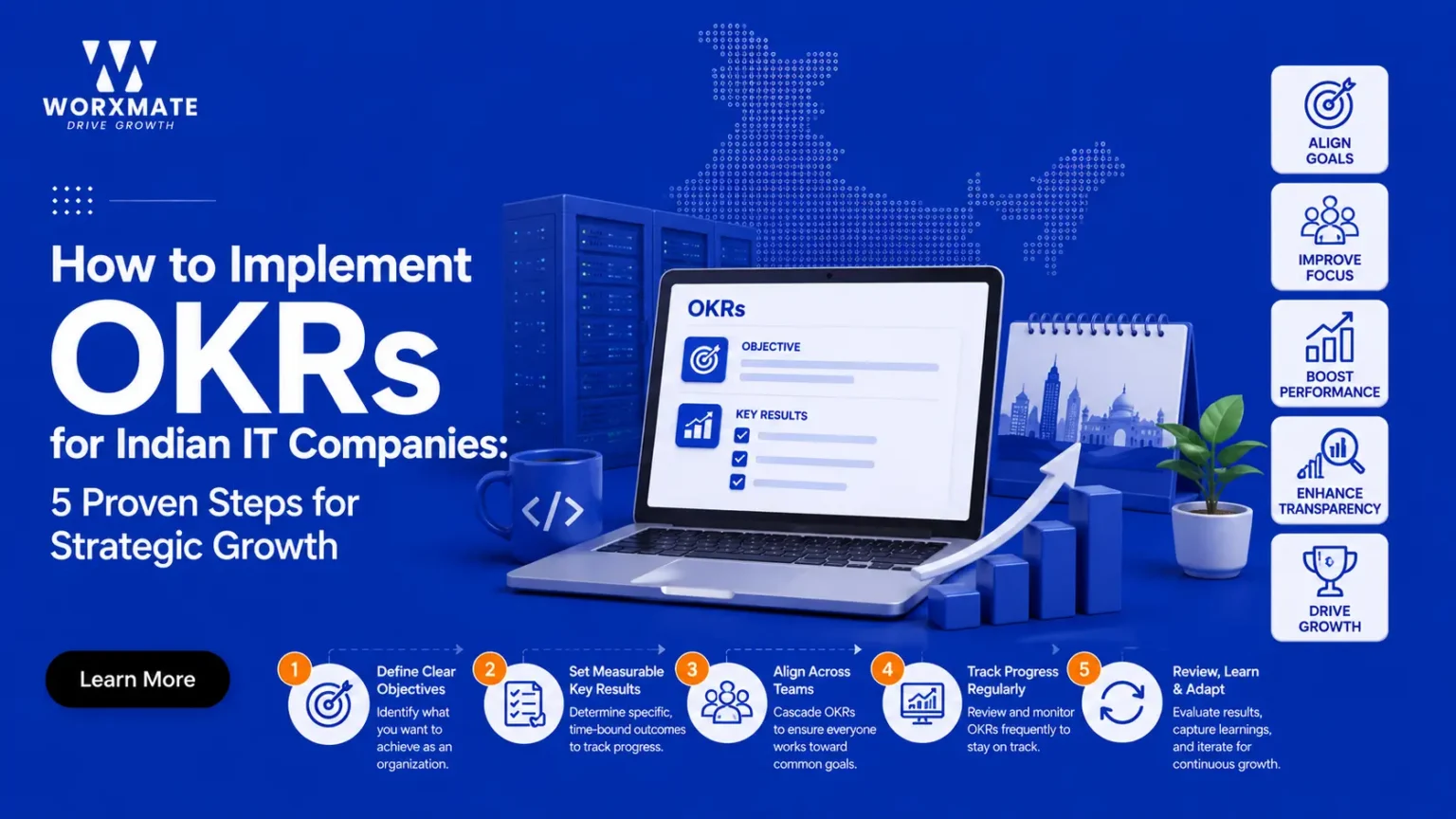
Summary
Implementing OKRs for Indian IT companies involves defining a clear framework, aligning project deliverables with strategic outcomes, and fostering a culture of continuous feedback. The success of OKRs for Indian IT companies hinges on moving beyond traditional output-focused metrics to embrace outcome-driven goal setting that supports agility and growth.
This guide provides a practical, step-by-step approach for CTOs, HR Directors, and Operations Managers in Indian IT services and SaaS companies to effectively adopt OKRs and drive measurable results across their distributed tech teams.
For Indian IT companies, the shift from traditional Key Performance Indicators (KPIs) to Objectives and Key Results (OKRs) is no longer a luxury but a strategic imperative. As the Indian tech landscape rapidly evolves, embracing OKRs for Indian IT companies provides the agility and alignment needed to navigate dynamic market demands and ambitious growth targets. Many Indian IT service firms, accustomed to project-based billing and resource utilization metrics, often find themselves struggling with a fragmented view of performance that doesn’t clearly link daily work to overarching business strategy.
Traditional goal-setting methods, while providing a sense of control, often lead to a focus on outputs (e.g., lines of code, tickets closed, billable hours) rather than the ultimate business outcomes (e.g., customer satisfaction, revenue growth, market share). This disconnect can stifle innovation and hinder the strategic organizational alignment crucial for scaling. A Gartner survey revealed that only one in four HR leaders feel their organization has a sustainable performance management model, indicating a significant gap that OKRs can fill by providing a clear, transparent, and outcome-focused framework.
This guide will walk you through five essential steps to successfully implement OKRs for Indian IT companies, ensuring your tech teams are not just busy, but strategically effective. We’ll cover everything from defining your OKR framework to sustaining momentum and leveraging technology for seamless tracking.
Step 1: Define Your OKR Framework for Indian IT Teams
Begin by establishing a clear, adaptable OKR framework tailored to the unique dynamics of Indian IT companies, considering both services and product-led operations.
This initial step is critical because a well-defined framework provides the foundational structure for all subsequent OKR activities, ensuring consistency and clarity across diverse teams. It helps translate abstract company vision into concrete, measurable objectives. According to McKinsey, over 80% of Indian companies consider digital transformation a top priority, highlighting the need for agile goal-setting frameworks like OKRs.
Pro Tip: Start with 3-5 company-level Objectives, each supported by 2-4 measurable Key Results. Ensure these are ambitious yet achievable, and clearly communicate how they connect to the broader business strategy and long-term vision.
Step 2: Align Billable Hours with Strategic Business Objectives
Translate traditional billable hour targets and project milestones into outcome-oriented Key Results that directly contribute to strategic Objectives for Indian IT companies.
This is where many IT firms falter, focusing on activity over impact. By aligning billable hours with strategic outcomes, you ensure that every hour spent directly contributes to client success and organizational growth, rather than just clocking time. It shifts the mindset from “how much work did we do?” to “what value did we create?”
Example: Instead of “Achieve 85% team utilization,” try “Increase client project success rate to 90% by delivering critical features that drive customer adoption.” The billable hours become a means, not the end, to achieve the objective.
Step 3: Implement a Robust OKR Tracking System
Choose and implement an OKR tracking system that can support the distributed nature of many Indian IT companies and provide real-time visibility into progress.
Manual spreadsheets quickly become unsustainable and inaccurate, especially for large or growing teams. A dedicated OKR platform automates data collection, visualizes progress, and facilitates real-time OKR tracking, which is essential for agile decision-making. This centralizes goal data and makes it easier for everyone to see how their work contributes to company-wide OKRs for Indian IT companies. A dedicated OKR platform automates data collection, visualizes progress, and facilitates real-time OKR tracking, which is essential for agile decision-making. If you’re weighing options, our top OKR platforms breakdown compares tools built for exactly this kind of distributed-team tracking.
Pro Tip: Look for software solutions that offer intuitive dashboards, integration capabilities with existing project management tools, and robust reporting features to monitor OKR tracking metrics effectively.
Unlock Goal Clarity and Accelerate Employee Growth
Looking to drive goal clarity and employee growth? Discover how Worxmate’s AI-powered Performance Management Software can help.
Step 4: Foster a Culture of OKR Adoption and Transparency
Address potential cultural resistance by actively involving teams in the OKR-setting process and promoting transparency across all levels of the organization.
Change management is crucial for successful OKR implementation. Research by Harvard Business Review suggests that cultural resistance is often the biggest hurdle in organizational change, impacting up to 70% of change initiatives. Empowering employees to contribute to their own OKRs for Indian IT companies fosters ownership and intrinsic motivation. This also reinforces the idea that OKRs are a tool for growth, not just evaluation.
Pro Tip: Conduct workshops, provide training, and ensure leaders visibly champion OKRs. Encourage open dialogue during OKR check-ins and celebrate small wins to build momentum and address concerns about overcoming resistance to change.
Step 5: Sustain Momentum with Continuous Review and Adaptation
Establish a regular rhythm of OKR reviews, feedback, and adaptation to keep goals relevant and maintain high engagement among Indian IT companies.
OKRs are not set once and forgotten. Continuous feedback and iteration are vital to their effectiveness, especially in fast-paced IT environments. Regular reviews help identify bottlenecks, celebrate progress, and allow for necessary adjustments to Key Results or even Objectives if market conditions change. This agile approach ensures that OKRs for Indian IT companies remain dynamic and effective.
Pro Tip: Implement weekly OKR check-ins and quarterly OKR planning cycles. Encourage honest self-assessment and peer feedback during these sessions, focusing on learning and improvement rather than blame.
Conclusion
Knowing how to implement OKRs for Indian IT companies gives leaders a repeatable system to connect daily execution to strategic outcomes. Whether your priority is accelerating digital transformation, enhancing client satisfaction, or fostering a culture of innovation, this process builds the OKR discipline that keeps teams aligned and performance management on track.
Teams that follow this process build stronger organizational alignment across functions, maintain momentum through structured OKR check-ins, and power their performance management cycle with real data. The result is a team that moves from activity tracking to outcome ownership — exactly what a modern OKR implementation system is built for.
Ready to put this OKR implementation process into action? Explore how OKR software removes the manual effort from goal tracking, use OKR alignment to connect every step to company priorities, and manage progress inside a structured OKR tracking metrics. Start your free trial with Worxmate and turn this process into measurable results your team can own.


Written by
An OKR Coach with 20+ years of implementation experience, Madhusudan has guided over 50 organisations through successful OKR transformations, training more than 500 leaders. Learn more about Worxmate.
Frequently Asked Questions
OKRs (Objectives and Key Results) are a goal-setting framework that helps organizations define ambitious, measurable goals. For Indian IT companies, OKRs are crucial for shifting focus from activity to outcomes, fostering agility, and aligning distributed teams towards strategic priorities, especially as over 80% prioritize digital transformation according to McKinsey.
Indian IT companies can transition by first defining clear, outcome-focused Objectives, then linking traditional KPIs like billable hours to measurable Key Results that reflect strategic impact. This requires a cultural shift towards transparency, continuous feedback, and leveraging dedicated OKR software for effective tracking and alignment.
The ROI for Indian IT companies implementing OKRs includes enhanced strategic alignment, improved employee engagement and accountability, and a clearer focus on high-impact outcomes. This leads to better decision-making, increased customer satisfaction, and ultimately, accelerated business growth and competitive advantage in a dynamic market.
Overcoming cultural resistance in Indian tech teams involves transparent communication about the benefits of OKRs, involving employees in the goal-setting process, and providing adequate training. Leaders must champion the initiative, foster psychological safety for honest feedback, and celebrate milestones to reinforce positive adoption, as cultural hurdles impact many change initiatives per HBR.
While spreadsheets work initially, they quickly fail to scale across distributed IT teams, leading to fragmented data and manual tracking overhead. Dedicated OKR software like Worxmate automates progress tracking, integrates with developer tools, and provides real-time visibility into strategic alignment.
Delivery managers should treat billable hours as baseline operational metrics while using OKRs to drive strategic value, such as reducing code refactoring time or increasing client retention. This shifts the team’s focus from merely logging hours to delivering high-impact, high-quality outcomes that justify premium billing.
We recommend a hybrid cadence: weekly or bi-weekly check-ins at the team level to monitor progress and unblock dependencies, combined with structured quarterly reviews to evaluate and reset company-wide OKRs. This ensures agility in fast-moving tech environments while maintaining long-term strategic alignment.
OKRs provide software engineers and IT professionals with clear visibility into how their daily work impacts the company’s strategic growth, fostering a sense of purpose. By linking OKRs to skill development and transparent performance metrics, HR leaders can create clear career pathways that boost engagement and retention.
Cascading should be a bi-directional process where leadership sets the high-level strategic Objectives, and distributed engineering teams define their own localized Key Results to support them. This collaborative approach ensures that remote developers understand the strategic context behind their tasks, driving higher ownership and alignment.