Worxmate vs Asana: 5 Key Differences for Cross-Team Collaboration
Actionable insights to align your OKRs with everyday performance management-from proven frameworks to the tools that power them.
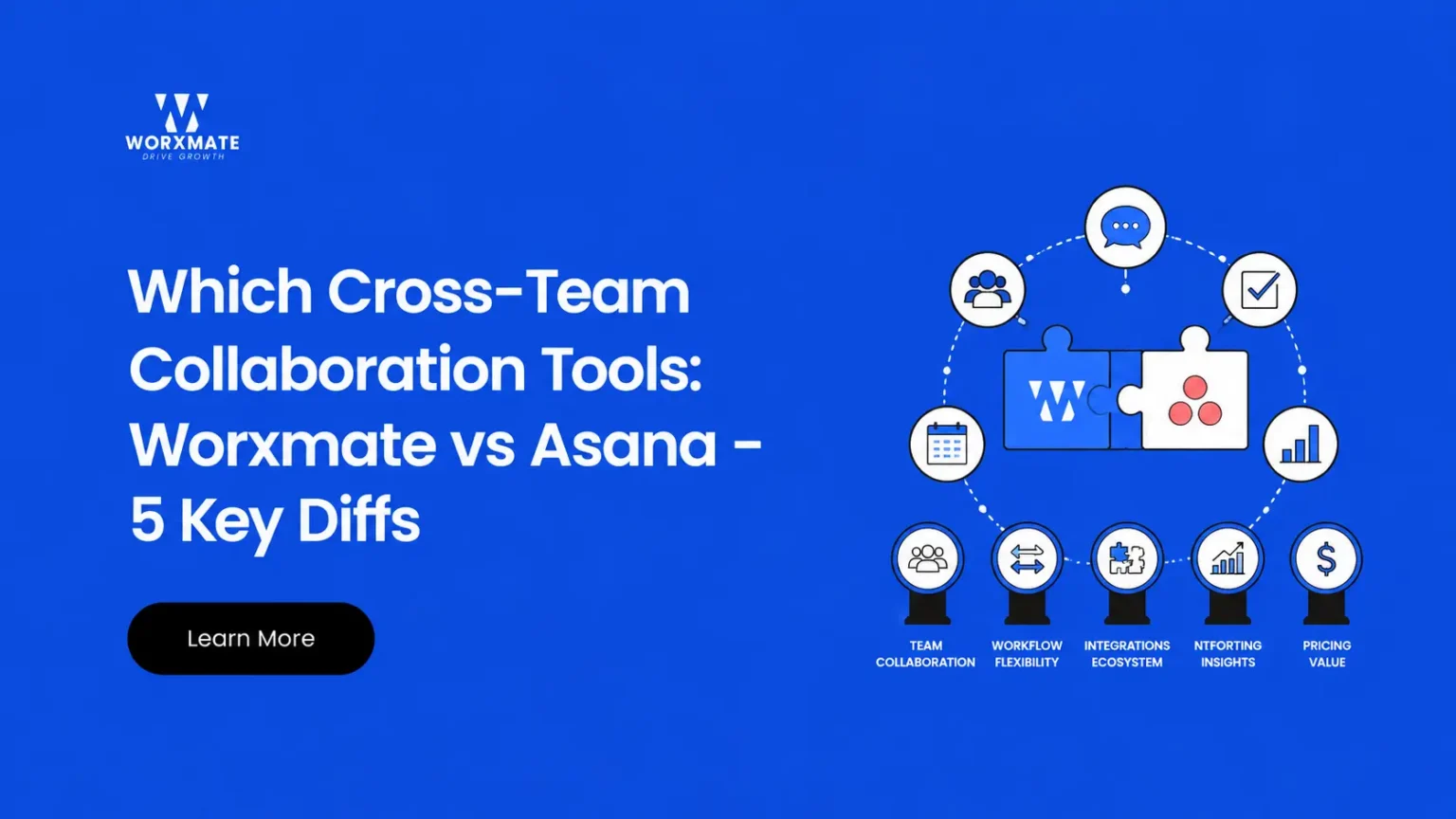
Cross-Team Collaboration Tools: Choosing the right platform requires balancing task execution with strategic alignment. While Asana excels in operational project management, Worxmate integrates OKRs and top performance review tools into a unified architecture for mid-market and enterprise teams seeking measurable outcomes.
Modern organizations frequently suffer from tool sprawl and operational friction when scaling cross-functional teams. Selecting the correct cross-team collaboration tools determines whether departments pull together toward shared strategic priorities or remain siloed in task execution. Leaders evaluating platforms like Worxmate and Asana must look beyond basic feature checklists to evaluate how architectural design directly impacts organizational alignment and day-to-day execution.
This comprehensive analysis compares Worxmate and Asana across key architectural, operational, and strategic dimensions. Organizations seeking to evaluate performance management approaches alongside task tracking will find distinct differences in how each platform handles accountability, continuous feedback, and strategic focus.
At a Glance: The Key Differences
| Category | Worxmate | Asana |
|---|---|---|
| Primary Philosophy | OKR-driven performance & strategic alignment | Project & task management, operational execution |
| OKR Management | Native, integrated with performance | Project goals, but not native OKR framework |
| Performance Management | Comprehensive 360 feedback, 1:1s, continuous feedback | Limited to task-based updates, no formal reviews |
| Goal-to-Task Link | Native line of sight from company OKRs down to execution | Task dependencies and milestones without structural OKRs |
| Ease of Use | Structured for leadership and strategic alignment | Intuitive task-level boards, lists, and timelines |
| Pricing Model | Value-based transparent structuring for mid-market | Tiered plans (Basic, Premium, Business, Enterprise) |
| Best For | Mid-market to Enterprise strategic alignment | Small teams to Enterprise task tracking |
Architectural Foundation: Native Unified Workflows vs Fragmented Legacy Modules
The core structural divergence between Worxmate and Asana lies in their native architecture. Worxmate is engineered from the ground up to connect strategic vision with execution. It combines Objectives and Key Results (OKRs), 360-degree feedback, and one-on-one meetings into a single environment. This eliminates the need for third-party bridges or disjointed database connectors.
Asana, by contrast, operates primarily as a task and project database. While highly effective for managing sprints, creative pipelines, and operational milestones, its architecture does not natively support continuous performance management or formal review cycles. Teams adopting Asana for holistic enterprise management often find themselves stitching together separate HRIS tools to capture qualitative employee growth and strategic milestones.
Operational Integration and Workflow Friction
Operational efficiency depends heavily on how smoothly teams can update their progress without administrative fatigue. Worxmate embeds weekly check-ins, confidence scores, and milestone tracking directly into the rhythm of work. Employees update key results alongside daily task reporting, ensuring that progress visibility remains high across all team goals.
Asana excels in workflow automation through customizable rules, triggers, and dependencies. It streamlines operational handoffs between departments, reducing manual status requests. However, when organizations attempt to leverage these operational workflows for broader goal alignment, they often encounter limitations in tracking qualitative employee feedback and developmental progress.
Strategic Alignment vs Disconnected Task Tracking
Clear visibility into how daily tasks roll up into company-wide strategic priorities is essential for preventing wasted effort. Worxmate’s native OKR framework ensures that every individual contributor sees their direct impact on key results. Cascading objectives provide transparent accountability across departments.
Asana allows users to attach projects to broader portfolio goals, but it lacks the granular key-result tracking required for rigorous OKR execution. While operational tasks are tightly managed, leaders relying solely on task-based completion metrics may miss early indicators of strategic drift or lagging performance.
Pricing Transparency and Total Cost of Ownership
Evaluating the total cost of collaboration software involves more than looking at per-seat subscription tiers. Worxmate’s value-based pricing is tailored for mid-market and enterprise organizations looking to consolidate multiple HR and strategic alignment tools into a single investment.
Asana utilizes a structured per-user tier model ranging from Basic and Premium to Business and Enterprise. While entry-level tiers are accessible for small teams, advanced administrative controls, portfolio reporting, and enterprise security features require upgrading to higher-priced tiers. When factoring in the additional cost of separate performance review software, the total cost of ownership shifts based on organizational needs.
Scenario Decision Trees: When to Choose Asana vs Worxmate
Choosing the optimal platform depends entirely on your primary organizational bottleneck. If your biggest hurdle is operational task congestion, project visibility, and deadline tracking, Asana provides an industry-leading environment for day-to-day execution.
Conversely, if your organization struggles with strategic drift, disconnected departmental silos, and the absence of structured performance reviews, Worxmate provides the holistic framework required to unify strategic alignment with continuous employee development. Regular check-ins maintain momentum and keep strategic priorities front of mind. Tracking a real-time confidence score helps identify at-risk targets before quarter-end. Surfacing operational blockers early ensures leadership can clear obstacles quickly.
Worxmate: Pros and Cons
- Pros: Native OKR management provides crystal-clear strategic alignment. Comprehensive performance features foster accountability and growth. Integrated tracking links daily work directly to high-level outcomes.
- Cons: Steeper initial onboarding for teams unfamiliar with structured OKR frameworks. Custom quote pricing model requires direct consultation during early evaluation.
Asana: Pros and Cons
- Pros: Exceptional project views including lists, boards, and timelines. Robust workflow automation streamlines repetitive tasks. Highly intuitive user interface with rapid team adoption.
- Cons: Lacks native OKR methodology and formal employee review cycles. Communication remains strictly project-centric rather than holistic and developmental.
Bottom Line
Selecting cross-team collaboration tools ultimately hinges on whether your priority is task-level operational efficiency or company-wide strategic alignment. For organizations seeking to unite execution with continuous performance management and clear OKRs, Worxmate offers an integrated solution.
Ready to evaluate modern alternatives? Book a demo with Worxmate to see how unified strategic alignment transforms your organization.


Written by
An OKR Coach with 20+ years of implementation experience, Madhusudan has guided over 50 organisations through successful OKR transformations, training more than 500 leaders. Learn more about Worxmate.
Frequently Asked Questions
Worxmate is built natively for OKR-driven strategic alignment and continuous performance management, whereas Asana is primarily designed for operational project management and task tracking.
No, Asana allows users to set project goals and portfolios, but it does not natively support the full OKR methodology with cascading objectives and measurable key results.
Yes, Worxmate includes comprehensive performance management features such as 360-degree feedback, continuous feedback loops, 1:1 check-ins, and structured review cycles.
Asana excels in dedicated task management, offering versatile views like Kanban boards, lists, timelines, and advanced workflow automation rules.
Asana offers transparent tiered subscription plans (Basic, Premium, Business, Enterprise), while Worxmate provides custom value-based pricing tailored for mid-market and enterprise strategic alignment.
Yes, Worxmate is specifically designed for mid-market to enterprise organizations seeking to align company-wide goals with continuous employee performance and accountability.
Yes, because Asana focuses strictly on project delivery and task updates, organizations requiring formal performance reviews must integrate separate HR tools.
Worxmate embeds weekly check-ins directly into OKR progress tracking, allowing team members to report confidence scores, highlight blockers, and discuss growth in tandem.
Some organizations leverage Worxmate for executive OKR oversight and strategic performance alignment while utilizing Asana for granular daily task execution.
You can schedule a personalized walkthrough of the platform to see how native OKRs and performance management integrate with your existing workflows.