 WORXMATE

In today’s fast-paced business landscape, establishing clear hr goals is more critical than ever. As organizations navigate challenges like digital transformation, talent shortages, and evolving employee expectations, setting effective HR objectives for 2025 can drive growth and engagement across the board.
In this post, we’ll explore how strategic hr goals for 2025 can enhance employee experience, boost productivity, and align your people strategy with overall business success.
Whether you’re looking for hr goals examples to refine your department’s strategy or seeking to set hr smart goals using proven frameworks, read on for actionable insights, real-world case studies, and expert recommendations to help you achieve your objectives.
Understanding HR Goals for 2025
HR goals are more than just targets-they are the foundation of your organization’s people strategy. With the growing importance of employee engagement, digital transformation, and continuous learning, defining clear hr objectives and goals is key to fostering a resilient workforce. For 2025, HR leaders must focus on:
- Enhancing employee engagement: Creating a culture where every team member feels valued.
- Optimizing recruitment and onboarding: Streamlining processes to attract and retain top talent.
- Promoting continuous learning and development: Ensuring staff are equipped with future-ready skills.
Adopting the SMART framework (Specific, Measurable, Achievable, Relevant, Time-bound) enables HR professionals to transform broad ambitions into hr smart goals that directly support business growth.
Top 5 HR Goals for 2025 to Future-Proof Your Workforce
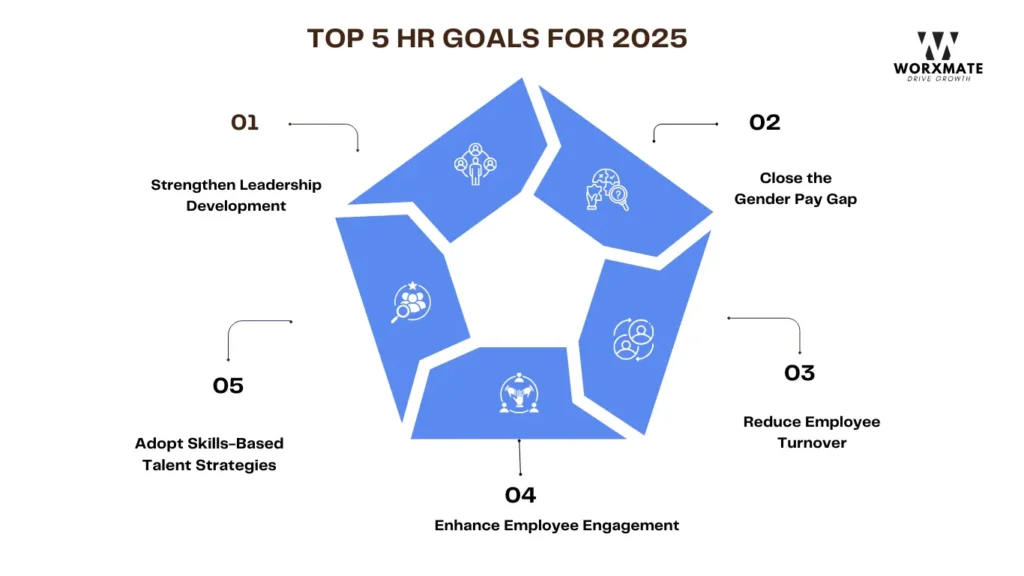
1. Strengthen Leadership Development
Why It Matters: Why It Matters: According to Gartner Report 75% of HR leaders say managers are overwhelmed, while 70% lack adequate training. With AI and remote work reshaping leadership demands, investing in continuous development is critical.
Example Goal:
- SMART Objective: “Increase managerial preparedness by implementing monthly leadership workshops, achieving a 30% improvement in team productivity scores by Q4 2025.â€
Action Steps:
- Partner with platforms like LinkedIn Learning for on-demand training.
- Use 360-degree feedback tools to identify skill gaps.
2. Close the Gender Pay Gap
Why It Matters: According to PwC Report Women still earn $0.82 for every $1 earned by men. Addressing pay equity boosts retention, reputation, and profitability.
Case Study: Salesforce’s $12 Million Pledge
In 2023, Salesforce spent $12 million to eliminate statistically significant pay disparities across gender and ethnicity. The result? A 33% increase in female leadership representation and 14% higher employee satisfaction.
Example Goal:
- SMART Objective: “Conduct quarterly pay audits to reduce gender pay disparities by 5% by mid-2025.â€
3. Reduce Employee Turnover
Why It Matters: According to Gallup Replacing an employee costs 6–9 months of their salary. Retention hinges on engagement, career growth, and flexibility.
Example Goal:
- SMART Objective: “Launch a mentorship program to improve retention rates by 15% among mid-level employees by 2026.â€
Action Steps:
- Analyze exit interviews to pinpoint turnover drivers.
- Offer personalized career pathing tools.
4. Enhance Employee Engagement
Why It Matters: According to PwC Report Gallup Disengaged teams have 18% lower productivity. Yet, only 23% of employees feel connected to their organization’s mission.
Case Study: Microsoft’s AI-Driven Engagement
Microsoft used AI-powered surveys and real-time feedback tools to tailor wellness programs. This led to a 41% drop in burnout reports and a 20% rise in discretionary effort.
Example Goal:
- SMART Objective: “Implement quarterly pulse surveys to boost engagement scores by 10% within 12 months.â€
5. Adopt Skills-Based Talent Strategies
Why It Matters: According to LinkedIn 44% of HR leaders anticipate difficulty filling roles. Shifting from job titles to skills opens doors to internal mobility and innovation.
Example Goal:
- SMART Objective: “Reskill 25% of the workforce in AI literacy by Q3 2025 to meet tech-driven demands.â€
Effective Strategies for Setting HR Goals
Achieving success with hr goals in 2025 requires a structured approach. Here are some proven strategies:
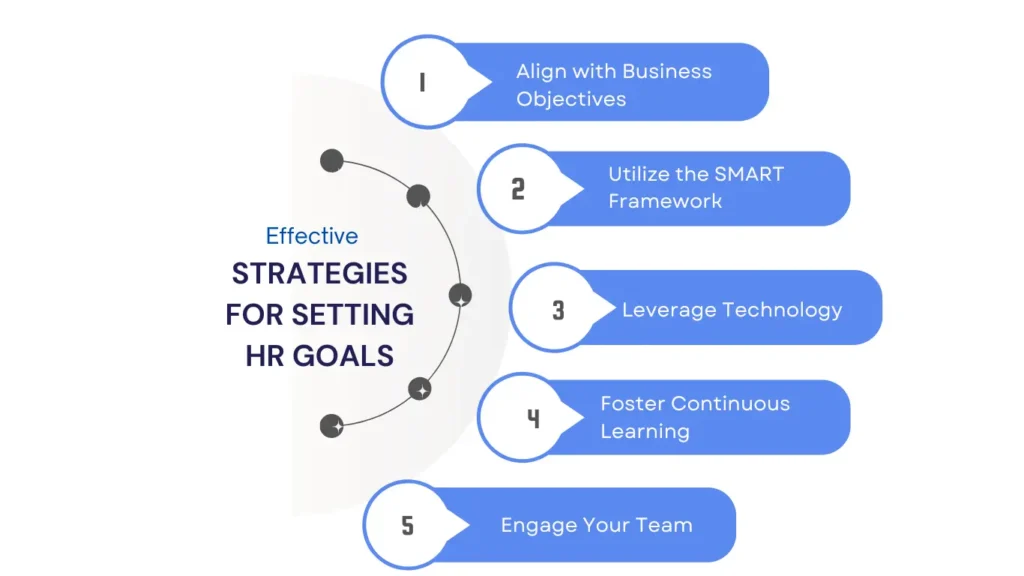
Align with Business Objectives:
Ensure that your goals for HR support the broader business strategy. Regularly engage with senior leaders to understand strategic priorities and tailor your HR initiatives accordingly.
Utilize the SMART Framework:
Transform your objectives into actionable targets by making them:
- Specific: Define precise outcomes (e.g., “Increase employee engagement survey scores by 10% within 6 months”).
- Measurable: Use key performance indicators (KPIs) to track progress.
- Achievable: Set realistic targets based on available resources.
- Relevant: Link your HR goals directly to organizational needs.
- Time-bound: Establish clear deadlines to maintain momentum.
Leverage Technology:
Embrace digital tools and platforms to streamline HR processes. Automation and people analytics can free up time for strategic initiatives.
Foster Continuous Learning:
Integrate professional development programs to upskill employees and address future skills gaps.
Engage Your Team:
Involve employees in goal-setting to enhance ownership and accountability. Regular feedback sessions can help adjust strategies in real time.
Case Study: PwC’s CSR-Driven Employee Engagement Strategy
Organizations increasingly recognize that corporate social responsibility (CSR) is not just an external branding tool but a catalyst for internal growth and engagement.
PwC’s 2021 report, The Keys to Corporate Responsibility & Employee Engagement, demonstrates how aligning CSR initiatives with HR goals can drive retention, productivity, and organizational success.
The Challenge: Linking CSR to Employee Retention
By 2025, employees-especially younger generations-prioritize purpose-driven work. PwC identified a critical gap: while 74% of employees believed companies should reduce environmental impact, only 21% felt their organizations communicated CSR efforts effectively. This disconnect risked losing talent to competitors with stronger ESG (Environmental, Social, Governance) commitments.
The Strategy: Quantifying CSR Participation
PwC launched a data-driven initiative to measure CSR’s impact on retention and engagement:
- Segmented Employee Groups: Classified employees into three tiers-no CSR involvement, occasional participants, and highly engaged advocates.
- Tracked Metrics: Hours volunteered, donations made, and projects led.
- Correlated Outcomes: Analyzed how CSR participation influenced retention, productivity, and client satisfaction.
The results were striking: employees engaged in CSR activities showed 5% higher retention rates than non-participants. For PwC, this translated to a $165 million ROI from reduced turnover costs.
Leveraging Technology for HR Success
Modern HR departments increasingly rely on technology to achieve their hr goals. Platforms that offer integrated performance management and OKR software, like Worxmate, provide comprehensive tools for setting, tracking, and evaluating HR objectives. Here’s how technology can empower your HR team:
- Streamlined Processes: Automate repetitive administrative tasks such as payroll, onboarding, and performance reviews, freeing up valuable time for strategic planning.
- Data-Driven Decisions: Use people analytics to measure the effectiveness of HR initiatives, monitor KPIs, and adjust strategies in real time.
- Enhanced Communication: Facilitate continuous feedback through digital platforms, ensuring that employees remain engaged and aligned with organizational goals.
Worxmate’s robust OKR Tracking Software enable HR professionals to break down complex goals into manageable milestones and monitor progress with clarity. By integrating these advanced tools, you can transform traditional HR functions into strategic drivers of business growth.
Achieve Your HR Goals with Worxmate
In today’s dynamic business environment, setting and executing the right hr goals can transform your organization. With the help of advanced platforms like Worxmate, you can streamline your HR processes, leverage data-driven insights, and empower your team to reach new heights.
Worxmate’s comprehensive performance management and OKR Software are designed to support your journey from goal-setting to measurable success.


Written by
An OKR Coach with 20+ years of implementation experience, Madhusudan has guided over 50 organisations through successful OKR transformations, training more than 500 leaders. Learn more about Worxmate.