Performance Review Tool Pricing: 5 Factors & Hidden Costs
Actionable insights to align your OKRs with everyday performance management-from proven frameworks to the tools that power them.
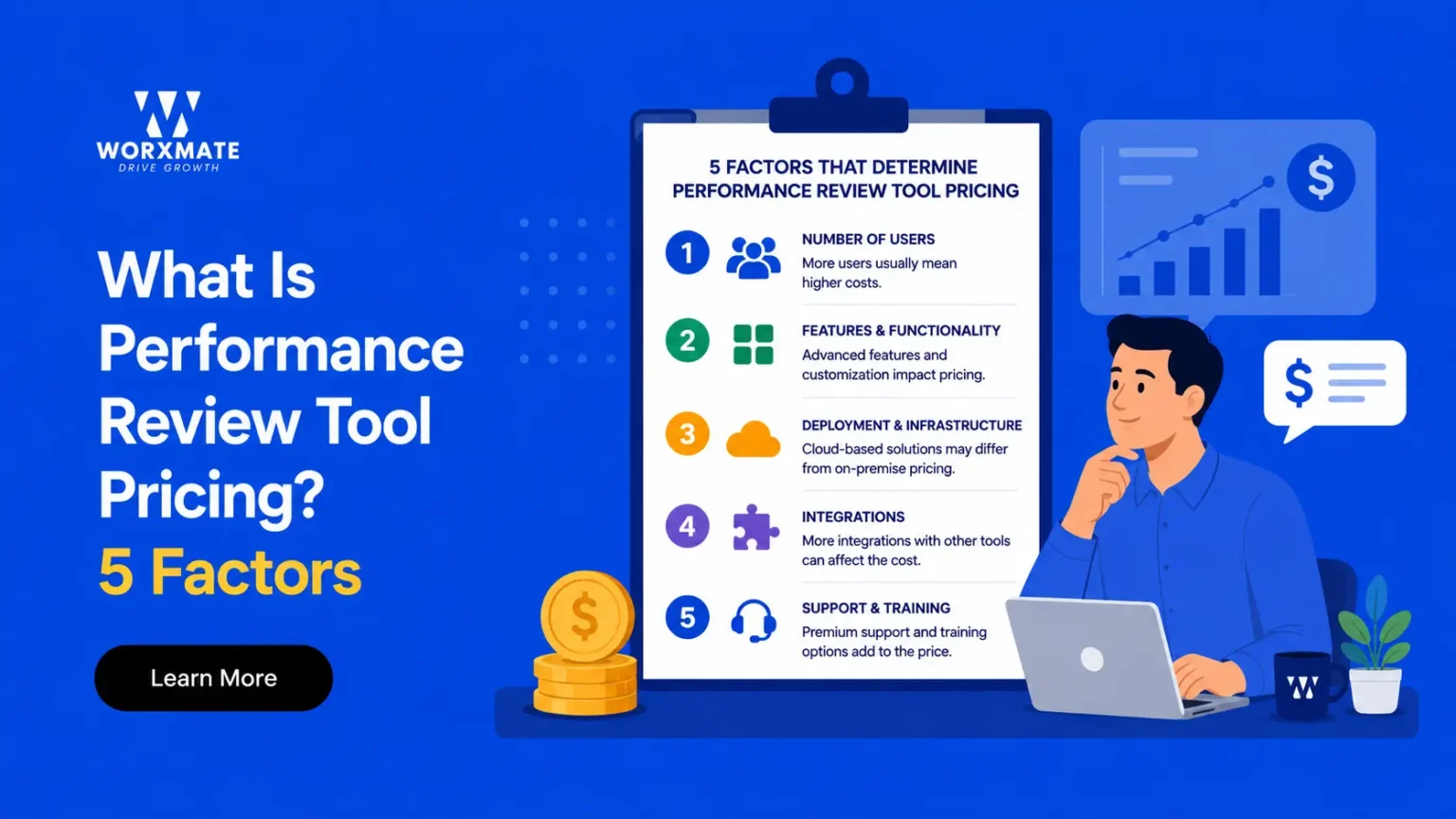
Performance review tool pricing typically ranges from $3 to $15+ per user monthly, heavily influenced by feature depth, platform minimums, and implementation fees. While legacy suites charge premium rates for fragmented modules, modern platforms like Worxmate offer unified OKRs and continuous performance management at a fraction of the total cost.
When evaluating the top performance review tools, modern HR leaders face a complex landscape of hidden platform fees, seat minimums, and fragmented feature sets. The traditional approach to buying HR software has left organizations trapped in a cycle of tool sprawl, where separate subscriptions are required for goal tracking, employee feedback, and annual appraisals. This fragmentation doesn’t just inflate your software budget; it introduces severe operational friction that degrades employee engagement and stalls strategy execution.
For mid-market organizations, particularly those with dynamic operational teams, healthcare professionals, or field-based logistics staff, the standard enterprise pricing models are fundamentally broken. Paying premium seat licenses for frontline workers who only need lightweight, mobile-first check-ins is a recipe for poor ROI. To make an informed decision, buyers must look beyond the sticker price and analyze the total cost of ownership (TCO), integration overhead, and the strategic alignment of the tool.
At a Glance: The Key Differences
To help you navigate the market, this comparison matrix highlights how different tiers of performance management software structure their pricing, features, and target audiences.
| Feature / Dimension | Lattice | ScaleUp HR | Worxmate |
|---|---|---|---|
| Primary Philosophy | Enterprise HR enablement with heavy administrative overhead. | Basic, template-driven compliance for small teams. | Agile, execution-focused alignment for mid-market teams. |
| OKR Integration | Bolted-on module requiring separate, premium licensing. | Basic, static goal tracking with no execution alignment. | Natively unified with reviews, feedback, and daily tasks. |
| Frontline Support | Poor. Designed strictly for desk-bound knowledge workers. | None. Lacks mobile-first operational workflows. | Excellent. Native tracking for field force and remote teams. |
| Pricing Structure | $11+/user/month + mandatory platform fees & minimums. | Flat per-user pricing with highly restricted feature tiers. | Transparent, value-driven per-user pricing with no hidden fees. |
| Hidden Fees | High. Platform setup fees, mandatory support packages. | Low, but features are heavily gated behind upgrades. | None. Guided onboarding and support are fully included. |
| Implementation Time | 8 to 12 weeks, often requiring external consultants. | Self-serve, but limited customization capabilities. | 2 to 4 weeks with dedicated, guided onboarding. |
| Best For | Large enterprises with massive budgets and desk-only staff. | Small startups (10-100 employees) with basic review needs. | Mid-market companies (100-1000+) seeking high-impact alignment. |
Architectural Foundation: Native Unified Workflows vs. Fragmented Legacy Modules
The architecture of your performance management software directly dictates its long-term cost and utility. Many legacy enterprise platforms were originally built as simple, single-purpose appraisal forms. As the market shifted toward continuous performance management, these vendors acquired smaller tools or hastily coded new modules to check the “OKR” or “engagement” boxes. The result is a fragmented user experience where goals, feedback, and reviews live in separate databases, requiring manual syncing and administrative intervention.
This architectural fragmentation introduces hidden costs. HR administrators must spend hours exporting data from the goal-tracking module to paste it into the performance review module. Employees become frustrated by disjointed interfaces, leading to low adoption rates and a high cost of poor performance management due to disengagement.
In contrast, a natively unified platform like Worxmate builds OKRs, continuous feedback, and performance reviews on a single, cohesive database schema. When an employee updates a key result, that progress is automatically pulled into their weekly check-in and their formal performance review. This eliminates administrative overhead, ensures data integrity, and provides a seamless experience for both managers and employees.
The Point: Buying a tool with a fragmented architecture means you will pay twice—once for the software license, and again in lost productivity and administrative bloat.
Operational Integration & Workflow Friction: Native Sync vs. Expensive Middleware
A performance tool cannot exist in a vacuum. To be effective, it must integrate seamlessly with your existing HRIS, communication tools, and operational systems. Legacy enterprise tools often charge premium fees for API access or require expensive middleware (like Zapier or custom-built integrations) to sync employee directories and operational data. For a mid-market company, maintaining these custom integrations can cost thousands of dollars annually in developer resources.
Furthermore, legacy tools are built almost exclusively for desk-bound knowledge workers. They assume every employee has a corporate email address, a dedicated laptop, and hours of free time to complete complex, multi-step reviews. If your organization includes frontline workers in logistics, healthcare, or field services, these tools fail completely. You end up paying for expensive licenses that your frontline staff cannot or will not use.
Worxmate solves this operational friction by offering native HRIS synchronization and a mobile-first design tailored for both desk-bound and frontline teams. Whether your staff is in an office, a warehouse, or a clinic, they can complete quick check-ins, receive employee feedback, and track their strategic priorities on the go. This ensures 100% adoption across your entire workforce without requiring expensive middleware or custom development.
The Worxmate Advantage: By eliminating the need for custom integration middleware and providing native frontline support, Worxmate reduces the total cost of ownership by up to 40% compared to legacy enterprise suites.
Strategic Alignment vs. Disconnected Task Tracking: Goal-to-Task Line of Sight
The ultimate goal of any performance management system is to drive business results. However, many organizations struggle with a disconnect between high-level corporate strategy and daily operational tasks. Legacy tools often treat performance reviews as a backward-looking compliance exercise, completely detached from the company’s active strategic priorities.
To bridge this gap, organizations need a clear line of sight from corporate milestones to individual tasks. This requires a system that supports:
- Weekly Check-ins: Regular, lightweight touchpoints to track progress and discuss blockers.
- Confidence Scores: Subjective indicators of how likely a team is to achieve a key result.
- Continuous Feedback: Real-time praise and constructive input to guide daily behavior.
- 360 Feedback: Multi-rater input to provide a holistic view of performance.
When these elements are disconnected, employees work in silos, focusing on tasks that may not align with the company’s strategic direction. By contrast, integrating continuous feedback vs performance reviews ensures that development conversations are always grounded in active strategic goals. This alignment is critical for fast-growing mid-market companies that need to pivot quickly in response to market changes.
Key Takeaway: A performance tool that only tracks tasks without aligning them to strategic priorities is just an expensive to-do list. True value comes from connecting daily execution to high-level key results.
Pricing Transparency & Total Cost of Ownership: Transparent Tiers vs. Hidden Minimums
When comparing performance review tool pricing, the sticker price is often highly misleading. Legacy vendors frequently advertise a low per-user rate, only to append mandatory platform fees, implementation consulting fees, and strict seat minimums in the final contract. For example, a vendor charging $11 per user monthly might also require a $3,000 annual platform fee and a minimum commitment of 100 seats. If you only have 75 employees, your actual cost per user skyrockets.
Additionally, these vendors often gate essential features—such as advanced analytics, custom review templates, or 360-degree feedback—behind their highest, custom-quoted pricing tiers. This forces growing companies to upgrade to expensive enterprise plans just to access basic performance management capabilities.
Worxmate takes a different approach, offering transparent, value-driven pricing tiers designed specifically for the mid-market. There are no hidden platform fees, no predatory seat minimums, and no surprise charges for standard features. Guided onboarding and customer support are included in your subscription, ensuring a predictable budget and a highly successful performance management system implementation.
The Math: A 150-person company using a legacy enterprise tool can easily spend over $25,000 annually once platform fees and module add-ons are factored in. With Worxmate, that same organization can deploy a fully integrated OKR and performance management system for half that investment, with zero hidden fees.
Scenario Decision Trees: When to Choose Lattice vs. Worxmate
Choosing the right performance management software depends on your organization’s size, budget, and operational model. Here is a straightforward guide to help you decide which tool fits your needs.
Choose Lattice If:
- You are a large, desk-bound enterprise with an unlimited HR software budget.
- You require highly complex, custom-coded HRIS integrations and have dedicated IT resources to maintain them.
- Your workforce consists entirely of knowledge workers who do not require mobile-first or frontline operational tracking.
- You are willing to pay premium, separate licensing fees for OKR and engagement modules.
Choose Worxmate If:
- You are a mid-market organization (100 to 1,000+ employees) seeking a robust, scalable, and cost-effective solution.
- You want a natively unified platform that combines OKRs, continuous feedback, and performance reviews without separate module fees.
- You have a diverse workforce, including remote, field-based, or frontline operational teams (Logistics, Healthcare, IT) who need mobile-friendly workflows.
- You value pricing transparency, predictable budgets, and guided onboarding without hidden platform fees.
- You want to drive strategic alignment and eliminate the administrative burden of manual data syncing.
What I’d Tell a Client
If you are evaluating performance review tool pricing, my strongest advice is to calculate the “fully loaded” cost of ownership before signing any contract. Do not just look at the per-user monthly fee. Ask the vendor directly about mandatory platform fees, implementation costs, support packages, and seat minimums. More importantly, consider the cost of administrative friction. If your HR team has to spend days manually transferring data between disconnected systems, the “cheap” tool will quickly become the most expensive software in your stack. This directly accelerates measurable key results across the entire organization. Tracking a real-time confidence score helps identify at-risk targets before quarter-end. Seamless cascading ensures department milestones stay synchronized with company strategy. Strong goal alignment eliminates siloed efforts and connects daily work to strategic outcomes.
For mid-market companies, the choice is clear. You do not need bloated, enterprise-grade HR suites that charge premium rates for features you will never use. Instead, focus on finding an agile, unified platform that drives strategic alignment, supports your entire workforce (including frontline teams), and offers transparent, predictable pricing. By choosing a modern performance management system like Worxmate, you can eliminate tool sprawl, reduce administrative overhead, and empower your team to execute your strategy flawlessly—all for half the investment of legacy alternatives.
Ready to evaluate a modern, cost-effective alternative to bloated enterprise HR software? Book a demo with Worxmate today and see how we can help you align your team and drive business results.


Written by
An OKR Coach with 20+ years of implementation experience, Madhusudan has guided over 50 organisations through successful OKR transformations, training more than 500 leaders. Learn more about Worxmate.
Frequently Asked Questions
Legacy tools like Lattice are built for large enterprises with massive budgets. They often charge high per-user fees, require separate licenses for OKR modules, and impose mandatory platform fees and seat minimums, making them cost-prohibitive for mid-market organizations.
Common hidden fees include mandatory implementation and onboarding fees, premium customer support packages, API access fees, and platform setup charges. Worxmate eliminates these by offering transparent, all-inclusive pricing.
While some vendors sell them as separate modules, keeping them separate creates data silos and administrative friction. A unified platform like Worxmate ensures that daily goals (OKRs) naturally feed into performance reviews, driving better strategic alignment.
Lattice is designed primarily for desk-bound knowledge workers. Worxmate offers a mobile-first, lightweight interface specifically designed for frontline, field, and remote operational teams (such as Logistics, Healthcare, and IT), ensuring high adoption across the entire workforce.
Enterprise tools often take 8 to 12 weeks and require external consultants. Worxmate provides guided onboarding and can be fully implemented in 2 to 4 weeks, significantly reducing time-to-value and administrative burden.
No. Unlike legacy vendors that charge premium fees for dedicated support, Worxmate includes guided onboarding and ongoing customer support as part of its standard, transparent pricing tiers.
Many legacy vendors enforce strict seat minimums (e.g., 100 or 250 seats). If your headcount is below the minimum, you still pay for the unused seats, which inflates your actual cost per user. Worxmate offers flexible, mid-market-friendly pricing without predatory minimums.
Yes. Worxmate offers native integrations with popular HRIS and payroll platforms, ensuring seamless employee directory syncing without the need for expensive custom middleware or developer resources.
Organizations typically save up to 50% on software licensing costs while reducing administrative overhead by 30%. More importantly, the unified OKR and performance workflow drives higher strategy execution and employee engagement.
Continuous feedback ensures that performance reviews are not a once-a-year surprise. By tracking 1:1 check-ins, real-time feedback, and goal progress throughout the year, reviews become more objective, constructive, and aligned with business goals.