
Summary
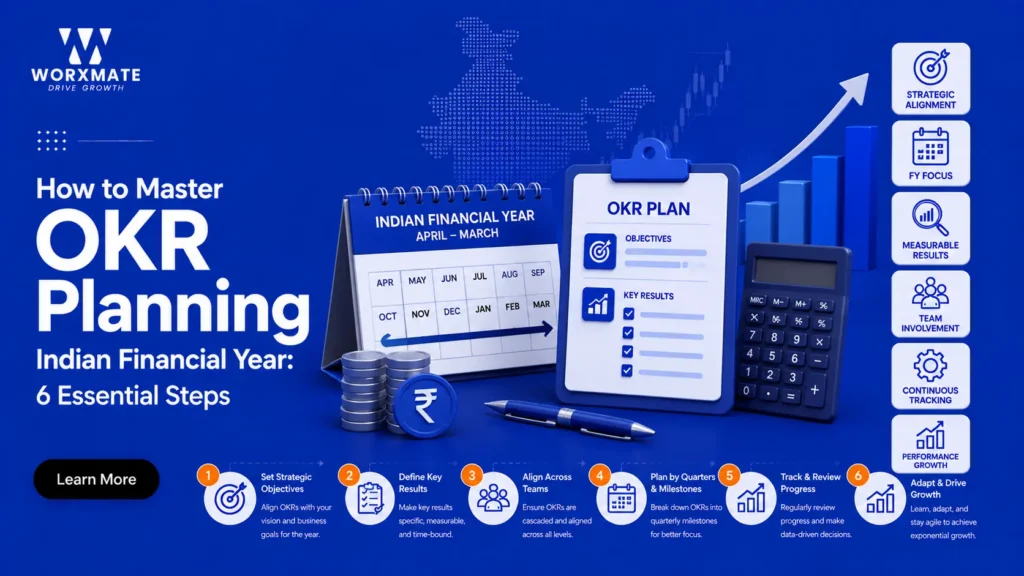
Effective OKR planning Indian financial year strategies begin by aligning your goal cycles with the nation’s April-March fiscal calendar. This approach ensures that strategic objectives, key results, and performance reviews are synchronized with critical financial reporting, budgeting, and tax cycles.
By adopting a structured OKR planning Indian financial year framework, organizations can achieve greater internal alignment, enhance accountability, and drive measurable outcomes that directly support their annual business planning and regulatory compliance.
For organizations operating in India, effective goal setting demands more than just a robust framework; it requires precise alignment with the local business context. This is particularly true for OKR planning Indian financial year cycles, which traditionally run from April 1st to March 31st. While many global companies default to a January-December calendar, businesses in India must synchronize their strategic initiatives with this unique fiscal rhythm to ensure seamless operations and accurate financial reporting.
Ignoring the Indian financial year can lead to significant disconnections between strategic goals, operational execution, and financial performance. This misalignment often results in fragmented data, missed opportunities for strategic alignment, and increased administrative burden. Understanding how to structure your OKR planning Indian financial year process is not just about compliance; it’s about optimizing your entire performance management cycle for maximum impact.
This guide will walk you through six essential steps to effectively integrate your OKR planning Indian financial year calendar. We’ll cover everything from understanding the fiscal landscape to leveraging technology to automate your goal-setting process, ensuring your team is set up for success from day one of the new financial year.
Step 1: Understand the Indian Financial Year Cycle
The first step in effective OKR planning Indian financial year is to fully grasp the April-March fiscal cycle. This period dictates budgeting, taxation, and financial reporting for nearly all businesses in India.
Why it matters: This cycle is critical because government policies, tax deadlines, and most corporate financial reporting are tied to it. Aligning your OKR planning quarterly vs annual cycles with this framework ensures that your strategic goals directly support and are supported by your financial planning. According to the Reserve Bank of India (RBI), the financial year for all entities typically ends on March 31st.
Pro tip: Educate your teams, especially those new to the Indian market or those accustomed to calendar-year planning, on the significance of the April-March financial year. This foundational understanding is key to successful OKR adoption.
Step 2: Identify Pitfalls of Misaligned OKR Planning
Recognize the common challenges and inefficiencies that arise when OKRs are not aligned with the Indian financial year. This often manifests as a disconnect between strategic goals and financial realities.
Why it matters: Misalignment can lead to disjointed strategic goal setting, where objectives set for a calendar year might not correspond with fiscal year budgets or year-end financial reviews. This can cause confusion, reduce accountability, and make it difficult to measure true business impact. For instance, a sales team might hit its calendar-year OKRs but miss fiscal year-end targets due to differing reporting periods.
Pro tip: Conduct an internal audit of past goal-setting cycles. Identify instances where a lack of OKR planning Indian financial year alignment created friction or made it harder to assess performance. This internal data can be a powerful motivator for change.
Step 3: Map Your OKR Planning Indian Financial Year Quarters
Structure your OKR cycles to precisely match the April-March fiscal year. This means your annual OKRs will span April to March, with quarterly breakdowns following suit.
Why it matters: This direct mapping ensures that your annual goals culminate with the financial year-end, simplifying reporting and strategic reviews. It streamlines the entire OKR planning Indian financial year process, from budget allocation to performance assessment. According to a Harvard Business Review article, clear cycles are crucial for OKR success, emphasizing the need for structured quarterly reviews.
Example:
- Q1: April 1 – June 30
- Q2: July 1 – September 30
- Q3: October 1 – December 31
- Q4: January 1 – March 31
This structure makes your OKR planning Indian financial year transparent and predictable.
Unlock Goal Clarity and Accelerate Employee Growth
Looking to drive goal clarity and employee growth? Discover how Worxmate’s AI-powered Performance Management Software can help.
Step 4: Synchronize Performance Reviews with the Indian Fiscal Year
Align individual and team performance reviews with the quarterly and annual OKR cycles that follow the Indian financial year. This means year-end reviews should coincide with the close of Q4 (March 31st).
Why it matters: This synchronization ensures that employee performance is assessed against goals that directly feed into the company’s fiscal year-end outcomes. It facilitates a comprehensive view of both individual and organizational achievements, making compensation and development discussions more relevant and data-driven. According to Gallup research, effective performance management is continuous and aligned with business cycles.
Pro tip: Schedule annual performance reviews and 360-degree feedback sessions to conclude shortly after March 31st, allowing for a fresh start with new goals in April. This smooth transition is vital for continuous OKR planning Indian financial year success.
Step 5: Navigate Global vs. Local OKR Planning Indian Financial Year Alignment
For multinational corporations or companies with global operations, establish clear guidelines for reconciling global calendar-year OKRs with the local Indian financial year. This might involve a hierarchical mapping or distinct local OKRs.
Why it matters: This is a common challenge that, if not addressed, can lead to significant reporting complexity and operational friction. A clear strategy ensures that local teams can focus on their specific strategic priorities while still contributing to broader global objectives. This dual alignment of OKR planning Indian financial year with global goals requires careful planning and communication.
Example: A global sales team might have a Jan-Dec OKR for overall revenue, but the India sales team will have an April-March OKR for local market share, with clear conversion metrics linking the two. This ensures both global and local OKR planning Indian financial year targets are met.
Step 6: Leverage Technology for Seamless OKR Planning Indian Financial Year
Implement a dedicated OKR and performance management software that can be configured to support the Indian financial year. This automates tracking, reporting, and review processes, making OKR planning Indian financial year much more efficient.
Why it matters: Manual tracking in spreadsheets is prone to errors and becomes unwieldy, especially with complex fiscal year alignments. Software like Worxmate provides the flexibility to set custom fiscal year cycles, automate OKR check-ins, and generate reports that align with local requirements. This ensures consistent and accurate OKR planning Indian financial year data.
Pro tip: When evaluating OKR software, prioritize platforms that offer customizable fiscal year settings, robust reporting, and integration capabilities to seamlessly fit into your existing Indian business planning ecosystem. This will greatly simplify your OKR planning Indian financial year process.
Conclusion
Knowing how to approach OKR planning Indian financial year gives HR directors and operations managers a repeatable system to connect daily execution to strategic outcomes. Whether your priority is enhancing financial alignment, improving team accountability, or driving measurable growth, this process builds the OKR discipline that keeps teams aligned and performance management on track.
Teams that follow this process build stronger OKR alignment across functions, maintain momentum through structured OKR check-ins, and power their performance management cycle with real data. The result is a team that moves from activity tracking to outcome ownership – exactly what a modern OKR and performance management system is built for.
Ready to put this OKR planning Indian financial year process into action? Explore how OKR software removes the manual effort from goal tracking, use goal alignment to connect every step to company priorities, and manage progress inside a structured strategic performance management system. Start your free trial with Worxmate and turn this process into measurable results your team can own.