 WORXMATE
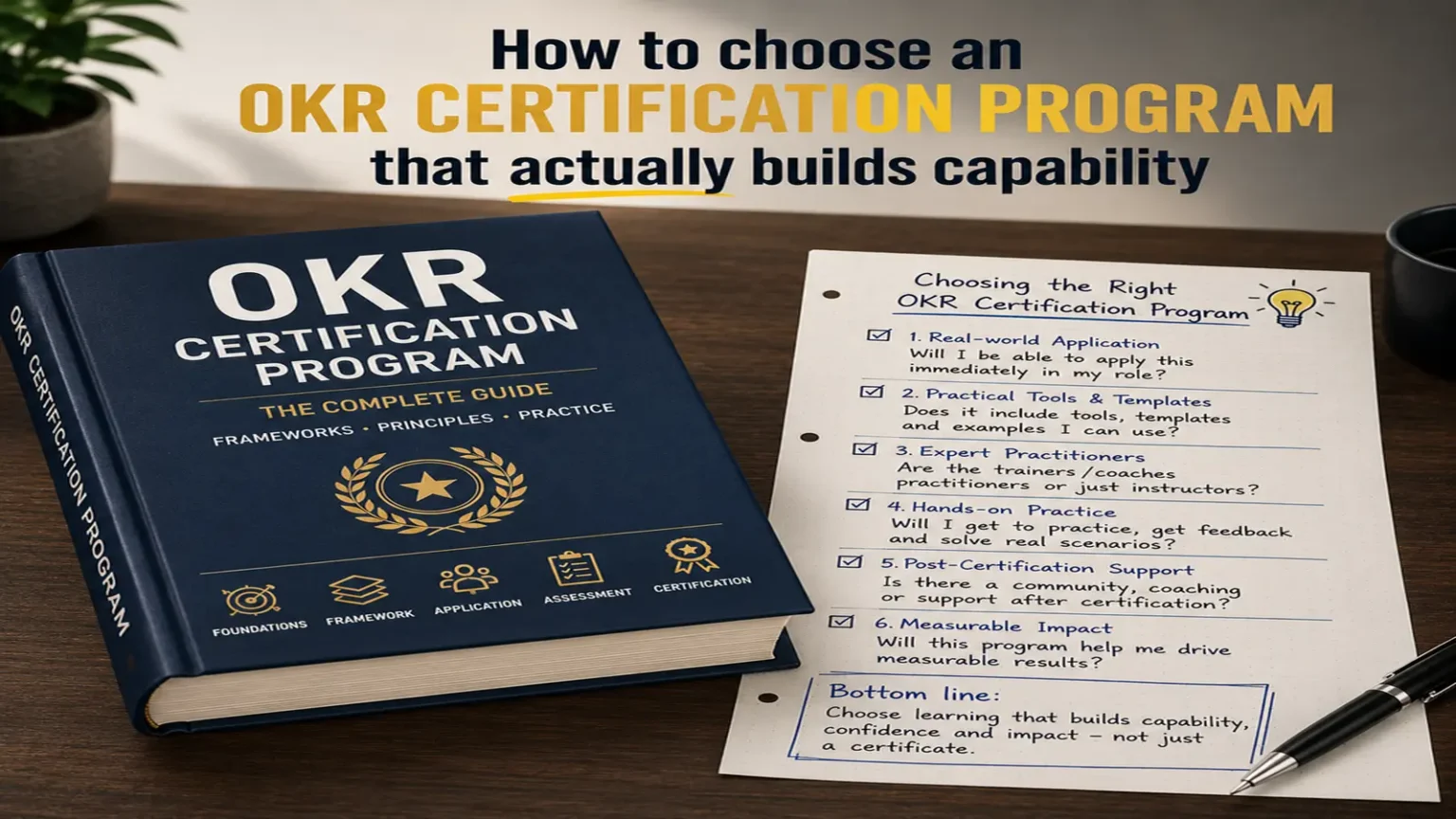
OKR Certification Programs: Most OKR certification programs test theoretical recall rather than applied execution. When evaluating training alongside the Best OKR software, organizations must prioritize practical coaching and verified behavioral change over multiple-choice exam badges.
Most OKR certifications teach a body of knowledge. That is the entire problem.
If you are evaluating OKR certification programs right now, you have probably noticed they mostly look the same: modules, an exam, a digital badge. That format works well for subjects that are stable and procedural, where the correct answer does not change depending on the room you are standing in. OKRs are not that kind of subject. They are a coached behaviour change, and a body of knowledge cannot teach a behaviour change. It can only describe one.
I say this as someone who has spent the last decade coaching OKR implementations across 50+ organisations, not as a criticism of any specific competitor. It is a structural problem with how most of the industry chose to build its certifications, and it is worth understanding before you spend a training budget on one. The providers are not wrong to have built exam-based programs. The format was simply borrowed from the wrong neighbourhood.
Why OKR Certifications Ended Up Shaped Like Exams
The certification format most providers use today was borrowed wholesale from adjacent fields where it genuinely works. Project management has PMP. Process improvement has Six Sigma. Both are built on procedures that do not change based on who is applying them: a defined process, executed correctly, produces a predictable result. An exam is a perfectly reasonable way to certify that someone has memorised a stable procedure.
OKRs are not procedural in that sense. The same Key Result can be a genuine outcome-driven goal in one team and a disguised task list in another, depending entirely on whether the person writing it actually understood the distinction, in their own context, under their own constraints. That distinction cannot be certified by a multiple-choice exam, because the exam tests whether someone can recognise the right answer when it is presented to them. It does not test whether they can produce it, unprompted, inside their own messy, specific organisation.
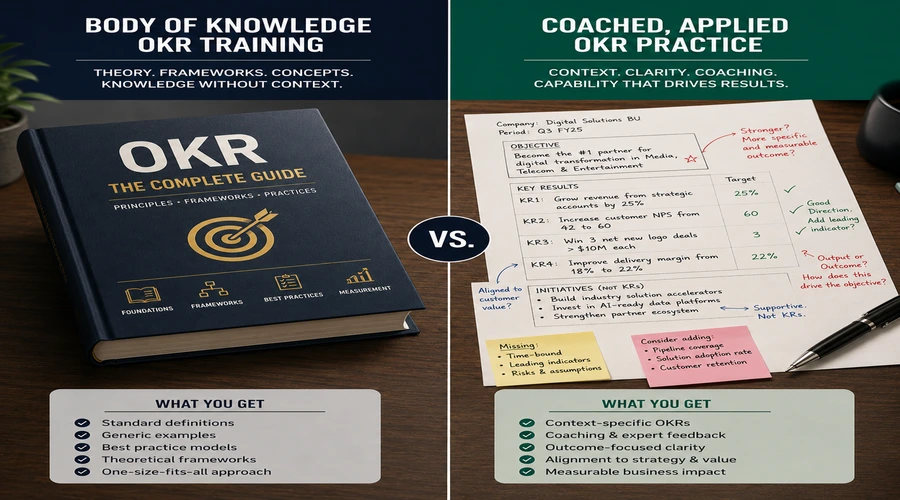
What a Body of Knowledge Certification Actually Tests
Look closely at what most OKR certification exams actually measure, and it usually comes down to three things: whether you can define an Objective, whether you can define a Key Result, and whether you can identify a poorly written example when shown one. All three are useful as a starting vocabulary. None of them tell you whether the person can walk into their own quarterly planning meeting and write something genuinely different from what they would have written before the course.
That gap, between recognising a good example and producing one under real conditions, is where most OKR programs actually fail. Not because the leaders involved never learned the definitions. Because nobody checked whether they could apply the definitions to their own business, with their own politics, their own resourcing constraints, and their own habit of measuring activity instead of outcome.
One of the clearest examples I have coached through was a listed Indian fintech company preparing for an aggressive five-year revenue target. I ran the session as one of the largest formats I coach in: 35-plus leaders in a full auditorium. Almost every leader in that room could define an Objective and a Key Result correctly if you had quizzed them. Almost none of them had written their own goals correctly. Nearly every leader was blaming the IT team for missed targets, treating IT as responsible for driving business outcomes rather than enabling them.
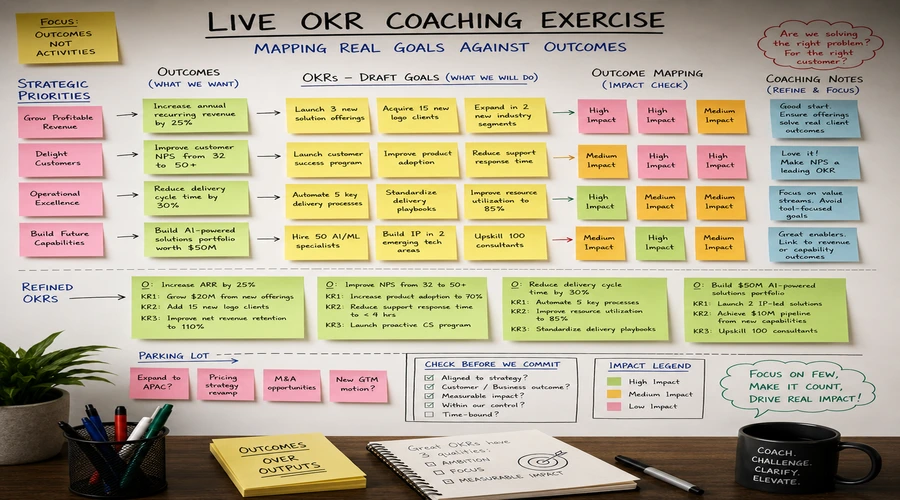
The turning point was not another definition. Every leader wrote their current goals, impact, and challenges on sticky notes across the wall. The MD walked the room, note by note, and shared what he found: roughly 80% of the goals in that room, written by leaders who knew the textbook definitions, were not designed in the right direction. Two to three quarters later, the IT blame culture had disappeared entirely, and field sales had worked out how to drive three times the results with the right investment and marketing support. None of that came from better definitions. It came from someone coaching the application, in the room, against their real goals.
| This is not a body of knowledge. It is the operating manual for what we have already proven works. |
The Belief Most Certifications Get Backwards
Why Modern AI Automation Outperforms Static Spreadsheets
Traditional OKR training programs often assume teams will track goals using static spreadsheets or legacy project management tools. However, modern implementation requires leveraging the Best OKR software equipped with predictive AI forecasting and real-time alignment mapping.
When certified leaders transition from theory to practice, having automated check-in rhythms and intelligent progress tracking ensures that strategic objectives do not stall out between quarters. Spreadsheets cannot coach teams through ambiguity; modern platforms provide the necessary guardrails.
Underneath the exam-format problem sits a deeper one: most OKR certifications treat OKRs as a set of rules to be memorised correctly, when the entire discipline is closer to a thinking process to be practised repeatedly. A rule has one correct application, checkable against a key. A thinking process has to be applied fresh, every cycle, against whatever the business is actually facing that quarter.
This is why two leaders can sit through the exact same certification, pass the exact same exam, and produce completely different quality OKRs six months later. One of them was coached through applying the thinking process to their own real ambiguity, more than once, with feedback each time. The other memorised the rule well enough to pass a test and was never asked to apply it under pressure before being certified.
A body of knowledge certification cannot distinguish between these two people at the point of certification, because it only ever tested recall. That is the structural gap, not a quality problem with any individual provider’s content. The format itself was never built to measure the thing that actually matters.
What to Actually Look For in an OKR Certification
If you are comparing programs right now, four questions will tell you more than any syllabus page.
Does it require real submitted work, or only an exam? A program that certifies you after a multiple-choice test alone is certifying that you can recognise a good OKR, not that you can write one for your own team under real constraints. Look for programs that require an actual OKR writing submission, assessed against your own context.
Is it delivered live, or entirely pre-recorded? Pre-recorded content has a place, particularly as an accessible entry point. But the capability that actually changes outcomes, translating a framework through your own team’s real constraints, requires a live coach who can respond to your specific situation, not a video that plays the same way for everyone.
Does it teach a framework you can trace to real implementations? Ask where the curriculum came from. A body of knowledge assembled from OKR literature is not the same as a curriculum built from what has actually worked, and failed, inside real organisations at scale.
Does the certification differentiate between writing OKRs and coaching others through them? These are different skills. A program that certifies both at the same level is usually under-serving one of them.
What happens if someone fails the practical component? This question tells you more than almost any other. If a program has no meaningful way for a submission to fail, an exam score with a pass mark set low enough that nearly everyone clears it, or a coaching design that is not actually reviewed against a rubric, the certification is not really assessing capability. It is issuing a certificate of attendance with extra steps.
What It Costs to Certify the Wrong Thing
The cost of a body-of-knowledge certification is not the training budget spent on it. It is what happens afterward, when an organisation reasonably assumes a room full of newly certified leaders can now run an OKR program, and discovers three quarters later that the program looks exactly the same as it did before anyone got certified.
That gap shows up most clearly in the metric most organisations never measure: what percentage of certified leaders can independently write a genuine outcome-driven goal, without a template, without a coach standing next to them. Worxmate calls this the Execution Maturity Rate, and it typically sits well below what a stack of completed certificates would suggest. A certificate proves someone sat through a program and passed an assessment. It does not prove the organisation’s actual capability moved.
My Take
I would not tell someone to avoid every exam-based certification on principle. A well-built Foundation-level program, even a self-paced one, has real value as a shared starting vocabulary, particularly for a large cohort who need to be speaking the same language before deeper work begins. Worxmate’s own OKR Foundation Program is intentionally lighter touch for exactly this reason.
What I would push back on is treating that entry-level credential as equivalent to a certification that is supposed to prove you can coach or lead an OKR program. If the certification you are evaluating for that purpose does not require you to produce real, assessed work against your own context, ask what exactly it is certifying. Usually, the honest answer is that you can pass an exam about OKRs. Not that you can run one. The badge will look identical on a resume either way. What it actually represents will not.
Where to Go From Here
If you want a certification built around demonstrated capability rather than exam recall, OKR Certified Practitioner and OKR Certified Coach both require real submitted work: an actual OKR writing submission at the Practitioner tier, and a full coaching program design at the Coach tier. Neither certifies attendance. Both certify output.
If your program is already past the certification stage and needs the underlying failure pattern addressed directly, the Coaching Cliff is very often the reason a well-trained leadership team still has not moved the business. Worth reading before you assume the fix is more training.
And if you are not yet sure where your own organisation’s gap actually sits, Worxmate’s free Organization Performance Audit will tell you directly, with no product pitch attached.
A credential is only as good as what it required you to prove. Ask that question before the next one goes on a resume.
Further Reading
The Coaching Cliff: Why OKR Coaching Cliff: Why OKR Coaching Fails After the Workshop Ends – what happens after certification, when coaching has to reach below the C-suite.
OKR Certification – DEEP Framework – the full three-tier program referenced throughout this piece.
2026 OKR Execution Maturity Framework – the benchmark data behind the Execution Maturity Rate figures cited here.
Organization Performance Audit – a free, no-pitch diagnostic of where your organisation’s execution gap actually sits. This directly accelerates measurable key results across the entire organization. Regular check-ins maintain momentum and keep strategic priorities front of mind. Tracking a real-time confidence score helps identify at-risk targets before quarter-end. Surfacing operational blockers early ensures leadership can clear obstacles quickly. Seamless cascading ensures department milestones stay synchronized with company strategy. Strong goal alignment eliminates siloed efforts and connects daily work to strategic outcomes.
OKRs Explained – for readers who want the framework fundamentals before evaluating certifications against them.
Measurable Goals – on what actually distinguishes a measurable outcome from a completed task.
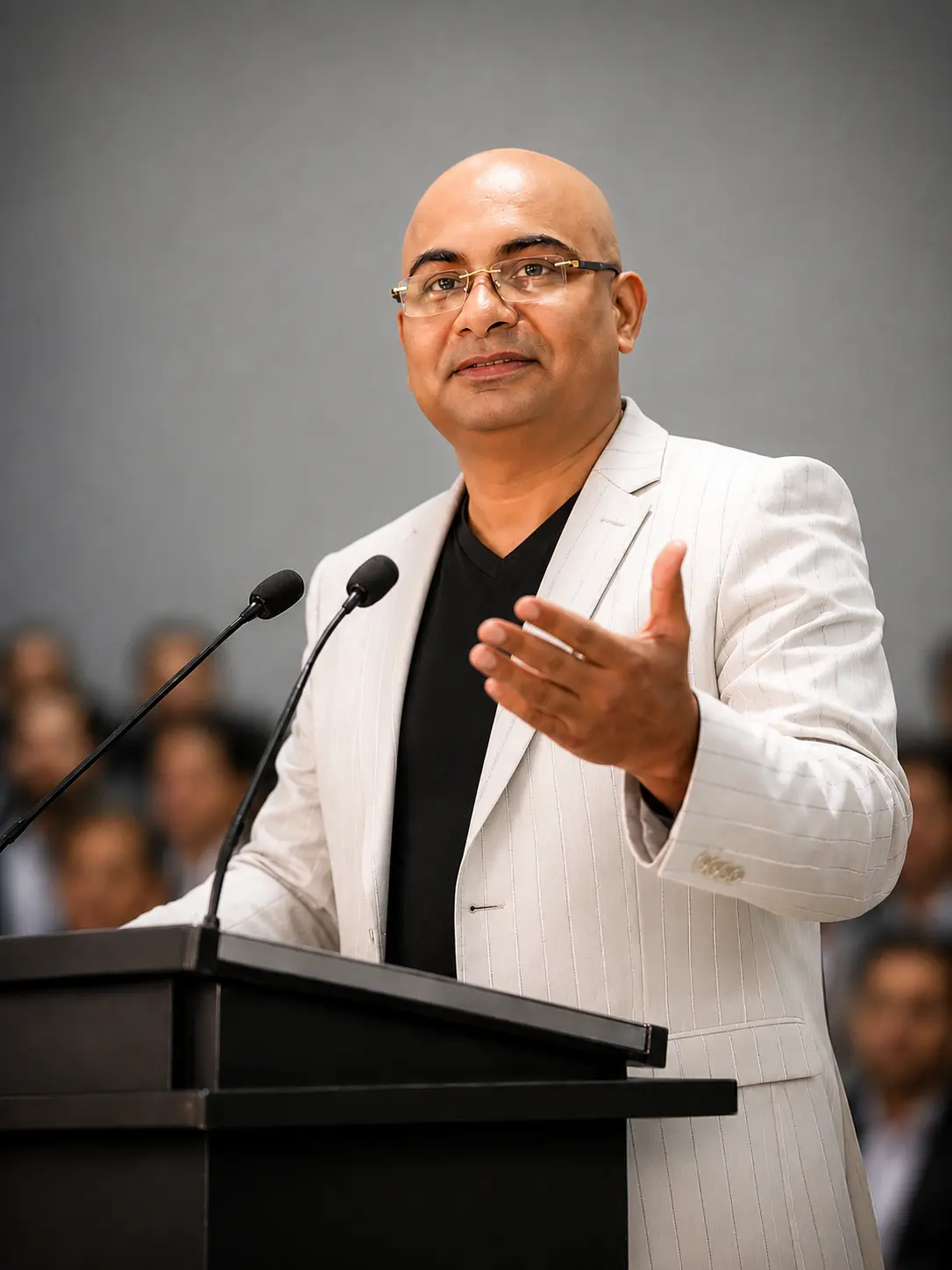
Written by
An OKR Coach with 20+ years of implementation experience, Madhusudan has guided over 50 organisations through successful OKR transformations, training more than 500 leaders. Learn more about Worxmate.