 WORXMATE
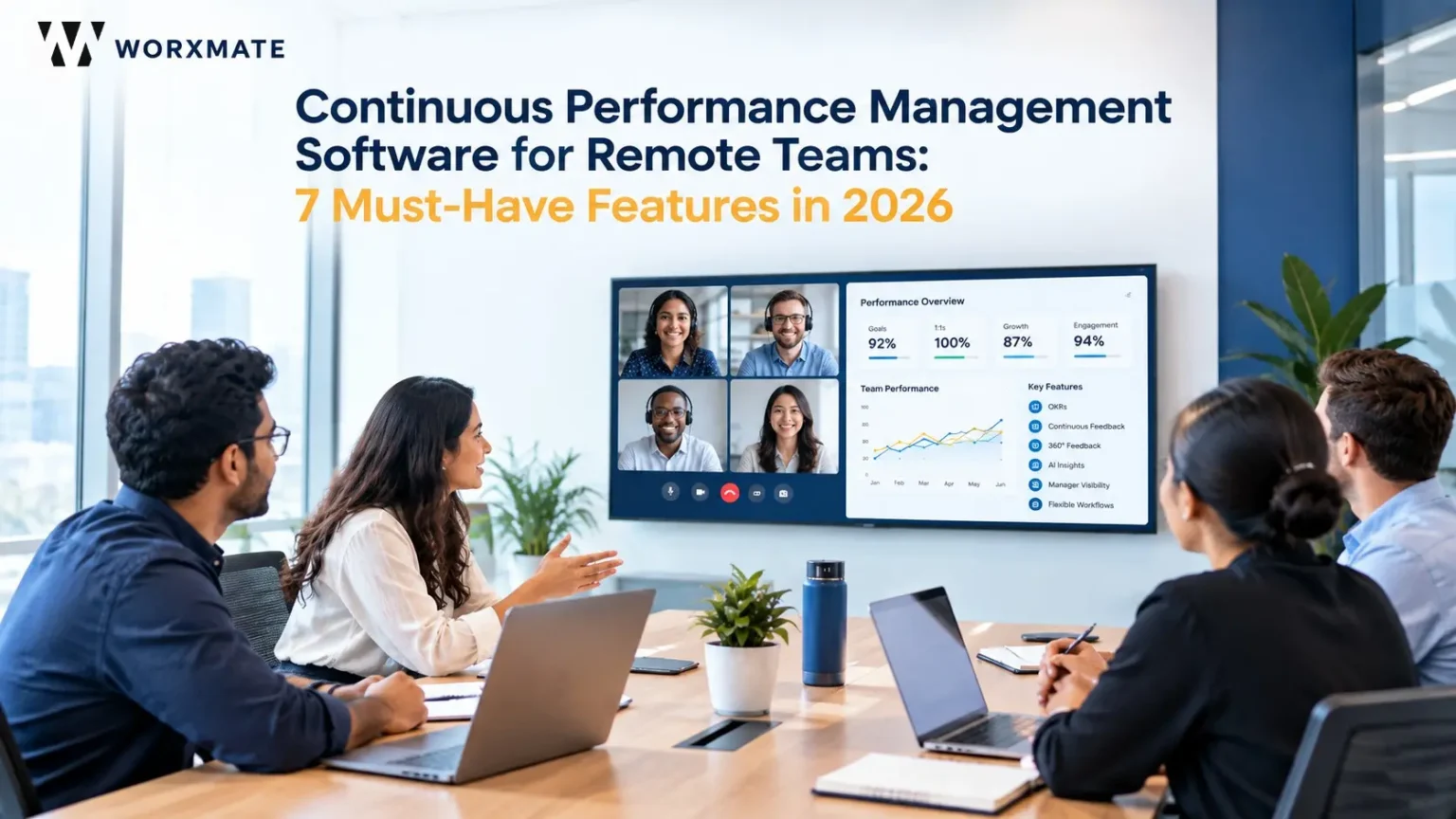
Continuous performance management software for remote teams needs to do four things a co-located team’s tools never had to: run async-first, surface real-time feedback without a scheduled meeting, generate AI-driven risk signals for people a manager can’t observe directly, and run goals and performance conversations on one engine instead of two stitched-together tools. Most platforms marketed at remote teams only deliver one or two of these. Worxmate runs all four through its DEEP AI™ framework, where Orbit AI generates the people-side risk signals that a distributed manager would otherwise have to notice unprompted. If you’re evaluating vendors right now, the seven features below are the checklist to run every option against before a demo call, not after.
What a Remote Team Needs From This Software That an Office Team Never Did
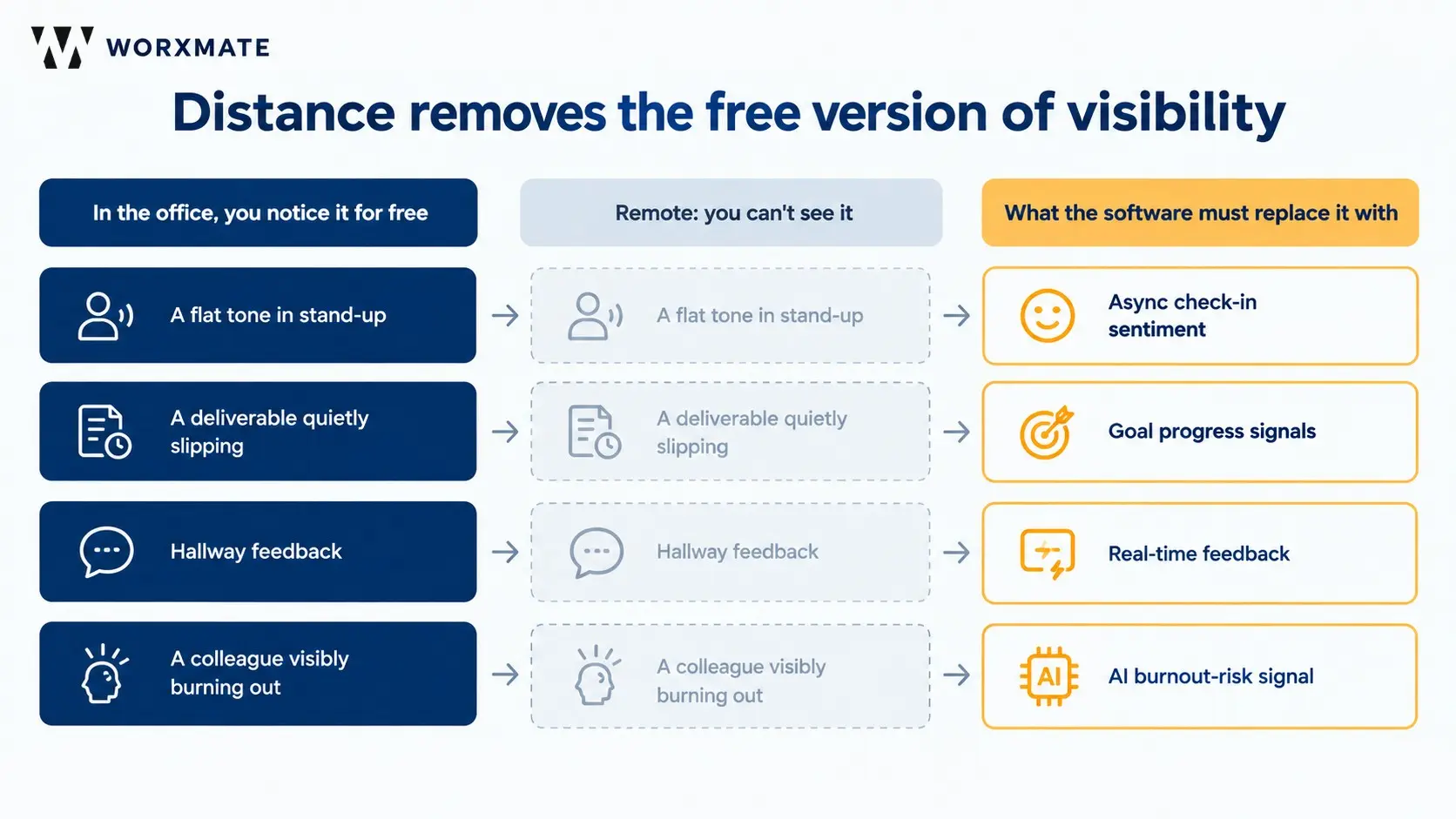
An office manager gets performance signal for free: a flat tone in a stand-up, a deliverable that’s quietly slipping, a sideways glance across the room. Take the office away and none of that survives the transition unless the software is built to replace it. Continuous performance management software for remote teams is that replacement layer, and the vendors that treat it as a generic OKR platform with a remote-friendly label attached are the ones that fail teams the fastest.
I’ve evaluated this category against real distributed rollouts, including a 70,000-person IT services organisation running teams across three continents, and the pattern holds every time: the software that wins isn’t the one with the longest feature list. It’s the one built around the specific mechanics of distance, async timing, invisible burnout, feedback that can’t wait for a scheduled call, rather than a synchronous tool with a “remote” tag bolted on.
That’s the lens for everything below. Each of the seven features is a pass/fail test, not a nice-to-have.
Most vendor comparisons in this category get the order of operations backwards. Buyers start with a demo, get impressed by a clean dashboard, and only stress-test the async and AI-signal capabilities after they’re already emotionally committed to a vendor. Run this checklist before the first demo, not after, and you’ll cut your shortlist faster and avoid the sunk-cost bias that keeps buyers evaluating a platform that failed feature one on question one of a sales call.
See these features running on a real distributed team’s data.
Book a demo and we’ll map Worxmate’s async check-ins and Orbit AI signals against your actual time-zone spread.
The 7 Features That Separate a Real Fit From a Repackaged Status Tool
1. Async-First Check-Ins
If a platform’s default check-in assumes everyone is online at the same time, it will quietly fail your most distributed hires first. Continuous performance management tools for remote teams need to treat zero-overlap time zones as the normal case, not the edge case. This is the single fastest way to disqualify a vendor: ask directly what a check-in looks like for two people with no overlapping working hours, and watch how confidently they answer.
A surprising number of platforms marketed as “remote-ready” still default to a live check-in flow with an async option buried three menus deep. That ordering matters. If async is the exception rather than the default, adoption will skew toward whichever team members happen to share working hours with their manager, and the rest quietly fall out of the visibility loop the software was bought to create in the first place.
2. Real-Time Feedback, Not Review-Cycle Feedback
Real-time performance tracking for remote teams means feedback capture that doesn’t wait for a scheduled 1:1 or a quarterly cycle. Worxmate’s real-time feedback layer captures input the moment it’s relevant, which matters more for remote teams than co-located ones, because there’s no hallway conversation to catch what the system misses in between.
3. AI-Driven Risk Signals, Not Status Dashboards
This is where best continuous performance management software for remote teams claims tend to fall apart under scrutiny. A dashboard tells you what was already reported. A signal tells you what’s likely to become a problem before anyone reports it. Orbit AI, Worxmate’s People Intelligence model, is built specifically to surface engagement decline, burnout risk, and attrition triggers for people a manager can no longer observe directly, exactly the gap a remote team creates.
Ask any vendor to name their signals specifically during a demo. “We show you engagement trends” is a dashboard claim. “We flag a specific employee as at elevated attrition risk based on declining check-in sentiment and slipping goal velocity” is a signal claim. The difference between those two answers is usually the difference between a platform that catches a problem in week three and one that catches it at the annual review.
4. One Engine for Goals and Performance
Continuous performance management platform for remote teams evaluations should immediately rule out any setup that requires a separate OKR tool stitched to a separate check-in tool. Someone ends up manually connecting what a person is working on to how they’re actually doing, and for a distributed team, that manual reconciliation almost never happens consistently. Worxmate’s DEEP AI™ framework runs both on the same data model: Define for goal quality, Execute for the continuous check-in and risk-detection layer.
5. 360 Feedback That Works Across Time Zones
360 feedback software that depends on live sessions will systematically under-collect input from your most distributed contributors, the exact people whose feedback is hardest to gather any other way. Confirm collection works fully async before assuming a “360 feedback” feature checkbox means what you think it means.
6. Manager Visibility That Doesn’t Depend on the Manager Asking
If a platform requires a manager to proactively dig for the signal, it hasn’t solved the visibility problem, it’s relocated it onto an already-stretched manager. Axis AI surfaces which goals are genuinely at risk across a distributed team before a status update would reveal it, and Nexus AI connects that signal structurally so a pattern in one distributed team doesn’t stay isolated from what leadership needs to see.
7. Hybrid-Team Flexibility
Continuous performance management software for hybrid teams needs to apply the same
six features consistently across in-office and remote days, not just to the fully remote portion of a workforce. A platform that only turns on async logic for “remote” employee profiles will recreate the exact visibility gap for whichever days someone isn’t in the building.
Not sure which of these seven your current setup is missing?
An Organization Performance Audit maps exactly where your distributed team’s visibility gaps sit before you switch platforms.
Feature Depth vs. Remote Team Fit
| Feature | Weak for Remote Teams | Strong for Remote Teams |
|---|---|---|
| Check-in cadence | Synchronous only | Async-first, flexible cadence |
| Feedback timing | Scheduled review cycles only | Continuous, real-time capture |
| Risk detection | Manual manager judgement | AI-driven signals (e.g., Orbit AI) |
| Goal-to-performance link | Two separate tools | Single engine, shared data model |
| 360 feedback collection | Live-session dependent | Async-compatible collection |
| Manager visibility | Requires manual digging | Surfaced automatically |
| Hybrid consistency | Remote-only logic | Applied evenly across in-office and remote |
Unlock Goal Clarity & Accelerate Employee Growth
Looking to drive goal clarity and employee growth? Discover how Worxmate’s AI-powered Performance Management Software can help.
What This Looks Like for Different Team Sizes and Regions
Buying criteria shift depending on how your distribution actually looks. Here’s how to prioritise:
| Team Profile | Priority Feature | Common Mistake |
|---|---|---|
| Remote teams India — multi-state, overlapping working hours within one country | Async-first design, even for “same country” teams | Assuming domestic teams don’t need async logic |
| Remote teams USA — 4–6 domestic time zones plus contractors | Real-time feedback and AI risk signals over dashboards | Buying a tool built for a single time zone and scaling it later |
| Remote teams UK — split between UK staff and offshore delivery centers | Manager visibility that covers offshore teams evenly | Visibility concentrating only on the UK-based half of the team |
| Distributed engineering teams | 360 feedback that works across sprints and time zones | Live-session-only peer feedback tools |
| Asynchronous teams with no working-hour overlap | Every one of the 7 features, non-negotiably | Treating async as a nice-to-have instead of a filter |
Our best OKR software for remote teams in US guide covers the market-specific vendor landscape in more depth if you’re evaluating that region specifically, and OKR software for hybrid teams and hybrid team OKRs cover the goal-cascade side of a mixed in-office and remote setup.
Worxmate vs. the Alternatives for Remote Teams
Here’s the direct comparison for anyone shortlisting right now:
| Criterion | Worxmate | 15Five | Lattice | Betterworks |
|---|---|---|---|---|
| Async-first check-ins | Yes, built into Execute | Partial, check-in focused | Limited, review-centric | Partial, enterprise-configured |
| AI-driven risk signals | Yes (Orbit AI) | Limited | Limited | Limited |
| Goals + performance on one engine | Yes (DEEP AI™) | Check-ins primary, OKRs secondary | OKRs as a feature, HR-owned | OKRs primary, feedback secondary |
| Pricing transparency | Published, self-serve | Published, self-serve | Quote-based | Quote-based |
| Best fit | Distributed teams needing goals + risk detection in one system | Teams wanting lightweight, frequent check-ins | HR teams already invested in the Lattice ecosystem | Large enterprise, long procurement cycles |
For the full feature-by-feature breakdown, see alternatives to 15Five, alternatives to Lattice, and alternatives to Betterworks. If pricing is the deciding factor at this stage, our dedicated guide on continuous performance management software pricing breaks down what drives cost across all four.
The proof point: in the IT services rollout mentioned earlier, distributed leaders went from having no cross-market visibility into what was blocking progress to being able to identify root causes and separate impact-driving initiatives from effort-consuming ones within two to three quarters of running goals and check-ins through one system, not two.
Notice what didn’t change in that outcome: headcount, org structure, or the fact that the team was still spread across three continents. What changed was the system generating visibility. That’s the pattern worth testing for in any vendor demo, not whether the interface looks polished, but whether the underlying architecture would have produced that same result for a team this distributed.
Ready to see the seven features running side by side?
Start a free trial and test async check-ins, real-time feedback, and Orbit AI signals with your own distributed team.
How to Evaluate and Buy: The 5-Question Vendor Checklist
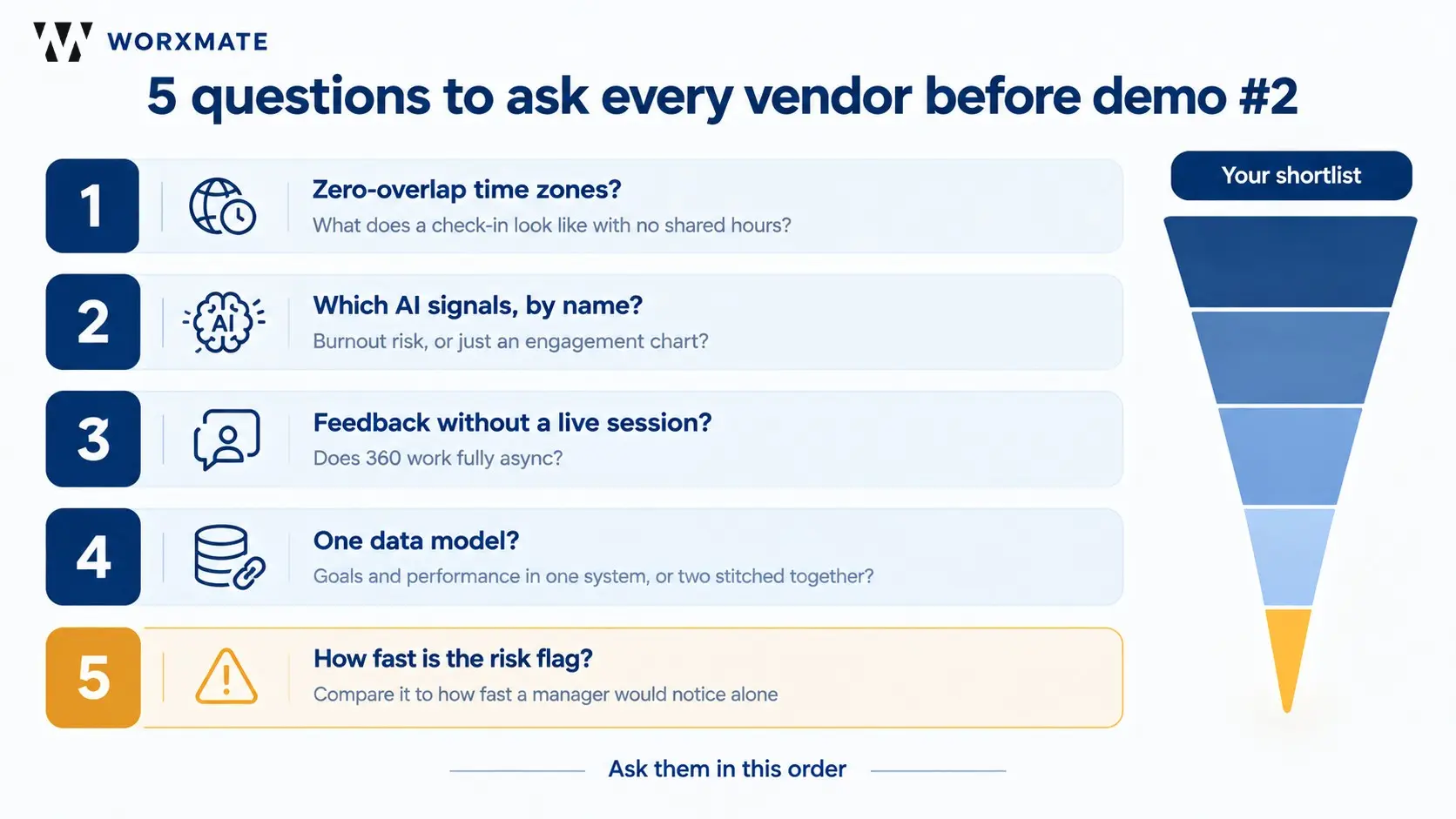
Run every vendor on your shortlist through these five questions before a second demo call:
- How does the platform handle zero-overlap time zones? If every feature assumes some shared working hours, it will fail your most distributed hires first.
- What are the AI risk signals actually named, and how are they generated? Vague “insights” dashboards are not the same as named, specific signals like burnout risk or engagement decline.
- Does feedback collection work without a live session? This determines whether your quietest, most distributed contributors get heard at all.
- Do goals and performance share one data model, or are they two products bolted together? Two tools stitched together will always leak signal at the seams.
- How quickly would a manager see a risk flag versus how quickly they’d notice it unprompted? This single number tells you whether a platform solves the visibility problem or just repackages the status quo.
Our performance tracking tools for remote teams guide covers the broader vendor landscape if you’re earlier in this evaluation, and managing remote team performance without micromanagement is the right resource if manager workload, not vendor features, is the sticking point in your organisation.
Run these five questions in the order listed. Most vendors can talk convincingly about goals and dashboards, so questions one through three should happen before you ever get to a features walkthrough. If a sales team resists answering question one directly, that’s information in itself: it usually means async wasn’t a design decision, it was a feature added after the fact.
The Bottom Line on Continuous Performance Management Software for Remote Teams
Distance doesn’t reduce how much visibility a manager needs. It removes the free version of it. Continuous performance management software for remote teams has to rebuild that visibility deliberately, through async-first check-ins, real-time feedback, AI-driven signals, and a single engine running both goals and performance, not a synchronous tool with a remote label attached.
The Platform Path: If you’re ready to see how these seven features work together for a distributed team, explore Worxmate’s performance management software, check current pricing, or book a demo mapped against your team’s specific time-zone spread.
The Consulting Path: If the deeper issue is whether your distributed leadership team has the coaching and structure to act on the signal once it surfaces, our OKR consulting work addresses that directly. The software is the infrastructure. The coaching is the capability. You need both, and in the right order.


Written by
An OKR Coach with 20+ years of implementation experience, Madhusudan has guided over 50 organisations through successful OKR transformations, training more than 500 leaders. Learn more about Worxmate.