WORXMATE

Employee Development Planning is a strategic framework that aligns individual career growth with organizational goals to drive performance. By integrating continuous skill assessments, goal alignment, and automated execution tracking through the OKR platform, enterprises boost employee retention, eliminate skill gaps, and increase profitability by up to 21%.
Are your top performers thinking about leaving? The numbers tell a sobering story. According to Gartner research, only 46% of employees feel genuinely supported in their career development.
Even more concerning, while 55% of employees expect a promotion within two years, only 40% actually achieve it. This disconnect between expectations and reality is costing businesses their best talent.
The solution isn’t complicated, but it requires commitment. An employee development plan transforms vague career aspirations into concrete action steps that benefit everyone involved.
When Harvard Business Review surveyed employees, they found that 94% would stay with their current employer if the company invested in their development. That’s not just impressive—it’s a game-changer for retention.
What is an Employee Development Plan?
An employee development plan is a personalized strategy that maps out how an employee will acquire new skills, strengthen existing competencies, and progress toward their career goals.
Think of it as a GPS for professional growth—it shows where you are, where you want to go, and the best route to get there.
These plans typically include specific development objectives aligned with both individual aspirations and organizational needs, actionable steps to achieve those goals, timelines and milestones for tracking progress, and required resources such as training programs, mentorship, or certifications.
Development planning goes beyond simple training programs. While training teaches specific skills, employee development planning takes a holistic approach to career advancement.
It considers long-term career trajectories, personal values, and how individual growth supports broader business objectives.
The most effective development plans are collaborative documents created through honest conversations between employees and managers. They’re living roadmaps that evolve as circumstances change, not static documents filed away and forgotten after one annual review.
Why Employee Development Plans Matter for Your Business
The business case for employee development plan initiatives is overwhelming. Research from Harvard Business School reveals that companies offering targeted training experience a 17% increase in productivity and a 21% boost in profitability. But the impact extends far beyond the bottom line.
Retention becomes predictable when development is prioritized. Deloitte research shows that 70% of employees would consider leaving their current company for one that invests more seriously in employee growth and development. That’s not a small preference—it’s a deal-breaker for most of today’s workforce.
Skill gaps close faster with structured planning. Gartner found that employees currently apply only 54% of the newly learned skills they acquire. Why?
Because learning without context or application plan fails to stick. A proper development plan for employee success ensures new skills get immediately integrated into daily work, dramatically improving retention and application rates.
Engagement skyrockets when employees see a future. Gallup’s extensive workplace research demonstrates that employees who know and use their strengths are nearly six times more engaged than those who don’t. Development plans help identify these strengths and create opportunities to leverage them consistently.
Your employer brand strengthens organically. When current employees experience genuine career growth, word spreads. Today’s job candidates actively seek companies with clear development pathways, making your investment in current employees your best recruitment strategy.
Unlock Goal Clarity & Accelerate Employee Growth
Looking to drive goal clarity and employee growth? Discover how Worxmate’s AI-powered Performance Management Software can help.
Key Components of an Effective Employee Development Plan
Every successful employee development plan contains these essential elements that transform good intentions into measurable results.
Clear, measurable goals form the foundation. Using the SMART framework—Specific, Measurable, Achievable, Relevant, and Time-bound—ensures objectives remain focused and trackable. Instead of “improve leadership skills,” an effective goal reads “complete advanced leadership certification and lead two cross-functional projects by Q3.”
Honest skills assessment identifies starting points. This includes performance reviews, 360-degree feedback, self-assessments, and frank conversations about strengths and gaps. Understanding current capabilities prevents wasted effort on irrelevant training and highlights the most impactful growth areas.
Diverse learning activities accelerate development. The most effective plans blend on-the-job training (70%), mentoring and coaching (20%), and formal education (10%). This approach recognizes that most meaningful learning happens through real-world application, not classroom lectures.
Resource allocation and support demonstrate commitment. Employees need time, budget, and management support to pursue development activities. Plans that don’t account for resources become aspirational documents that breed cynicism rather than growth.
Regular check-ins and adjustments keep plans relevant. Quarterly reviews allow for course corrections, celebrate progress, and adapt to changing circumstances. Development isn’t linear, and rigid plans fail when reality shifts.
Alignment with organizational goals ensures mutual benefit. The best development plans advance both individual careers and company objectives simultaneously. This alignment transforms professional development from an employee perk into a strategic business advantage.
How to Create an Employee Development Plan: A Step-by-Step Guide
Building an effective employee development plan follows a systematic process that balances individual aspirations with organizational needs.
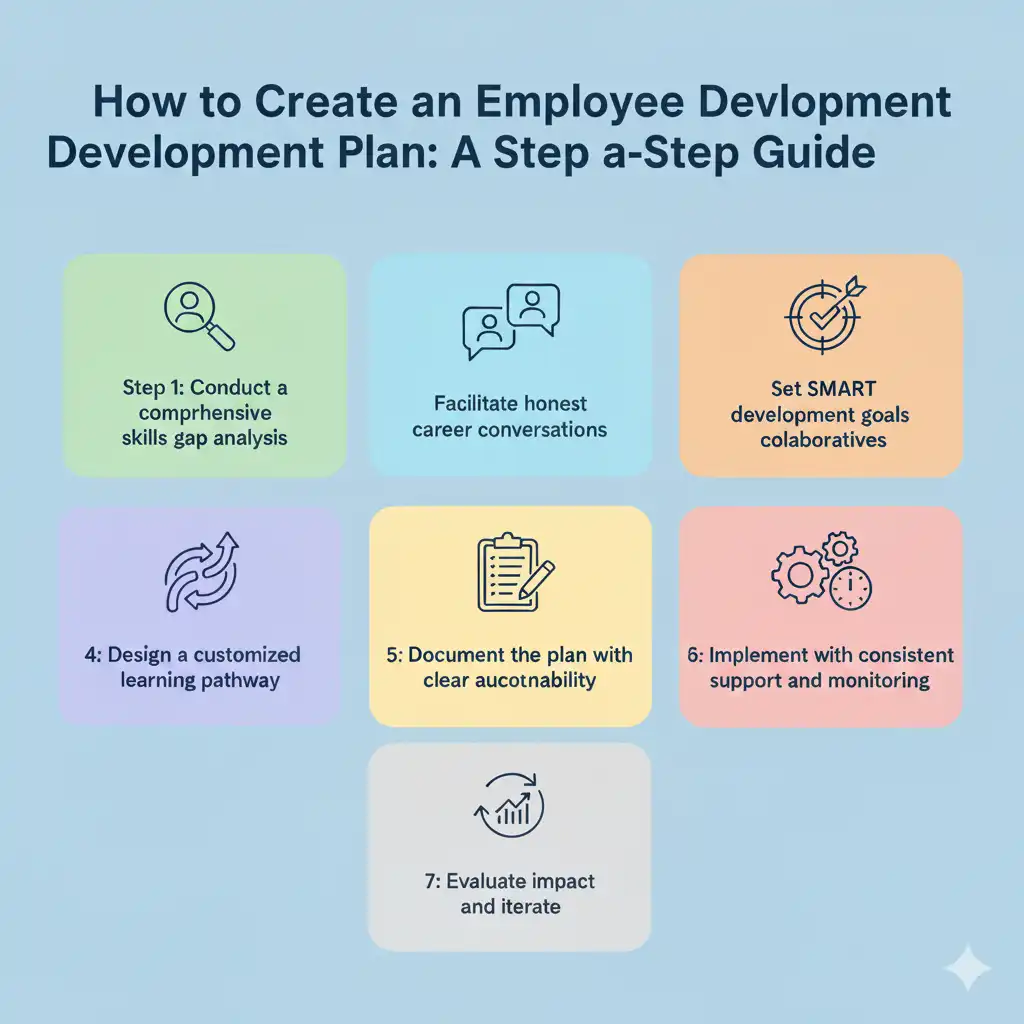
Step 1: Conduct a comprehensive skills gap analysis.
Start by evaluating current competencies against role requirements and future business needs. Use performance data, manager feedback, and employee self-assessments to identify specific areas where development would create the most value. Ask employees what skills they believe are important for their growth and the company’s success.
Step 2: Facilitate honest career conversations.
Schedule dedicated time for managers and employees to discuss career aspirations, interests, and growth areas. Where do they see themselves in five years? What roles or departments excite them? What skills do they want to develop? These conversations reveal motivations that data alone can’t capture.
Step 3: Set SMART development goals collaboratively.
Transform aspirations into concrete objectives with specific metrics and timelines. Ensure goals align with both the employee’s career trajectory and organizational priorities. For example: “Develop data analysis capabilities by completing Python certification and leading quarterly reporting process within six months.”
Step 4: Design a customized learning pathway.
Identify the most effective combination of learning methods for each goal. Consider formal training courses, mentorship pairings, job shadowing opportunities, stretch assignments, cross-functional projects, and self-directed learning resources. Match learning styles to activities for maximum effectiveness.
Step 5: Document the plan with clear accountability.
Create a written development plan that specifies each goal, required actions, assigned resources, deadlines and milestones, success metrics, and review schedule. This document becomes the reference point for ongoing conversations and progress tracking.
Step 6: Implement with consistent support and monitoring.
Schedule regular check-ins (monthly or quarterly) to review progress, provide feedback, remove obstacles, and adjust the plan as needed. Development requires sustained attention, not annual reviews followed by neglect.
Step 7: Evaluate impact and iterate.
Measure outcomes against initial goals, assess skill application in real work contexts, gather feedback from employees and managers, and use insights to refine future planning processes. Continuous improvement applies to development systems, not just employee skills.
Employee Development Plan Examples That Drive Results
Different career stages and objectives require tailored approaches to employee development planning.
Skill-Based Development Plan Example:
A customer service representative wants to handle complex issues more effectively. The plan includes attending a three-day advanced customer service workshop, weekly role-play sessions practicing difficult scenarios, biweekly coaching with a senior representative, and performance tracking through improved customer satisfaction scores measured quarterly.
Leadership Development Plan Example:
A high-performing individual contributor prepares for team management. The development plan incorporates leadership competency training covering communication and strategic thinking, participation in cross-functional projects to understand broader operations, shadowing current managers during team meetings and performance reviews, and formal mentoring from a senior leader with monthly sessions.
Time-Based Development Plan Example:
A junior developer aims to master Python within six months. The roadmap includes completing an online Python course in months 1-3, working on internal projects using Python under senior developer guidance in months 3-5, obtaining industry-recognized Python certification by month 6, and monthly progress reviews with the team lead throughout.
Career Advancement Plan Example:
An operations analyst prepares for a leadership track over two quarters. The plan involves leading a cross-department workflow redesign project, completing leadership communication training, delivering presentations to executives, and informally mentoring junior team members.
Each example demonstrates clear objectives, specific actions, defined timelines, and measurable outcomes—the hallmarks of effective employee development plan examples.
Case Study: How Randstad Reduced Turnover by 49% Through Development Planning
When global HR consulting firm Randstad implemented a comprehensive mentoring program as part of their employee development strategy, they created a natural experiment to measure impact.
The Challenge:
Like many organizations, Randstad faced concerning turnover rates among employees who felt their career development wasn’t adequately supported. Exit interviews revealed that lack of growth opportunities ranked among the top reasons talented professionals left the company.
The Solution:
Randstad launched a large-scale global mentoring program that paired employees with experienced mentors who could guide their professional development. The program included structured development plans, regular check-ins, and clear pathways for skill building and career progression.
The Results:
The impact was dramatic and measurable. Employees who participated in the mentoring and development program were 49% less likely to leave Randstad compared to those who didn’t participate. This wasn’t just about retention—engaged employees also reported higher satisfaction, increased confidence in their abilities, and clearer understanding of their career trajectories within the organization.
-
Key Takeaway:
Randstad’s experience demonstrates that structured development initiatives deliver quantifiable business outcomes. When employees see genuine investment in their growth through mentorship and clear development plans, they reciprocate with loyalty and enhanced performance. The 49% reduction in turnover translated directly to reduced recruitment costs, retained institutional knowledge, and stronger team continuity.
Unlock Goal Clarity & Accelerate Employee Growth
Looking to drive goal clarity and employee growth? Discover how Worxmate’s AI-powered Performance Management Software can help.
Benefits of Employee Development Plans for Organizations and Employees
The advantages of systematic employee development planning extend throughout the entire organization.
For Employees:
Development plans provide clear career pathways that reduce uncertainty about professional futures, increased confidence and competence through targeted skill building, enhanced job satisfaction from feeling valued and invested in, greater autonomy as capabilities expand, and improved marketability whether they stay or eventually move on.
For Organizations:
Companies implementing effective development programs experience significantly improved retention rates—critical in today’s competitive talent market, reduced hiring and onboarding costs by developing internal talent, increased productivity as employees become more skilled and efficient, enhanced innovation from empowered, confident team members, and stronger employer branding that attracts top candidates.
The Competitive Advantage:
McKinsey research found that lack of skills and inefficiency costs a median-size S&P 500 company approximately $163 million annually. Development plans that systematically close skill gaps don’t just improve employee satisfaction—they directly impact profitability and competitive positioning.
The Engagement Connection:
Gallup’s analysis proves that engagement, performance, and development are interdependent. Organizations can’t achieve high performance without engaged employees, and employees can’t stay engaged without development opportunities. Development plans integrate all three elements into a cohesive growth system.
Predictive Flight-Risk Detection & AI Execution Frameworks
Traditional employee development planning relies heavily on reactive annual reviews, leading to uncaptured flight risks and stale strategic alignment. Modern enterprise growth requires continuous execution tracking integrated directly with real-time operational metrics.
By leveraging an organizational strategy framework, managers can bridge the gap between high-level business objectives and daily workforce growth activities.
1. Predictive Flight-Risk Detection
AI algorithms analyze engagement signals, confidence scores, and check-in cadences to detect early warning indicators of employee attrition before turnover occurs. Early intervention allows leaders to restructure development pathways and retain critical high-performing talent.
2. Automated Skill Gap Remediation
Rather than waiting for quarterly reviews, continuous feedback loops automatically map emergent skill deficits against current quarterly key results, triggering personalized learning pathways directly inside the employee workflow.
3. Real-Time Confidence Scoring
Weekly check-ins incorporate dynamic confidence scoring across all strategic priorities, giving executives instant visibility into execution blockers and individual development trajectories.
Worxmate vs. Legacy Development Platforms (e.g., Profit.co)
Selecting the right development management platform determines whether your strategic plans drive actual growth or sit forgotten in spreadsheets. The comparative matrix below highlights how Worxmate’s unified architecture outperforms legacy point-solution platforms.
| Evaluation Dimension | Worxmate Unified Platform | Legacy Competitors (e.g., Profit.co) |
|---|---|---|
| Primary Philosophy | Unified OKRs, Continuous Performance & Talent Alignment | Disjointed OKR tool with third-party add-ons |
| AI Capabilities | Native DEEP AI Framework & Predictive Flight-Risk Detection | Basic AI text generation without predictive intelligence |
| Performance Management | Unbiased AI Third Eye continuous reviews & 1:1 check-ins | Manual periodic reviews requiring heavy admin overhead |
| Goal-to-Task Link | Native bi-directional alignment with operational tasks | Requires complex third-party API connectors |
| Ease of Use | Zero-friction workflow with 30+ native integrations | Steep learning curve across disjointed modules |
| Pricing Model | Transparent, predictable enterprise tiers | Hidden modular upsells for essential performance features |
| Best For | High-growth enterprise teams seeking rapid strategy execution | Organizations needing basic goal lists without continuous feedback |
The Point: Point-solution tools fragment workforce data, making true career development impossible to measure. A unified platform ensures every development activity directly accelerates company strategic goals.
How Worxmate Transforms Employee Development Planning
Creating and managing employee development plans becomes exponentially easier with the right technology. Worxmate’s Performance Management Software is specifically designed to streamline the entire development planning process.
AI-powered goal creation helps managers and employees define clear, relevant development objectives aligned with organizational priorities. The proprietary DEEP AI framework (Define, Execute, Evaluate, Plan) guides teams through the complete development cycle, from initial goal setting through progress evaluation and dynamic future planning.
Unbiased performance reviews ensure development decisions are based on objective operational metrics, not unconscious bias. The AI ‘Third Eye’ analysis removes subjective bias from review cycles, creating equitable growth opportunities across all teams. Tracking a real-time confidence score helps identify at-risk targets before quarter-end. Seamless cascading ensures department milestones stay synchronized with company strategy.
Integrated tracking and reporting provides real-time visibility into strategy execution and individual progress across the enterprise. Dynamic dashboards highlight key results, uncover blockers during 1:1 check-ins, and ensure continuous performance management stays closely aligned with organizational strategic priorities.
Seamless workflow integration ensures development planning fits naturally into daily operations without administrative overhead. With native connections to over 30 business tools, Worxmate ensures strategic alignment translates into consistent daily execution.
Ready to transform how your organization approaches employee development? Book a demo with Worxmate today and discover how AI-powered performance management can help you build future-ready teams, improve retention, and drive measurable business results through systematic employee development.
An effective employee development plan is no longer optional in today’s competitive talent landscape—it’s essential for attracting, retaining, and maximizing the potential of your workforce.
The research is clear: organizations that invest systematically in employee growth see measurable improvements in retention, productivity, engagement, and profitability.
The most successful development plans balance individual career aspirations with organizational needs, combine diverse learning methods, and maintain consistent accountability through regular reviews and adjustments.
Whether you’re implementing development planning for the first time or refining existing processes, the frameworks and examples in this guide provide a roadmap for creating programs that deliver real results for employees and businesses alike.


Written by
An OKR Coach with 20+ years of implementation experience, Madhusudan has guided over 50 organisations through successful OKR transformations, training more than 500 leaders. Learn more about Worxmate.