 WORXMATE
Summary
Individual goals are personalized objectives that employees set to enhance their skills, advance their careers, and contribute meaningfully to their organization’s success. Unlike company-wide targets, these goals focus on personal development, skill building, and career advancement while aligning with broader business objectives. Research consistently shows that employees with clear individual goals are 90% more likely to achieve superior performance, demonstrate higher engagement levels, and experience greater job satisfaction. By establishing specific, measurable, and time-bound objectives, professionals can create a roadmap for continuous improvement, unlock their potential, and drive both personal and organizational success in today’s competitive workplace environment.
The Power of Individual Goals in Modern Workplaces
In today’s rapidly evolving professional landscape, the most successful employees aren’t just those who complete their daily tasks—they’re the ones who continuously set and achieve meaningful individual goals that propel their careers forward while driving organizational success.
Whether you’re aiming to enhance your technical skills, improve leadership capabilities, or advance to a higher position, individual goals serve as the compass that guides your professional journey.
The importance of individual goals in the workplace cannot be overstated. According to McKinsey’s 2024 performance management survey, 72% of employees cite goal setting as a strong motivator for performance, while organizations with effective goal-setting practices are 3.5 times more likely to enhance employee engagement and retention.
These statistics reveal a fundamental truth: when employees have clarity about what they want to achieve personally within the context of their work, both individual and organizational performance soar.
The SMART criteria for setting effective individual goals: specific, measurable, attainable, relevant, and time-based
What Are Individual Goals and Why They Matter
Individual goals are personalized objectives that employees establish to guide their professional development, skill enhancement, and career advancement within their workplace context.
Unlike organizational goals that apply broadly across teams or departments, individual goals for work focus specifically on what each person wants to accomplish to grow professionally and contribute more effectively to their organization.
These goals typically encompass several key areas including career advancement, skill development, leadership growth, and personal effectiveness improvements.
They serve as a bridge between an employee’s personal aspirations and their organization’s strategic objectives, creating alignment that benefits both parties.
Achieve Your Goals Faster
See how Worxmate can help your team set clear goals and achieve faster results. Book your free demo today and experience the power of AI-driven OKRs in action.
The Strategic Importance of Individual Goals
The research-backed benefits of individual goal setting are compelling. Gallup’s extensive workplace studies demonstrate that employees with clear, aligned goals show 23% higher profitability, 18% higher productivity, and 12% better customer metrics compared to their counterparts without defined objectives.
Furthermore, organizations that effectively link individual goals to business priorities report that 91% of their employees feel more connected to company success.
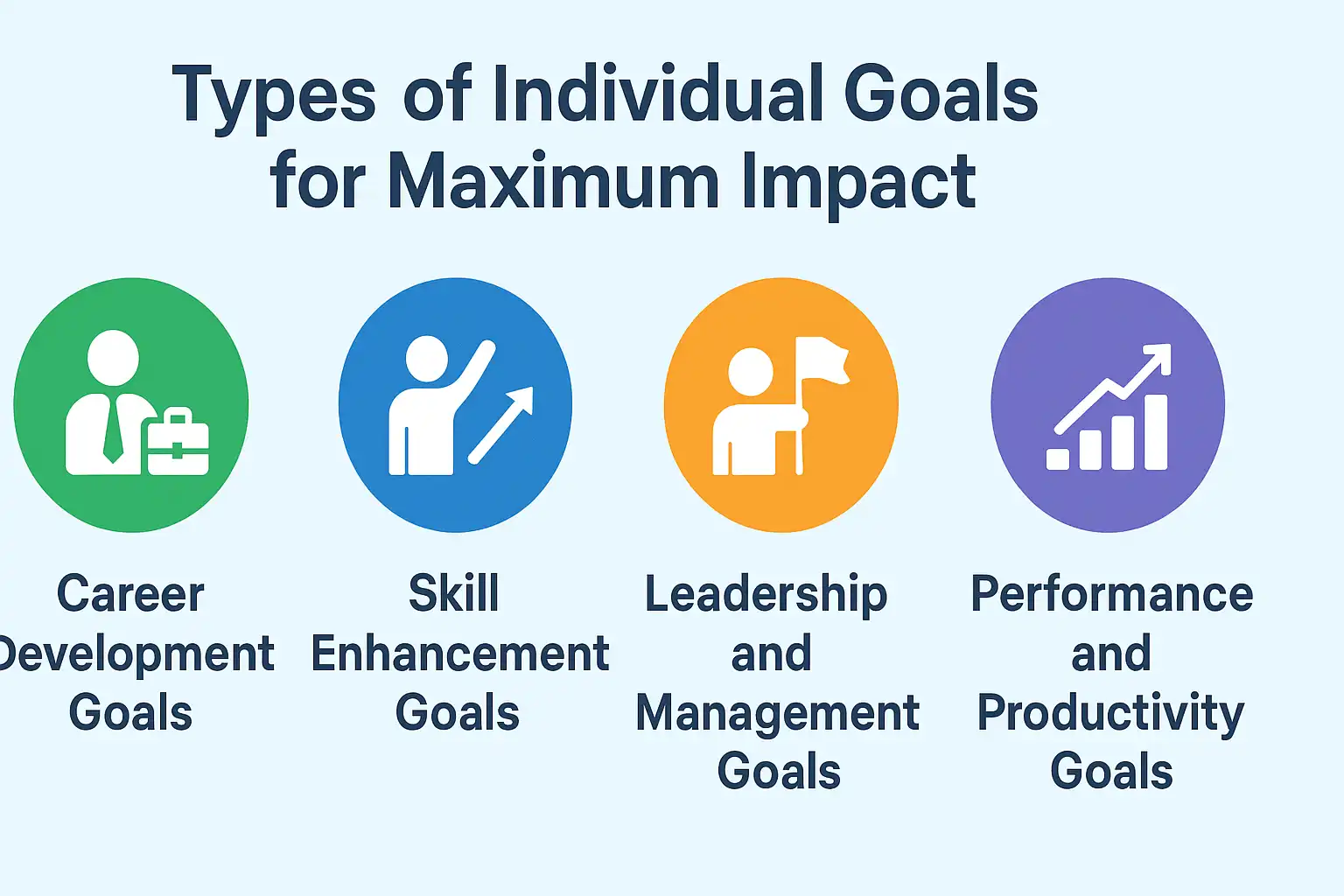
Types of Individual Goals for Maximum Impact
Understanding the different categories of individual goals examples for work helps professionals create a comprehensive development strategy. Here are the primary types that drive workplace success:
-
Career Development Goals
These objectives focus on advancing your position, expanding responsibilities, and building the foundation for future roles. Examples include:
-
- Promotion-Focused Goals: “Achieve promotion to senior analyst within 18 months by exceeding quarterly targets by 15% and completing advanced analytics certification”
- Role Expansion Goals: “Take on leadership responsibilities for cross-functional projects to gain management experience”
- Industry Expertise Goals: “Become a recognized subject matter expert by publishing three industry articles and speaking at two conferences this year”
-
Skill Enhancement Goals
Professional skills development remains crucial for staying competitive and valuable in your field:
-
- Technical Skills: “Master Python programming for data analysis by completing online coursework and applying skills to three real projects within six months”
- Soft Skills: “Improve public speaking abilities by joining Toastmasters and delivering monthly presentations to the leadership team”
- Digital Literacy: “Become proficient in new CRM software and train five team members on its effective usage”
-
Leadership and Management Goals
Even for individual contributors, developing leadership capabilities creates future opportunities:
-
- Team Leadership: “Lead a cross-functional project team of eight members to successful completion within budget and timeline”
- Mentoring: “Mentor two junior colleagues and help them achieve their quarterly performance objectives”
- Decision-Making: “Develop stronger analytical decision-making skills by shadowing senior managers and taking ownership of departmental recommendations”
Read more: Differences Between Leadership and Management
-
Performance and Productivity Goals
These objectives focus on improving current job effectiveness and efficiency:
-
- Quality Improvement: “Reduce error rates in deliverables by 25% through implementing new quality control processes”
- Efficiency Enhancement: “Streamline workflow processes to increase personal productivity by 20% while maintaining quality standards”
- Customer Impact: “Improve customer satisfaction scores from 85% to 92% through enhanced service delivery techniques”
Case Study: Microsoft’s Individual Goal Transformation Success
Microsoft provides an exceptional example of how strategic individual goal implementation can transform organizational performance and employee satisfaction.
Faced with evolving market demands and the need for greater employee engagement, Microsoft redesigned their performance management system to emphasize individual goal setting aligned with business objectives.
-
The Challenge
Prior to their transformation, Microsoft struggled with traditional annual reviews that left employees feeling disconnected from company strategy. Employee engagement scores were stagnant, and many high-performers felt their individual contributions weren’t adequately recognized or developed.
-
The Implementation Strategy
Microsoft implemented a comprehensive individual goals framework that included:
-
- Personalized Development Planning: Each employee worked with their manager to establish 3-5 individual goals that balanced personal career aspirations with team and organizational needs.
- Quarterly Check-ins: Rather than annual reviews, Microsoft instituted quarterly goal review sessions where employees could adjust objectives based on changing business priorities and personal growth.
- Technology Integration: They leveraged Microsoft Teams to make individual goals visible across the organization, fostering collaboration and peer support.
- Growth Mindset Culture: The company embraced a culture where failure was viewed as learning, encouraging employees to set ambitious individual goals without fear of punishment for falling short.
Read More: 7 Ways to Foster a Growth Mindset Among Employees
-
The Results
The transformation yielded remarkable outcomes:
-
- Employee Engagement: Engagement scores increased by 15% within the first year of implementation
- Productivity Gains: Teams reported 20% improvement in project delivery times due to clearer individual accountability
- Retention Improvement: Turnover decreased by 12% as employees felt more connected to their career development
- Innovation Boost: The number of employee-driven innovation projects increased by 35% as individual goals encouraged creative thinking
-
Key Success Factors
Microsoft’s success stemmed from several critical factors:
Alignment with Business Strategy: Individual goals were directly connected to Microsoft’s strategic priorities, ensuring personal development supported organizational success.
Manager Training: Extensive coaching helped managers become better at facilitating individual goal-setting conversations and providing ongoing support.
Flexibility and Adaptation: The system allowed for goal adjustments throughout the year, recognizing that both business needs and individual circumstances change.
Reward and Recognition : Microsoft connected individual goal achievement to compensation and recognition programs, reinforcing the importance of personal development.
This case study demonstrates that when individual goals are thoughtfully implemented with proper support systems, both employees and organizations thrive. The key lies in creating alignment between personal aspirations and business needs while providing the framework and support necessary for success.
How to Set Effective Individual Goals: The SMART Framework
The SMART framework remains the gold standard for setting individual goals. This approach ensures your objectives are Specific, Measurable, Achievable, Relevant, and Time-bound.
-
Specific Goals
Your individual goals should be clear and well-defined. Instead of “I want to be healthier,” specify “I will exercise for 30 minutes, five days per week.” Specific goals eliminate ambiguity and provide clear direction.
-
Measurable Goals
Include quantifiable elements in your individual goals. This allows you to track progress and know when you’ve achieved success. For example, “Increase monthly sales by 20%” rather than “Improve sales performance”.
-
Achievable Goals
Set challenging yet realistic individual goals. Goals that are too easy won’t motivate you, while impossible goals lead to frustration and abandonment. Research shows that challenging but achievable goals lead to optimal performance.
-
Relevant Goals
Ensure your individual goals align with your values, priorities, and long-term objectives. Goals that don’t connect to what truly matters to you are less likely to sustain motivation over time.
-
Time-bound Goals
Set specific deadlines for your individual goals. Time constraints create urgency and help you prioritize activities. For example, “Complete certification program within six months” provides clear accountability.
Achieve Your Goals Faster
See how Worxmate can help your team set clear goals and achieve faster results. Book your free demo today and experience the power of AI-driven OKRs in action.
Best Practices for Individual Goal Success
1. Regular Review and Adjustment
Successful individual goals require ongoing attention, not annual set-and-forget approaches. McKinsey research reveals that organizations encouraging quarterly goal reviews see 62% higher success rates in goal achievement.
2. Seek Manager Support and Feedback
The most effective individual goals benefit from managerial guidance and support. Gallup studies show that employees who receive weekly feedback from their managers are three times more likely to be engaged at work.
3. Document Progress and Learnings
Maintaining a goal journal or digital tracking system helps identify patterns, celebrate wins, and learn from setbacks. This practice increases goal achievement rates by approximately 20%.
4. Connect Goals to Broader Purpose
Individual goals become more motivating when connected to meaningful outcomes. Research indicates that employees who understand how their goals contribute to organizational success show 33% higher performance levels.
Align Individual Goals with Organizational Success Using Worxmate
While setting individual goals is crucial, the real challenge lies in maintaining alignment with organizational objectives while tracking progress effectively. This is where Worxmate’s OKR software becomes invaluable for modern professionals and organizations.
Worxmate transforms individual goal setting from a traditional annual exercise into a dynamic, ongoing process that drives both personal development and business results.
The platform enables employees to create individual goals that seamlessly integrate with team and company objectives, ensuring everyone moves in the same direction while pursuing personal growth.
Key benefits of using Worxmate for individual goals include:
- Real-time Goal Tracking: Monitor progress on individual goals with visual dashboards that show advancement toward key milestones
- Alignment Visibility: See how your individual goals connect to team and company objectives, creating meaningful context for your work
- Collaboration Features: Share updates, seek feedback, and celebrate achievements with managers and colleagues
- Progress Analytics: Gain insights into goal achievement patterns and identify areas for improvement
Ready to transform your individual goal setting? Worxmate makes it simple to create, track, and achieve meaningful professional objectives that drive both personal success and organizational performance. Book a Demo today to see how our OKR software can revolutionize your approach to individual goal management and unlock your full potential in the workplace.
Conclusion
Individual goals represent one of the most powerful tools for professional development and organizational success in today’s workplace.
The evidence is clear: employees who set specific, measurable, and aligned individual goals consistently outperform their peers, demonstrate higher engagement levels, and contribute more effectively to their organization’s success.
The key to maximizing the impact of individual goals lies in thoughtful implementation—creating objectives that balance personal aspirations with organizational needs, establishing regular review processes, and leveraging technology tools that support ongoing progress tracking and alignment.
Companies like Microsoft, Adobe, and others have demonstrated that when individual goal setting is done strategically, both employees and organizations thrive.
As you begin or refine your individual goal-setting journey, remember that the most effective goals are those that challenge you to grow while contributing meaningfully to your team’s success.
By following the frameworks and best practices outlined in this guide, you’ll be well-positioned to achieve both personal fulfillment and professional advancement in your career.


Written by
An OKR Coach with 20+ years of implementation experience, Madhusudan has guided over 50 organisations through successful OKR transformations, training more than 500 leaders. Learn more about Worxmate.