 WORXMATE
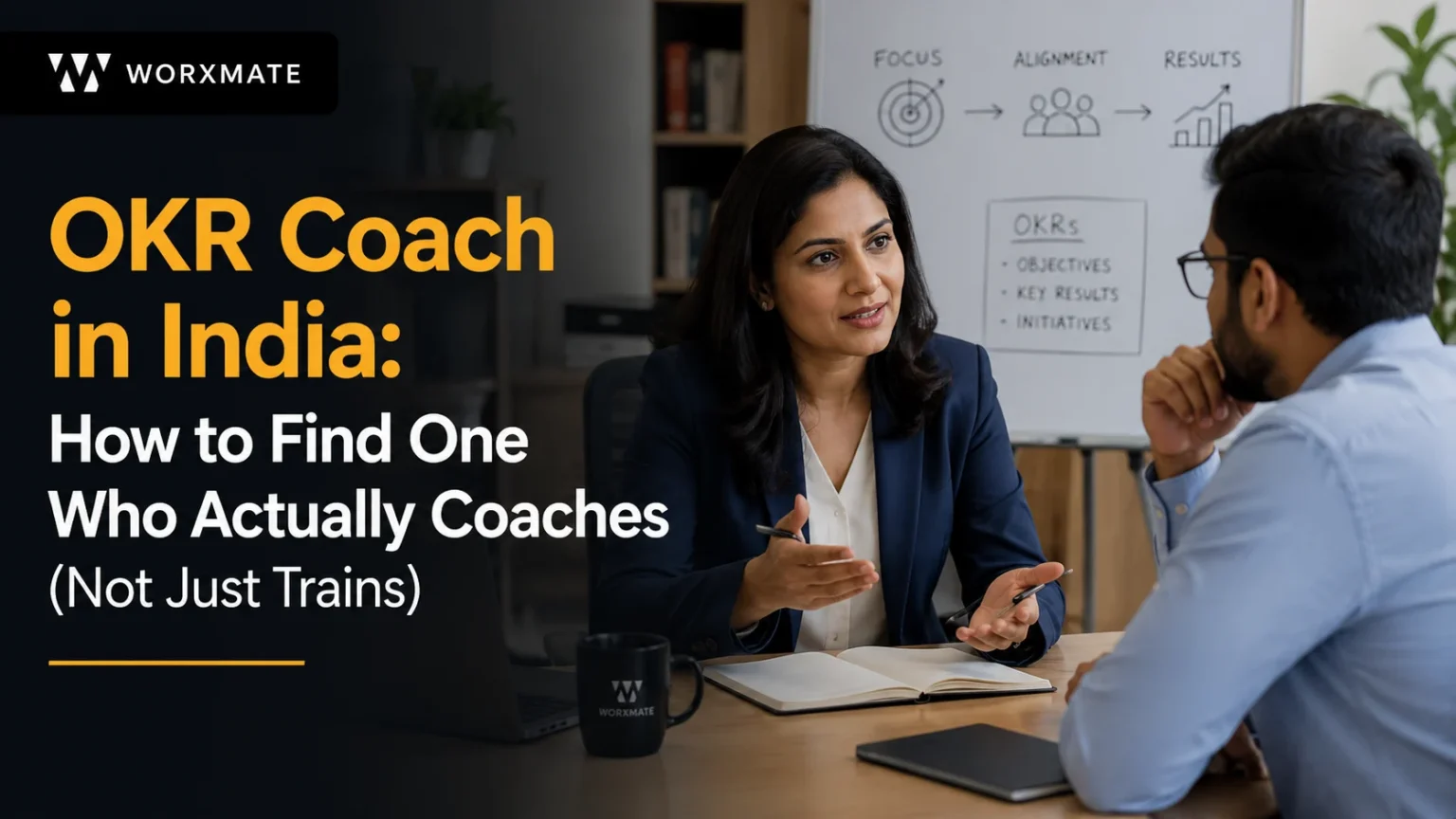
An OKR coach in India works with you across multiple sessions on your own real goals until you can independently write and execute outcome-driven OKRs. A trainer’s job ends the moment a workshop is delivered; a coach’s job ends when you no longer need them in the room. Before you hire an OKR coach in India, check three things: does the engagement continue past the first session, will the coach review OKRs you actually write for your own team, and do they measure capability change over a full quarter rather than a same-day feedback score. Worxmate’s 2026 OKR Benchmark Report puts the Execution Maturity Rate at 5–15% after training alone, versus 30–40% after 12 months of real coaching.
Search “OKR coach in India” and almost everything that matches you is a trainer. A session gets booked, a room fills up, a framework gets explained well, everyone claps, and six weeks later nothing has changed about how anyone actually writes a goal. That is not a coaching failure. It was never coaching. It was training wearing a coaching job title.
The distinction is not semantic, and treating it as interchangeable is the single most common reason organisations in India spend a training budget and get a training outcome, when what they actually needed was a coaching outcome.
This matters more in India specifically than the search phrase alone suggests, because “coach” and “trainer” are used almost interchangeably in how OKR services get marketed here. A LinkedIn profile, a workshop listing, and a corporate training vendor’s homepage will all use the word “coach” for what is, structurally, a single facilitated session. That is not dishonest marketing so much as an industry-wide blur, but the blur costs the buyer real money and real time if it goes unnoticed until after the invoice is paid.
Why the Distinction Isn’t Semantic
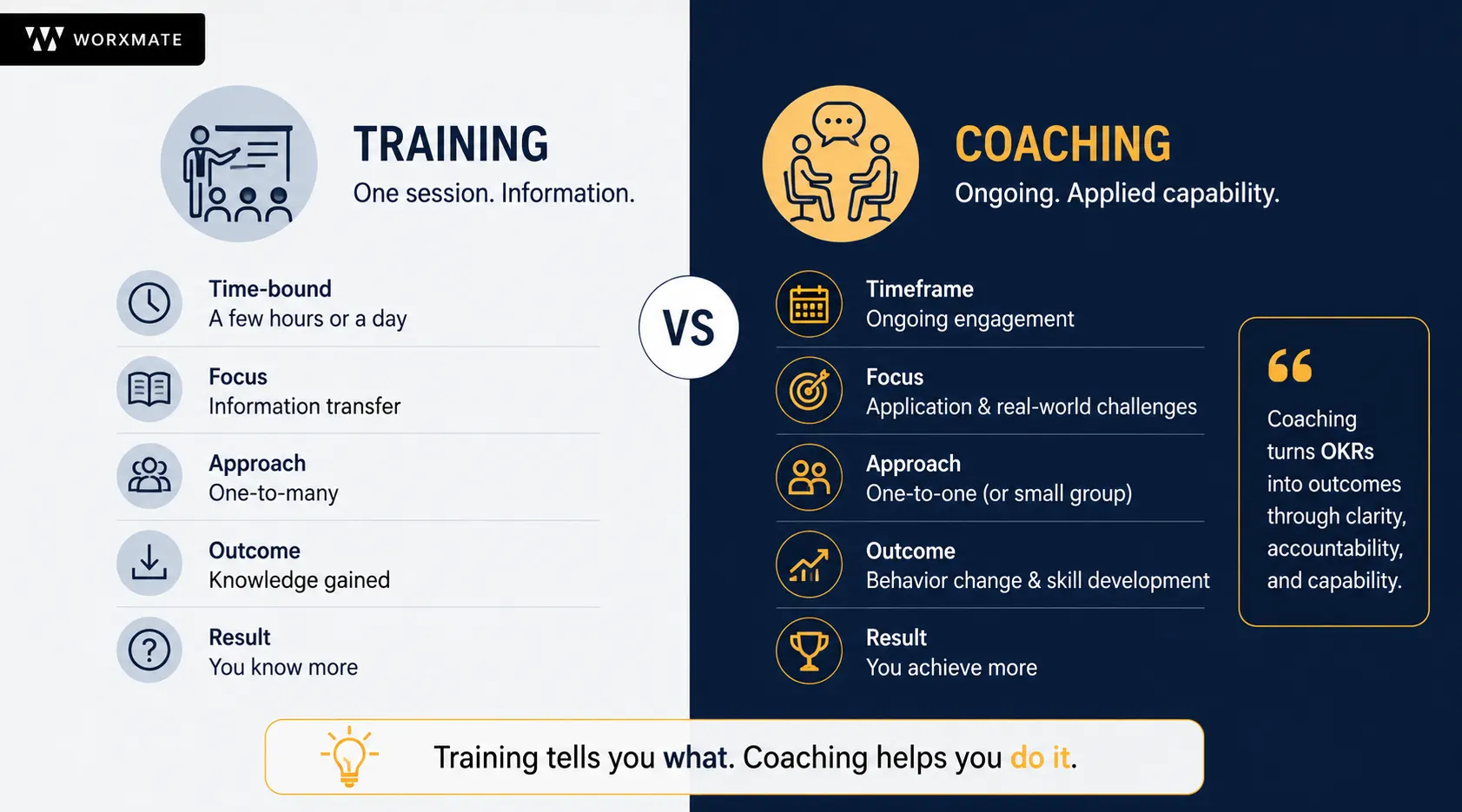
Training is a one-time transfer of information. A trainer’s job is complete the moment the session ends and the content has been delivered clearly. Whether anyone in the room can actually apply it three weeks later, under their own real constraints, was never part of the trainer’s brief.
Coaching is different in kind, not just duration. A coach’s job is not complete until you can independently do the thing, applied to your own real goals, without them in the room. That is why real submitted work matters more than a passing exam score, and it is exactly as true when you are hiring an OKR coach in India directly as when you are evaluating a certification program.
The measurable version of this distinction is what Worxmate calls the Execution Maturity Rate: the percentage of leaders who can independently write a genuine outcome-driven goal, without a template, without someone standing next to them. Training moves attendance numbers. Only coaching moves that number.
This is not a small gap in practice. According to Worxmate’s 2026 OKR Benchmark Report, most organisations sit at 5% to 15% Execution Maturity Rate after a single training session or workshop, essentially unchanged from where they started. Organisations running genuinely ongoing coaching over 12 months typically reach 30% to 40%. That difference did not come from a better slide deck. It came from someone continuing to work with the same people, on their own real goals, past the point where a single session would have ended.
What Actually Changes When You Hire the Right OKR Coach in India
The gap between an OKR coach in India who builds real capability and one who delivers a well-reviewed afternoon is not a matter of opinion it shows up in a number. That number does not move on its own. It moves because someone kept working with the same people, on their own real goals, past the point where a workshop would have wrapped up. The table below shows how the Execution Maturity Rate typically tracks against the type of engagement an organisation actually buys.
| Engagement Type | Typical Execution Maturity Rate | What Actually Happened |
|---|---|---|
| Single workshop or training session | 5–15% | Content delivered once; no return visit to check application |
| OKR coach in India engaged for one quarter | 15–25% | First cycle written with support; habits not yet independent |
| OKR coaching engagement over 12 months | 30–40% | Leaders write and defend outcome-driven OKRs without a template |
None of this means a single quarter of coaching is wasted it means the number tells you honestly where you stand, instead of a satisfaction score telling you how the room felt. If you want to see where your own organisation sits against this benchmark before you sign anything, run the audit rather than guess.
See Where Your Organisation Sits on the Execution Maturity Rate
Before you hire an OKR coach in India, benchmark your leadership team against the 2026 Execution Maturity Framework — five minutes, no pitch.
Achieve Your Goals Faster
See how Worxmate can help your team set clear goals and achieve faster results. Book your free demo today and experience the power of AI-driven OKRs in action.
How to Tell Before You Sign Anything
Does the engagement continue after the first session? A single workshop, however well delivered, is training by definition. Coaching requires a second, third, and fourth touchpoint, ideally spaced across real work cycles, not a single day.
Will they observe you apply it to a real, live goal? Ask directly: will you review an OKR I actually write for my team, or only walk me through examples. The answer tells you immediately which category you are buying.
Do they measure change over time, or only satisfaction on the day? A post-session feedback score measures whether people enjoyed the room. It says nothing about whether capability actually moved. Ask what they track a quarter later.
Is the coaching allowed to reach below the person who hired them? If a coach is engaged by a CEO or HR leader but only ever meets with that one person, the coaching has already hit its ceiling, regardless of how good that one relationship is.
Can they describe what typically goes wrong, not just what usually goes right? Anyone can describe a successful engagement. A coach who has genuinely worked across enough real organisations will have a specific, honest answer for how coaching engagements commonly underperform, usually something about buy-in below the person who hired them, or a client wanting to compress a multi-quarter process into a single afternoon. A coach who insists nothing ever goes wrong is either inexperienced or not being fully straight with you.
OKR Coach vs OKR Trainer in India – Quick Checklist
| What You Ask | Trainer’s Likely Answer | Real OKR Coach’s Likely Answer |
|---|---|---|
| Does this continue after today? | “We can schedule a follow-up if needed.” | “Session two is already on the calendar, tied to your first check-in cycle.” |
| Will you review OKRs I actually write? | “We’ll walk through examples together.” | “Bring your team’s draft — we’ll rewrite it live.” |
| How do you measure success? | “Feedback forms at the end of the day.” | “Execution Maturity Rate tracked at 90 days and again at 12 months.” |
| Who do you work with below the person who hired you? | “Whoever attends the session.” | “Every layer that has to run a check-in conversation, not just the C-suite.” |
| What usually goes wrong? | “Nothing, sessions go well.” | Names a specific, honest failure pattern from past engagements. |
A Real OKR Coaching Engagement Inside an Indian Organisation
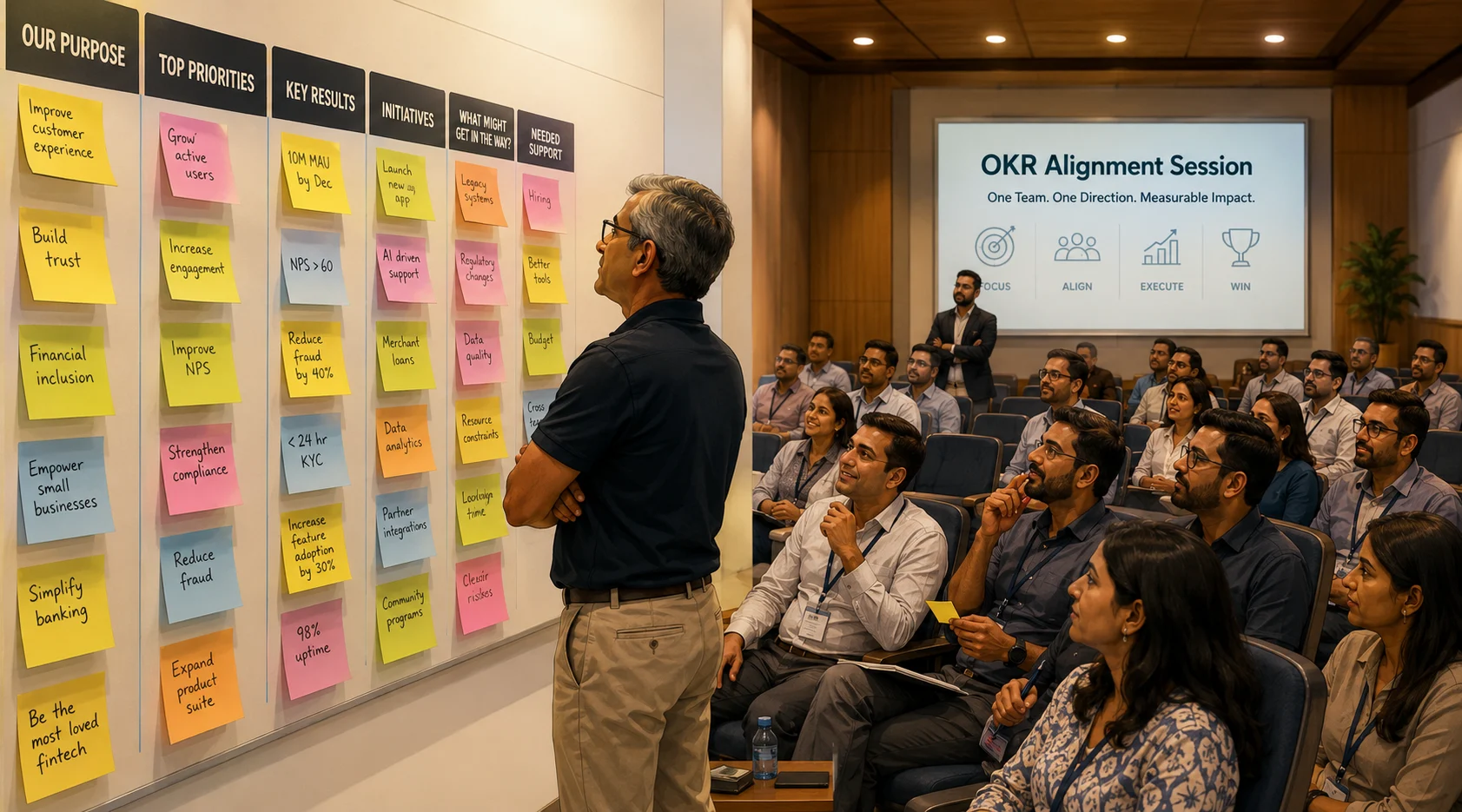
One of the largest coaching formats I have run in India was a three-day, in-person engagement for a listed fintech company targeting ₹5,000+ Cr in revenue within five years, 35+ leaders in a full auditorium, one of the best-equipped rooms I have coached in. The starting state was not encouraging. Almost every leader in that room was blaming the IT team for missed goals, citing a lack of data and analytics, when IT was at best an enabler and never the owner of business outcomes.
The turning point was not a slide. Every leader wrote their current goals, their impact, and their challenges on sticky notes and stuck them on the wall. The Managing Director was asked to walk the wall himself and share what he found, out loud, in front of the room. His reaction moved from surprise roughly 80% of the goals on that wall were pointed in the wrong direction to conviction that this was not a nice-to-have workshop, it was necessary work.
What a textbook would not have told you to do next: ask the next level of leadership to collectively agree on only 3–5 goals that actually mattered, together, in the room. Alignment happened through that conversation, not through a cascade diagram. Leaders started naming which other teams they needed support from without being prompted cross-functional dependency thinking showing up on its own, because the room had earned it rather than been taught it.
Two to three quarters later, the IT blame culture was gone. Field sales had worked out how to drive 3X results with the right investment behind it. New territory entry was pre-planned with the right product positioning instead of improvised after launch. That is what an OKR coach in India engaged for outcomes, not for an event, actually produces.
What This Looks Like Done Properly
“It was a very good experience the workshop offered clear explanations not only on what OKRs are, but also on how to effectively implement them and achieve potential results. The three OKR training sessions provided a clear and practical understanding of how to set and align objectives, made highly effective by an excellent trainer who kept the content engaging, relevant, and easy to apply,” said Julio Fernandes, Service Delivery Manager at Syensqo.
Notice the structure Julio is describing without naming it directly: three sessions, not one, each building on the last, focused on application rather than a single information dump. That sequencing is the actual mechanism separating a coaching engagement from a training session that happens to run for a few hours. It is a small detail in how the quote is worded, but it is exactly the detail worth listening for when someone describes a past engagement to you.
It is also worth noticing what Julio does not describe: a single dazzling presentation that ended and was never referenced again. The value came from continuity, one session’s understanding carrying into the next, rather than from any individual session being exceptional in isolation. That is a difficult thing to fake, and a genuinely useful thing to ask a prospective coach about directly: how does session two build on what happened in session one, specifically for your situation, not in general.
A trainer’s job is complete when the content has been delivered. A coach’s job is not complete until you can do it without them in the room.
My Take
I would not tell someone in India to avoid training altogether. Training has real value at the right moment, particularly as a shared starting vocabulary before deeper coaching begins, and a good trainer is not a lesser hire than a good coach. The two simply solve different problems. A large team that has never heard of OKRs benefits enormously from a well-run training session before anyone attempts one-to-one coaching, since coaching a group with no shared vocabulary tends to spend its early sessions re-explaining basics rather than doing the actual work of application.
What I would push back on is buying training while believing you have bought coaching, because the two get marketed under the same job title constantly, and the gap between them only becomes visible three months later, when the workshop is a distant memory and nothing underneath has actually changed.
A simple test before you sign anything: ask the person you are considering hiring to describe, specifically, what changes between the first session and the last one. A trainer will describe content covered. A coach will describe a specific capability the person or team did not have before and now does. That single question tends to surface the real answer faster than any credentials page will.
The Coaching Cliff: Why Even Real OKR Coaching in India Fails Below the C-Suite
There is a failure mode the OKR coaching industry rarely names, mostly because it implicates the most common engagement model sold. I call it the Coaching Cliff — the point where coaching ends at the C-suite and the organisation is left to cascade the OKR framework on its own. Setting the leadership team’s OKRs is the beginning of an implementation, not the deliverable. Most OKR coaches run the leadership workshop, help the top layer write their OKRs, and leave once the invoice is paid. Within one quarter, the program dies below that layer, because the people actually responsible for carrying it forward middle management, the layer where OKR programs genuinely live or die were never coached on how to run a meaningful check-in conversation or surface a blocker honestly.
There is a related structural mistake worth naming before you sign anyone: who owns the OKR program inside your organisation. When HR owns it, the rest of the leadership team treats OKRs as one more framework used to assess performance, not as a strategy execution operating system. When the CEO’s office owns it, with an OKR coach in India supporting that ownership rather than replacing it, OKRs function as what they were meant to be. The ownership decision determines the outcome before a single OKR gets written.
Find Out Where Your Coaching Cliff Actually Sitsstrategy execution
A free, no-pitch diagnostic that shows exactly which layer of your organisation the current OKR effort stops reaching.
How Worxmate Extends OKR Coaching in India Between Sessions
A coach cannot sit in the room every week, and a good one should not need to. What a coaching engagement needs between sessions is something that keeps the same discipline alive a place where a goal gets defined properly, checked in on honestly, evaluated with real data, and carried into the next cycle instead of quietly forgotten.
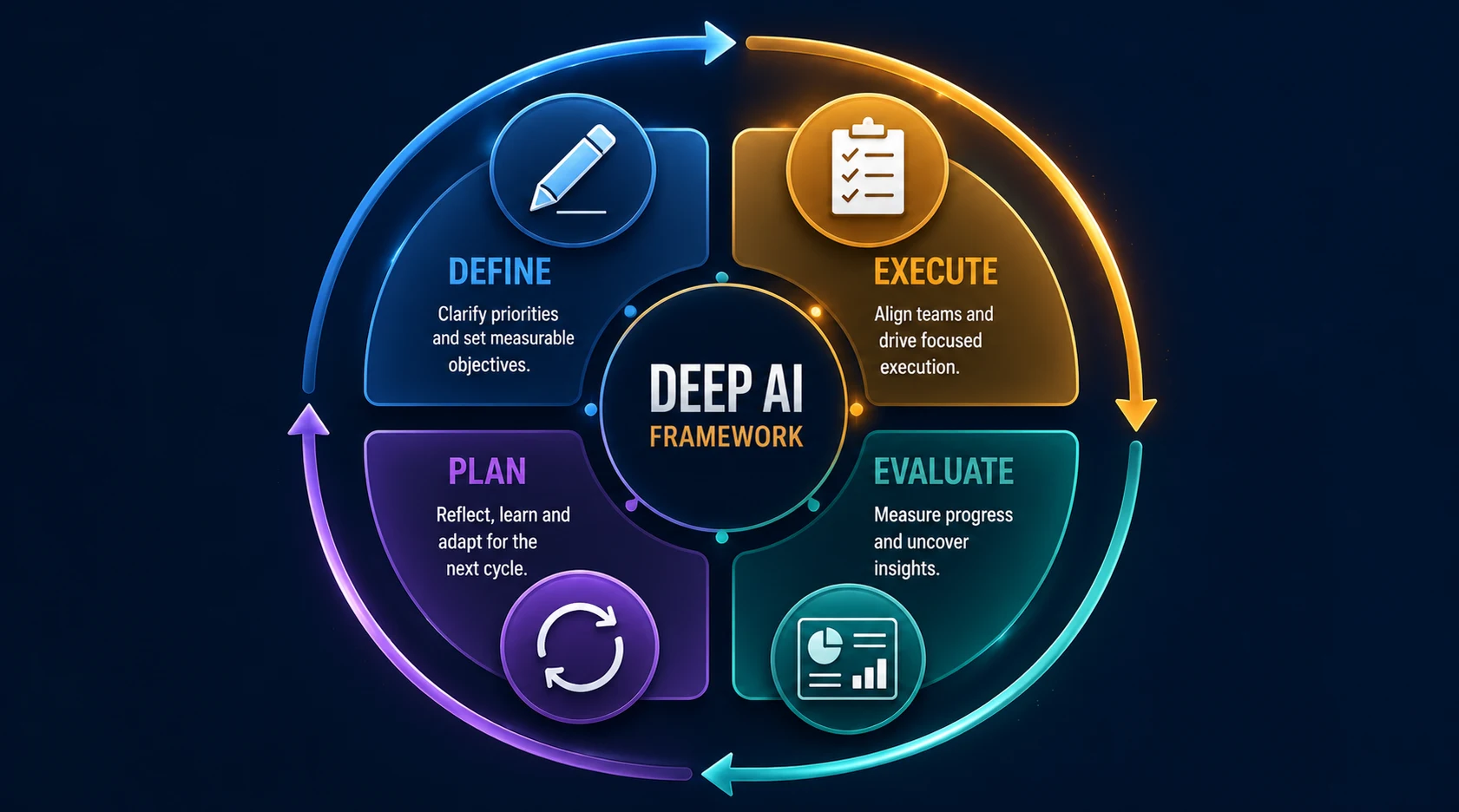
That is the job Worxmate’s DEEP AI™ framework is built to do: Define, Execute, Evaluate, Plan. Define is where AI-assisted goal writing and quality scoring catches an output dressed up as an outcome before it ever reaches a coaching session. Execute is where automated check-ins and at-risk detection surface a stalled goal before week six rather than at the quarterly review. Evaluate turns the retrospective into something backed by data instead of memory. Plan is what most organisations skip entirely carrying the lesson from one cycle into the next rather than starting from zero every quarter.
Underneath that framework sit three AI models built for a different question than most HR software asks: Orbit AI looks at individual and team performance intelligence, Axis AI looks at business performance intelligence at the leadership level, and Nexus AI looks at organisational intelligence where alignment actually exists and where it is only displayed. None of these replace what an OKR coach in India does in a live session. They exist so the discipline a good coach builds does not evaporate the moment the session ends.
| DEEP AI Stage | What the OKR Coach Reinforces | What the Platform Automates |
|---|---|---|
| Define | Distinguishing output from outcome in your own words | AI-assisted goal writing and quality scoring |
| Execute | Honest check-in conversations, not status theatre | Automated check-ins and at-risk detection |
| Evaluate | A retrospective that names what actually failed | Data-backed scorecards, not self-reported scores |
| Plan | Carrying the lesson into the next quarter, on purpose | Cycle-over-cycle organisational learning |
OKR Coach in India vs OKR Consultant vs OKR Coaching Platform
These three get used interchangeably in conversation and they are not the same purchase. An OKR coach in India is a personal, ongoing engagement — one or a few people, working on your own real goals, across multiple sessions. An OKR coach and OKR consultant are evaluated differently: consulting typically means a broader organisational engagement diagnosis, program design and delivery across the whole company. A dedicated OKR software platform is neither a person nor a program it is the infrastructure that keeps whatever a coach or consultant builds alive between sessions, instead of decaying the way frameworks tend to when nobody is watching.
| OKR Coach in India | OKR Consultant | OKR Software Platform | |
|---|---|---|---|
| Scope | Individual or small leadership team | Full organisation, program design | Every team, every cycle |
| Duration | Multiple sessions, ongoing | Fixed project timeline | Continuous |
| Best evaluated with | Questions in this article | A separate consultant evaluation checklist | Feature and workflow fit |
| What it replaces | Nothing — builds capability | Nothing — designs the program | Nothing — keeps discipline visible |
The honest answer for most organisations in India is not one of these three. It is coaching to build the capability, a platform to keep it visible between sessions, and, for larger, multi-layer organisations, a consulting engagement to design how the program cascades in the first place. Confirm which one you are actually buying before the contract gets signed, not three months in.
If you are outside India and comparing formats, the same coaching-versus-training distinction shows up in our OKR coaching guide for UK founders, though the vendor landscape and pricing norms differ by geography.
Read the Full Playbook Before Your Next OKR Cycle
Worxmate’s Strategic OKR Implementation guide walks through exactly how coaching, consulting and the platform fit together — free download.
Where to Go From Here
“The software is the infrastructure. The coaching is the capability. You need both — and in the right order.”
If you want ongoing coaching for your own leadership team, not a single workshop, Worxmate’s OKR consulting for India is structured around sustained engagement, not a one-day session.
If you want to become the kind of coach this piece describes, rather than hire one, OKR Certified Coach requires a real coaching program design, not just an exam.
If you would rather start with the infrastructure and bring coaching in once the team is using OKRs consistently, explore Worxmate’s OKR software and check current pricing before you decide who coaches your team through it.
The right OKR coach is not the one with the best-reviewed workshop. It is the one still checking in on your real goals a quarter later.
Further Reading
Best OKR Consultants in India 2026: What to Actually Look For — the same evaluation logic applied to consulting firms rather than individual coaches.
The Coaching Cliff: Why OKR Coaching Fails After the Workshop Ends — what happens when even genuine coaching stops too early.
OKR Certification India: What HR Leaders Should Look for — the organisational version of this same training-versus-coaching distinction.
2026 OKR Execution Maturity Framework — the benchmark data behind the Execution Maturity Rate figures cited here.
Organization Performance Audit — a free, no-pitch diagnostic of where your organisation’s execution gap actually sits.
Also related: How to Implement OKRs in India and Affordable OKR Consulting Services for organisations still deciding on budget and format.
Written by
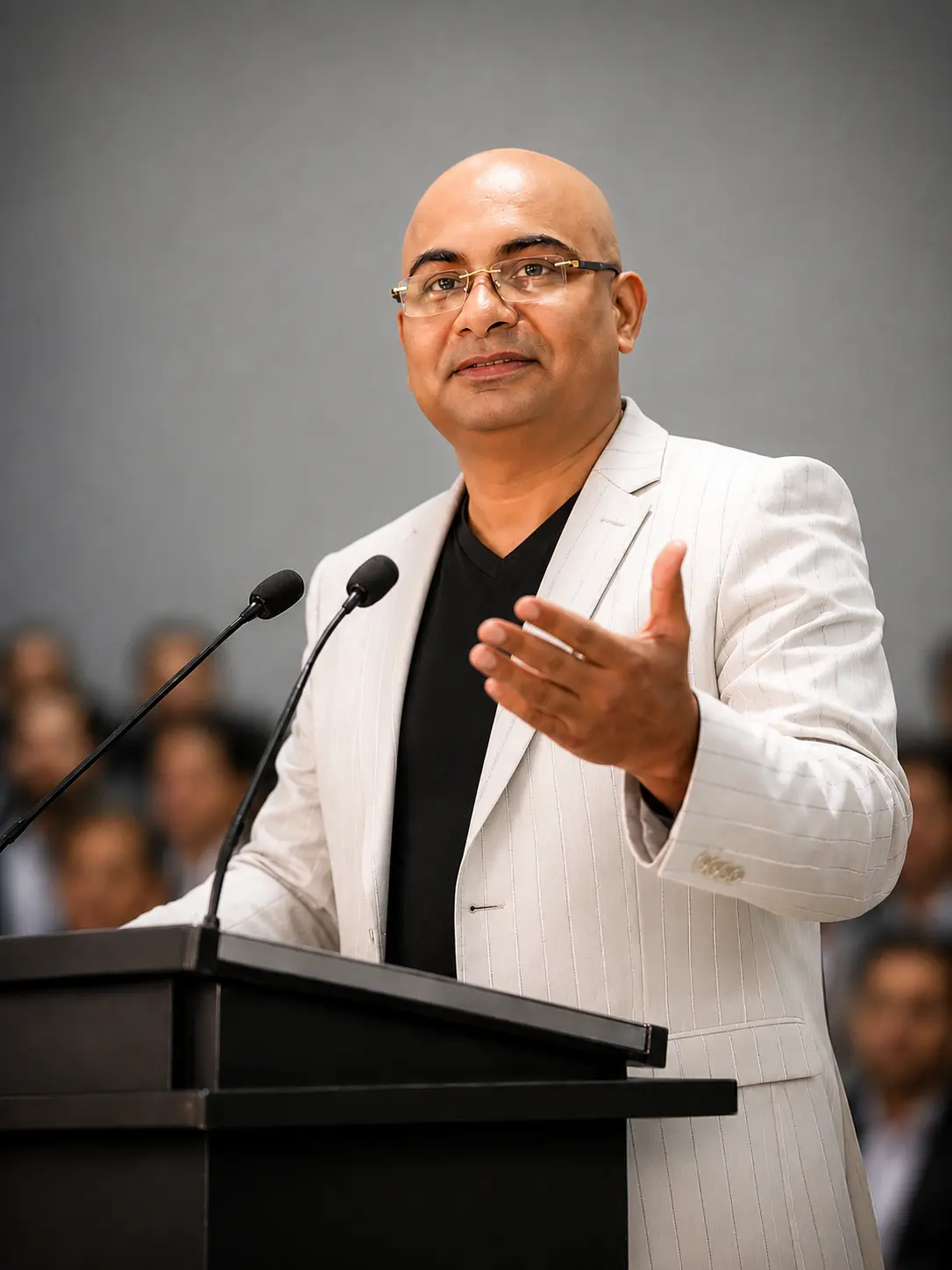
An OKR Coach with 20+ years of implementation experience, Madhusudan has guided over 50 organisations through successful OKR transformations, training more than 500 leaders. Learn more about Worxmate.