 WORXMATE
Quick Answer
OKR vs KPI examples highlight a fundamental difference: OKRs are ambitious, outcome-focused goals designed to drive change and growth, while KPIs are vital health metrics tracking the performance of existing processes. Understanding this distinction is critical for effective strategy execution, ensuring teams pursue innovation while maintaining operational stability.
I’ve sat through countless strategy review meetings where the terms “OKR” and “KPI” were thrown around interchangeably, often leading to confusion, diluted focus, and ultimately, stalled progress. The problem isn’t just semantics; it’s a fundamental misunderstanding of what each tool is designed to achieve, and when to use it. When a team uses a KPI as an Objective, they’re not driving new outcomes; they’re just tracking a status quo. When an OKR is treated like a mere operational metric, its aspirational power is lost. This conceptual blur creates a significant execution gap, where leadership believes they’ve set a growth agenda, but the teams are simply maintaining existing performance.
The real pain point emerges when leaders look at their dashboards and see all green, yet the business isn’t moving forward in the ways they envisioned. Revenue targets are hit, but market share isn’t growing. Customer satisfaction scores are stable, but churn is creeping up in a critical segment. This isn’t a problem with the numbers themselves; it’s a problem with what those numbers are measuring, and whether they align with the strategic intent. Without a clear distinction between what drives transformation (OKRs) and what monitors ongoing health (KPIs), organisations end up busy, but not truly effective.
My perspective on this isn’t theoretical. It comes from being in the room for 50+ OKR implementations and coaching over 500 leaders across diverse industries from a 70,000-person IT services giant to a lean European fintech startup. I’ve seen firsthand how clarity here can unlock significant execution velocity, and how confusion can derail even the most well-intentioned strategic plans. My role isn’t to present a textbook definition, but to share what actually works when you’re trying to get a leadership team to execute on a strategy, not just articulate one.
The Costly Confusion: Why Mixing OKRs and KPIs Derails Strategy
The most common mistake I observe is treating OKRs as glorified KPIs, or vice versa. This isn’t a minor error; it fundamentally undermines strategic execution. When an Objective is “Maintain 95% customer satisfaction,” it’s not an aspirational, outcome-driven goal. It’s a baseline performance metric. It tells you if you’re holding steady, not if you’re breaking new ground. Conversely, trying to make a KPI like “System Uptime” into an OKR often leads to convoluted Key Results that lose sight of the operational reality.
This conflation leads to several critical systemic failures. First, it creates a false sense of progress. Dashboards might show all metrics in the green, yet the organisation isn’t truly innovating or growing. Second, it dilutes accountability. When everything is a “goal,” nothing is truly a priority that requires new effort or cross-functional collaboration. Third, it stifles genuine outcome thinking. Teams become focused on hitting a number, rather than understanding the underlying impact they are trying to create for the business or the customer. This is why a strong understanding of what is a business outcome is so vital.
I’ve seen this play out in organisations struggling with organizational alignment, where departments report success on their individual metrics, but the collective strategic needle barely moves. The problem isn’t a lack of effort; it’s a lack of clarity on what constitutes a strategic leap versus what defines operational health. This impacts everything from resource allocation to how performance is evaluated. An organisation that cannot clearly distinguish between these two types of measures will struggle with strategy implementation and monitoring, constantly chasing outputs instead of outcomes.
Practitioner Insight: Beyond the Definitions – The Outcome-Driven Mindset
The real distinction between OKRs and KPIs isn’t just about what they are, but how you think about them. It’s about cultivating an outcome-driven mindset. I recall working with a European fintech startup that was excellent at shipping features (outputs), but struggled to connect those features to tangible business impact (outcomes). Their initial OKRs were filled with metrics like “launch new payment gateway” or “complete API integration.” These are tasks, not results.
Our breakthrough came through relentless “so what” questioning during their OKR workshops. For every Key Result they proposed, we’d ask: “So what? If you achieve that, what changes for the customer or the business?” This pushed them past the activity and into the impact. For example, “Launch new payment gateway” evolved into “Reduce payment processing time by 20% for high-volume transactions, leading to a 5% increase in successful transaction volume.” The second is an outcome, measured by a Key Result, driven by the first (an output). This shift in thinking is critical and doesn’t happen overnight. It’s a 12-month journey, not a single quarter’s adjustment, regardless of seniority.
“Alignment is agreement between teams on what matters, why it matters, and how each team’s work connects to the teams around them. You cannot set that in a tool. You can display it. You cannot create it.”
Another invisible blocker is the fear of failure. Leaders often write “safe,” easily completable Key Results rather than genuinely ambitious outcomes. They treat the OKR as a performance appraisal metric, rather than a learning tool. Our coaching explicitly addresses this, making it clear that cycle-one “failure” (not hitting 100% of an ambitious KR) is learning, not performance failure. This psychological safety is essential for fostering true outcome-driven thinking. This distinction is crucial for understanding the core differences between OKRs and KPIs.
This journey from output to outcome thinking is what we measure as Execution Maturity Rate. In a typical first cycle, organisations show an Execution Maturity Rate of only 5-15%. This means only a small fraction of leaders can independently write genuine outcome-driven goals without heavy coaching or templates. However, in organisations coached consistently over 12 months, this rate reaches 30-40%. This isn’t just about writing better goals; it’s about a fundamental shift in how leadership approaches strategy execution.
Execution Maturity Rate: First Cycle vs 12 Months of Coaching
This is why dedicated coaching is non-negotiable. It’s not about a one-time workshop; it’s about ongoing mentorship that maps to a leader’s career background. A finance leader thinks in budget cycles, a product leader in sprints, a sales leader in pipeline. Effective coaching translates outcome thinking into their specific operational language, ensuring the distinction between OKRs and KPIs becomes intuitive, not just theoretical.
The Worxmate Approach: Integrating OKRs and KPIs for Cohesive Execution
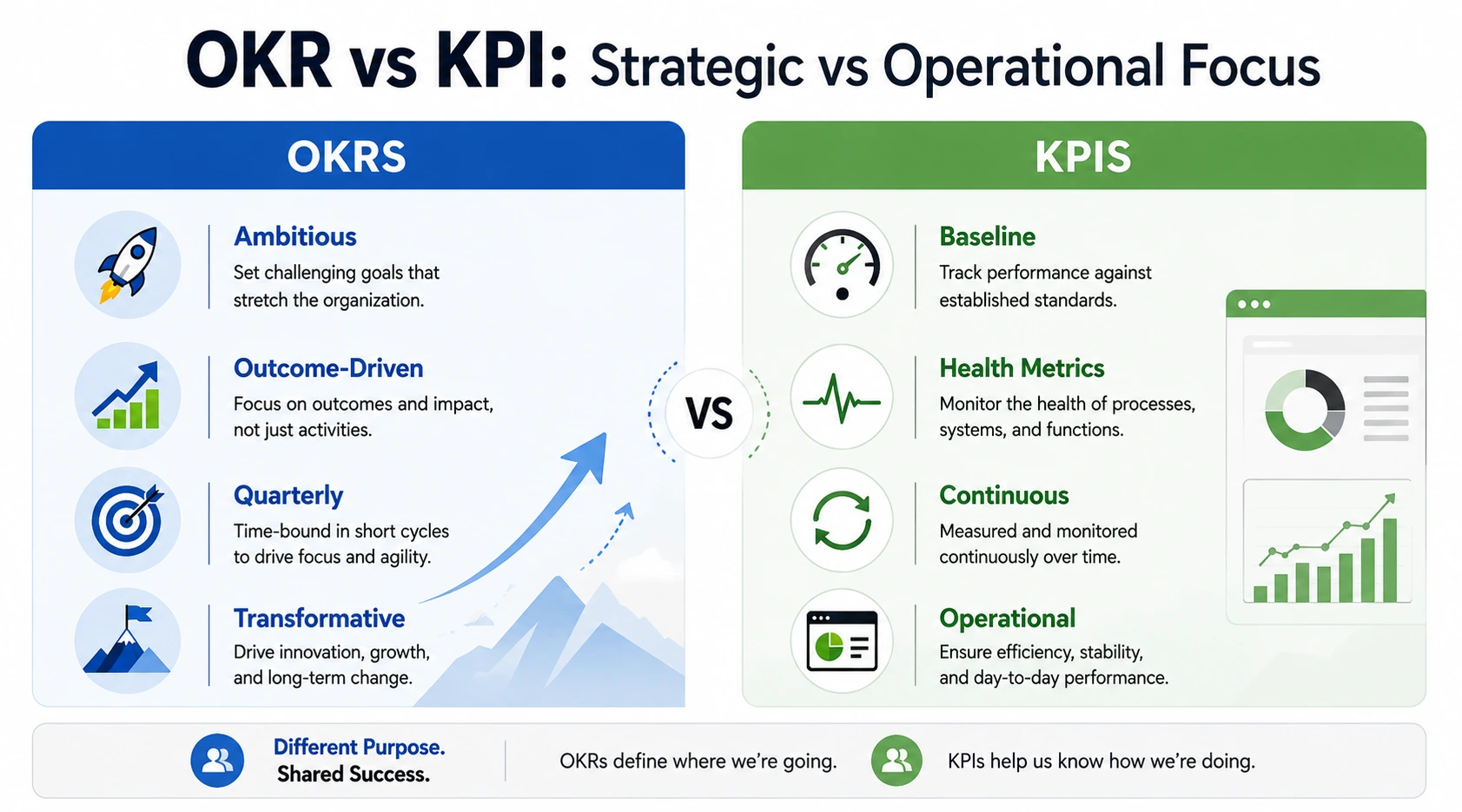
The most effective organisations don’t choose between OKRs and KPIs; they use both strategically. OKRs provide the compass for where to go, while KPIs are the gauges that tell you if your vehicle is running smoothly on the way there.
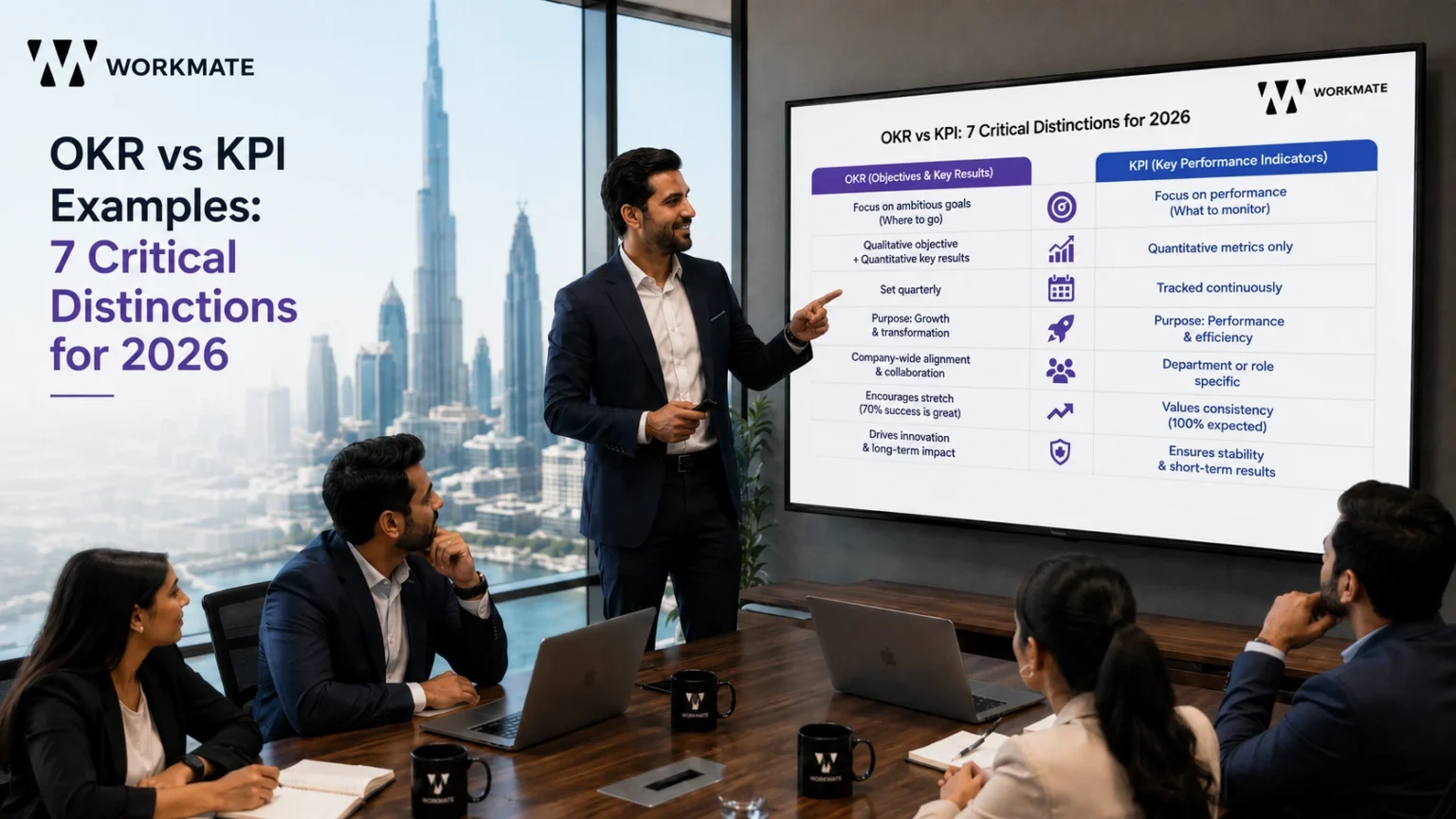
Here’s a table outlining the 7 critical distinctions, illustrated with concrete OKR vs KPI examples:
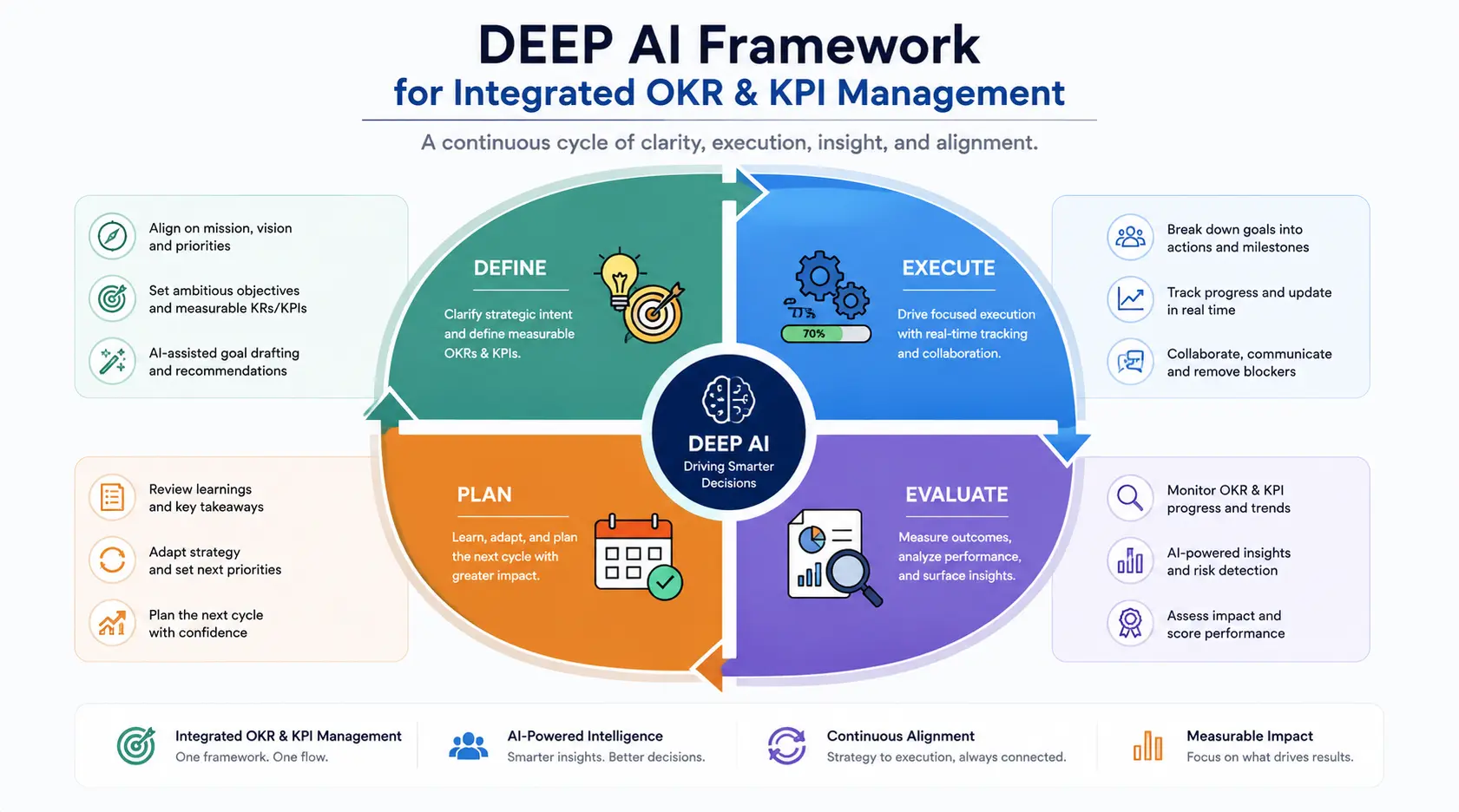
Worxmate’s approach is built on the DEEP AI framework: Define, Execute, Evaluate, Plan. This framework provides the structure to manage both OKRs and KPIs effectively.
- Define: Our AI-assisted goal writing tools (Define) help leaders craft genuine outcome-driven OKRs, ensuring they are ambitious and measurable, not just rephrased KPIs. It also helps articulate the underlying problem the OKR is solving, ensuring clarity on the “why.”
- Execute: Automated check-ins (Execute) track progress on OKRs and integrate with existing data sources to monitor KPIs in real-time. This provides at-risk detection for both strategic goals and operational health metrics.
- Evaluate: Data-backed retrospectives (Evaluate) allow teams to learn from both OKR progress and KPI shifts, understanding the causal links.
- Plan: Cycle-over-cycle organisational learning (Plan) refines both strategic objectives and the operational metrics that support them, ensuring continuous improvement.
By The Numbers
Worxmate Experience: Across 50+ implementations and coaching 500+ leaders, the most common initial confusion is between OKRs and KPIs. Resolving this is the first step to achieving a higher Execution Maturity Rate.
This integrated approach means dedicated OKR software like Worxmate isn’t just a tracking tool; it’s an execution engine. It’s purpose-built to handle the nuances of ambitious goal setting and the rigor of continuous performance monitoring, unlike HRIS platforms which treat OKRs as just another feature within an HR workflow. An HRIS is excellent for managing HR processes, but it’s not designed to drive strategy execution from the CEO’s office.
OKR Execution Maturity Framework 2026
Understand your organisation’s current level of OKR execution capability and identify critical areas for improvement to drive real outcomes, not just activities.
What This Looks Like in Practice: A Coordinated Rhythm
When the distinction between OKRs and KPIs is clear, an organisation moves with a coordinated rhythm. I worked with a 70,000-person IT services organisation that was struggling with “output-vs-outcome” confusion, particularly between its project delivery metrics (KPIs) and its strategic innovation goals (OKRs). Their leadership team would spend hours debating which was which.
We introduced a “Thinking Process” based on 2-3 top-level business unit priorities. For each priority, we’d ask: “What new, measurable outcome will define success for this priority this quarter (OKR)?” and then, “What existing operational metrics must we maintain or improve to ensure foundational health while we pursue this outcome (KPIs)?” This simple framing, applied to specific strategic goals, clarified everything.
For example, a priority might be “Expand market share in the APAC region.”
- OKR: “Successfully onboard 3 new enterprise clients in APAC, generating $XM in recurring revenue by Q3.” (This is a new, ambitious outcome).
- KPIs: “Maintain client satisfaction (NPS) above 70 for existing APAC clients,” “Keep average sales cycle length for enterprise deals under 90 days,” “Ensure sales team pipeline coverage remains at 3x.” (These are ongoing health metrics that ensure the foundation is stable while pursuing the OKR).
This clear separation allowed teams to focus their weekly OKR check-ins on progress towards the new outcomes, while simultaneously monitoring their KPIs through automated dashboards. It eliminated the ambiguity that had previously stalled progress. The result: a significant increase in both strategic agility and operational stability. “One completed OKR is worth more than five written ones,” especially when you know it’s truly driving a new outcome, not just tracking existing performance. This clarity is what drives the shift from outputs to outcomes.
My Take: Infrastructure and Capability
The software is the infrastructure. The coaching is the capability. You need both, and in the right order. Understanding the difference between OKR vs KPI examples is foundational, but translating that understanding into consistent execution requires more than just a tool. It demands a shift in mindset, reinforced by structured processes and expert guidance.
If you’re ready to implement a system that clarifies these distinctions and drives real outcomes, explore our OKR software, review our pricing, or get a demo to see it in action. If you recognise that the challenge is more about embedding the right capabilities and thinking within your leadership team, then our OKR consulting services can provide the hands-on guidance and coaching needed to make this distinction a natural part of your organisation’s execution DNA.

Written by
An OKR Coach with 20+ years of implementation experience, Madhusudan has guided over 50 organisations through successful OKR transformations, training more than 500 leaders. Learn more about Worxmate.