 WORXMATE
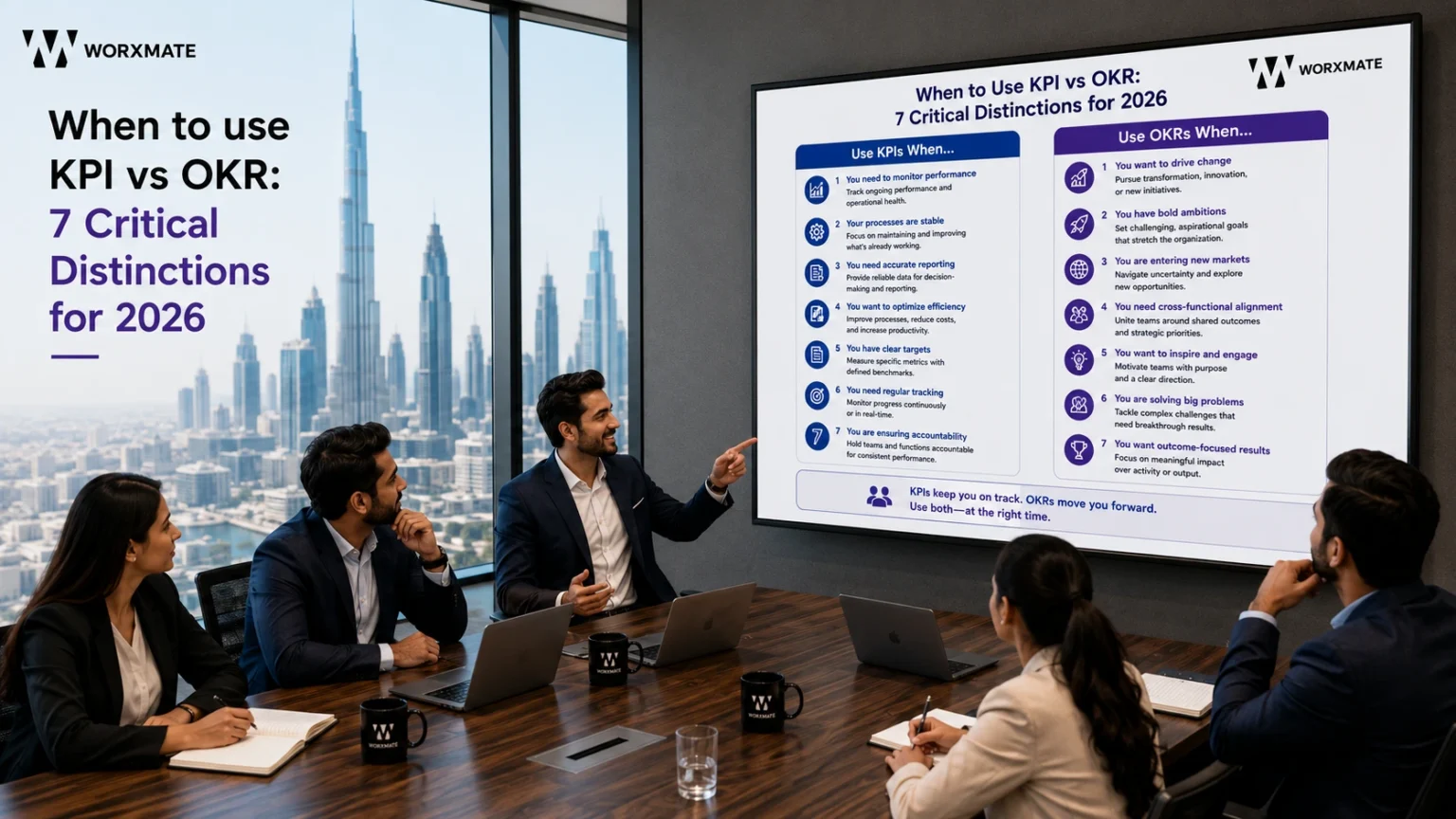
KPI vs OKR Framework: KPIs monitor ongoing operational health while OKRs drive strategic transformation. Deploying a unified performance management platform bridges health metrics and growth drivers to eliminate execution drift.
You’ve just wrapped up a quarter, the dashboards are green, but the strategic needle hasn’t moved. The team is hitting all its Key Performance Indicators (KPIs), yet the big bets are still just that: bets. This is the moment when the question of when to use KPI vs OKR stops being academic and becomes urgent. I’ve seen this scenario play out in countless organisations, from a 70,000-person IT services giant struggling with output-vs-outcome confusion, to a lean European fintech startup where product and commercial teams were hitting their individual metrics but delivering no shared market impact. The common thread? A fundamental misunderstanding of what each framework is designed to achieve, leading to a muddled execution picture where activity is mistaken for progress.
My experience across 50+ OKR implementations and coaching 500+ leaders has shown me one truth: the distinction between KPIs and OKRs is not just theoretical. It dictates whether your strategy remains a PowerPoint deck or becomes a living, breathing engine of execution. When leaders conflate the two, they inadvertently build a system that rewards maintenance over momentum, and incremental tweaks over genuine transformation. The result is often a program that looks good on paper, with high completion rates for “goals” that are, in reality, just well-tracked business as usual. This is a costly mistake, not just in terms of wasted effort, but in lost strategic velocity.
The Core Problem: Conflating Health Metrics with Growth Drivers
The fundamental pain point I consistently observe is that leaders fail to differentiate between metrics that measure the health of their current operations (KPIs) and those that drive strategic change (OKRs). This isn’t just about semantics; it’s about focus. If your team’s “Objective” is to “Maintain 99% uptime,” that’s a critical KPI. It tells you if you’re keeping the lights on. But is it driving new value, market share, or innovation? Unlikely. That objective belongs to a system designed to monitor stability, not provoke strategic shifts.
The issue is compounded when organisations attempt to force KPIs into an OKR framework. They end up with “Objectives” that lack ambition and “Key Results” that are simply rephrased operational targets. This dilutes the power of OKRs, turning them into another reporting chore rather than a strategy execution engine. Across the organisations I have coached, the initial Execution Maturity Rate – the percentage of leaders who can independently write a genuine outcome-driven goal – sits between 5% and 15% in a typical first cycle. This low figure is often a direct consequence of this KPI/OKR confusion. Leaders default to what they know: measurable outputs, which look a lot like KPIs.
Execution Maturity Rate: In a typical first OKR cycle, the percentage of leaders who can independently write genuine outcome-driven goals without coaching, a template, or quality review is only 5-15%. This often stems from conflating OKRs with operational KPIs.
This confusion also impacts the quality of discussions during check-ins. Instead of asking “Are we moving towards our ambitious outcome?” teams get stuck on “Are we hitting our numbers?” which is a very different conversation. The strategic intent gets lost. For a deeper dive into the fundamentals of these two goal-setting methodologies, I often direct clients to our article on OKR vs KPI, which lays out the core definitions. However, knowing the definitions is one thing; understanding when to use KPI vs OKR in practice is another entirely.
When to use KPI vs OKR: Distinguishing Between Health and Change
Achieve Your Goals Faster
See how Worxmate can help your team set clear goals and achieve faster results. Book your free demo today and experience the power of AI-driven OKRs in action.
Why Traditional Static Trackers Fail in 2026
While legacy tools treat OKRs as static spreadsheets, modern execution requires continuous intelligence. Relying on manual updates leaves leadership blind to execution drift until it is too late.
The Operational Reality: Traditional goal trackers lack predictive analytics. They record historical outcomes rather than forecasting check-in friction.
The Worxmate Advantage: A modern performance management platform uses predictive AI to flag at-risk key results weeks before quarter-end, replacing guesswork with data-backed intervention.
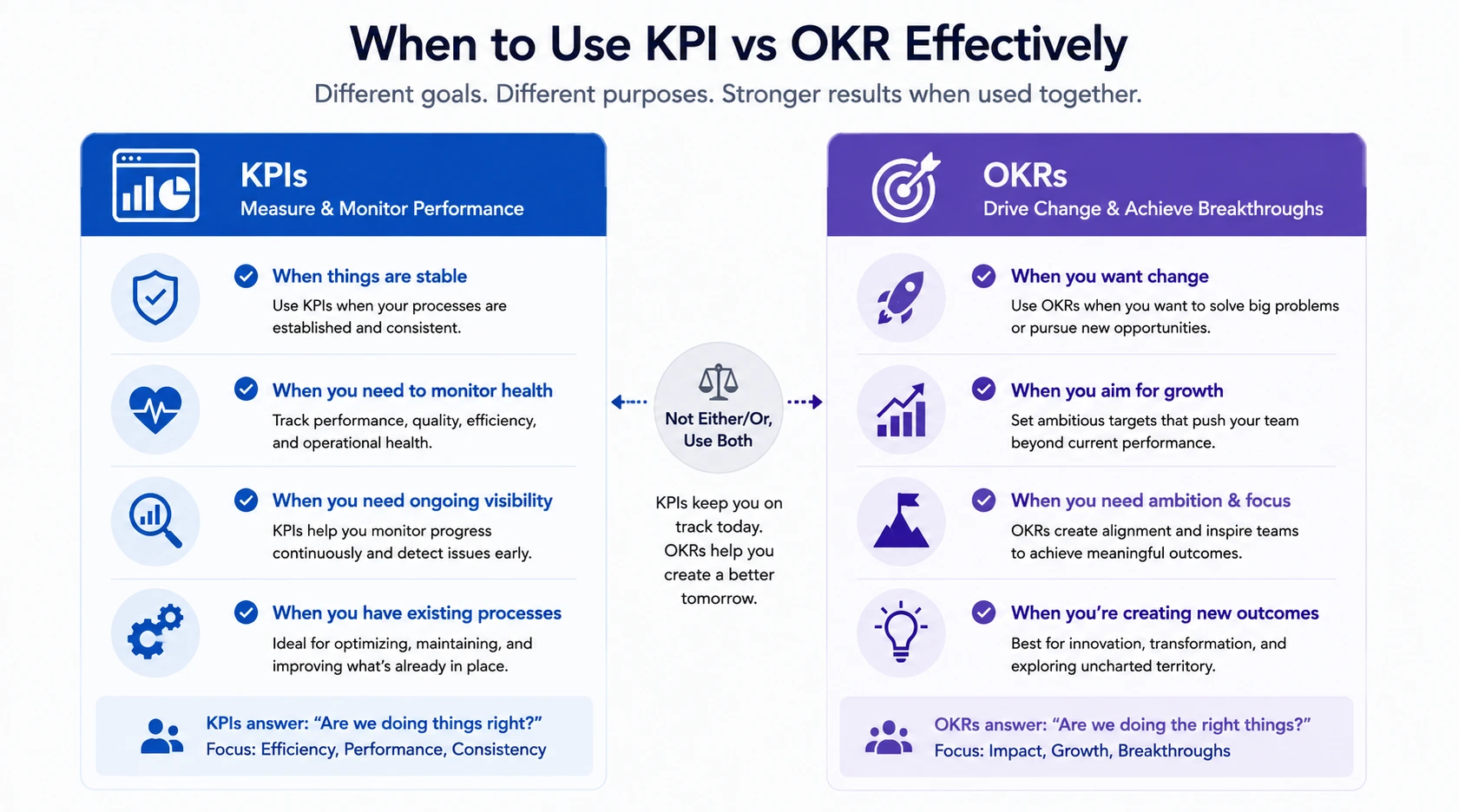
The critical distinction lies in their purpose. KPIs are your dashboard for the present: are you healthy? Are you stable? Are you meeting your service level agreements? OKRs are your compass for the future: where are you going? What new value are you creating? What significant problem are you solving?
Let’s break down the practical differences to clarify when to use KPI vs OKR:
| Aspect | Key Performance Indicators (KPIs) | Objectives and Key Results (OKRs) | N/A | N/A | N/A | N/A | N/A | N/A | N/A | N/A | N/A |
|---|---|---|---|---|---|---|---|---|---|---|---|
| Primary Purpose | Monitor the health and performance of ongoing operations; maintain status quo. | Drive ambitious, outcome-focused change, growth, or innovation. | |||||||||
| Focus | Outputs, efficiency, quality, financial stability, operational excellence. | Outcomes, impact, strategic initiatives, challenging the status quo. | |||||||||
| Nature | Reactive or descriptive; measure what happened. | Proactive and aspirational; define what needs to happen. | |||||||||
| Target Setting | Often based on historical data, industry benchmarks, or service level agreements. | Ambitious, stretch goals, often 60-70% completion is considered successful. | |||||||||
| Time Horizon | Continuous, ongoing monitoring (daily, weekly, monthly). | Typically quarterly, tied to strategic cycles. | |||||||||
| Relationship | Can be “moved” by OKRs, or act as guardrails for OKR execution. | Drive improvements in KPIs, or focus on areas not currently measured by KPIs. |
A European fintech startup I coached illustrates this perfectly. Their product team had KPIs like “Number of features shipped” and “Bug fix rate.” Their commercial team had KPIs like “Number of sales calls” and “Conversion rate.” All green. But the CEO couldn’t understand why their new payment gateway wasn’t gaining market traction. The problem was they were hitting outputs, not outcomes. We shifted their focus to OKRs like “Objective: Become the preferred payment partner for SMBs in Region X” with Key Results like “Increase active SMB users of payment gateway from Y to Z” and “Achieve X% repeat transaction volume.” Crucially, these KRs were co-owned by Product and Commercial. Suddenly, their “Number of features shipped” KPI became a means to an end, not the end itself. The conversation moved from “Did we build it?” to “Did it move the business?”
“Alignment is agreement between teams on what matters, why it matters, and how each team’s work connects to the teams around them. You cannot set that in a tool. You can display it. You cannot create it.”
This highlights a critical counterintuitive belief: Alignment is agreement between teams, not a platform configuration. You can display an agreement once it exists. You cannot create one in a tool. KPIs can be aligned through reporting structures, but OKRs demand cross-functional agreement on shared outcomes. This is the difference between reporting on what you did and collaborating on what you want to achieve.
OKR Execution Maturity Framework 2026
Benchmark your organisation’s OKR execution maturity and identify critical areas for improvement beyond basic goal setting.
Leveraging Both: KPIs as Guardrails for OKR Execution
The goal isn’t to choose one over the other. The most effective organisations understand when to use KPI vs OKR and how they complement each other. KPIs act as guardrails for your OKRs. As you pursue ambitious OKRs, you must ensure that your core operational health (measured by KPIs) doesn’t suffer.
For instance, an OKR might be to “Launch a new product in a nascent market to capture early adopter share.” The Key Results would focus on adoption, engagement, and market penetration. Alongside this, you’d still monitor critical KPIs like “Customer Support Response Time,” “Product Stability Uptime,” and “Net Promoter Score.” If your OKR pursuit causes these KPIs to dip significantly, it’s a signal to adjust your approach or resources. One Middle East energy and utility company (8,000+ employees, $45Bn) fixed scattered strategic ownership by explicitly defining which KPIs served as health metrics for their OKRs, ensuring that growth didn’t come at the cost of operational integrity.
Coaching must map to a leader’s career background, not a slide deck. A finance leader thinks in budget cycles, a product leader in sprints, a sales leader in pipeline. This context is vital when helping them differentiate between KPIs and OKRs.
Another practical application is to use KPIs as a baseline for OKRs. If a KPI is consistently underperforming, it might become the focus of a new OKR. For example, if “Customer Satisfaction Score” (a KPI) has stagnated at 70% for three quarters, an OKR could be “Objective: Delight our customers through exceptional service” with Key Results targeting an increase in CSAT to 85% and a reduction in first-call resolution time. This demonstrates how an underperforming KPI can trigger a strategic OKR. This dynamic interplay is crucial for strategic performance management.
Coaching Impact on Maturity: After 12 months of consistent coaching, organisations typically see their Execution Maturity Rate improve significantly, reaching 30-40% of leaders who can independently write outcome-driven goals.
The DEEP AI Framework: Integrating KPIs and OKRs for Holistic Performance
Our DEEP AI framework (Define, Execute, Evaluate, Plan) provides a structure for understanding when to use KPI vs OKR within a holistic performance system.
- Define: This is where OKRs truly shine. Our Define AI-assisted tool helps leaders craft clear, outcome-driven Objectives and Key Results, moving away from output-focused KPIs masquerading as OKRs. It ensures that the strategic intent is captured upfront.
- Execute: This phase involves the day-to-day work and regular check-ins. Here, both OKRs and KPIs play a role. OKRs guide the strategic actions, while KPIs provide real-time feedback on operational health. A drop in a critical KPI during an OKR cycle is an immediate red flag, indicating that the strategic pursuit might be destabilizing core operations. Worxmate’s Execute feature enables automated check-ins and at-risk detection for OKRs, while also allowing for the monitoring of key health KPIs in parallel.
- Evaluate: At the end of a cycle, the evaluation phase uses data-backed retrospectives to assess OKR achievement and learn from both successes and failures. Here, you also review how KPIs were impacted. Did the ambitious OKRs move the needle positively on relevant KPIs? Were any critical KPIs negatively affected? This dual perspective provides a complete picture of performance.
- Plan: This final stage involves cycle-over-cycle organisational learning. Insights from both OKR performance and KPI trends feed into the next planning cycle, refining future OKRs and identifying which KPIs might need dedicated strategic attention. This continuous feedback loop ensures that your definition of business outcomes evolves.
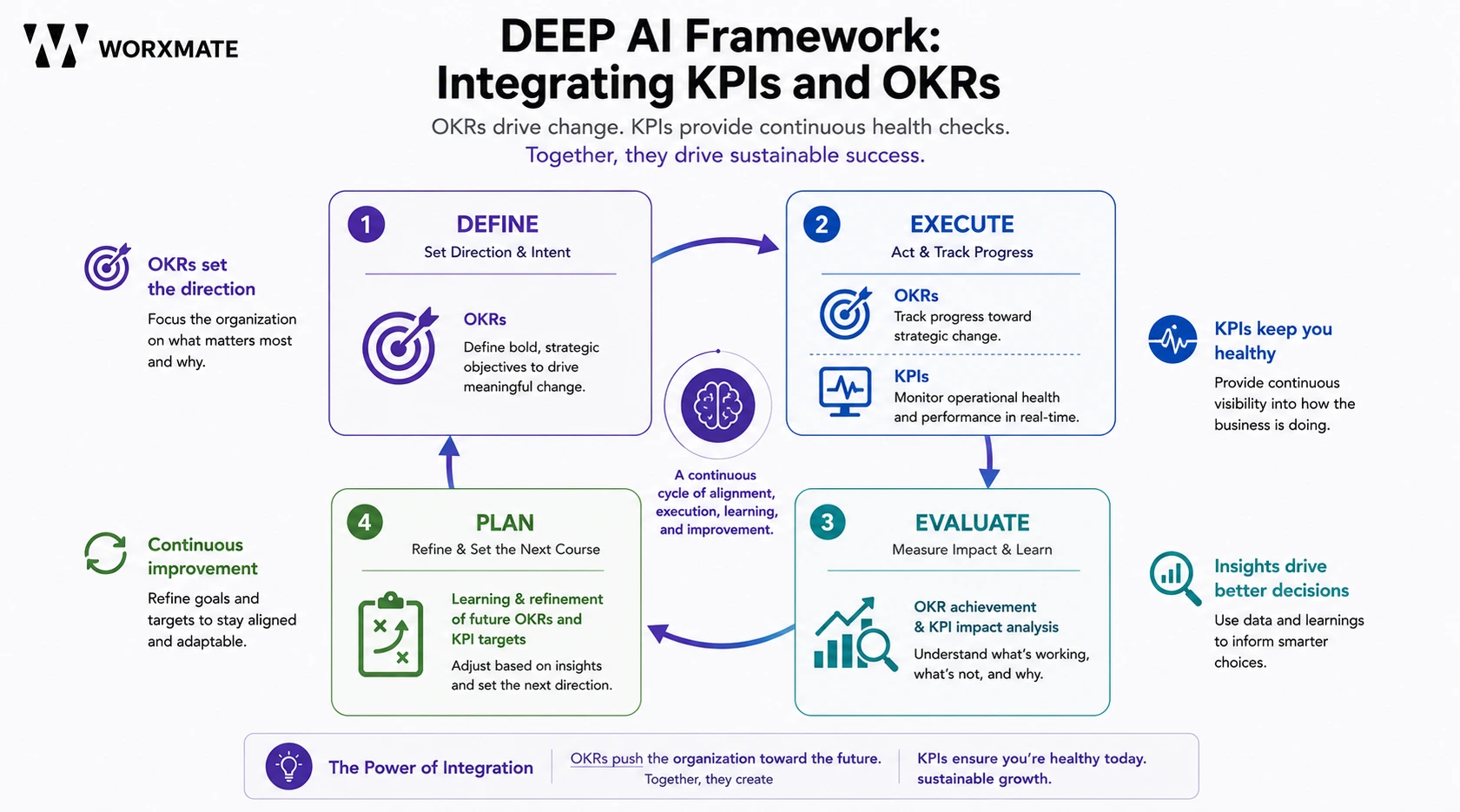
This integrated approach is vital because ignoring KPIs during an OKR cycle is akin to driving a car with your foot on the accelerator while ignoring the fuel gauge and oil pressure light. You might reach your destination faster, but you risk breaking down along the way. Understanding when to use KPI vs OKR isn’t about choosing a tool; it’s about building a robust operating system for your business.
Execution Maturity Rate: First Cycle vs 12 Months of Coaching
What This Looks Like in Practice: A Field Observation
In practice, the clarity around when to use KPI vs OKR fundamentally shifts leadership conversations. Instead of asking, “Are we hitting our numbers?” the question becomes, “Are we making strategic progress while maintaining our operational health?” This seems subtle, but the impact is profound. It moves teams from a purely reactive stance to a proactive, outcome-driven mindset.
I recall a large IT services organisation (70,000+ people) that initially struggled with this. Their management review boards were essentially KPI reporting sessions. Projects were green, but strategic initiatives designed to move them up the value chain were consistently behind. We introduced a “Thinking Process” for deriving OKRs directly from 2-3 top-level business unit priorities. This forced leaders to ask “so what?” when presenting a Key Result. If a KR simply tracked an output, the “so what?” would inevitably lead back to a KPI. If it tracked an outcome, the “so what?” would lead to a strategic impact. This rigorous process, coupled with 1:1 coaching (never just group training), helped them internalise the distinction. They began using their OKR software for strategic foresight and their existing reporting tools for operational oversight.
The shift isn’t instantaneous. The transition from output to outcome thinking cannot happen in a single quarter regardless of seniority. It is a 12-month journey, which is why Execution Maturity Rate is measured across a year, not 90 days. During this journey, early warning signals are crucial. One such signal is the volume of product support queries a team raises. If a team is raising 15-20 queries per day in week one of an OKR program, it often predicts that adoption will break. This isn’t usually a software problem; it’s a clarity problem a lack of understanding of the system, often stemming from the KPI/OKR confusion.
OKR Consulting
Get hands-on support from seasoned practitioners to implement OKRs correctly and avoid common pitfalls like KPI/OKR confusion. Tracking a real-time confidence score helps identify at-risk targets before quarter-end. Surfacing operational blockers early ensures leadership can clear obstacles quickly. Seamless cascading ensures department milestones stay synchronized with company strategy. Strong goal alignment eliminates siloed efforts and connects daily work to strategic outcomes.
Talk to an OKR Coach →
My Take: The Path to Integrated Performance
Understanding when to use KPI vs OKR is not about choosing between good and bad. It’s about choosing the right tool for the right job, and then integrating them intelligently. KPIs are foundational; they tell you if your engine is running smoothly. OKRs are aspirational; they tell you if you’re building a faster, better engine for the future.
The software is the infrastructure. The coaching is the capability. You need both, and in the right order. If you’re ready to implement a system that clarifies these distinctions and drives genuine strategic execution, consider two paths.
For those ready to equip their teams with purpose-built tools for strategic execution, explore our OKR software, understand its pricing, and get a demo to see how it can simplify goal management. If you recognize that the software is only as good as the strategy and coaching behind it, consider engaging with our OKR consulting services to build the internal capability needed for sustained success.


Written by
An OKR Coach with 20+ years of implementation experience, Madhusudan has guided over 50 organisations through successful OKR transformations, training more than 500 leaders. Learn more about Worxmate.