 WORXMATE

OKR Consulting & Evaluation in India: Selecting top-tier OKR expertise requires looking past vanity metrics. Enterprise leaders must evaluate coaching depth, middle-manager cascade, and AI-enabled platforms such as Best OKR software solutions to drive sustainable business execution across diverse industries.
This directly accelerates measurable key results across the entire organization. Regular check-ins maintain momentum and keep strategic priorities front of mind. Tracking a real-time confidence score helps identify at-risk targets before quarter-end. Surfacing operational blockers early ensures leadership can clear obstacles quickly. Seamless cascading ensures department milestones stay synchronized with company strategy. Strong goal alignment eliminates siloed efforts and connects daily work to strategic outcomes.
Most “best OKR consultant in India” lists rank the wrong thing. They rank marketing presence: who has the slickest website, the most LinkedIn posts, the longest client logo wall. None of that predicts whether an engagement will actually change how your leadership team executes. Deploying the moving from KPIs to OKRs playbook alongside enterprise-grade Best OKR software is essential for true alignment. I am not going to give you a ranked list of names. I am going to give you the six questions that actually separate a consultant who will move your business from one who will run a good workshop and leave.
I say this as someone who is, structurally, exactly the kind of person a listicle like this would rank. I would rather you know how to evaluate that claim yourself than take my word for it. Every one of the six questions below is one I would be comfortable being asked directly, by you, before signing anything.
Why the Obvious Signals Are the Wrong Signals
Brand size and price are the two variables Indian enterprise buyers lean on most when evaluating OKR consultants, and both are weak predictors of outcome. A large consulting brand name reduces the risk of the decision looking bad in a board meeting. It says almost nothing about whether the specific person coaching your leadership team has actually run an implementation at your scale, in your industry, and stayed past the point where most engagements end. This isn’t just anecdotal — Harvard Business Review has pointed out that a large share of well-formulated strategies fails specifically because of poor execution, not poor planning, and much of that failure traces back to leaders who never translate the plan below their own level. Read the HBR research →
Price cuts the other way just as often. A lower price frequently means a shorter engagement, a more junior consultant, or a generic curriculum reused across every client regardless of context. None of this shows up until three or four months in, when the workshop is over, the invoice is paid, and the organisation discovers the coaching never reached below the leadership team.
Six Questions That Actually Separate Consultants
1. Can they show a real, specific engagement, not just a testimonial?
A testimonial quote proves someone had a positive experience. It does not prove what changed. Ask for a specific example: what was the situation, what did the consultant actually do differently from the obvious advice, and what changed two or three quarters later. If the answer stays generic, the engagement was probably generic too.
2. Does their coaching reach below the C-suite, or stop there?
This is the single question worth asking before any other. Most OKR engagements in India follow the same shape: a leadership workshop, a round of applause, an invoice, and then silence. The moment coaching stops at the top, and the organisation is expected to cascade everything on its own is the single biggest predictor of program failure, and it is worth asking directly: who coaches my middle managers in month three?
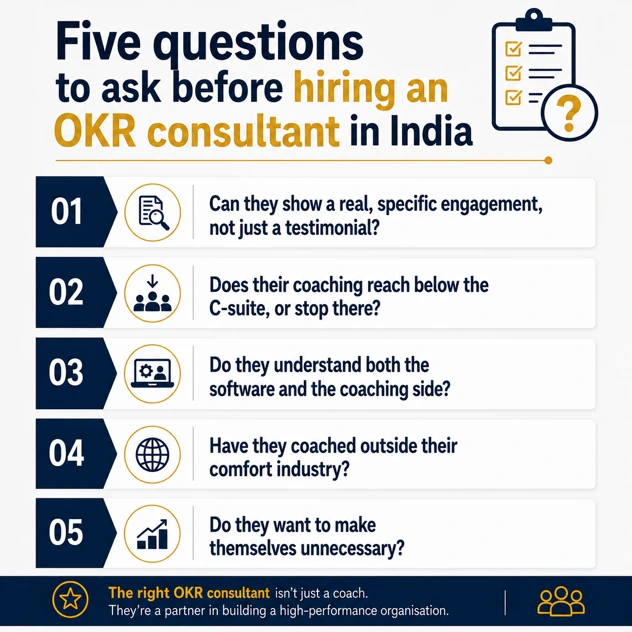
3. Do they understand both the software and the coaching side?
A consultant who only coaches, with no product background, often gives advice that sounds right in a workshop and breaks the moment it meets an actual platform’s constraints. A consultant who only sells software often defaults to configuration advice dressed up as strategy. The useful middle ground is rare enough to ask about directly: has this person actually built or run the technical side of an implementation, not just facilitated a discussion about it?
4. Have they coached outside their comfort industry?
An OKR failure inside a fintech looks different from one inside a manufacturing firm or an IT services company. A consultant who has only ever worked inside one industry brings pattern recognition from that industry alone, and will often mistake a symptom specific to your business for a universal OKR problem, or the reverse.
5. Do they want to make themselves unnecessary?
This is the most counterintuitive question on this list, and the most revealing. Ask directly: what does success look like for your engagement, and does it include the point where I no longer need you? A consultant whose business model depends on permanent retention has a quiet incentive to keep your team slightly dependent. Listen for whether the answer includes a real handoff point, not just a renewal date.
6. Can they explain what typically goes wrong, not just what typically goes right?
Anyone can describe a successful engagement. Ask instead what the most common way an engagement with them underperforms, and why. A consultant who has genuinely coached enough organisations will have a specific, honest answer, usually something about buy-in below the leadership team, or a client trying to compress the timeline. A consultant who insists nothing ever goes wrong is either inexperienced or not being straight with you, and neither is a good foundation for the several months you are about to spend working together.
Ask who coaches your middle managers in month three. If the honest answer is nobody, you already have your evaluation.
Red Flags Worth Noticing Before the Contract Is Signed
Beyond the six questions, the sales conversation itself tends to reveal more than any case study a consultant hands you. A few patterns are worth watching for specifically.
A proposal that reads identically for every industry. If the diagnostic phase of a proposal could be copied into a competitor’s pitch by changing only the company name, the engagement behind it is probably just as generic. A consultant who has actually done the work asks pointed questions about your specific structure before proposing anything.
Reluctance to name what happens after the workshop. Ask directly what the engagement includes in month two and month three, not just the kickoff. A confident, specific answer is a good sign. A pivot back to describing the workshop itself is not.
Case studies with no numbers attached. “The client was very happy” is not evidence. “Goal completion accuracy went from roughly 20% to over 80% within three quarters” is evidence, even anonymised. If every example a consultant offers stays qualitative, ask why none of them were ever measured.
What This Looks Like When It Works
One of the clearest examples I have coached through in India was a listed fintech company preparing for an aggressive five-year revenue target. I ran the session as one of the largest formats I coach in: 35-plus leaders in a full auditorium. Almost every leader in that room was blaming the IT team for missed targets, treating IT as responsible for driving business outcomes rather than enabling them.
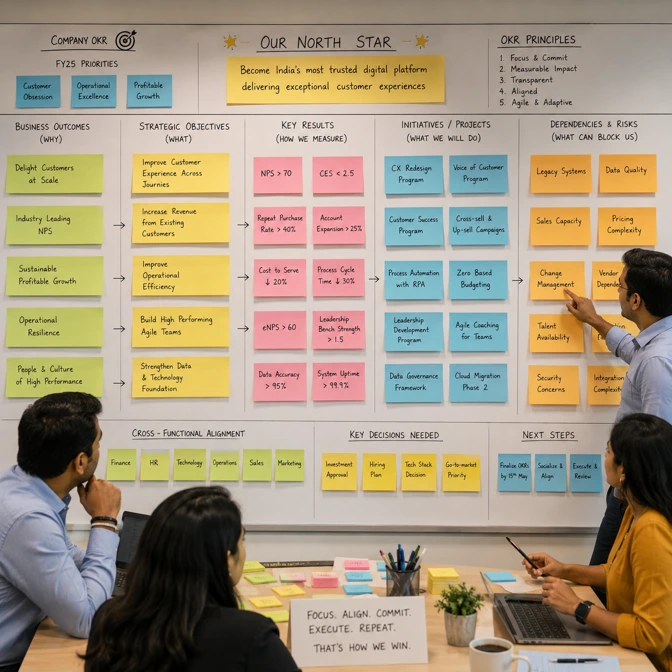
The turning point was not a slide about best practices. Every leader wrote their current goals, impact, and challenges on sticky notes across the wall. The MD walked the room, note by note, and shared what he found: roughly 80% of the goals in that room were not designed in the right direction, despite most of those leaders being able to define an Objective and a Key Result correctly if asked. Two to three quarters later, the IT blame culture had disappeared entirely, and field sales had worked out how to drive three times the results with the right investment and marketing support.
Notice what actually produced that shift. It was not a workshop delivered once and left behind. It was coaching that stayed in the room past the point where the leadership team already understood the theory, applied to their own real goals, with someone senior enough in the room to make the misalignment impossible to ignore.
That same engagement is a useful test of the six questions above, applied retrospectively. Could the consultant show a specific engagement, not a testimonial? Did the coaching reach a room of 35 leaders, not just the six or eight at the very top? Was there a clear moment where the organisation’s own leadership, not the consultant, did the work of finding the misalignment? All three answers here are yes, and that is not a coincidence. It is what the six questions are actually designed to surface.
My Take
I would not tell you to avoid every large consulting brand, or to assume every boutique practitioner is better by default. Size is not the actual variable. The six questions above are.
If you ask a prospective consultant these six questions and get specific, confident answers grounded in real engagements, you have found someone worth hiring, whatever their firm’s size or your city’s local reputation for them. If the answers stay vague, particularly on the Coaching Cliff question, that vagueness is the most useful data point you will get in the entire evaluation process. Based on Worxmate’s 2026 OKR Benchmark Report, most organisations sit at a 5% to 15% Execution Maturity Rate after a first cycle. Ask any consultant you are evaluating what that number looks like across their own past engagements. Most will not have measured it. That, too, is useful information.
Where to Go From Here
If you want to see how these six questions translate into an actual engagement, Worxmate’s OKR consulting for India is built around exactly this standard: coaching that reaches below the C-suite, delivered by someone who has built the software as well as run the coaching.
If you would rather build this capability inside your own organisation before bringing in an outside engagement, OKR Certification DEEP Framework is built around real submitted work, not an exam and a badge.
And if you are not yet sure which of these your organisation actually needs, Worxmate’s free Organization Performance Audit will tell you directly, with no product pitch attached.
The best OKR consultant in India is not the one with the biggest logo wall. It is the one who can tell you, specifically, who coaches your middle managers after the invoice is paid.
Further Reading
The Coaching Cliff: Why OKR Coaching Cliff: Why OKR Coaching Fails After the Workshop Ends – the single question worth asking any consultant before you hire them.
How to Choose an OKR Certification Program – the same evaluation logic applied to certification providers instead of consultants.
Why Most OKR Implementations Fail in the Gulf’s Fast-Scaling Enterprises – how these same failure patterns show up differently outside India.
OKR Consulting – India – the full engagement model referenced in this piece.
2026 OKR Execution Maturity Framework – the benchmark data behind the Execution Maturity Rate figures cited here.
Organization Performance Audit – a free, no-pitch diagnostic of where your organisation’s execution gap actually sits.

Written by
An OKR Coach with 20+ years of implementation experience, Madhusudan has guided over 50 organisations through successful OKR transformations, training more than 500 leaders. Learn more about Worxmate.