 WORXMATE
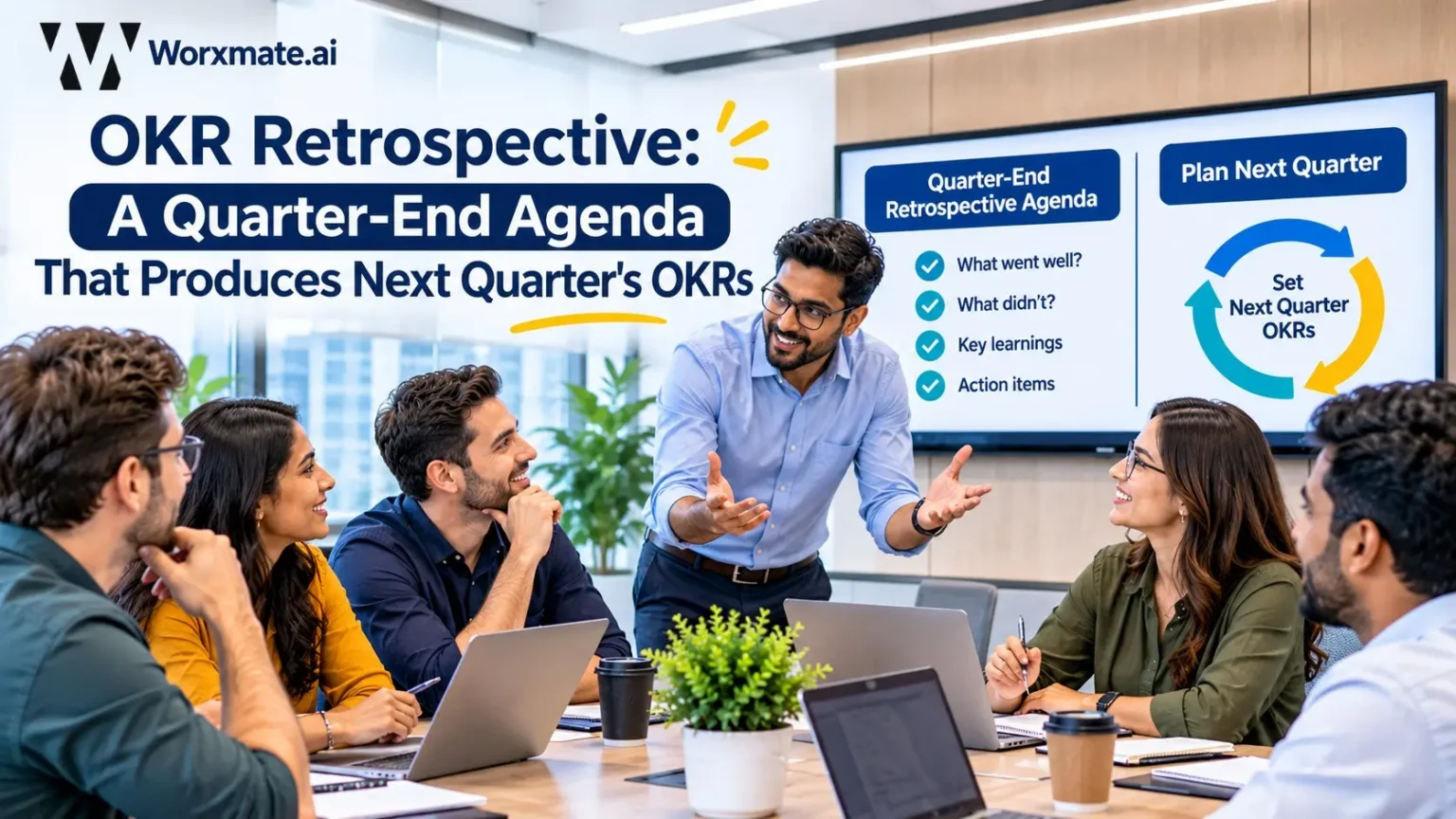
An OKR retrospective agenda is a time-boxed quarter-end meeting that moves in seven steps: set a safe contract, read the scores, audit outcomes against outputs, find root causes, decide what to keep, kill, carry or change, draft two or three priorities for next quarter, and commit owners. Run it in about 90 minutes, after pre-work that scores every key result honestly. The meeting is only successful if it ends with a first draft of next quarter’s OKRs, not just a list of lessons.
Most OKR retrospectives end with a good conversation and no next quarter.
People leave feeling honest and a little lighter. Two weeks later the new OKRs are written from a blank page, by the same people, with the same habits. The learning stayed in the room. That is the failure this guide is built to prevent, so the OKR retrospective agenda below is designed backwards from its output: the first draft of next quarter’s OKRs.
Fear sits underneath most of this. In the early cycles of any program, leaders carry a silent worry that missing a stretch goal will be read as poor performance. That worry produces safe, easily completed key results and polite retrospectives. A retrospective should say, from the first minute, that a missed stretch goal in cycle one is learning, not failure. The program only fails when the organisation stops learning from the cycles it runs.
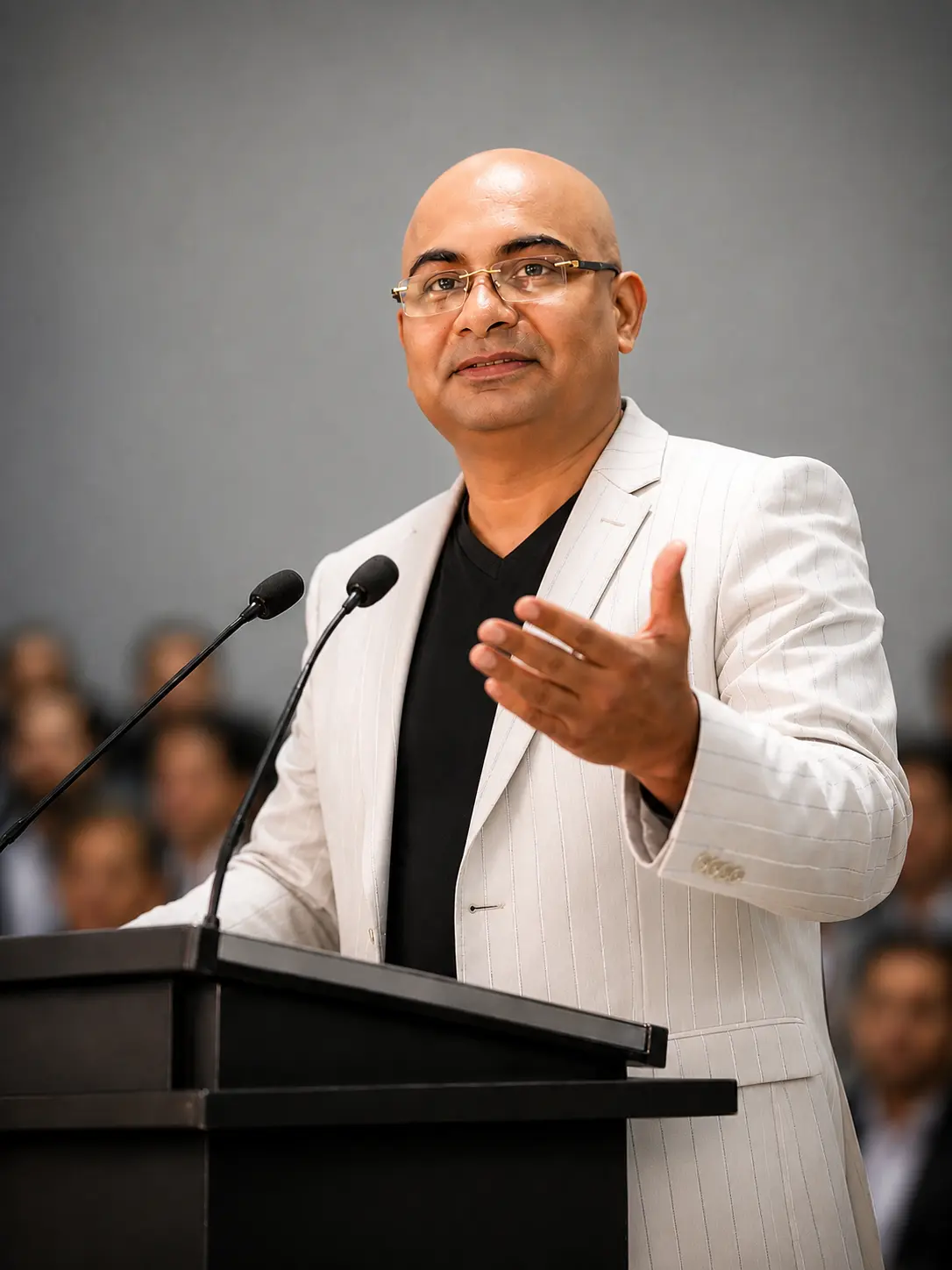
About the author: I am Madhusudan Nayak (Maddy), Co-Founder and CEO of Worxmate. I have spent 20+ years in strategy execution and 10+ years implementing OKRs across 50+ organisations, and I have trained 500+ leaders. This agenda comes from facilitating quarter-end rooms, not from a template library.
Why a Quarter-End OKR Retrospective Rarely Reaches Next Quarter’s OKRs
A quarter-end OKR retrospective fails in one of three ways. It becomes a status meeting, where people re-report numbers everyone has already seen. It becomes a blame meeting, where the lesson is who disappointed whom. Or it becomes a reflection meeting with no planning attached, so insight never changes what gets written next.
If you want the fundamentals of what a retrospective is and why it matters, read our explainer on the OKR retrospective. This piece assumes you know that and are asking a narrower question: what exactly happens in the room, and how does it feed the next cycle?
It also sits next to, not on top of, OKR reviews. An OKR review reports on progress. A retrospective decides what the organisation will do differently. One completed OKR is worth more than five written ones, and a retrospective that produces something the organisation carries into the next cycle is part of what “completed” means.
OKR Retrospective Agenda: The Quarter-End Timeline
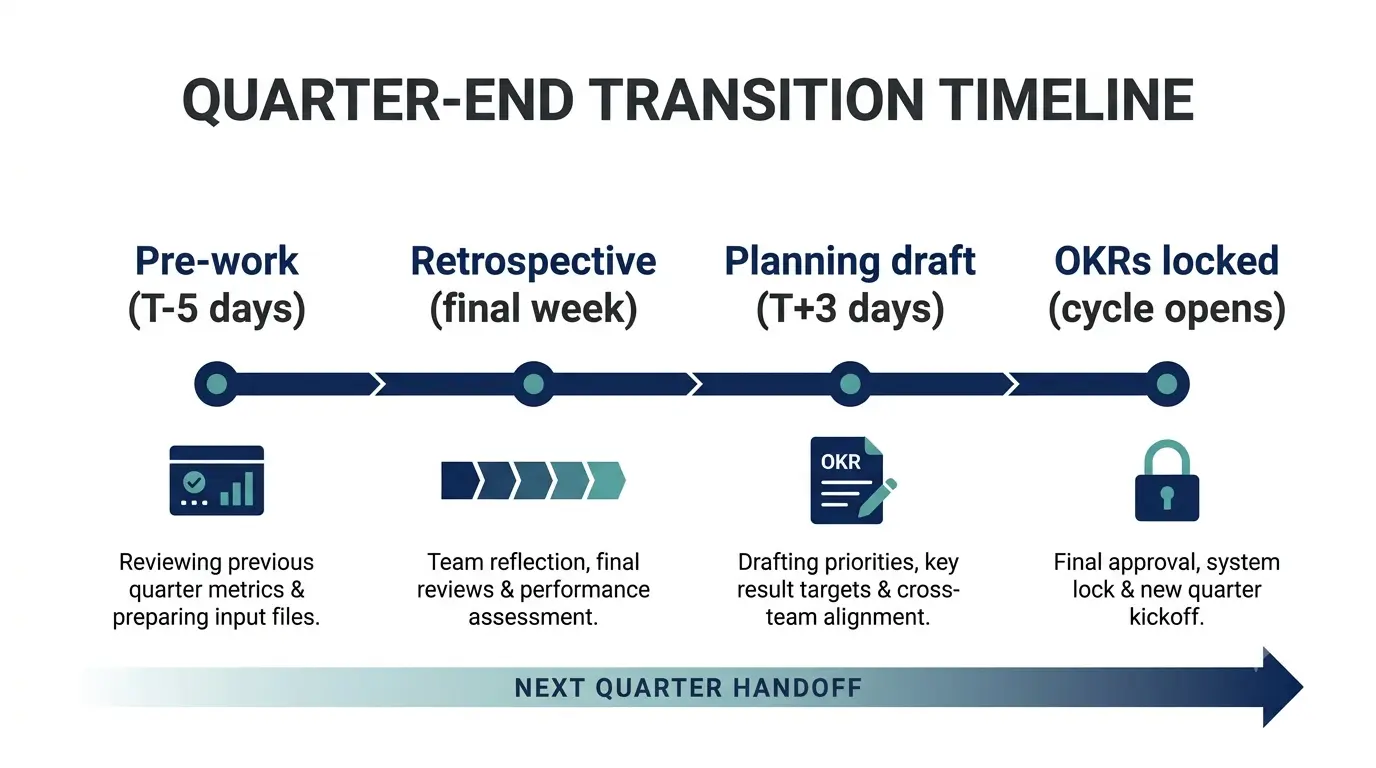
The meeting is the middle of a sequence, not the whole of it. Here is the OKR retrospective timeline I would use for a typical quarterly cycle. These timings are my starting suggestion, so adjust them to your cadence.
- About five days before quarter end: OKR retrospective pre-work: score every key result and assemble the retrospective pack.
- Final week of the quarter: the 90-minute retrospective itself.
- Within three working days after: a planning session that turns the draft into proper objectives and key results.
- Before the new cycle opens: lock, publish and link the new OKRs.
If you are still deciding on the cycle length itself, our guide to quarterly vs annual vs continuous and OKR planning quarterly vs annual cycles will help. For the wider rhythm, see mastering the OKR cycle.
Before the Meeting: Pre-Work That Makes 90 Minutes Enough
Most retrospectives overrun because the room is doing arithmetic. Do the arithmetic in advance and use the meeting for decisions.
Score every key result before anyone meets. That is how to score OKRs at the end of the quarter without arguing in the room. Use one scale across the whole company. Our guides to the OKR scoring system and the Google OKR grading scale cover the mechanics, and automated OKR scoring removes the manual step. Startups can start with OKR grading for startups.
Pull the check-in history. The story of a quarter lives in the OKR check-ins, especially the weeks where status turned amber and nobody said why. The OKR check-in meeting template shows what good ones record.
Build a one-page retro pack. Include scores, health trend, the three biggest misses, the three biggest wins and any dependency that blocked more than one team. Our guide on OKR health indicators helps you pick the health signals.
Scores mean little without a reading rule. Use something like this in the room:
| Score | What it usually signals | The question to ask |
|---|---|---|
| 0.0 to 0.3 | Weak progress, or a goal that was never within reach | Was this ambition we learned from, or a goal nobody owned? |
| 0.4 to 0.6 | Real movement on a stretch goal | What did we learn that should shape the next version of this? |
| 0.7 to 1.0 | Strong delivery, possibly too safe | Was this a genuinely hard outcome, or an easy output? |
Remember the difference between aspirational vs committed OKRs. A 0.5 on an aspirational key result can be a good quarter. A 0.5 on a committed one is a problem. Never read a score without knowing which kind it was.
The 90-Minute OKR Retrospective Meeting Agenda
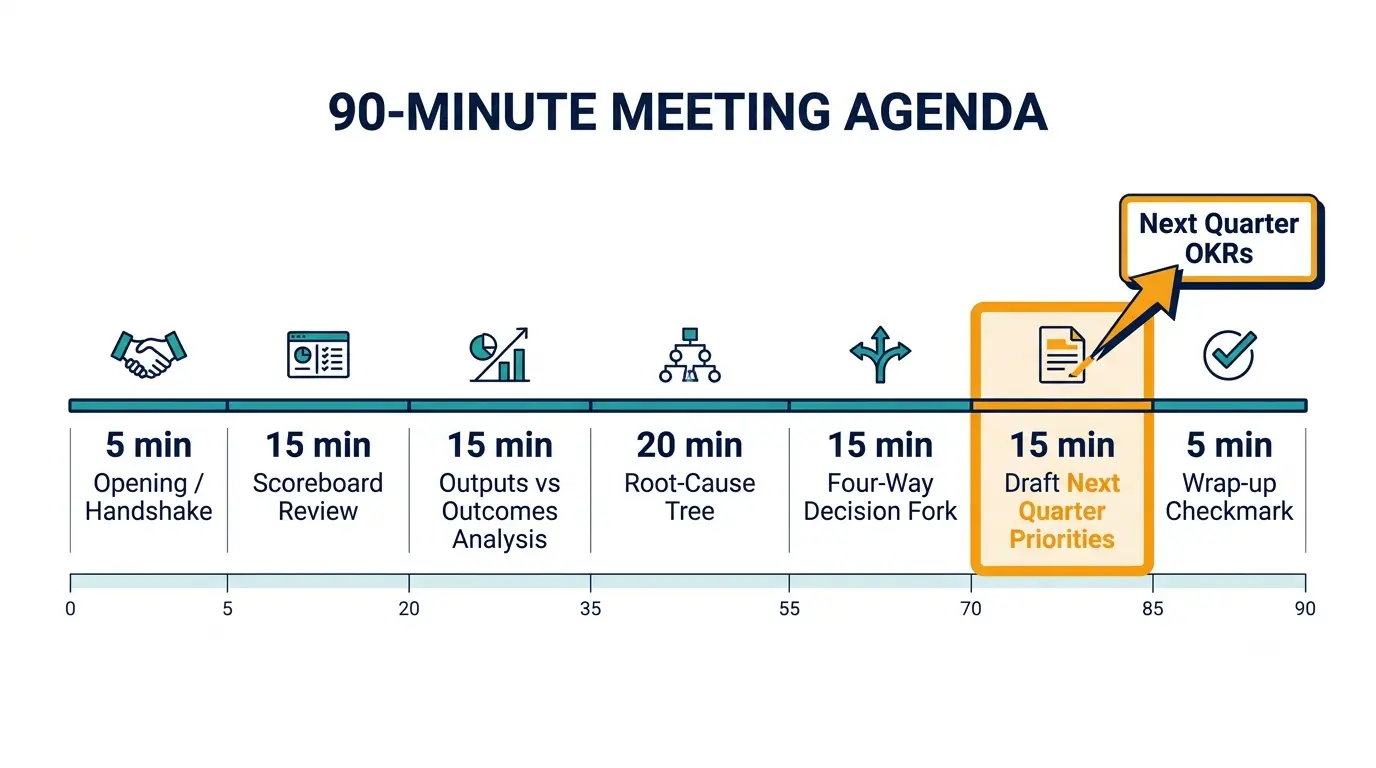
Here is the OKR retrospective meeting agenda in one view. Each step has a purpose, a question and an output you can point to at the end.
| # | Step | Time | Core question | Output |
|---|---|---|---|---|
| 1 | Set the contract | 5 min | Are we here to learn or to assess? | Agreed ground rules |
| 2 | Read the scoreboard | 15 min | What do the numbers and check-ins say? | Shared facts |
| 3 | Outcome audit | 15 min | Did we change an outcome, or finish outputs? | Marked list of outcome vs output goals |
| 4 | Find root causes | 20 min | Why did the misses and wins happen? | Three to five causes |
| 5 | Keep, kill, carry or change | 15 min | What should happen to each OKR? | A decision per OKR |
| 6 | Draft next quarter’s priorities | 15 min | What two or three things matter most now? | Draft priorities |
| 7 | Commit and close | 5 min | Who owns what, and by when? | Owners and dates |
Step 1: Set the contract (5 minutes)
State plainly that this is a learning meeting. Say that a missed stretch goal is information, and that scores will not be used as a performance rating here. If your OKRs are owned by HR, expect this to be hard: OKRs run as an appraisal tool produce defensive retrospectives. The ownership decision shapes the room before anyone speaks.
Step 2: Read the scoreboard (15 minutes)
Walk the one-page pack. No debate yet, only facts. Ask each team lead to name one number that surprised them. Resist the urge to explain. Surprises are the raw material for step 4.
Step 3: Outcome audit (15 minutes)
This is where an OKR retrospective earns its name. Go through the key results and mark each as an output (something we did) or an outcome (something that changed). Use the output vs outcome distinction and keep asking “so what?” until you reach a change in customer, revenue or behaviour.
At a listed Indian fintech, every leader wrote their goals, expected impact and challenges on sticky notes and put them on a wall. The MD walked the wall and found that about 80% of the goals were not designed in the right direction. That visible gap did more than any report. A smaller version of that exercise works in any retrospective: put the key results in front of the room and mark them honestly.
Step 4: Find root causes (20 minutes)
Ask why for the biggest misses and the biggest wins. For each, separate three kinds of cause: the goal was wrong, the execution was weak, or a dependency blocked it. Look for leading indicators that moved early. They tell you what to track in the next cycle.
Keep the discussion on causes in the system, not on people. Cross-functional blockers deserve special attention: if two teams each said “we were waiting on the other”, that is a candidate for a co-owned key result next quarter.
Step 5: Keep, kill, carry or change (15 minutes)
Go OKR by OKR and decide one of four things. Keep it if it is still the right outcome and was on track. Kill it if it no longer matters. Carry it if it is unfinished but still matters, re-scoped from what you learned. Change it if the outcome is right but the key results were wrong. Unfinished work is not automatically next quarter’s work, and a rolled-over OKR with the same wording is usually an unlearned lesson.
Step 6: Draft next quarter’s priorities (15 minutes)
Now, while the lessons are fresh, agree two or three priorities. Not twelve. At an APAC retail company in an expansion phase, I asked the CEO to share his top three priorities so leaders could begin writing OKRs. In 45 minutes he could not define them clearly, not because he was not sharp, but because nobody had ever asked him to compress his vision into outcomes an organisation could cascade from. A two-day war room followed before a single OKR was written. A retrospective is the cheaper moment to do that compression.
At a Middle East energy and utility group, we skipped the weeks-long exercise and ran a one-week agile brainstorm to agree on the two or three things that, if not done, would hurt business performance most. The same logic applies here: agree on what matters, then write. Link your draft to your strategic priorities before it goes any further.
Step 7: Commit and close (5 minutes)
Name an owner and a date for writing each new objective. Name which key results will be co-owned across teams. Agree the date of the planning session. End by reading back the draft priorities aloud. If they do not sound different from last quarter’s, the retrospective did not change anything.
Is each quarter’s retrospective making your leaders better at writing outcomes?
The OKR execution maturity framework shows where your leaders stand today, so you know whether your retrospectives are building capability or just conversation.
How to Turn Retrospective Findings Into Next Quarter OKRs
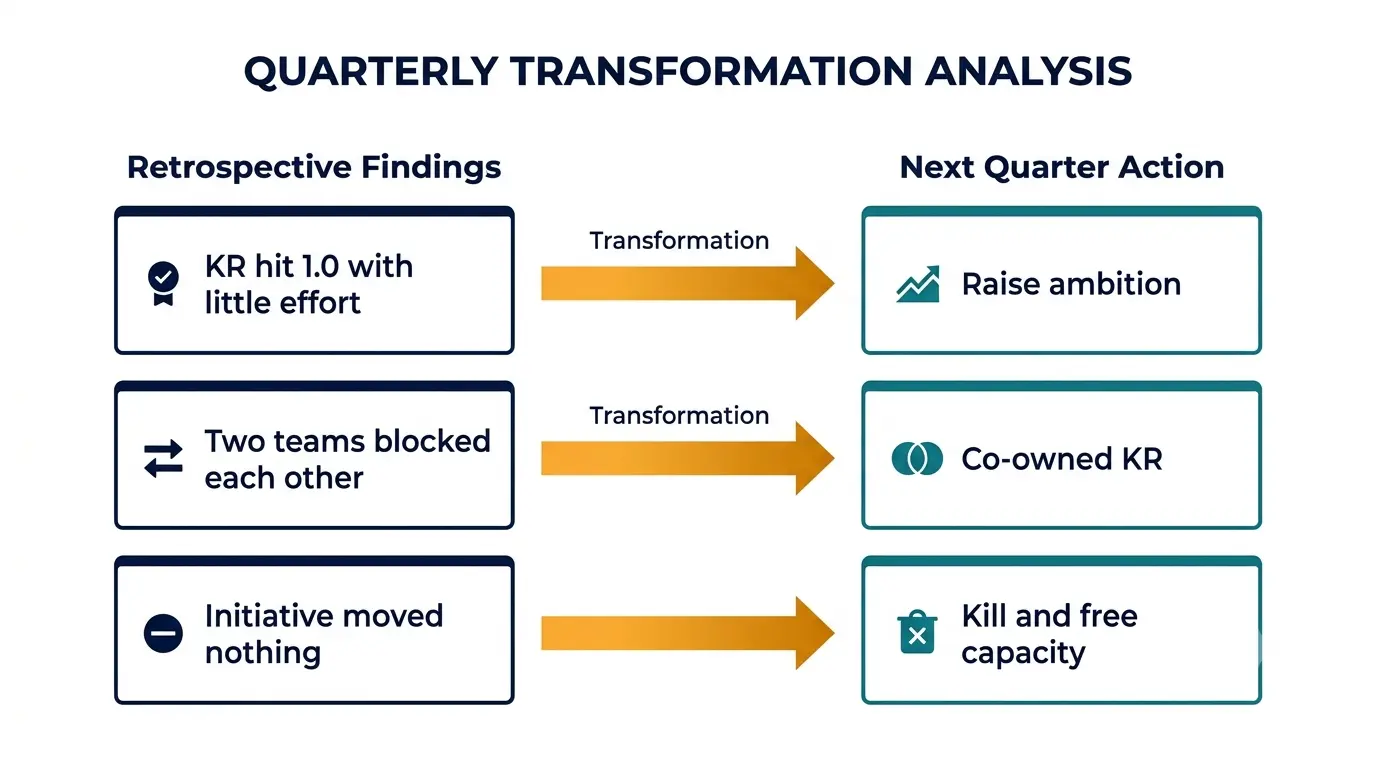
This is the step most retrospectives skip, and it is the reason this article exists. You do not leave with “lessons learned”. You leave with specific changes to the OKRs you are about to write. Here is how common findings translate into next quarter OKRs.
| What the retrospective found | What it becomes in next quarter’s OKRs |
|---|---|
| Key result scored 1.0 early, with little effort | Raise the ambition. Move from a committed to an aspirational target, or from output to outcome. |
| Key result completed, but the business outcome did not move | Rewrite as the outcome. Ask “so what?” until the key result describes a change. |
| Two teams blocked each other | Create a co-owned key result so both are accountable for the same result. |
| Stretch goal scored 0.4 with clear learning | Carry it, re-scoped, with the leading indicator you discovered added as a key result. |
| An initiative consumed effort and moved nothing | Kill it, and free the capacity for one of the two or three priorities. |
| Check-ins went stale by week six | Fix the cadence before writing new goals. Set a named owner and a weekly slot. |
| Nobody could explain how a team OKR linked upward | Rebuild the link as an agreement between the parent and child owners. |
That last row is the alignment point. Alignment is agreement between teams, not a configuration in a tool, and a retrospective is a natural moment to test it. Our guides to OKR alignment and goal alignment go deeper.
After the retrospective, hold the planning session. The mechanics of writing the objectives themselves sit in OKR planning and in a typical OKR cycle. Do not try to write final wording inside the retrospective. Draft priorities there, write properly afterwards.
Your retrospective keeps surfacing the same problems?
Our ebook on the common pitfalls of implementing OKRs shows why the same issues repeat from cycle to cycle and how to break the pattern.
Who Should Attend an OKR Retrospective and Who Facilitates It
Start with OKR retrospective attendees. Who should attend an OKR retrospective at leadership level? The people who own company and business-unit OKRs, plus the person who owns the program. For an OKR retrospective for leadership teams, keep the room small enough that everyone speaks. At team level, the lead and the owners of each key result are enough.
The OKR retrospective facilitator matters more than the guest list. The facilitator should not be the person whose goals are under review, and should not be a manager scoring their reports. In a first-cycle program, a coach or the strategy head’s office is a good fit. That is the heart of how to facilitate an OKR retrospective: a neutral voice, strict time boxes and a refusal to let the loudest score win. OKR retrospective facilitation gets easier by the third cycle.
For an OKR retrospective for remote teams, send the retro pack 24 hours ahead and capture decisions in a shared document as you go. For an OKR retrospective for startups, the same seven steps compress into about 45 minutes with two or three OKRs.
Expect the quality of the room to improve slowly. The shift from output to outcome thinking cannot happen in three months, regardless of seniority. That is why the Execution Maturity Rate is measured across 12 months. In a typical first-cycle implementation it sits between 5% and 15%. In a well-coached program that has run consistently for 12 months, it reaches 30% to 40%. Your first few retrospectives will feel rough, and that is normal.
Achieve Your Goals Faster
See how Worxmate can help your team set clear goals and achieve faster results. Book your free demo today and experience the power of AI-driven OKRs in action.
Quarter-End OKR Review Questions Leaders Ask
If you are asking how to run an OKR retrospective end to end, the OKR retrospective process is three parts: pre-work, the 90-minute meeting and the planning session. These are the questions that come up around it.
OKR retrospective vs OKR review
The OKR retrospective vs OKR review question decides your calendar. A quarterly OKR review, or end-of-quarter OKR review, is where results are reported. An OKR cycle review that only reports is really an OKR review meeting, and it belongs before the retrospective: 30 minutes, facts only. Wondering how to run a quarterly OKR review meeting? Keep it to scores and blockers, and save the decisions for the retrospective. Quarterly OKR planning then follows both.
What to do with unfinished OKRs at the end of the quarter
Should you carry over OKRs to the next quarter? Sometimes, but OKR carry-over is a decision, not a default. For an OKR carry forward, keep only the outcome that still matters, re-scoped from what you learned. Watch for sandbagging OKRs, where a team set a low bar and finished early. Those need a higher target, not a rollover. And if you need to know how to kill OKRs that are not working, say so in the room, record why and give the freed capacity to one of next quarter’s priorities.
Action items, outcomes and lessons
Close every meeting with OKR retrospective action items that have an owner and a date, then record them in an OKR learning log so the next retrospective can check them. The OKR retrospective outcomes you want are decisions, not observations. The log is also what separates a lessons learned OKR practice from a one-off conversation, and it turns the OKR cycle closeout into something the next cycle can read.
Turning a retrospective into the next plan
How to turn an OKR retrospective into next quarter OKRs comes down to the retrospective to planning handoff: draft the priorities in the room, then write the objectives within three days. How to write next quarter OKRs from lessons learned? Start from the findings table above, not a blank page. Unlike an OKR post-mortem, which hunts for fault, the point here is to change what you write next.
Seven Mistakes That Turn a Retrospective Into a Status Meeting
- Reading scores aloud for an hour. Do it in pre-work.
- Scoring generously to avoid conflict. Generous scores hide the lessons.
- Treating the retrospective as a performance review. It kills honesty.
- Rolling every unfinished OKR forward. Decide keep, kill, carry or change.
- Writing final OKR wording in the room. Draft priorities, then plan.
- Stopping at the C-suite. If middle managers never run their own retrospective, the program fades below leadership.
- Skipping the retrospective when the quarter went well. Easy wins hide sandbagged goals.
These are close cousins of the broader patterns in why OKRs fail and common OKR mistakes to avoid. If the retrospective itself is not changing anything, the problem is rarely the agenda. It is usually the safety of the room.
Do people in your organisation feel safe missing a stretch goal?
The performance culture maturity framework helps you see whether your culture rewards learning or only delivery.
Where Evaluate and Plan Fit in DEEP AI
In DEEP AI (Define, Execute, Evaluate, Plan), the retrospective sits across the last two stages. Evaluate is where the quarter becomes data: scores, check-in history and health trends. Plan is where that data becomes the next cycle. Without them, every retrospective is rebuilt from memory and opinion, and nothing compounds from quarter to quarter.
The earlier stages decide what you have to learn from. Define catches weak outcomes before they are committed, and Execute keeps check-ins honest so the quarter has a record. Then Evaluate turns the quarter into evidence, and Plan carries it forward.
Around them, Axis AI shows where business performance drifted from plan, Orbit AI shows which leaders and managers need coaching, and Nexus AI shows patterns that repeat across teams. Without that view, retrospectives rely on whoever remembers the quarter best.
Bottom Line: A Retrospective Is a Planning Meeting in Disguise
Run the retrospective so that it ends with next quarter’s priorities on the table. Do the arithmetic before the meeting. Spend the 90 minutes on outcomes, causes and decisions. Then plan.
The software is the infrastructure. The coaching is the capability. You need both, and in the right order.
Path 1: the platform. To see scoring, check-ins and retrospectives in one place, explore Worxmate OKR software, look at pricing or book a demo.
Path 2: the consulting. If your retrospectives are polite but change nothing, our OKR consulting is built to coach leaders through real cycles.

Written by
An OKR Coach with 20+ years of implementation experience, Madhusudan has guided over 50 organisations through successful OKR transformations, training more than 500 leaders. Learn more about Worxmate.