 WORXMATE
Quick Answer
OKR software for managers turns everyday check-ins and 1:1s into structured coaching data instead of a status-update ritual. The best manager effectiveness software surfaces which direct reports are falling behind before the next performance review, not after it. Worxmate builds this into its DEEP AI™ framework: structured OKR check-ins for managers feed Orbit AI, which flags overload and disengagement four to eight weeks ahead of a formal review, so manager effectiveness becomes measurable instead of anecdotal. This is the same gap that shows up across most manager-employee alignment tool categories: teams log the conversation but nothing reads the pattern underneath it.
The real cost of unstructured manager-employee check-ins
A manager running eight direct reports has eight 1:1s a week. Each one starts the same way: “So, how’s it going?” Fifteen minutes later, both people leave the call unsure whether anything was actually decided. Three months later, a direct report resigns, and the exit interview reveals frustration that had been building since the second month, frustration the manager never saw, because nothing from those eight weekly conversations was ever captured anywhere searchable.
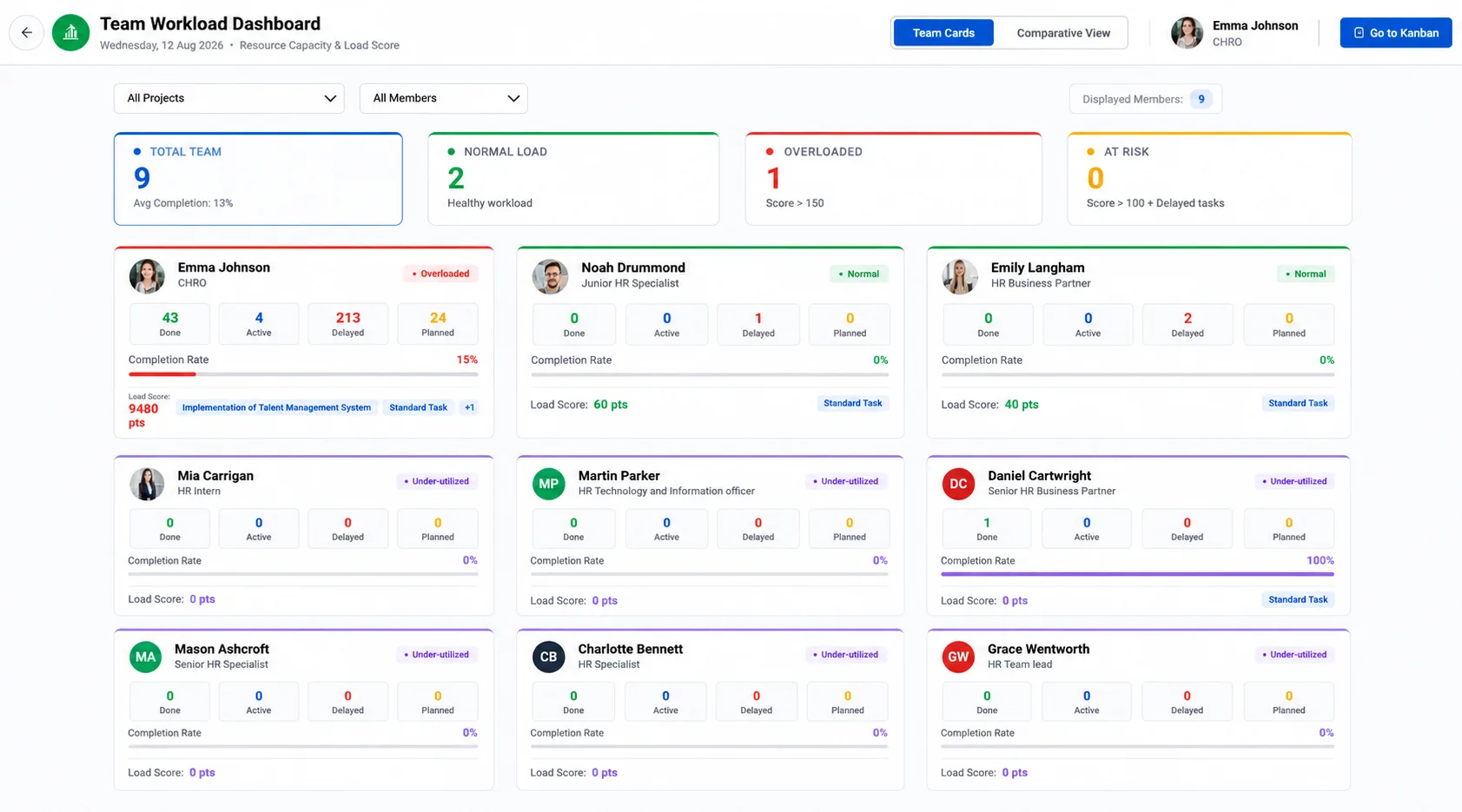
This is the actual gap behind most “manager effectiveness” initiatives: not a lack of care, but a lack of structure. Managers aren’t given a framework that turns a conversation into a signal. HR rolls out a performance improvement plan process for when things have already gone wrong, but there’s rarely a system that catches the drift while it’s still fixable. In my conversations with HR leaders running mid-market and enterprise teams, this specific failure comes up more than any other: 1:1s are treated as optional rather than core process, scheduled on the calendar but not built into any system that remembers what was said in them. The role of leadership in OKR failures traces back to exactly this not bad managers, but managers working blind, with no OKR software for manager effectiveness anywhere in their weekly workflow.
The scale of the problem compounds fast. A single manager with eight direct reports is running roughly 400 one-on-ones a year. Even a highly attentive manager can’t reliably remember which action item from six weeks ago was never followed up on, or notice that a report’s language in check-ins has quietly shifted from “on track” to “manageable” to “we’ll see.” Those shifts are real signals. They’re just invisible without something structured enough to hold them across time. This is precisely why what is quality of work as a concept keeps getting reduced to output metrics in most performance systems: nobody has built the infrastructure to capture the conversational signal that actually predicts it. A manager coaching software layer that only logs attendance is solving the easy 20% of the problem and leaving the hard 80% (whether the conversation actually moved anything) untouched.
OKR software for managers exists to close that specific gap: not to replace the 1:1 conversation, but to make sure what happens in it becomes visible, trackable, and actionable before it becomes a resignation letter or a missed goal. That’s the distinction between a tool that records check-ins and a genuine manager-employee alignment tool: one produces a transcript, the other produces a pattern a manager can act on.
What manager effectiveness actually looks like in OKR software
Manager effectiveness isn’t a training module or a personality trait. Inside an OKR alignment software context, it’s measurable through specific, observable signals.
| Signal | What It Reveals |
|---|---|
| Check-in consistency | Whether 1:1s are happening on a real cadence, not just scheduled |
| Key result ownership clarity | Whether each direct report knows exactly what they’re accountable for |
| Early risk flags | Whether a stalling goal is caught in week 3, not discovered in week 11 |
| Coaching follow-through | Whether action items from a 1:1 actually get revisited next time |
Most manager effectiveness tools stop at the first row: they track whether a check-in happened, not whether it was useful. A genuine manager-employee alignment tool needs all four, because a check-in that happens on schedule but surfaces nothing is functionally the same as no check-in at all. This is also where standardizing 1:1 meetings and 1:1 meeting automation matter consistency is the floor, not the ceiling.
The distinction matters more than it sounds. Plenty of manager effectiveness software on the market can tell an HR leader that Manager X ran 92% of scheduled 1:1s last quarter. Almost none of them can answer the follow-up question a CHRO actually cares about: of those 1:1s, how many surfaced a blocker that got resolved, versus how many were a status recap that changed nothing? A 1:1 meeting OKR software built around key results, rather than a generic notes field, is what makes that second question answerable, because the conversation is anchored to a specific, measurable key result instead of an open-ended agenda.
Unlock Goal Clarity & Accelerate Employee Growth
Looking to drive goal clarity and employee growth? Discover how Worxmate’s AI-powered Performance Management Software can help.
How Worxmate builds manager effectiveness into OKR software
Worxmate’s approach to manager effectiveness runs through two connected layers: structured check-ins as the Execute stage of DEEP AI™, and Orbit AI reading the pattern across those check-ins over time.
Structured 1:1 and check-in flow. The OKR check-in software, DEEP AI’s Execute stage — replaces the “how’s it going?” open-ended check-in with a structured flow: progress against each key result, blockers named explicitly, and a coaching prompt generated from what’s actually stalling. This is what makes OKR check-ins useful data rather than a box-ticking exercise, and it follows the same structure covered in our OKR check-in meeting template. Because every check-in is tied to a key result rather than a free-text field, the system can compare this week’s language and progress velocity against last week’s, which is the input Orbit AI needs to detect drift before a manager would notice it by instinct.
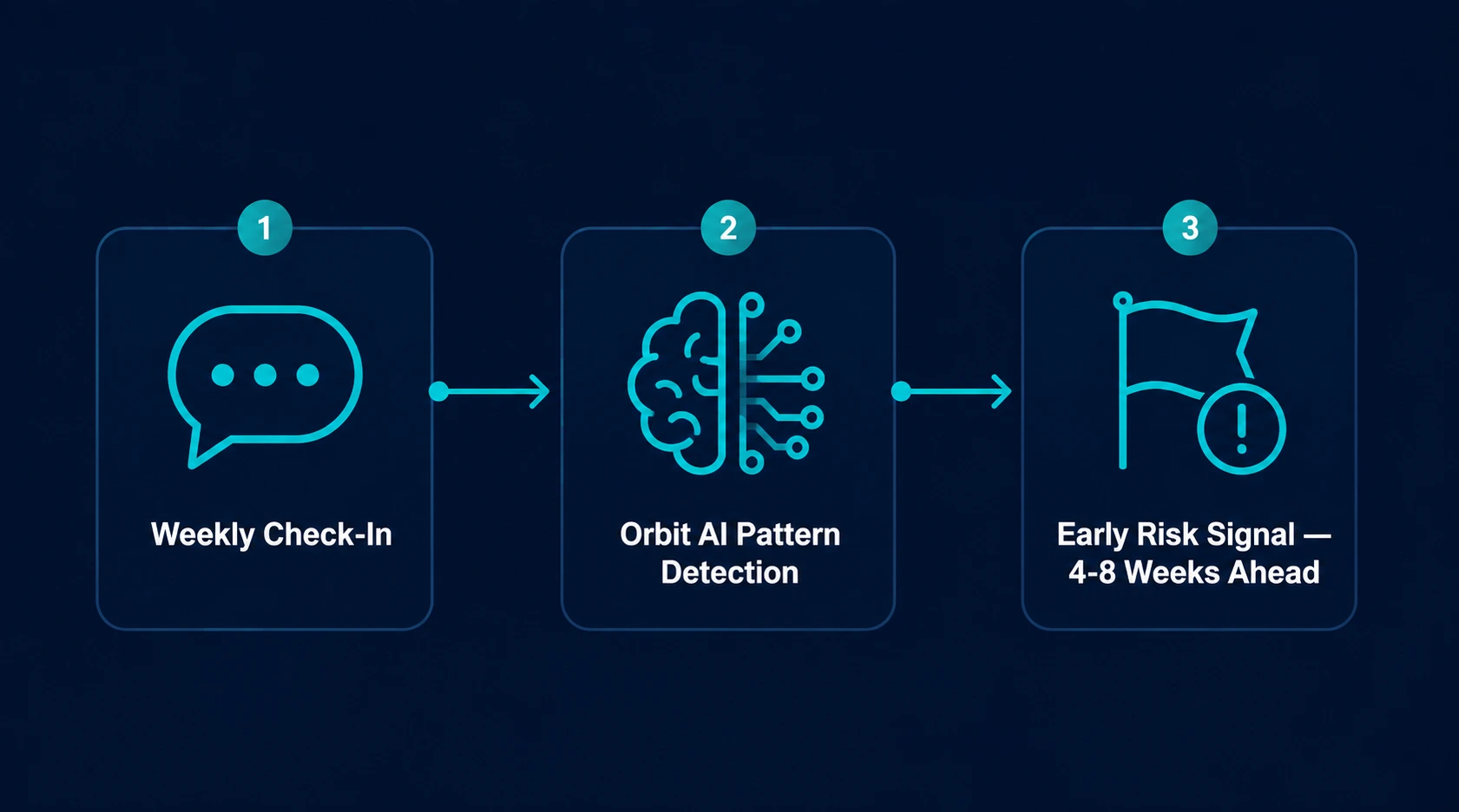
Orbit AI reads the pattern. Worxmate’s employee performance intelligence software doesn’t wait for a quarterly review to flag a struggling report. It reads check-in language, progress velocity, and workload signals across weeks to surface overload, disengagement, or flight risk four to eight weeks before it would otherwise be caught. Orbit AI tracks six named signals across this pattern: Burnout Risk, Attrition Trigger, Engagement Decline, Top Performer Flight Risk, Rating Inflation Drift, and Skills Decay. For a manager running eight 1:1s a week, this is the difference between noticing a pattern by instinct and having it surfaced directly, with the specific signal named rather than a vague “check in with this person” nudge.
Cross-functional visibility. Managers rarely operate in a silo. A direct report’s blocker is often another team’s dependency. Cross-functional team alignment and team OKR tracking make sure a manager isn’t troubleshooting a cross-team blocker alone, disconnected from the rest of the org’s alignment map. This is the part most standalone check-in apps can’t offer: because Worxmate’s OKR check-ins for managers sit inside the same cascade as the rest of the organization’s goals, a manager can see, in the same view, whether a report’s stalled key result is blocked by something inside the team or by a dependency owned three teams over.
From check-in to coaching: the full manager effectiveness loop
A single structured check-in is a data point. What actually changes manager effectiveness is what happens to that data point afterward, and this is where most manager coaching software stops short, because logging a check-in isn’t the same as acting on it. Worxmate closes this loop through the remaining two DEEP AI™ stages, both built with manager-level visibility in mind
Scorecards separate real progress from reported progress. The OKR scorecard software, the Evaluate stage, uses AI forecasting to flag when a direct report’s self-reported “on track” status doesn’t match their actual progress velocity. This matters at the manager level specifically, because a report who is struggling often reports optimistically right up until the point they can’t anymore. The scorecard catches the gap between the two, weeks before the gap would otherwise show up in a missed deadline.
Retrospectives turn a manager’s pattern into next-cycle coaching. The OKR retrospective tool, the Plan stage, doesn’t just close out a quarter, it surfaces which coaching conversations from this cycle actually moved the needle and which didn’t, so a manager isn’t repeating the same ineffective 1:1 approach every quarter without realizing it. One completed, honestly retrospected OKR is worth more to a manager’s development than five that were written, tracked loosely, and scored generously at the end.
Together, this is the difference between a manager effectiveness tool that logs conversations and one that actively improves how a manager coaches over time, which is also the standard how to get your team to actually use OKRs sets for adoption that sticks past the first cycle.
OKR software for managers vs. dedicated check-in and people tools
Several platforms are built specifically around manager-employee interaction rather than pure OKR tracking. Evaluators often shortlist these three alongside Worxmate precisely because they lead with manager-facing features rather than a generic goals module. Here’s how the category actually breaks down, and where each one is genuinely the stronger choice.
Betterworks is the strongest option for manager effectiveness at large enterprise scale. Its manager-facing tools are genuinely mature, built for organizations running structured review cycles across thousands of employees. The trade-off: no self-serve path, and a procurement cycle that can stretch for months, which makes it a poor fit for a mid-market team that wants to move this quarter.
Lattice combines performance management with an OKR module and works well when HR is the one driving the program. Where it creates friction is when a CEO or Strategy Head, not HR, is trying to drive execution, because OKRs end up absorbed into HR’s rhythm rather than the business’s rhythm, which slows exactly the kind of fast course-correction manager effectiveness is supposed to enable.
15Five pairs weekly check-ins with OKR tracking and performs best where a manager-employee check-in culture already exists. It’s reinforcing a habit, not building one from zero. Its cascade depth is limited, so it’s a stronger fit for single-team rollouts than for an organization trying to connect manager effectiveness to company-wide alignment.
| Tool | Manager Effectiveness Strength | Best Fit | Main Limitation |
|---|---|---|---|
| Worxmate | Structured check-ins + Orbit AI pattern detection | Mid-market to enterprise wanting early-warning signals, not just logging | — |
| Betterworks | Deep manager tooling at enterprise scale | 1,000+ person orgs with existing review cycle discipline | No self-serve, long procurement |
| Lattice | OKR + performance in one platform | HR-led programs | Friction when business (not HR) drives execution |
| 15Five | Strong weekly check-in habit-building | Teams that already have a 1:1 culture | Limited cascade depth |
Full breakdowns: Worxmate vs Betterworks, Worxmate vs Lattice, Worxmate vs 15Five.
The distinction worth remembering: manager vs leader is a real difference, and most manager effectiveness software on the market optimizes for the administrative side of managing (status, tracking, reporting) without touching the coaching and judgment side that actually separates a good manager from a great one. That gap is exactly what Orbit AI’s pattern detection is built to narrow, not replace.
Who needs OKR software built for manager effectiveness
- Business Unit Heads managing multiple team managers need visibility into which managers are running effective check-ins and which are just going through the motions, without having to sit in on every 1:1 personally. Our OKR software for Business Unit Heads page covers this pattern in more depth, specifically the challenge of judging manager quality at a distance.
- CHROs need attrition risk surfaced at the manager-report level before it becomes a resignation statistic — and need a defensible, data-backed answer when the board asks why turnover is climbing in one specific team. The OKR software for CHROs page walks through how that early-warning data gets built into a board-ready narrative.
- Talent Heads use the same early-warning data for succession planning and flight-risk forecasting, turning what used to be gut-feel talk-track into a pattern that can be tracked across quarters. hat use case is broken down further on the OKR software for Talent Heads page.
- L&D Heads can use the coaching-follow-through data to identify which managers need development themselves, rather than assuming manager training worked because a workshop happened. The OKR software for L&D Heads page goes into how that coaching-follow-through data feeds a development plan that isn’t guesswork.
This connects directly to the broader alignment picture. A manager effectiveness layer without visibility into how those team goals ladder into company objectives is only solving half the problem. The best OKR software with visual alignment mapping page covers how the two connect, and why a manager-employee alignment tool that can’t show the cascade above it is only ever giving a manager half the context they need to coach well.
Unlock Goal Clarity & Accelerate Employee Growth
Looking to drive goal clarity and employee growth? Discover how Worxmate’s AI-powered Performance Management Software can help.
What week one looks like for a manager
A manager shouldn’t need a training session to start using this. In week one, existing 1:1s move into the structured check-in flow, key results get explicit owners instead of implied ones, and Orbit AI starts building a baseline. There’s no meaningful signal from a single week, but the pattern-detection engine begins learning what “normal” looks like for that team immediately, rather than waiting for a quarter of data to accumulate. This is a deliberate design choice: most enterprise manager effectiveness software requires weeks of configuration before a manager sees anything useful, and by then the team has already lost the habit of using it.
By week three or four, most managers start seeing their first genuinely useful signal. Not a dramatic alert, but something like a report whose check-in language has quietly flattened, or a key result that’s been “on track” for three straight weeks without any measurable movement. These are the exact patterns a busy manager running eight parallel 1:1s is most likely to miss, and they’re also the patterns why OKRs feel like extra work usually traces back to . The process felt like overhead because it wasn’t surfacing anything the manager couldn’t already see.
By the end of the first quarter, the pattern data compounds into something a manager can act on proactively rather than reactively: which direct reports consistently under-report risk, which key results tend to stall in the same week of every cycle, and which coaching conversations from the previous cycle actually produced a change in behavior versus which ones were forgotten by the next check-in. That compounding is the actual product of OKR software for managers. The dashboard is the visible layer. The pattern underneath it, built weekly, is the part that changes how a manager runs their team.
OKR software for managers — pricing
Manager effectiveness features, including Orbit AI, are available across Worxmate’s Vital, Proficient, and Enterprise tiers, with the depth of AI-driven signals expanding at higher tiers. Enterprise plans add deeper cross-team pattern detection for Business Unit Heads managing multiple manager layers at once. Full current pricing is on the OKR software pricing page.
Watch Orbit AI read your team’s real check-in pattern
If you’re ready to see this on your team: the clearest way is watching Orbit AI read a real check-in pattern, not a demo org’s sample data. Book a live demo and we’ll walk through a real manager’s check-in flow with you.
If the gap is coaching skill, not software: the software surfaces the signal, it doesn’t teach a manager what to do with it. Our OKR consulting team works on the coaching capability that makes the signal actionable.The software is the infrastructure. The coaching is the capability. Most manager effectiveness initiatives need both, in that order.


Written by
An OKR Coach with 20+ years of implementation experience, Madhusudan has guided over 50 organisations through successful OKR transformations, training more than 500 leaders. Learn more about Worxmate.