 WORXMATE
Quick Answer
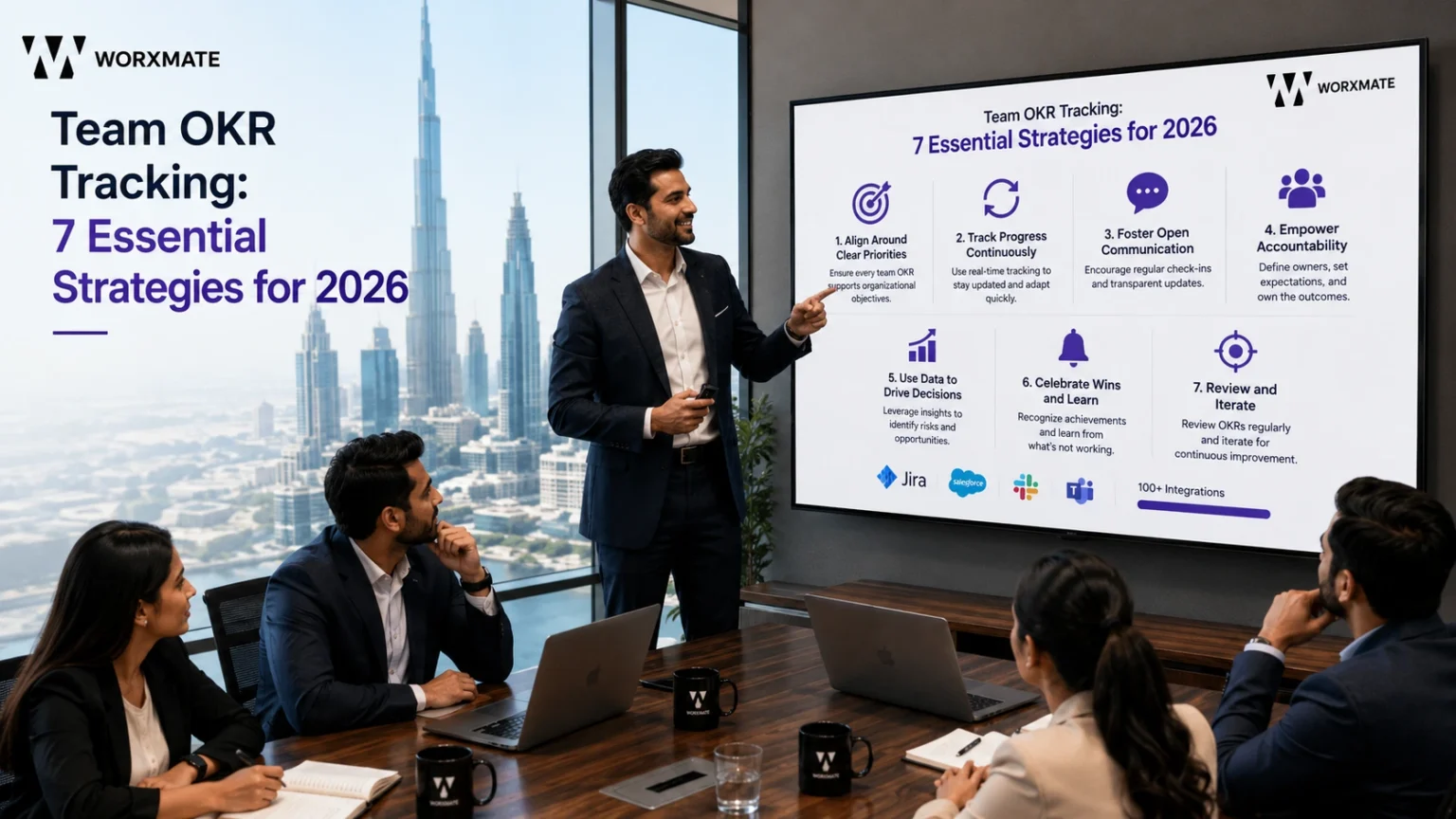
Effective team OKR tracking requires moving beyond simple completion rates to focus on real-time execution maturity and outcome achievement. It demands a dedicated platform that provides at-risk signals, supports outcome-driven goal writing, and fosters continuous alignment, rather than just logging progress against outputs. The key is to track not just “what” but “how well” teams are executing strategy.
I was in a quarterly business review recently where a Head of Product proudly presented a dashboard showing 90% completion rates for their team’s Key Results. On paper, it looked like a resounding success. Yet, the CEO’s frustration was palpable. “If everything is 90% complete,” he pressed, “why are we still behind on our market share target? Why haven’t we seen the uptake we expected?” The disconnect was stark: the team was busy, they were checking boxes, but they weren’t moving the business. This isn’t an isolated incident; it’s the core pain point for many leaders trying to implement effective OKR tracking at the team level.
The problem isn’t usually a lack of effort. It’s often a fundamental misunderstanding of what good team OKR tracking truly entails. Most teams track outputs features shipped, meetings held, content published and mistake these for outcomes. The software they use might even reinforce this by offering simple progress bars that reward activity, not impact. This creates a dangerous illusion of progress that masks a deeper execution gap. When teams are busy but not delivering strategic outcomes, it’s not a people problem; it’s a systemic tracking problem.
My experience across 50+ OKR implementations has shown me that the real challenge isn’t just setting OKRs, but ensuring that the tracking mechanism genuinely reflects strategic progress. Without this, OKRs become another administrative burden, a reporting exercise rather than a powerful engine for execution. The solution lies in shifting the focus from mere completion to the quality of execution and the actual business outcomes delivered.
Why Traditional Team OKR Tracking Falls Short
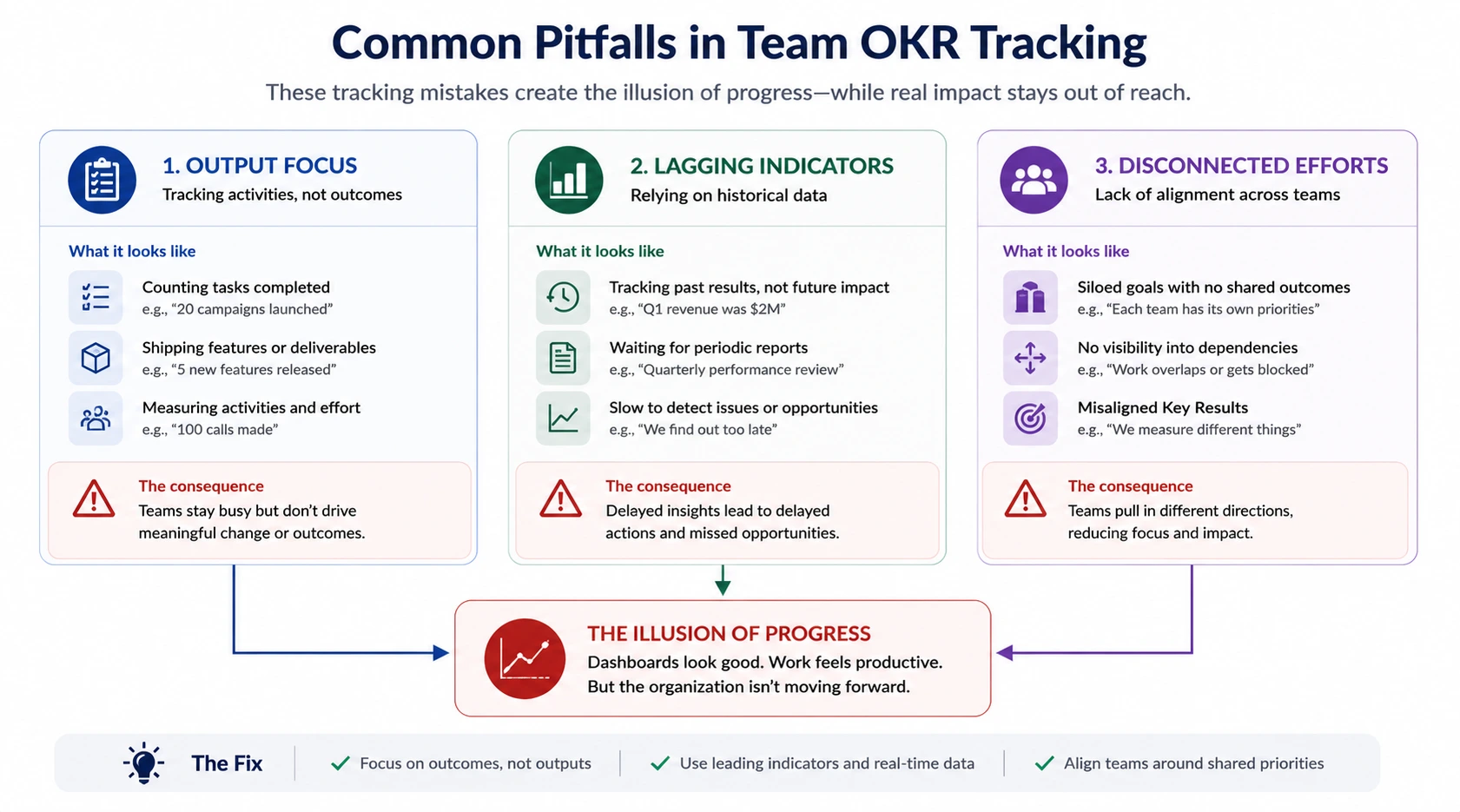
Many organizations launch OKRs with enthusiasm, only to see them devolve into a glorified task list. The tracking process often becomes a weekly ritual of updating percentages, devoid of critical analysis or proactive problem-solving. This isn’t because teams are intentionally misrepresenting their work, but because the systems and processes in place don’t equip them to do anything else. The typical pitfalls are predictable:
- Output Obsession: Teams track the volume of work completed user stories closed, campaigns launched, lines of code written. These are outputs. While necessary, they don’t tell you if the work actually moved the needle on customer satisfaction, revenue, or market penetration. Without a clear focus on outcomes vs. outputs, tracking becomes a measure of busyness, not effectiveness.
- Lagging Indicators Only: Most tracking focuses on what happened in the past. By the time a Key Result is flagged as “at risk” in a monthly review, it’s often too late to course-correct effectively. What’s needed are leading indicators that signal potential issues early.
- Disconnected from Strategy: Team OKRs, even if well-written, often exist in a silo. Without clear organizational alignment, one team’s “successful” OKR might inadvertently undermine another’s, or simply not contribute to the top-level company objectives.
- The Coaching Cliff: OKR programs often receive strong executive sponsorship and initial coaching, but this support rarely cascades to the middle management layer. Yet, this is precisely where team OKR tracking lives or dies. When coaching stops at the C-suite, the program dies below it within one quarter. Managers are left to interpret and implement OKRs without the necessary skills or support, leading to inconsistent tracking and poor adoption.
I’ve seen this play out repeatedly. In a 70,000-person IT services organization, teams were diligently tracking project milestones. The problem was, those milestones were internal deliveries, not customer impact. Their internal dashboards were green, but client satisfaction was flat. It took a live scenario game and a “Thinking Process” to help them derive outcome-driven OKRs from 2-3 BU-level priorities, forcing a fundamental shift in how they approached team OKR tracking.
The goal of team OKR tracking isn’t to create more reports; it’s to create a real-time feedback loop that enables proactive decision-making and genuine strategic execution. If your current tracking system isn’t doing that, it’s time to rethink the approach.
The Practitioner’s Lens: Alignment is Agreement, Not a Feature
One of the most profound lessons from my work with executive teams is this:
Alignment is agreement between teams on what matters, why it matters, and how each team’s work connects to the teams around them. You cannot set that in a tool. You can display it. You cannot create it.
This counterintuitive belief underpins effective team OKR tracking. Many leaders mistakenly believe that simply configuring an OKR platform to show dependencies or parent-child relationships automatically creates alignment. It doesn’t. What it creates is a visual representation of a relationship that may or may not exist in reality.
True alignment comes from difficult conversations, shared understanding, and a willingness to commit. It’s about a product team agreeing with a commercial team on a shared Key Result for example, “Increase active user engagement to 60%” where both teams co-own the outcome. This requires asking “so what?” repeatedly until the team understands the real business impact of their work. I saw this firsthand with a European fintech startup. Their initial OKRs were largely output-focused. Through repeated “so what” questioning and coaching on cross-functional KR co-ownership between Product and Commercial, they reached genuine outcome-thinking. Their team OKR tracking then became a reflection of shared commitment, not just individual task lists.
The real ROI metric of an OKR program isn’t goal completion rate; it’s Execution Maturity Rate. This measures the percentage of leaders who can independently write a genuine outcome-driven goal without coaching, a template, or a quality review. In a typical first cycle, it sits between 5% and 15%. In organizations coached consistently over 12 months, it reaches 30% to 40%. This shift is critical for effective team OKR tracking because it means teams are not just logging progress, but actively shaping their contribution to strategic outcomes. If teams can’t define outcome-driven goals, their tracking will always be superficial.
By The Numbers
Execution Maturity Rate: Typically ranges from 5-15% in a first OKR cycle, but can reach 30-40% after 12 months of consistent coaching, indicating a significant improvement in outcome-driven goal setting.
Another crucial observation: fear of failure is an invisible adoption blocker. Leaders, especially at the team level, will write safe, easily completable Key Results rather than genuinely ambitious outcomes unless the coaching explicitly makes clear that cycle-one failure is learning, not performance failure. This psychological safety is paramount for fostering true outcome-driven team OKR tracking. Without it, tracking becomes a defensive exercise designed to show “green” regardless of real impact.
The transition from output to outcome thinking cannot happen in a single quarter, regardless of seniority. It is a 12-month journey, which is why Execution Maturity Rate is measured across a year, not 90 days. This means your team OKR tracking system needs to support this long-term evolution, not just quarterly snapshots.
Execution Maturity Rate: First Cycle vs 12 Months of Coaching
Building a Robust System for Team OKR Tracking with DEEP AI
To move beyond superficial updates, team OKR tracking needs to be integrated into a strategic execution rhythm. This is where a framework like DEEP AI becomes invaluable. It provides a structured approach to the entire OKR cycle, ensuring that tracking is meaningful and actionable.
For team OKR tracking, the “Execute” phase is particularly critical. It’s not enough to simply log updates. A robust system must provide real-time warning signals. This means moving beyond a simple “green, yellow, red” status to understanding the underlying factors. For instance, if a team raises 15-20 product support queries per day in week one of using a new OKR tool, it’s a strong predictor that adoption will break. These are the kinds of signals that dedicated OKR software is built to detect, offering insights that an HRIS or generic project management tool simply cannot.
This brings me to a crucial category distinction: HRIS platforms (like Zoho People, Keka HR, Darwinbox) are built around HR workflows, where OKRs are one feature among many. For dedicated OKR software, OKRs are the feature. While HRIS systems are strong for HR processes, they are the wrong fit for serious OKR implementation and effective team OKR tracking. They lack the depth in AI-assisted goal writing, real-time at-risk detection, and outcome-driven analytics that a purpose-built OKR platform provides. This isn’t a criticism of HRIS platforms; it’s an acknowledgement of their different purpose.
OKR Execution Maturity Framework 2026
Understand where your organization stands in its OKR journey and identify key areas for improvement in execution and adoption.
What Effective Team OKR Tracking Looks Like in Practice
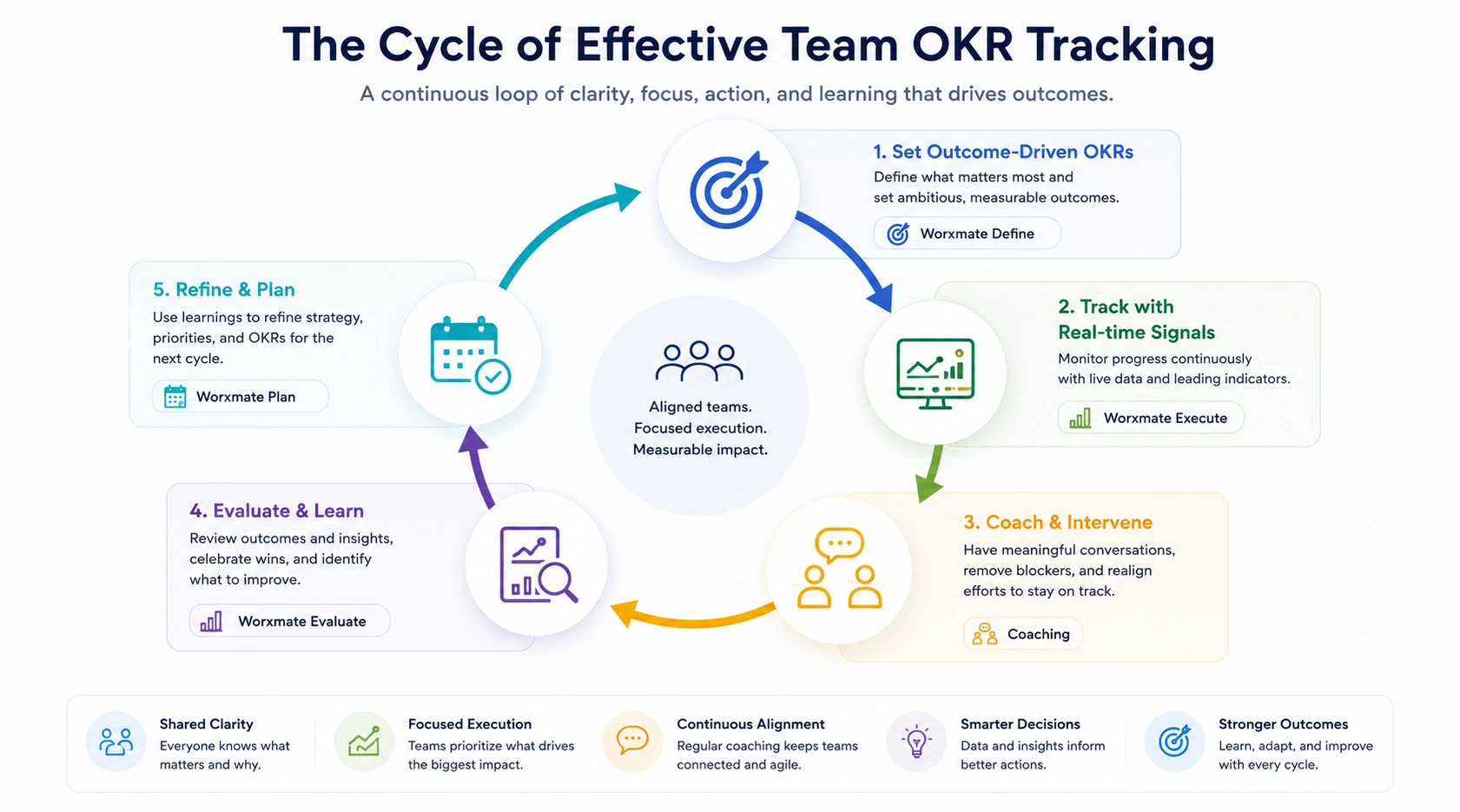
When team OKR tracking is done right, it transforms from a reporting chore into a dynamic management tool. It’s about proactive signals, not reactive post-mortems. Here’s what I’ve observed in organizations with high Execution Maturity Rates:
1. Real-time At-Risk Signals, Not Just Status Updates: Instead of waiting for a weekly check-in, the system provides immediate alerts when a Key Result is trending off track, or when dependencies are at risk. This allows managers to dive deep into the “why” during their OKR check-ins, rather than just logging a number. For example, if a Key Result is “Increase customer retention to 90%”, the system might flag it as “at risk” if customer support tickets for critical issues spike, even if the retention number hasn’t dropped yet.
2. Coaching and Intervention, Not Just Data Entry: Team leaders are equipped to act as coaches, not just administrators. They use the tracking data to facilitate conversations about roadblocks, resource allocation, and skill gaps. The focus shifts from “what did you do?” to “what do you need to move this forward?” This is especially important for middle managers who are often on the front lines of team execution.
Field Note
Week-one warning signals are often the clearest predictors of long-term OKR adoption. If teams are raising 15-20 product support queries per day in their first week with new software, it’s a red flag that adoption will break unless immediate coaching and support are provided.
3. Transparency and Cross-Functional Visibility: Teams can easily see how their OKRs connect to broader strategic objectives and how their progress impacts other teams. This fosters genuine cross-functional agreement and reduces siloed efforts. It’s not just about displaying a hierarchy; it’s about making the interdependencies explicit and actionable. This level of transparency requires a platform that’s designed for it, not an add-on feature.
4. Learning and Adaptation: The tracking process feeds directly into continuous learning. Retrospectives are not just about celebrating wins, but deeply analyzing failures and adapting the approach for the next cycle. This iterative process is what drives the increase in Execution Maturity Rate over time. For an APAC retail company, their CEO initially couldn’t name 3 clear priorities in 45 minutes. Through 1:1 coaching (not group training) and a two-day war room, they established clear priorities. This allowed teams to then track against those priorities meaningfully, leading to a noticeable improvement in execution velocity.
Ultimately, effective team OKR tracking is about enabling teams to understand their impact, identify issues early, and adapt quickly. It’s about creating an environment where “one completed OKR is worth more than five written ones” because that completed OKR genuinely moved the business forward.
Talk to an OKR Coach
Get tailored guidance to implement and scale OKRs effectively across your teams, ensuring real outcomes and sustained adoption.
My Take: The Dual Path to Execution Excellence
The software is the infrastructure. The coaching is the capability. You need both, and in the right order. Many organizations invest heavily in an OKR platform, only to find that teams still struggle with effective team OKR tracking because the underlying capabilities and understanding aren’t there. Conversely, robust coaching without the right tools can lead to manual, cumbersome processes that don’t scale.
If your teams are consistently busy but not delivering the expected strategic outcomes, it’s time to assess both your tooling and your team’s execution maturity. For leaders ready to build a system that moves beyond superficial progress reports, the path is clear. On one hand, you need a dedicated OKR platform designed to foster outcome-driven goal setting, provide real-time signals, and integrate seamlessly into your execution rhythm. Explore Worxmate OKR Software, understand our pricing, and get a demo to see how it can transform your team’s execution.
On the other hand, if your challenge is more about shifting mindsets, building capability, and ensuring deep alignment across your organization, then a pure software solution isn’t the first step. You need hands-on guidance to embed the right practices and overcome the “Coaching Cliff.” Our OKR Consulting services provide that expertise, working directly with your leaders to build the skills and culture necessary for sustained success. The goal is not just to track OKRs, but to genuinely move your business forward.


Written by
An OKR Coach with 20+ years of implementation experience, Madhusudan has guided over 50 organisations through successful OKR transformations, training more than 500 leaders. Learn more about Worxmate.