 WORXMATE
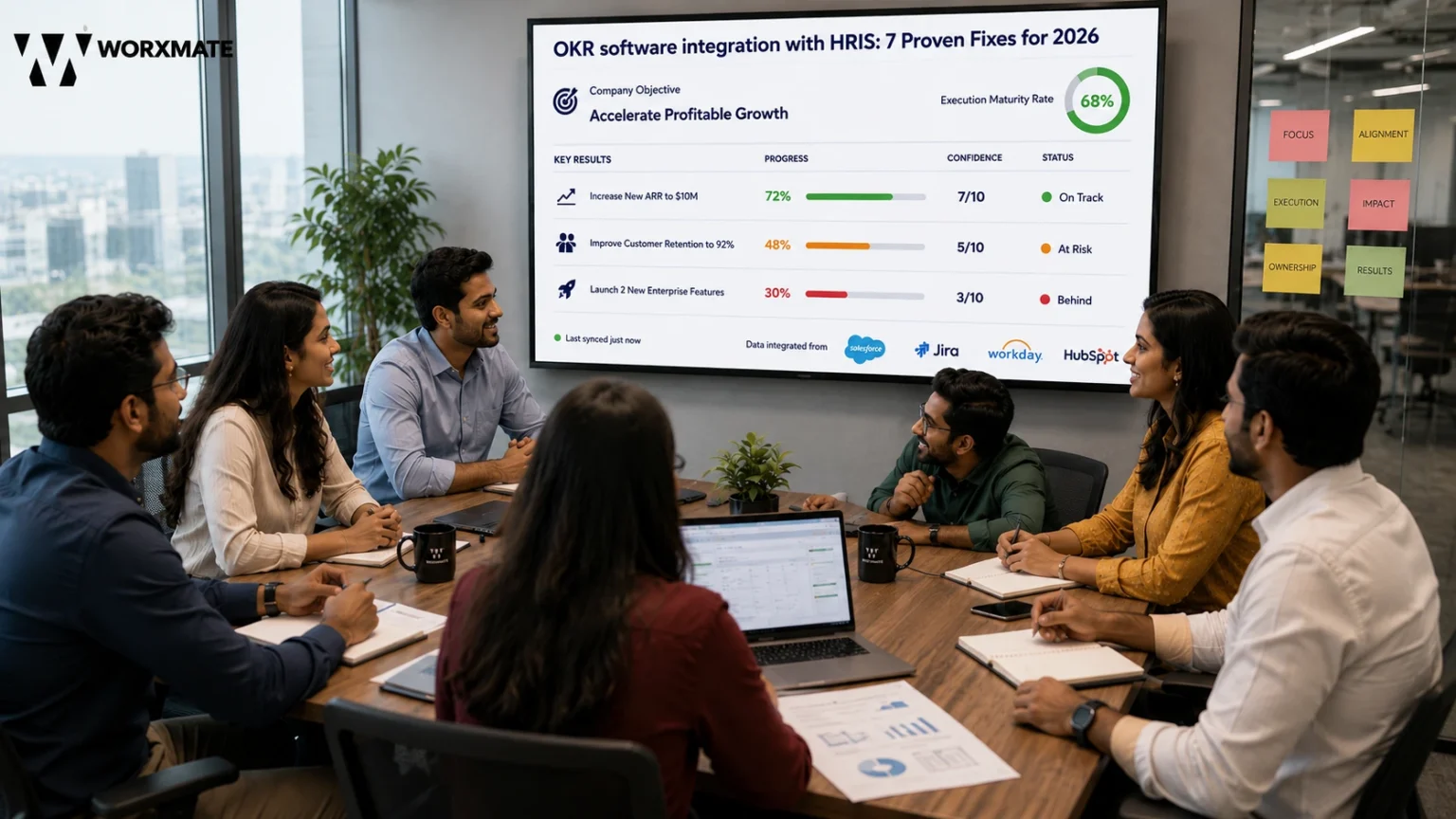
OKR software integration with HRIS is the critical bridge between employee data and strategic execution. By enabling automated OKR data sync, organizations eliminate manual reporting friction, ensure real-time alignment, and prevent the “Coaching Cliff” where strategy dies in silos. This integration transforms HR from a process administrator into a strategic driver of enterprise OKR workflow.
I recently sat in a boardroom with a CHRO of a 1,500-employee IT services organization who was exhausted. They had just finished their quarterly review, and the data was a mess. The HRIS showed one version of the truth regarding headcount and department structures, while their standalone goal-tracking spreadsheets showed another. Managers were spending four hours a week manually updating progress bars that were already out of date by the time the meeting started. This is the exact moment a leader realizes that strategy execution cannot live on an island. Without OKR software integration with HRIS, your strategic framework is just a digital paperweight.
The conviction I hold after 50+ implementations is simple: Alignment is agreement between teams, not a platform configuration. However, you cannot maintain that agreement if the data powering it is broken. When employee data synchronization fails, the trust in the system evaporates. If a developer sees their reporting line is wrong in the OKR tool, or a Sales Head sees a departed employee still owning a $2M revenue Key Result, they stop looking at the dashboard. The integration isn’t a “nice-to-have” technical feature; it is the fundamental plumbing of organizational trust.
In my experience, the gap between a successful rollout and a failed one often comes down to the enterprise OKR workflow. Most organizations treat OKRs as a separate event from the daily work. They set them in January and forget them by March. By integrating your OKR software with your existing HRIS, you move the strategy into the flow of work. You stop asking people to “do OKRs” and start asking them to “drive the business.”
30–40%
Execution Maturity Rate
Organizations using automated OKR data sync reach this maturity level within 12 months, compared to just 5-15% for those relying on manual updates.
The Hidden Cost of Fragmented HRIS OKR Integration
When we talk about HRIS OKR integration, we aren’t just talking about syncing names and email addresses. We are talking about the structural integrity of your strategy. I have seen HRIS performance management cycles grind to a halt because the “source of truth” for who reports to whom was disconnected from the goal-setting platform. This creates a “shadow hierarchy” where the work is happening in one direction, but the reporting is going in another.
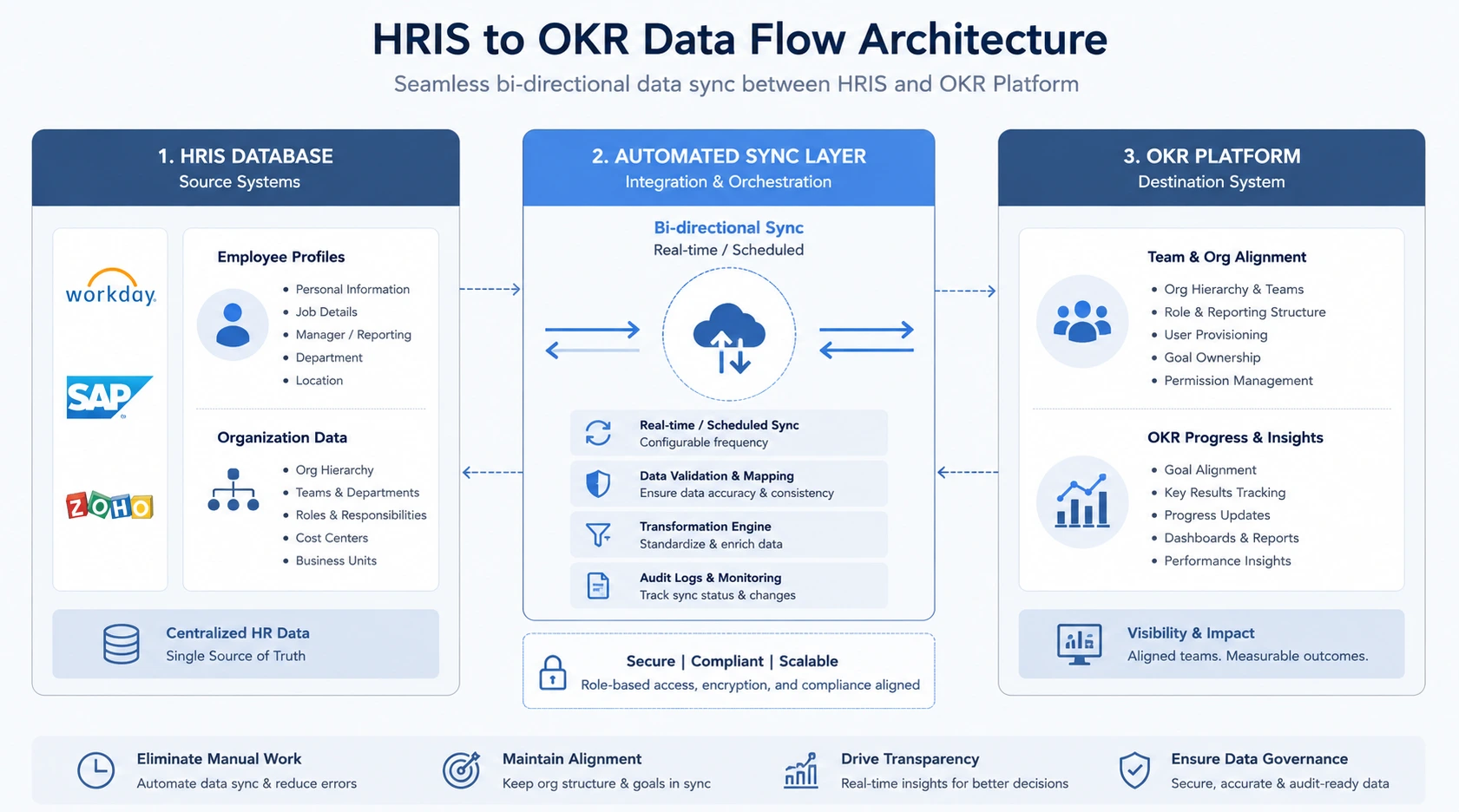
The pain is most acute during the employee data synchronization phase of a new quarter. In a typical enterprise, 3-5% of the workforce might change roles, join, or leave every month. Without an automated OKR data sync, HR teams spend dozens of hours manually reassigning Key Results. This is administrative debt that prevents HR from doing high-value work like coaching or talent development. According to research by Gartner, organizations that fail to integrate their talent data with business outcomes see a significant drop in employee engagement and strategic clarity.
Consider the enterprise OKR workflow in a high-growth SaaS company. If the OKR software for CTOs isn’t pulling the latest engineering squads from the HRIS, the QA engineering OKRs will inevitably be assigned to the wrong leads. This leads to the “Not My Goal” syndrome, where employees ignore targets because the system doesn’t reflect their actual daily reality. This is why OKR software integration with HRIS is the first thing I look for when auditing a failing program.
🎯 Practitioner Field Note
In my experience across 135+ HR leader conversations, the number one reason for OKR abandonment isn’t the difficulty of the goals, but the friction of the software. If it takes more than 3 clicks to update a result, people won’t do it.
Why Automated OKR Data Sync is Non-Negotiable
The transition from output to outcome thinking cannot happen in a single quarter. It is a 12-month journey. During this journey, the automated OKR data sync acts as the guardrail. It ensures that as people move through their performance management cycle, their goals move with them. This is particularly vital for BFSI OKR examples where regulatory compliance and clear accountability lines are mandatory.
Without automation, you hit the “Coaching Cliff.” This is the point where the C-suite stops coaching the layer below them because the data is too hard to find or too unreliable to act upon. When OKR software integration with HRIS is active, the data is always fresh. A manager can open a 1:1 and see exactly how their team is performing against the strategy vs tactics balance without asking for a manual report.
We often see this in enterprise OKR workflow designs for large-scale organizations. They might have 500+ leaders who need to be trained. If those leaders are spending their time fixing data errors instead of coaching their teams, the Execution Maturity Rate will never break the 15% ceiling. By automating the sync, you free up that mental bandwidth for actual leadership.
Bridging HRIS Performance Management and Business Outcomes
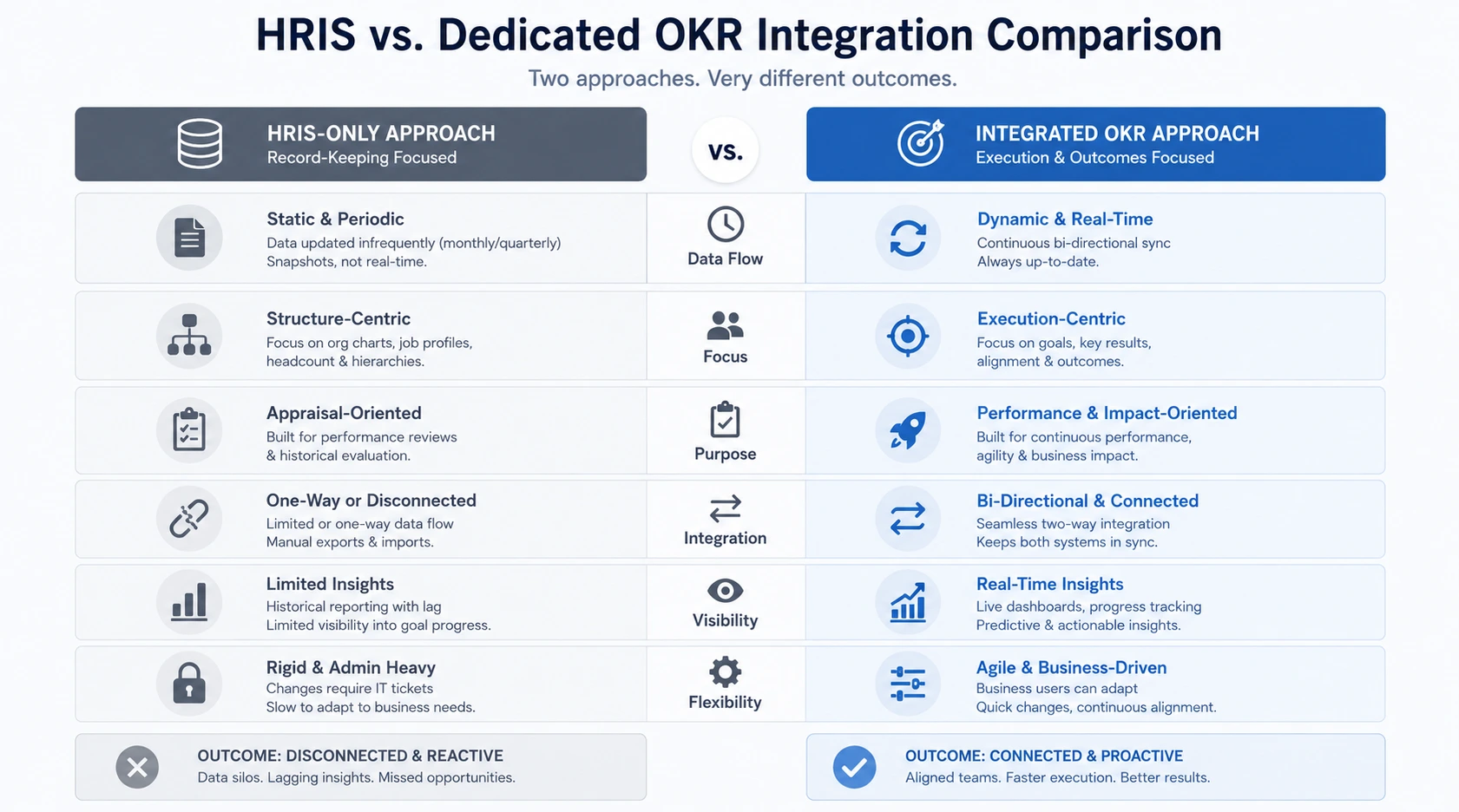
One of the most common and costly structural mistakes is HR owning OKRs as a standalone appraisal tool. When this happens, OKRs become “just another HR task.” To avoid this, the HRIS performance management system must be bridged with the business execution engine. This is where the Orbit AI performance intelligence layer becomes essential.
An OKR Coach evaluating a PMS platform asks one question: does this platform tell HR whether their people are moving the business, or does it tell HR whether their people completed the process? OKR software integration with HRIS allows you to answer the first part of that question. It links the “who” (from HRIS) with the “what” (from OKRs) and the “how well” (from Performance Reviews).
I recall a European fintech startup that struggled with this. They had great real OKR examples on paper, but their performance reviews were based on manager gut-feel rather than goal delivery. By implementing a PMS-OKR Bridge, they were able to see that their top-rated performers were often the ones contributing the least to strategic Key Results. This “Third Eye Layer” of visibility is only possible when employee data synchronization is seamless.
“OKRs owned by HR become a performance appraisal tool. OKRs owned by the CEO’s office become a strategy execution engine. The integration is what allows both to coexist without friction.”
The DEEP AI Framework for Enterprise OKR Workflow
To truly master OKR software integration with HRIS, we use the DEEP AI framework: Define, Execute, Evaluate, and Plan. Each of these stages is enhanced by a tight integration with your employee data.
- Define: Using the Define AI OKR writing tool, managers can draft goals that are automatically mapped to the correct department and level based on HRIS data.
- Execute: The Execute OKR check-in software sends automated reminders to the right people at the right time, because it knows exactly who is on which team.
- Evaluate: Performance data is pulled into retrospectives, allowing for a KPI to OKR conversion that is based on actual historical performance.
- Plan: Future cycles are planned using the Execution Maturity Rate data, identifying which departments need more coaching.
This framework ensures that automated OKR data sync isn’t just a technical background task, but a core part of how the company operates. It prevents the “Set and Forget” mentality that kills so many programs. When the system is integrated, the OKRs are visible in the tools people use every day, whether that’s Slack, Microsoft Teams, or their performance dashboard.
| Integration Level | Data Sync Type | Business Impact | Maturity Signal |
|---|---|---|---|
| Full Integration | Real-time Bi-directional | High Execution Velocity | 30-40% Maturity |
| Partial Sync | Weekly CSV Uploads | Moderate Admin Friction | 15-20% Maturity |
| No Integration | Manual Entry | High Risk of Failure | 5-10% Maturity |
Overcoming the “Coaching Cliff” with Employee Data Synchronization
The “Coaching Cliff” is a term I use to describe the moment when leadership stops supporting the OKR process because it feels like too much work. This usually happens in week three or four of a cycle. If the OKR software integration with HRIS is weak, managers have to chase people for updates. If the employee data synchronization is automated, the “chasing” is handled by the system.
In my work with a Middle East energy company (8,000+ employees), we found that by automating the sync between their SAP HRIS and the OKR platform, we reduced the time spent on “process administration” by 70%. This allowed their HR team to focus on HRIS performance management strategy rather than data entry. They moved from being “data janitors” to “strategic advisors.”
This is especially important when dealing with specialized roles, such as personal OKRs for designers or engineers. These roles often have very specific, outcome-based targets that don’t fit into a standard HRIS “job description” field. The integration allows the enterprise OKR workflow to capture these nuances without breaking the central reporting structure.
Impact of Automated Sync on Execution Maturity
Benchmark Data
12% Maturity
38% Maturity (+216% Lift)
Selecting the Right OKR Software Integration with HRIS
When evaluating tools, many leaders make the mistake of looking only at the feature list. They see “HRIS Integration” and check the box. But the quality of that integration varies wildly. A Betterworks alternative or a Mooncamp alternative should be judged on how it handles complex organizational changes, not just simple user provisioning.
A “week-one warning signal” I always watch for is the number of support queries regarding “missing users” or “wrong managers.” In a healthy automated OKR data sync, this number should be near zero. If your team is raising 15-20 queries per day in week one, your integration is broken, and your adoption will fail within the quarter. This is why we emphasize the enterprise OKR workflow as a foundational element of our OKR software USA and global implementations.
For organizations in India, finding the best OKR software in India often means finding a tool that can handle local HRIS platforms like Darwinbox or Keka alongside global ones like Workday. The employee data synchronization must be robust enough to handle the specific nuances of these platforms, such as multi-entity structures or complex leave policies that might affect goal timelines.
The Future of HRIS Performance Management
We are moving toward a world where HRIS performance management is no longer a separate silo from business operations. The rise of AI-driven insights means that the data living in your HRIS can now be used to predict which goals are at risk. This is the core of Orbit AI’s 6 Named Signals, which include Burnout Risk and Top Performer Flight Risk.
Imagine a scenario where your OKR software integration with HRIS notices that a key project lead has had zero check-ins for three weeks, while their HRIS record shows they haven’t taken a vacation in six months. The system can flag this as a “Burnout Risk” before it impacts the what is OKR delivery. This level of proactive management is only possible when the data is unified.
This is the “Third Eye” that HR leaders have been looking for. It moves HR from a reactive posture—dealing with problems after they appear in a quarterly review—to a proactive one. By leveraging automated OKR data sync, you are building an early warning system for your entire business strategy.
Admin Time Saved
70%
Reduction in manual data entry
Adoption Lift
+200%
Increase in weekly check-ins
What I’d Tell a Client About Integration
If you are considering OKR software integration with HRIS, don’t start with the API documentation. Start with your organizational chart. Is it accurate? Does it reflect how work actually gets done, or just how people are paid? If your HRIS data is messy, your OKR integration will be messy too. Clean the source before you build the bridge.
Secondly, remember that the software is the infrastructure, but the coaching is the capability. You need both, and in the right order. I have seen companies spend $100k on a perfect HRIS OKR integration only to have it fail because the managers didn’t know how to write an outcome-driven Key Result. They used the perfect automation to sync bad goals. This is why we always pair our platform with OKR consulting.
Finally, look for a partner who understands the enterprise OKR workflow at scale. A tool that works for a 50-person startup will often break at 5,000 people. You need a platform that can handle the complexity of employee data synchronization across multiple geographies, currencies, and business units. This is where the real ROI of OKR software integration with HRIS is found.
The Enterprise OKR Integration Guide
Learn how to connect your HRIS to your strategy engine without the technical debt.
The bottom line is this: your strategy is only as strong as the data that supports it. By investing in OKR software integration with HRIS, you aren’t just buying a feature; you are buying the ability to see your business clearly. You are removing the friction that prevents your best people from doing their best work. And in a competitive market, that clarity is the only sustainable advantage you have.
Whether you are looking for BFSI OKR examples or trying to fix a broken HRIS performance management system, the answer is the same. Connect your people data to your business outcomes. Automate the sync. Coach the leaders. The results will follow.
The software is the infrastructure. The coaching is the capability. You need both, and in the right order.
Path 1: The Platform
If you are ready to see how automated OKR data sync can transform your execution, explore our OKR Software and Pricing, or Get a Demo today.
Path 2: The Consulting
If you recognize that your platform isn’t the first problem and you need to build the leadership capability to drive outcomes, our OKR Consulting team can help you reach 30-40% Execution Maturity within 12 months.


Written by
An OKR Coach with 20+ years of implementation experience, Madhusudan has guided over 50 organisations through successful OKR transformations, training more than 500 leaders. Learn more about Worxmate.
