WORXMATE
Quick Answer
Effective OKR tracking metrics focus on measurable outcomes, not just activities. They require a shift from output-based reporting to understanding business impact, supported by consistent coaching and a purpose-built platform that surfaces at-risk signals early, enabling proactive adjustments and fostering true organisational alignment.
I once worked with a European fintech startup where the leadership team was convinced they were “doing OKRs right.” Every Monday, they’d review dashboards showing high completion rates for Key Results. Yet, the CEO was frustrated; despite all the green checkmarks, the company wasn’t growing as fast as projected, and customer churn remained stubbornly high. The problem wasn’t a lack of effort or even poor reporting. It was a fundamental misunderstanding of what truly constituted effective OKR tracking. Their Key Results were almost universally tracking outputs: “Launch X features,” “Complete Y marketing campaigns,” “Develop Z training modules.” They were busy, but they weren’t moving the needle on the outcomes that actually mattered for the business.
This isn’t an isolated incident. Across 50+ OKR implementations, I’ve seen this pattern repeat countless times. Leaders get caught in the trap of tracking activity, mistaking motion for progress. The shift from simply “doing OKRs” to genuinely driving strategic execution hinges on changing what you measure and how you interpret those measurements. It’s about moving beyond superficial completion rates to understanding the underlying health of your strategic initiatives.
My experience across diverse industries from a 70,000-person IT services organisation to an APAC retail giant has taught me that effective OKR tracking is less about the tool and more about the thinking behind it. I’ve coached 500+ leaders, helping them navigate the complexities of goal setting and performance measurement. The critical insight is that tracking is not merely about data collection; it’s about creating a feedback loop that informs decision-making and course correction. Without the right metrics, even the most sophisticated OKR software becomes a glorified task manager, incapable of driving real business outcomes.
The Hidden Cost of Misaligned OKR Tracking Metrics
The pain of ineffective OKR tracking manifests in various ways, but it always boils down to one core issue: a disconnect between effort and impact. Imagine a Head of Product proudly reporting that their team shipped all planned features, yet customer adoption rates haven’t budged. Or a Sales Leader hitting their activity targets for calls and demos, but revenue growth stagnates. This isn’t just frustrating; it’s a systemic failure that wastes resources and erodes confidence in the OKR program itself.
Common problems I observe include:
- Output-Obsession: Teams focus on what they did (e.g., “Published 10 blog posts”) rather than what impact it had (e.g., “Increased organic traffic by 15% leading to 5% more qualified leads”). This makes OKR tracking metrics misleading, as high completion rates can mask a lack of business value.
- Lagging Indicators Only: Relying solely on results that appear at the end of a quarter means discovering problems too late. By the time you see a dip in revenue, it’s often too late to course-correct effectively within the current cycle.
- Lack of Cross-Functional Agreement: When teams track their own metrics in isolation, they often optimize for their siloed goals without considering downstream dependencies or overarching strategic alignment. This leads to internal friction and fragmented effort. Organizational alignment is a prerequisite for effective tracking, not an outcome of it.
- Fear of Failure: Leaders write “safe” Key Results that are easily completable rather than genuinely ambitious outcomes. This is a subtle but potent adoption blocker. If the culture doesn’t explicitly frame cycle-one “failure” as learning, not performance failure, teams will game the system, rendering OKR tracking metrics meaningless.
This problem isn’t theoretical. It’s the reason why many OKR programs, despite significant investment in software and workshops, fail to deliver on their promise of improved execution. The dashboards might be green, but the business isn’t moving forward.
By The Numbers
Execution Maturity Rate: The percentage of leaders who can independently write genuine outcome-driven goals without coaching. Typically 5-15% in a first cycle, rising to 30-40% after 12 months of consistent coaching.
From Vanity Metrics to Execution Maturity: The Real ROI of OKR Tracking
The real ROI metric of an OKR program isn’t goal completion rate; it’s what I call Execution Maturity Rate. This metric measures the percentage of leaders who can independently write genuine outcome-driven goals without relying on coaching, templates, or quality reviews. In a typical first cycle, this rate sits between 5% and 15%. In organisations coached consistently over 12 months, it reaches 30% to 40%. This is the true indicator of whether your OKR tracking metrics are driving meaningful change.
The transition from output to outcome thinking cannot happen in a single quarter, regardless of seniority. It is a 12-month journey. This is why Execution Maturity Rate is measured across a year, not 90 days. It requires sustained effort and a shift in mindset that permeates all levels of the organisation.
“The real ROI metric of an OKR program is Execution Maturity Rate, not goal completion rate. In a typical first cycle it sits between 5% and 15%. In organisations coached consistently over 12 months, it reaches 30% to 40%.”
One of the most common and costly structural mistakes I see is HR owning OKRs. When HR owns OKRs, they invariably become an appraisal tool, focused on individual performance reviews. OKRs owned by the CEO’s office, however, become a strategy execution engine. This distinction is critical for effective OKR tracking, as the former incentivizes safe, easily completable Key Results, while the latter encourages ambitious, outcome-driven goals.
The “Coaching Cliff” is another significant adoption blocker. When coaching stops at the C-suite, the program dies below it within one quarter. The middle management layer is where OKR programs truly live or die. These managers are the ones translating strategic objectives into actionable Key Results for their teams. If they aren’t equipped to define and track outcome-driven metrics, the entire cascade breaks down. This means investing in OKR consulting and sustained coaching for all levels, not just the top. Coaching must map to a leader’s career background; a finance leader thinks in budget cycles, a product leader in sprints, a sales leader in pipeline. Generic slide decks don’t cut it.
Field Note
Week-one warning signals are crucial. If a team is raising 15-20 product support queries per day in week one, it predicts adoption will break. This indicates the program was pushed, not chosen, and fundamental understanding is missing, making effective OKR tracking impossible.
Achieve Your Goals Faster
See how Worxmate can help your team set clear goals and achieve faster results. Book your free demo today and experience the power of AI-driven OKRs in action.
The DEEP AI Framework for Outcome-Driven OKR Tracking Metrics
To truly master OKR tracking metrics, you need a structured approach that moves beyond simple goal setting to continuous execution and learning. Our DEEP AI framework provides this: Define, Execute, Evaluate, Plan. Each stage is designed to ensure your metrics are meaningful and actionable.
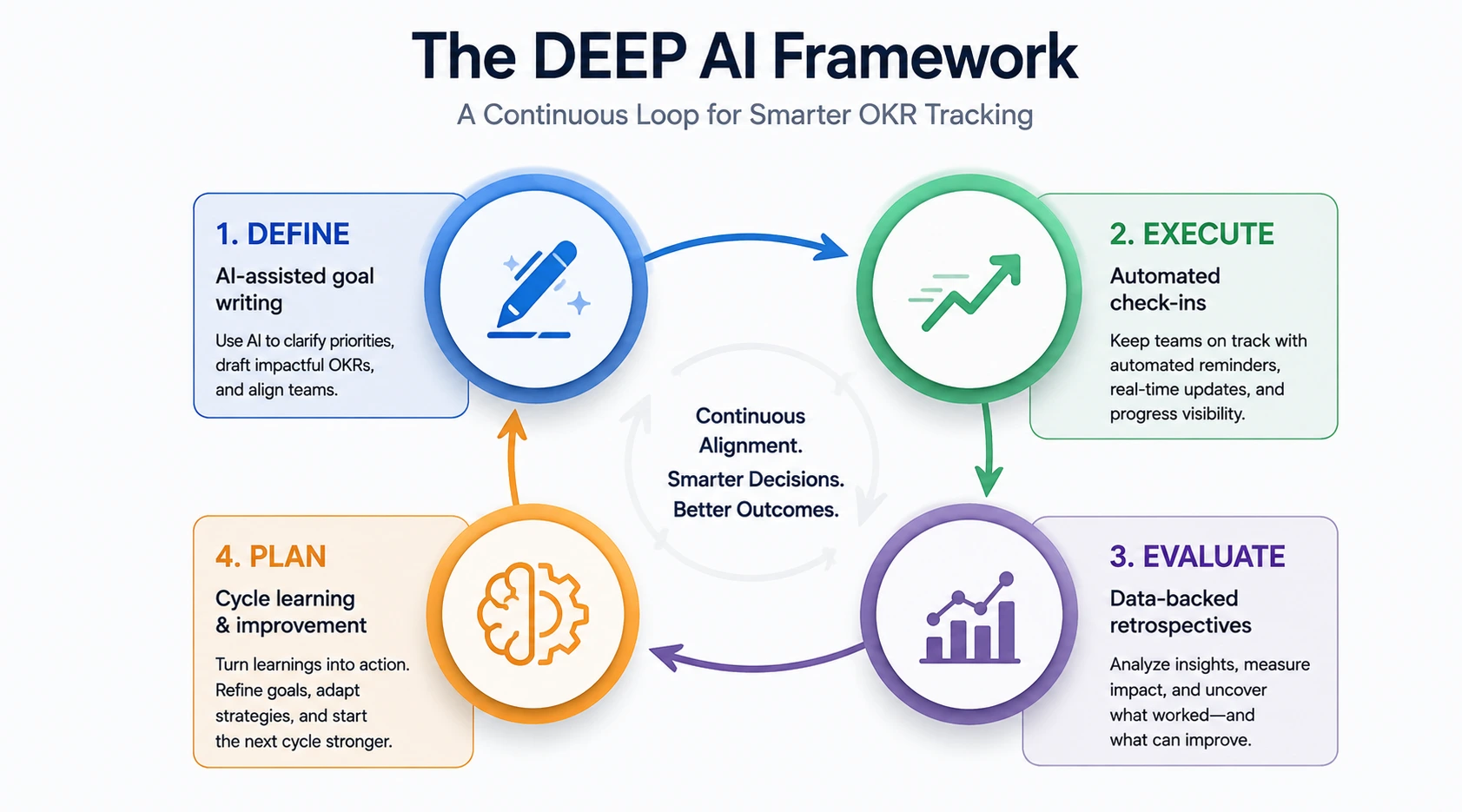
Let’s break down how this framework applies to your OKR tracking metrics:
At the heart of effective OKR tracking is the principle that Alignment = Agreement. You can display an agreement once it exists, but you cannot create one in a tool. True alignment means teams understand what matters, why it matters, and how their work connects to the teams around them. This agreement must be forged through dialogue and negotiation, not just configured in a dashboard. Once that agreement is in place, the right OKR tracking metrics make it visible.
This framework is supported by a purpose-built OKR software that provides the infrastructure for these processes. HRIS platforms like Zoho People or Darwinbox are excellent for HR workflows, but they treat OKRs as a feature, not the core. For serious OKR implementation, you need dedicated software that lives and breathes OKRs, enabling the deep analytical capabilities required for true outcome tracking.
OKR Execution Maturity Framework 2026
This framework provides a benchmarking scorecard for assessing your organisation’s actual OKR execution maturity, moving beyond simple completion rates to real impact.
What Effective OKR Tracking Metrics Look Like in Practice
Moving from theoretical understanding to practical application of OKR tracking metrics requires a fundamental shift in how teams operate. Consider the European fintech startup I mentioned earlier. After realizing their Key Results were output-focused, we initiated a targeted coaching program. Instead of “Launch 3 new features,” a Key Result became “Increase user engagement (weekly active users) by 15%.” Instead of “Complete 5 marketing campaigns,” it became “Improve lead conversion rate from MQL to SQL by 20%.”
This change wasn’t just semantic. It forced teams to think about the “so what” behind their activities. Product teams had to collaborate with Commercial to ensure new features actually drove adoption, and marketing teams had to work closely with sales to ensure campaigns generated truly qualified leads. This cross-functional Key Result co-ownership was a game-changer.
Effective OKR tracking isn’t about constant vigilance in a punitive sense; it’s about early signal detection. Weekly check-ins become crucial. These aren’t just status updates, but structured conversations around progress, roadblocks, and potential adjustments. A good system for OKR check-ins should highlight at-risk goals, allowing managers to intervene proactively.
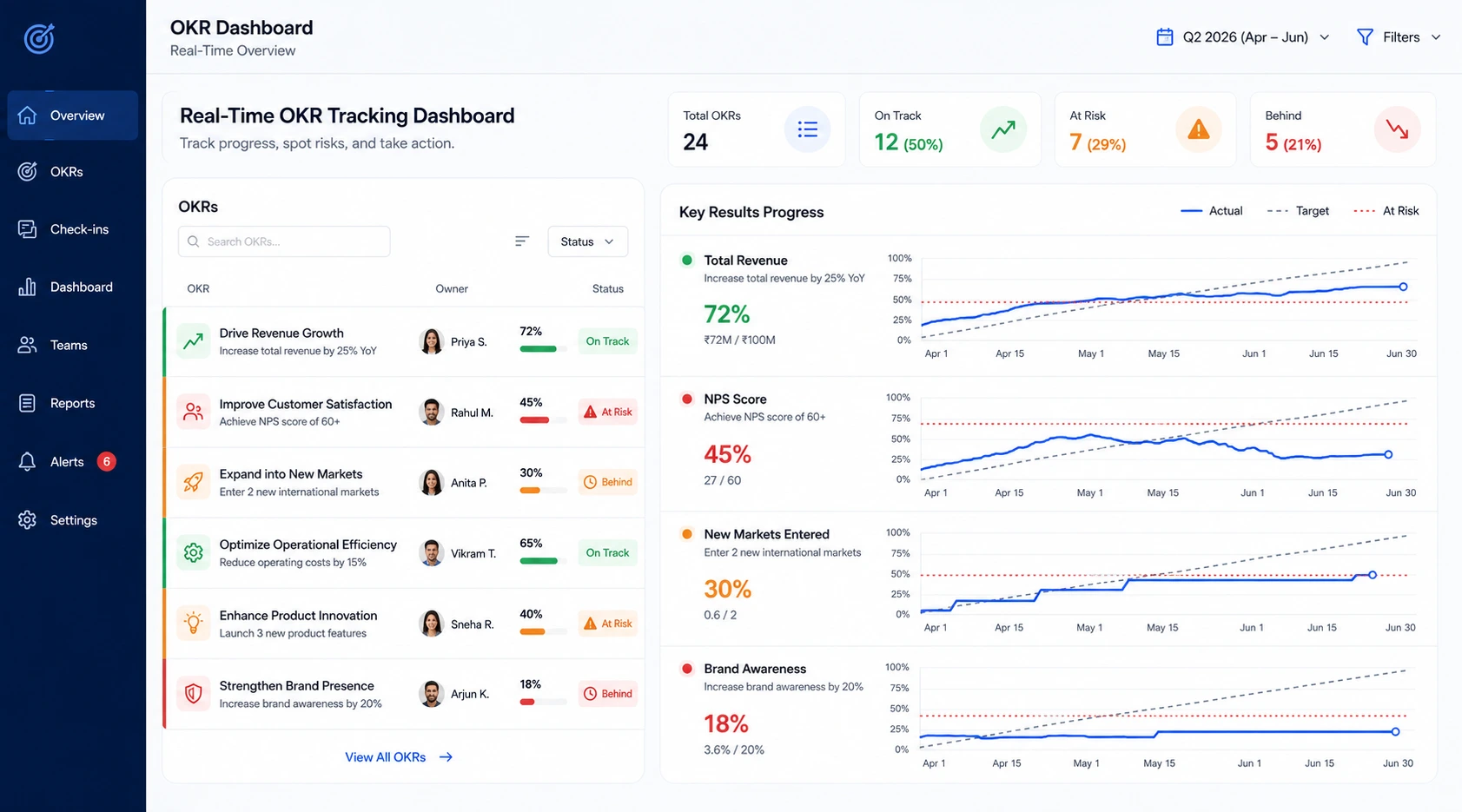
For example, a Key Result like “Reduce customer churn rate by 5%” might have leading indicators such as “Increase customer support ticket resolution time by 10%” or “Increase product usage of feature X by 20%.” Tracking these leading indicators provides early warning signals. If resolution times start to slip, or feature X adoption stalls, you know your churn KR is at risk long before the actual churn numbers hit. This proactive approach, enabled by robust Orbit AI analytics, is what separates successful OKR programs from those that merely track outputs.
The goal is to foster a culture where teams are empowered to use OKR tracking metrics to learn and adapt, not just report. This continuous cycle of defining, executing, evaluating, and planning ensures that the organisation is always moving the right things, even when the path isn’t perfectly straight.
My Take: The Software is the Infrastructure, the Coaching is the Capability
Implementing effective OKR tracking metrics is a journey, not a destination. It requires more than just a new tool; it demands a shift in mindset and consistent support. The software provides the infrastructure the dashboards, the automated check-ins, the data aggregation. But the capability the ability of your leaders and teams to define outcome-driven OKRs, to interpret the data, and to make informed adjustments comes from dedicated coaching and a commitment to continuous learning. You need both, and in the right order.
For organisations ready to streamline their OKR processes and gain true visibility into strategic execution, a purpose-built OKR platform can be transformative. It provides the real-time insights and automation needed to move beyond manual spreadsheets and subjective updates. Explore our OKR software, understand our transparent pricing, and see it in action with a demo.
However, if your challenge lies more in shifting your organisation’s mindset from outputs to outcomes, or if your teams struggle with writing effective Key Results, then the starting point isn’t software. It’s capability building. Our OKR consulting services are designed to embed outcome-driven thinking, ensure genuine alignment, and build the internal expertise required to make your OKR program a true engine of strategy execution.

Written by
An OKR Coach with 20+ years of implementation experience, Madhusudan has guided over 50 organisations through successful OKR transformations, training more than 500 leaders. Learn more about Worxmate.