 WORXMATE
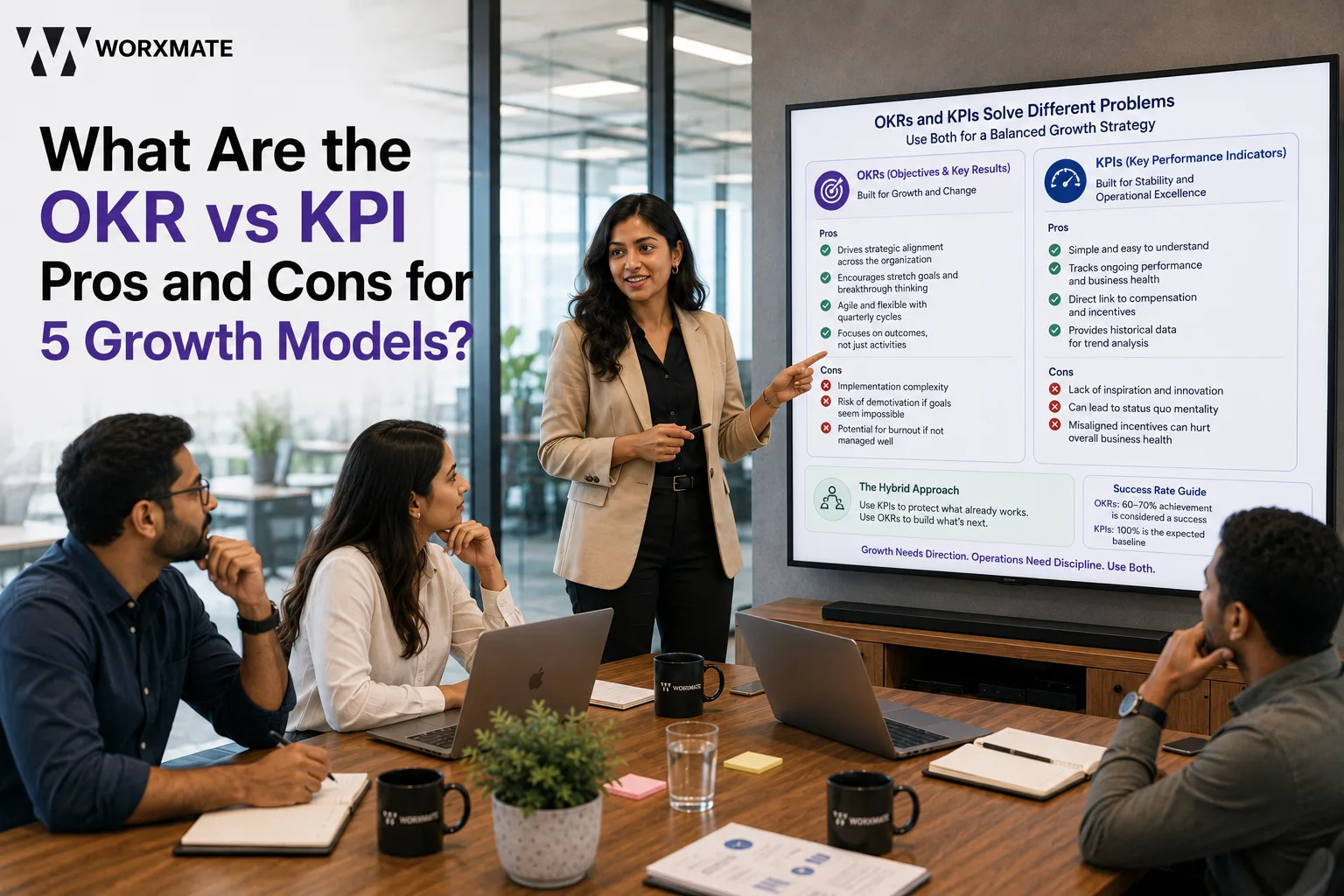
Quick Answer: OKRs and KPIs solve two different problems, so weighing OKR vs KPI pros and cons is really a question of growth vs. stability. OKRs (Objectives and Key Results) are built for ambitious, time-bound change their biggest pro is company-wide strategic alignment, their biggest con is implementation complexity. KPIs (Key Performance Indicators) track the ongoing health of existing processes their biggest pro is simplicity and a direct link to compensation, their biggest con is that hitting a target rarely inspires innovation. Most growing companies need both: KPIs to protect what already works, OKRs to build what’s next. If you’re still deciding which framework fits your company’s current stage, our pillar guide on OKR vs KPI breaks down the decision in more depth this article focuses specifically on the pros, cons, and trade-offs of each.
Understanding the Fundamentals: What Are OKRs and KPIs?
The okr vs kpi pros and cons are defined by the fundamental difference between where you want to go and how you are currently performing. OKRs, or Objectives and Key Results, are designed to facilitate aggressive growth and transformation by setting ambitious, time-bound goals. Conversely, KPIs, or Key Performance Indicators, act as the dashboard for your business, measuring the success of ongoing processes and steady-state operations.
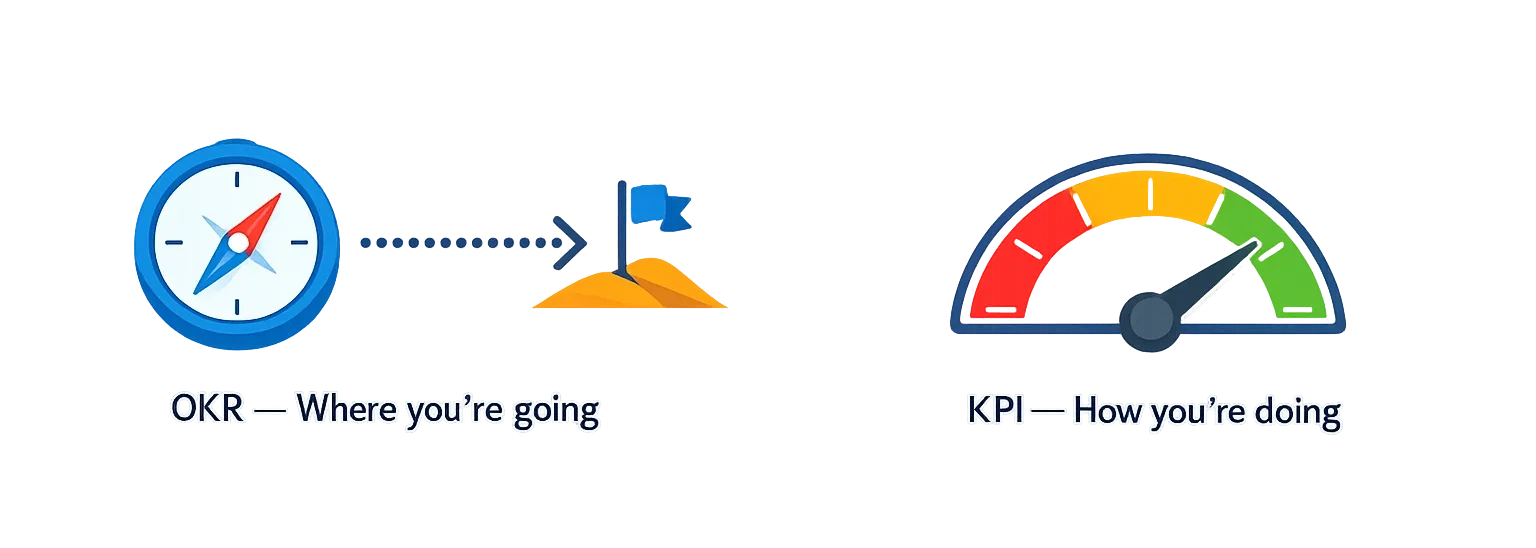
When analyzing the okr vs kpi pros and cons, it is helpful to view them as a compass and a speedometer. The OKR is the compass, pointing the organization toward a new destination or a strategic shift. The KPI is the speedometer, ensuring that the engine of the business is running at the correct pace and within safe parameters. According to research by McKinsey, companies that align their performance metrics with clear strategic priorities are significantly more likely to outperform their peers in market share and profitability.
The okr vs kpi pros and cons also involve the scope of measurement. OKRs typically involve a qualitative “Objective” followed by several quantitative “Key Results” that indicate progress. These are often “stretch goals” designed to push teams out of their comfort zones. KPIs, however, are almost always quantitative and are used to track the efficiency of a particular activity or department over an indefinite period. Understanding these definitions is the first step in deciding which framework—or combination thereof—best suits your current business growth strategy.
In many mid-market companies, the okr vs kpi pros and cons become most visible during quarterly planning. Leaders often struggle to decide whether to prioritize new initiatives (OKRs) or focus on hitting existing targets (KPIs). The reality is that a healthy organization requires both. Without KPIs, you might achieve a major objective while your core business health deteriorates. Without OKRs, you might hit every performance target but fail to innovate, leading to eventual stagnation in a competitive market.
The Pros and Cons of OKRs: Driving Growth and Innovation
Evaluating the okr vs kpi pros and cons requires a deep dive into the specific benefits of the OKR framework. One of the primary advantages of OKRs is their ability to foster high-level strategic alignment across disparate teams. Because OKRs are transparent and usually public within the company, every employee can see how their individual efforts contribute to the overarching mission. This visibility reduces silos and ensures that everyone is moving in the same direction.
Another significant factor in the okr vs kpi pros and cons is the focus on “stretch goals.” OKRs encourage teams to set objectives that are intentionally difficult to achieve. This “moonshot” thinking is what drives major breakthroughs. However, this also introduces a potential con: the risk of demotivation if goals are perceived as impossible. If a team consistently hits only 40% of their key results, they may begin to feel like they are failing, even if their actual progress is substantial compared to previous years.
-
Pro: Agility and Flexibility
OKRs are typically set on a quarterly basis, allowing companies to pivot quickly in response to market changes. This makes the okr vs kpi pros and cons heavily weighted toward OKRs for startups and high-growth sectors.
-
Pro: Focus on Outcomes
Unlike traditional task lists, OKRs focus on what the business actually achieves. This encourages an outcome-driven performance management culture rather than a focus on busy work.
-
Con: Implementation Complexity
Setting good OKRs is a skill that takes time to master. Many organizations fail in their first few cycles because they set too many objectives or confuse them with tasks.
-
Con: Potential for Burnout
The constant pressure to “stretch” can lead to employee fatigue if not managed with a supportive performance management framework.
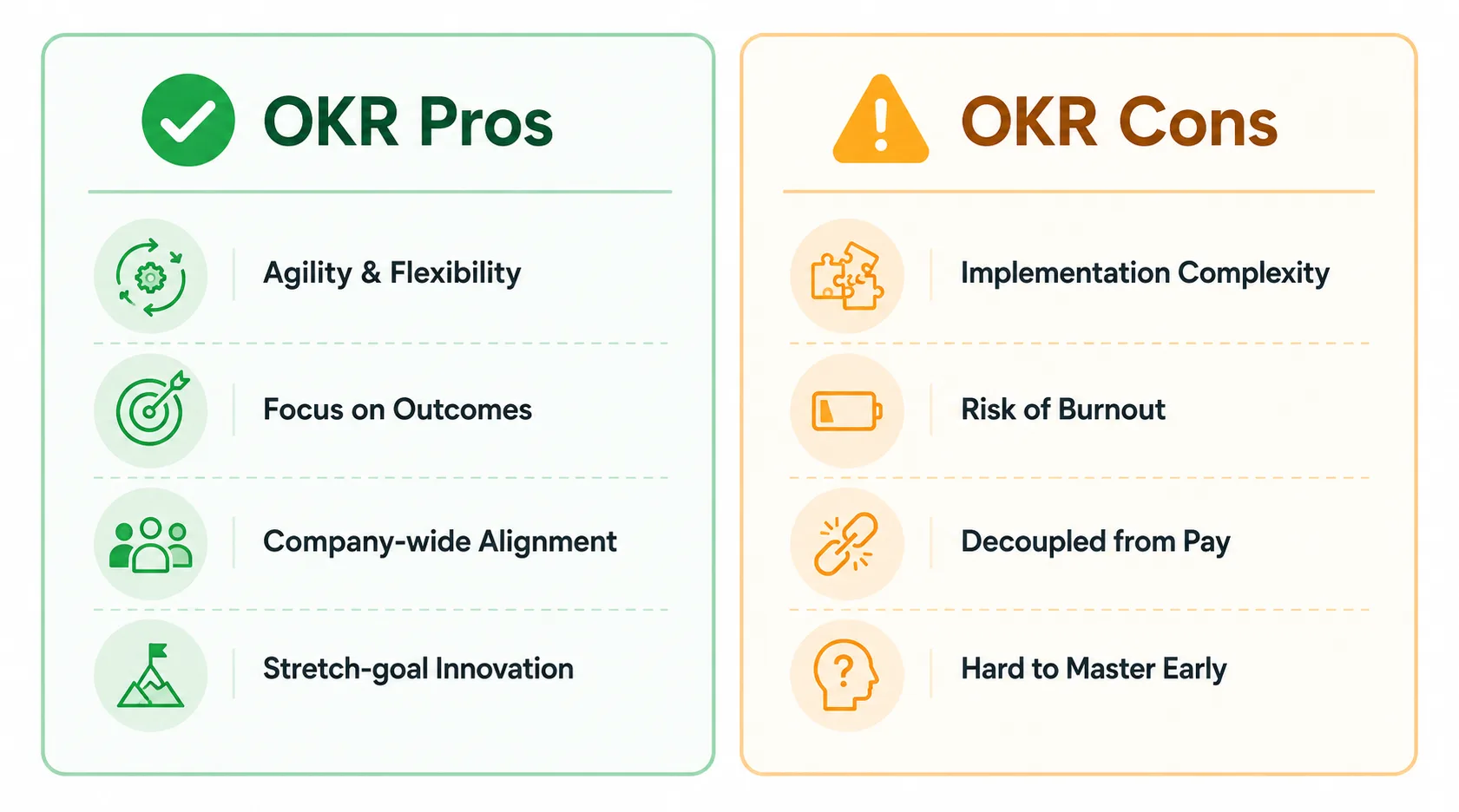
When considering the okr vs kpi pros and cons, it is also important to note that OKRs are generally decoupled from compensation. This is a deliberate design choice intended to encourage risk-taking. If an employee’s bonus is tied to a goal, they are likely to “sandbag” or set conservative targets they know they can hit. By removing the direct link to pay, OKRs allow for more ambitious thinking, though this can sometimes be a difficult cultural shift for traditional HR departments to manage.
Finally, the okr vs kpi pros and cons discussion must include the benefit of clarity. In a complex business environment, OKRs act as a filter. They help leaders say “no” to good ideas that don’t align with the current quarter’s top priorities. This focus is invaluable for mid-market companies that often have limited resources and cannot afford to chase every opportunity. By focusing on 3-5 key objectives, teams can achieve a level of execution that is impossible with a more scattered approach.
The Pros and Cons of KPIs: Maintaining Operational Excellence
While OKRs are about change, the okr vs kpi pros and cons for KPIs center on consistency and reliability. KPIs are the bedrock of operational excellence. They tell you if your customer support response times are within limits, if your sales pipeline is healthy, and if your production line is efficient. For established businesses, KPIs provide the data necessary to make incremental improvements to existing processes without the upheaval of a major strategic shift.
One of the strongest arguments in the okr vs kpi pros and cons for using KPIs is their simplicity and historical context. Because KPIs are often measured over years, they provide a wealth of data for trend analysis. This allows leaders to spot potential problems long before they become crises. For example, a slow but steady decline in a “Customer Satisfaction” KPI can alert a VP of Success to underlying product issues that might not be captured by a quarterly OKR focused on new feature adoption.
The Leading vs. Lagging Indicator Trap
Most engineering, industrial, and finance leaders default to KPI-only thinking because KPIs are what their performance systems have always measured and that’s the real root of most okr vs kpi pros and cons debates inside a company. The distinction that actually changes behavior isn’t “OKR vs KPI” in the abstract; it’s the difference between a lagging indicator (a KPI that tells you where you already stand) and a leading indicator (an outcome that tells you what needs to change before a problem becomes a crisis). Teams that only track lagging KPIs find out about a slowdown after it’s already cost them a quarter. Teams that connect ground-level, leading indicators to a strategic Objective catch the blocker while there’s still time to act on it.
-
Pro: Easy to Understand
KPIs are usually straightforward metrics, such as revenue, churn rate, or net promoter score. This makes the okr vs kpi pros and cons lean toward KPIs for simple performance tracking.
-
Pro: Link to Compensation
Unlike OKRs, KPIs are often directly tied to bonuses and incentives, providing clear motivation for employees to maintain high standards in their core roles.
-
Con: Lack of Inspiration
Hitting a KPI target rarely feels like a “win” in the same way that achieving a major objective does. It can lead to a “status quo” mentality where teams stop looking for better ways to work.
-
Con: Misaligned Incentives
If a KPI is poorly chosen, employees might optimize for the metric at the expense of the business health. For instance, a support team might close tickets faster to hit a speed KPI, reducing the quality of help provided.
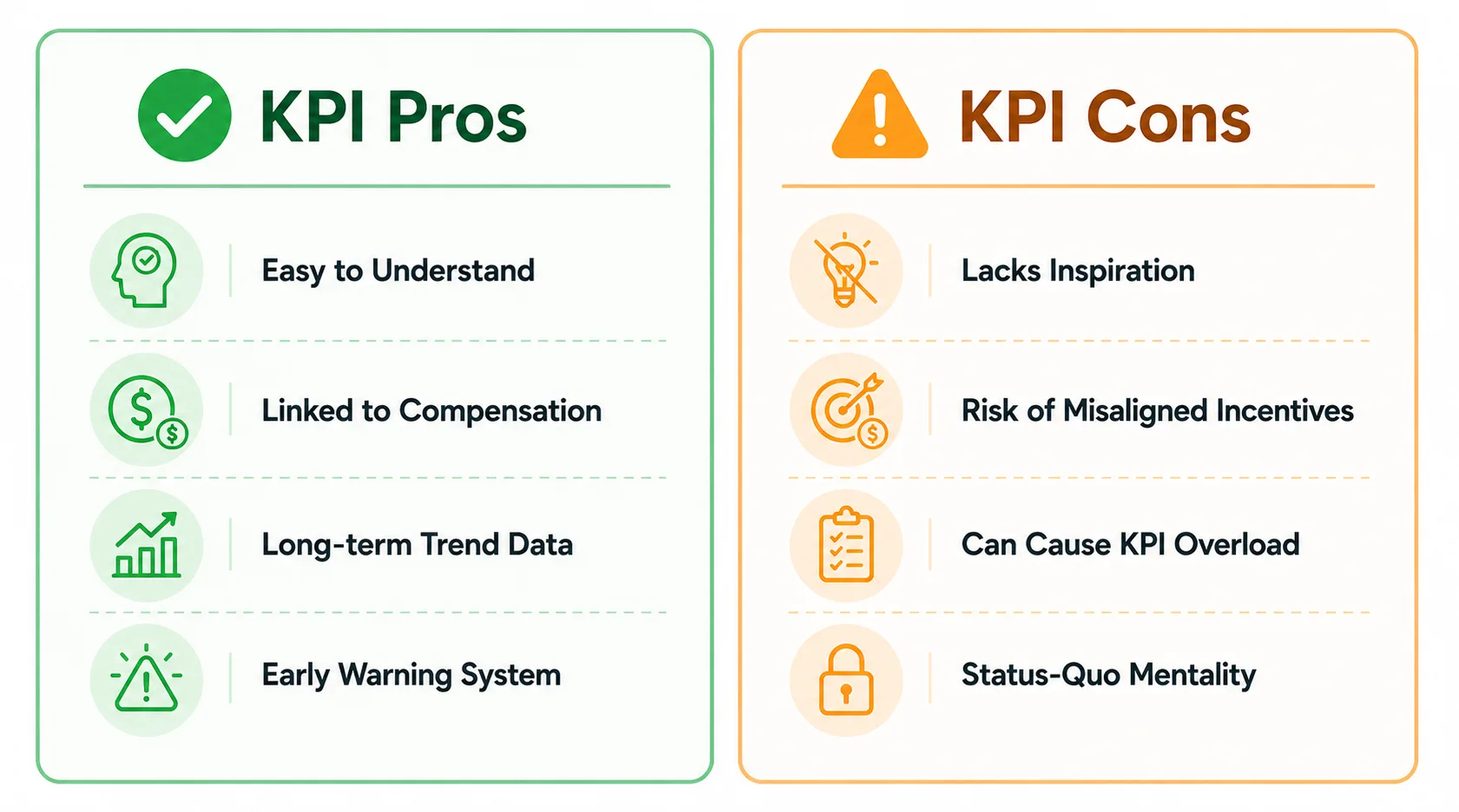
In the context of the okr vs kpi pros and cons, KPIs are essential for identifying “business as usual” performance. They act as the early warning system for the organization. According to Harvard Business Review, the most effective leaders use a balanced set of metrics that cover both financial performance and internal process health. Without these indicators, a company is essentially flying blind, unable to tell if its current success is sustainable or merely a temporary peak.
However, the okr vs kpi pros and cons also highlight the danger of “KPI overload.” Many managers make the mistake of tracking dozens of metrics, leading to “analysis paralysis.” When everything is a priority, nothing is. This is where the OKR framework can help by narrowing the focus. While you might monitor 50 KPIs at a departmental level, you should only have a handful of OKRs that define your strategic focus for the period. Balancing these two is the key to a robust performance management system implementation.
OKR vs. KPI: A Side-by-Side Comparison
To better understand the okr vs kpi pros and cons, it is helpful to compare them across several key dimensions. This comparison helps leaders decide which tool to use for a specific business challenge. While they are often treated as rivals, they are actually complementary tools that serve different masters: the OKR serves strategy, while the KPI serves operations.
| Feature | OKRs (Objectives and Key Results) | KPIs (Key Performance Indicators) |
|---|---|---|
| Primary Focus | Growth, innovation, and strategic change. | Stability, efficiency, and ongoing health. |
| Timeframe | Quarterly or annual cycles. | Ongoing, month-over-month, or permanent. |
| Goal Type | Aspirational, “stretch” goals. | Realistic, “attainable” targets. |
| Transparency | Public across the whole company. | Often restricted to relevant departments. |
| Success Rate | 60-70% is considered a success. | 100% is the expected baseline. |
| Common Failure Mode | Chasing too many “moonshots” at once, diluting focus. | OKR tracking metrics with no clear owner or action threshold. |
When looking at the okr vs kpi pros and cons in this format, it becomes clear that OKRs are designed for movement. If you want to enter a new market, launch a product, or overhaul your company culture, you need OKRs. If you want to ensure your website uptime remains at 99.9% or that your sales team makes 50 calls a day, you need KPIs. The okr vs kpi pros and cons aren’t about which is “better,” but which is appropriate for the task at hand.
There’s also a failure mode worth naming directly: teams that try to run 40–50 KPIs and a full OKR cascade at the same time, with no distinction between which metrics are “health” and which are “growth.” When that happens, the okr vs kpi pros and cons stop being a strategic choice and become a reporting burden — managers spend more time updating dashboards than acting on what the dashboards say. The fix isn’t fewer metrics for the sake of it; it’s tagging every metric as either a health indicator (KPI) or a growth indicator (OKR-linked) before you decide how often it needs to be reviewed.
Another nuance in the okr vs kpi pros and cons is how they interact. A KPI can often become the “Key Result” for an OKR. For example, if your KPI for “Customer Churn” is currently 5% and you want to reduce it to 2% as part of a strategic initiative, “Reduce Churn to 2%” becomes a Key Result. In this scenario, the KPI provides the metric, while the OKR provides the impetus for change. This synergy is why most successful mid-market companies use both frameworks simultaneously.
The Hybrid Approach: Why Your Business Needs Both
The most sophisticated leaders don’t choose between the okr vs kpi pros and cons; they integrate them into a unified performance management strategy. This hybrid approach allows a company to maintain its “runway” (KPIs) while building its “rocket” (OKRs). Without the runway, the rocket can’t take off; without the rocket, you’re just standing on a very expensive piece of asphalt.
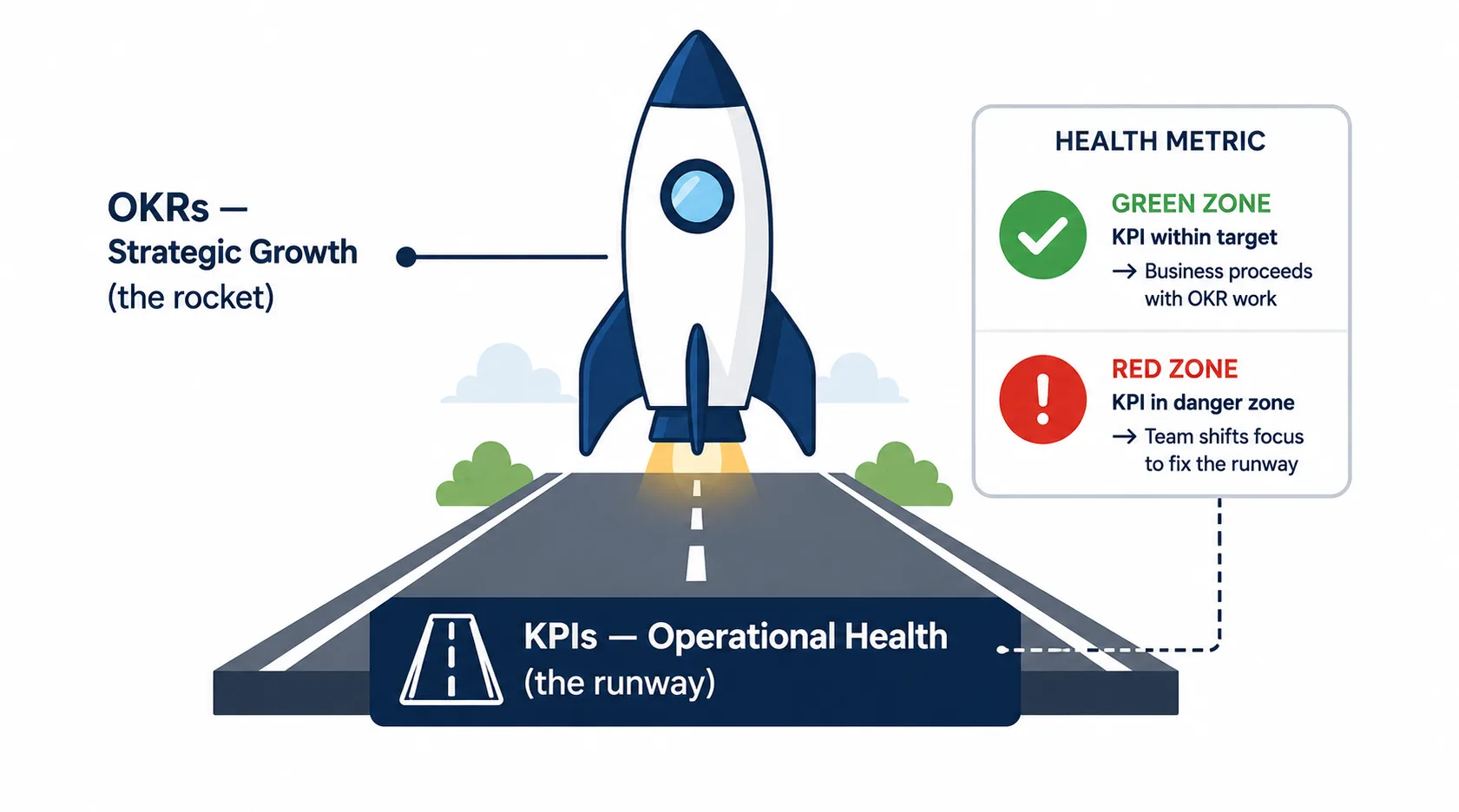
This balance is critical for maintaining okr alignment while respecting operational realities.
In a hybrid model, the okr vs kpi pros and cons are balanced by assigning different roles to each. KPIs are used to monitor the “health” of the business. As long as the KPIs are within their target ranges (often called “green zones”), teams can dedicate their creative energy to their OKRs. However, if a KPI drops into the “red zone,” it may trigger a shift in focus. The team might pause their OKR work to address the operational crisis, ensuring that the business remains stable while pursuing growth.
Implementing this hybrid model requires a clear understanding of performance metrics. You must distinguish between “health metrics” and “growth metrics.” Health metrics (KPIs) are the things you must do to stay in business. Growth metrics (OKRs) are the things you do to win the future. By categorizing your data this way, you avoid the common pitfall in the okr vs kpi pros and cons debate where teams feel overwhelmed by having too many “priorities.”
Furthermore, the hybrid approach addresses the “transparency” aspect of the okr vs kpi pros and cons. While individual KPIs might be private to a specific role, the OKRs provide the shared language that connects different departments. A developer might not care about the specific “Lead Response Time” KPI of the sales team, but they will care about the shared OKR to “Increase Market Share in the Enterprise Segment by 15%.” This shared objective gives the developer context for why they are being asked to prioritize certain security features over others.
Finally, the hybrid model helps in navigating the okr vs kpi pros and cons related to employee engagement. Gallup research shows that employees who feel their work is connected to a larger purpose are 21% more productive. By using OKRs to provide that purpose and KPIs to provide clear, achievable daily targets, companies create an environment where employees feel both inspired and grounded. This dual-focus is the hallmark of modern, high-performing organizations that have successfully navigated the okr vs kpi pros and cons of performance management.
Case Study: Adobe — Driving Strategic Pivot Through OKRs
-
The Challenge
Despite hitting all traditional operational KPIs for revenue and customer retention, Adobe realized that its annual performance review process was stifling innovation and slowing its transition to a cloud-based subscription model. The company was hitting its numbers, but employees were focused on “safe” targets rather than the radical changes needed to compete in a SaaS-first world.
-
The Solution
Adobe replaced its rigid annual review system with “Check-ins,” a framework heavily influenced by OKR principles. They moved away from static KPIs as the sole measure of success and introduced dynamic objectives that encouraged teams to experiment with new cloud features and customer engagement strategies, even if it meant risking short-term KPI fluctuations.
-
Results and Impact
Following this shift toward an OKR-aligned model, Adobe saw a significant increase in employee engagement and a faster-than-expected transition to its Creative Cloud platform. The company eliminated the “performance review” overhead, saving an estimated 80,000 manager hours per year, while its stock price increased by over 300% in the five years following the implementation of this more agile approach. (Source: Adobe / HBR)
Unlock Goal Clarity & Accelerate Employee Growth
Looking to drive goal clarity and employee growth? Discover how Worxmate’s AI-powered Performance Management Software can help.
How to Implement OKRs and KPIs within Worxmate
Navigating the okr vs kpi pros and cons becomes much easier when you have a dedicated tool to manage both. Worxmate is designed to handle the complexity of okrs vs kpis by providing a single source of truth for both strategic and operational data. Instead of juggling spreadsheets and disparate tracking tools, leaders can see their “moonshot” objectives and their “health” metrics in one integrated dashboard.
When you begin your performance management frameworks journey in Worxmate, you can set up high-level company objectives that cascade down to every department. This ensures that the okr vs kpi pros and cons are managed through alignment. You can link specific KPIs to your Key Results, so that when a team hits a performance milestone, the overall objective automatically updates. This automation reduces the administrative burden on managers and keeps the focus on execution.
Worxmate also addresses the “transparency” pro in the okr vs kpi pros and cons. By making OKRs visible to everyone, the platform fosters a culture of accountability. Employees can see how their work impacts the company’s objectives and key results, which increases motivation and engagement. Meanwhile, managers can use the KPI tracking features to monitor day-to-day performance, providing okr vs kpi software capabilities that traditional HR tools often lack.
For HR leaders concerned about the okr vs kpi pros and cons regarding burnout, Worxmate includes check-in features that facilitate regular conversations between managers and employees. These aren’t just about the numbers; they are about the “how” and the “why” of performance. By combining data with human insight, Worxmate helps companies maintain the high-pressure drive of OKRs without sacrificing the well-being of their workforce. This holistic approach is why so many mid-market companies are moving their performance management to Worxmate.
Ultimately, the okr vs kpi pros and cons aren’t something you have to solve alone. Worxmate provides the structure and the visibility needed to make both frameworks work in harmony. Whether you are a founder looking to scale or an HR manager looking to modernize your reviews, the platform offers the flexibility to adapt as your business grows. By integrating your strategic alignment goals with your operational reality, Worxmate turns the okr vs kpi pros and cons into a competitive advantage.
Conclusion
The real cost of the okr vs kpi pros and cons debate isn’t choosing the wrong framework—it’s the paralysis that comes from failing to integrate both into a cohesive strategy. Adobe’s transformation proves that even successful companies must move beyond static metrics to drive true innovation. When leaders treat OKRs as the engine of growth and KPIs as the vital signs of health, they create a resilient, high-performing organization.
To bridge the gap between strategy and execution, your team needs to master strategic alignment, implement robust performance management frameworks, and maintain clear performance metrics. By focusing on outcome-driven performance management, you ensure that every team member understands their role in the company’s future success.
Don’t let the complexity of managing different frameworks stall your organizational growth. Build a stronger culture of okr alignment, leverage integrated okr vs kpi software to keep data visible, and start your free trial with Worxmate to put these principles into practice today. The software gives you the infrastructure to track both frameworks in one place — but the harder part is usually the thinking, not the tooling. If your team already has a platform and still can’t tell a genuine outcome from a disguised task list, that’s a coaching gap, not a software gap. Worxmate’s OKR consulting engagements are built for exactly that transition. If you’re ready to see the platform first, you can also head straight to worxmate.ai to explore the full product.


Written by
An OKR Coach with 20+ years of implementation experience, Madhusudan has guided over 50 organisations through successful OKR transformations, training more than 500 leaders. Learn more about Worxmate.