 WORXMATE
Quick Answer
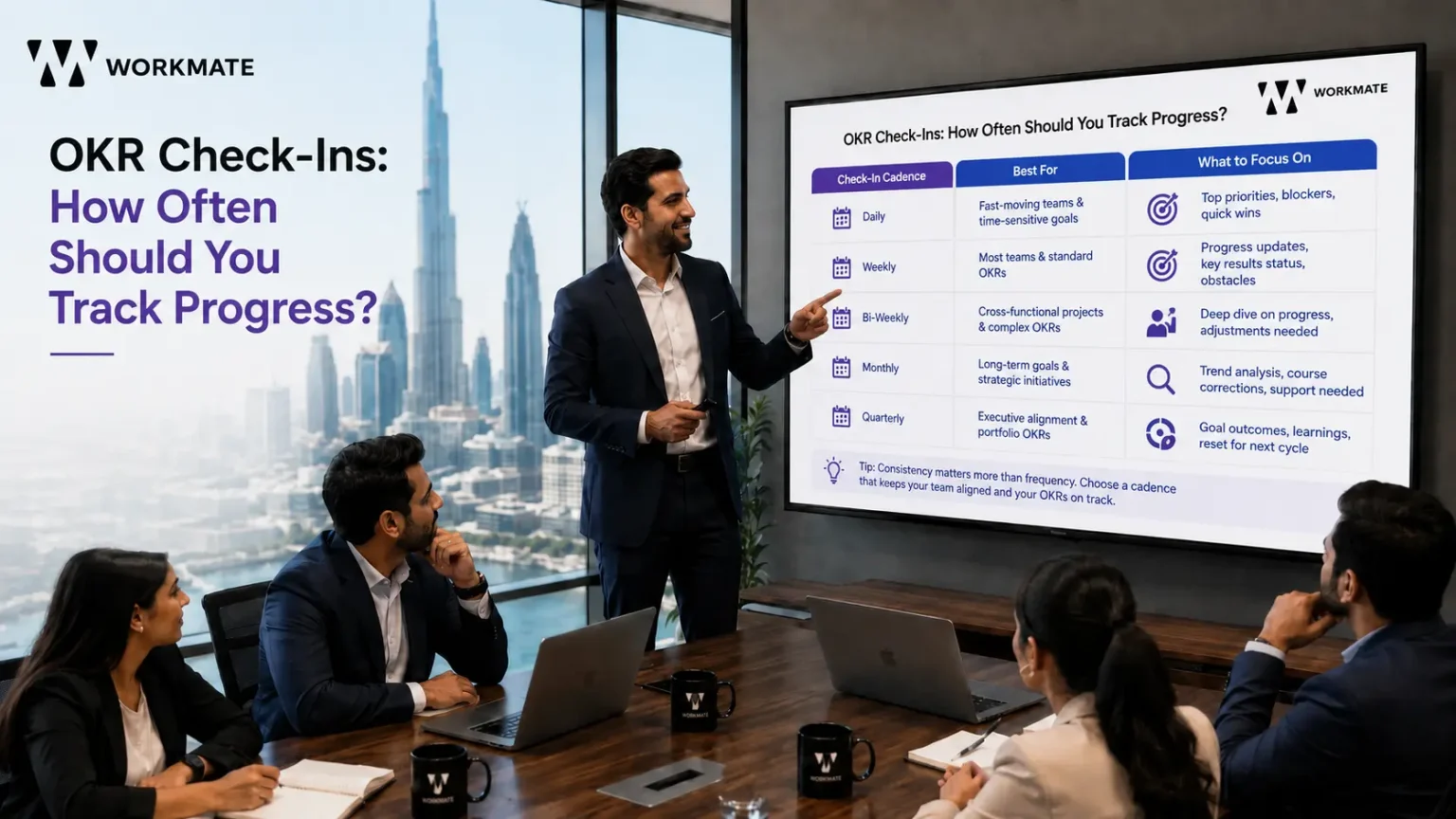
Run OKR check-ins weekly for execution-layer teams (sales, product delivery, customer success), biweekly for cross-functional initiatives with dependencies, and monthly for leadership-level strategic OKRs. The right cadence follows the speed of the work, not a fixed rule — and once a program matures, shift to exception-based check-ins that focus only on goals that are significantly ahead or at risk.
A BU Head once told me his team was “doing OKR check-ins every week” and then admitted, three questions later, that “check-in” meant an email reminder nobody replied to and a spreadsheet cell someone updated the night before the leadership review. That is not an OKR check-in. That is a compliance ritual wearing a check-in’s name tag.
The question I get asked more than any other in a first coaching session is some version of “how often should we be checking in on OKRs weekly, biweekly, monthly?” It’s a fair question. It’s also the wrong first question. The right first question is what the check-in is actually supposed to produce. Get that answer right, and the cadence follows. Get it wrong, and no schedule weekly, daily, or otherwise will save the program.
About This Guide
Madhusudan Nayak, Co-Founder & CEO of Worxmate, has spent 20+ years in strategy execution and 10+ years implementing OKRs across 50+ organisations a 70,000-person IT services firm, a $45Bn Middle East energy company, a listed Indian fintech, and companies across pharma, fintech, manufacturing, retail, and energy. This guide draws directly from that field experience, not from OKR theory.
The Real Question Isn’t “How Often” It’s “What Kind of Check-In”
Most organisations inherit their check-in cadence from a template, a consultant’s slide, or whatever the last software vendor recommended. Nobody asks whether the cadence matches the actual velocity of the work. A sales team closing deals weekly and a product team shipping a quarterly feature do not need the same check-in rhythm and forcing them into one schedule is one of the quiet reasons OKR programs stall.
Across the organisations I’ve coached, the pattern is consistent: teams that treat OKR check-ins as a reporting obligation update the tracker and move on. Teams that treat OKR check-ins as a strategic conversation surface blockers early, adjust course mid-quarter, and finish cycles with goals that were actually worked on, not just written. The difference isn’t the software. It’s whether the check-in was designed to produce a decision or just a data point.
This is also where most OKR tracking breaks down before it starts. If the only thing a check-in produces is a percentage in a cell, the team has built a very expensive way to confirm what they already suspected. The percentage should be the byproduct of the conversation not the entire purpose of it.
The sharpest insight in this piece: A check-in that only updates a number is a status report. A check-in that surfaces a blocker, a confidence score, and a next action is an execution ritual. Most OKR programs run the first and call it the second.
Why Most OKR Check-Ins Fail Before the First Question Is Asked
I call this the Coaching Cliff the moment OKR coaching stops at the leadership layer and the organisation is left to run check-ins independently, without ever having been shown how. It is the single most common failure mode I see, and the consulting industry rarely talks about it, because it implicates the standard engagement model: run a leadership workshop, help the C-suite write their OKRs, collect the invoice, leave.
Within one quarter, the program below the leadership layer collapses not because managers are resistant, but because the middle management layer, where check-in conversations actually happen, was never equipped to run them. Nobody taught a first-line manager how to ask, “what’s blocking this?” without it sounding like an accusation, or how to hold a confidence score conversation without it turning into a performance review.
There is a second, quieter reason check-ins fail: fear. In the early stages of any OKR program, people carry a silent worry that if they commit to an ambitious outcome and don’t deliver it, it will read as poor performance. Nobody says this out loud in a group workshop. It shows up instead as check-ins full of safe, easily completable Key Results output disguised as ambition. The fix isn’t a better tracking tool. It’s making explicit, from the first session, that missing a stretch goal in cycle one is learning, not failure. A program only fails if the organisation stops learning from the cycles it runs.
And a third signal I look for in the first week of any engagement: how many product or process queries is the team raising? If people are asking 15-20 questions a day about how to even log a check-in, adoption will break within weeks not might, will. That volume of friction means the tool and the team’s current OKR literacy are mismatched, and no amount of customer support fixes a mismatch. It has to be solved at the design level, before the cadence question even matters.
How Often Should You Run OKR Check-Ins? A Cadence Framework
Here is the framework I use with every client, adjusted for their specific cycle and team maturity not a generic “weekly is best practice” answer.
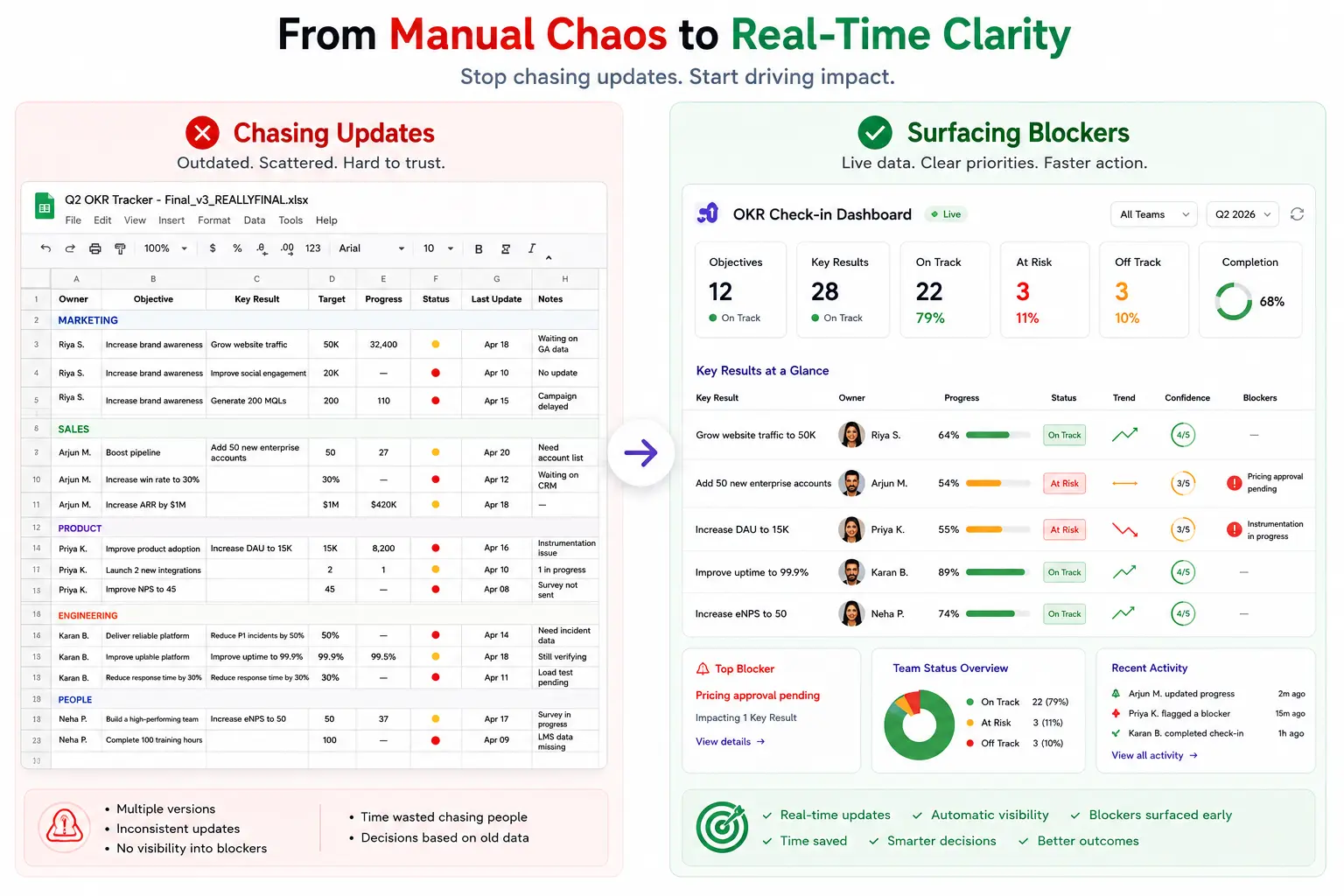
Weekly check-ins: the default for execution-layer teams. Sales, customer success, product delivery, and any team whose Key Results move in days rather than months should check in weekly. This is short enough to catch a stalling Key Result before it becomes an unrecoverable miss, and long enough that it doesn’t collapse into daily status theatre. This is consistent with what I see across the organisations I coach: teams running weekly check-ins complete meaningfully more of their goals than teams that only meet at quarter-end, because course correction happens while there’s still runway left in the cycle.
Biweekly check-ins: for cross-functional or dependency-heavy initiatives. When a Key Result depends on two or three teams delivering in sequence, a weekly cadence can generate noise without new information. Biweekly gives enough time for real movement between conversations while still catching a stalled dependency before it cascades.
Monthly check-ins: for leadership-level and annual strategic Key Results. C-suite and BU-level OKRs that track outcomes over a longer horizon — market share shift, org-wide capability building — don’t need weekly granularity. What they need is a monthly checkpoint that connects back to what the layers below are surfacing weekly, so leadership isn’t discovering a miss for the first time at quarter-end. This mirrors what Microsoft’s guidance on OKR business rhythm recommends: leadership operates on a slower strategic cadence while status flows up from more frequent team-level check-ins underneath it.
The cadence that matters more than any of these: the exception-based check-in. Once a program matures, the goal isn’t to review every Key Result every time. It’s to review by exception spending the conversation on what’s significantly ahead or significantly at risk, and letting on-track goals move through with a quick confidence score. This is what separates a check-in that respects people’s time from one that becomes the very “OKR nag” syndrome that kills adoption.
None of these cadences work if the check-in only lives in a document nobody opens between meetings. This is precisely the gap that real-time OKR tracking is built to close connecting the check-in conversation to what’s actually happening in the work, so the weekly ritual isn’t preceded by twenty minutes of someone hunting for the right number.
OKR Check-Ins Team Rituals That Actually Work
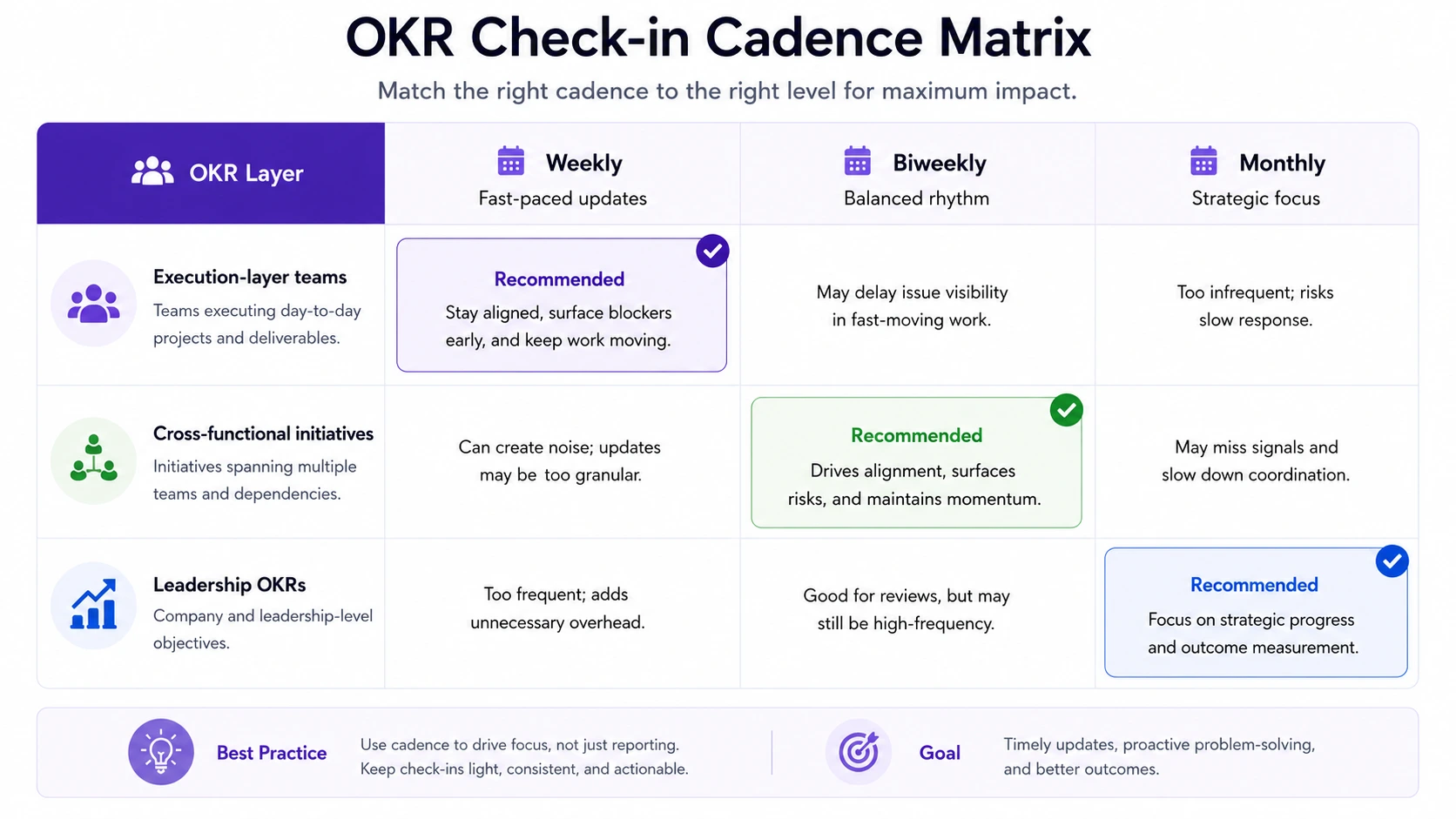
I’ve sat in the room for the failure mode enough times to describe it precisely. A manager opens a shared spreadsheet. Half the cells are blank. Someone updates their number to look better than the underlying reality, because nobody wants to be the red cell in front of the group. The conversation becomes a status recitation “we’re at 60%, we’re at 40%” and ends without anyone naming what’s actually in the way. That is an OKR tracking spreadsheet problem disguised as a meeting problem. The spreadsheet doesn’t hold history, doesn’t notify anyone between updates, and creates exactly the kind of version-control chaos that turns tracking into a chore people visit once a quarter instead of a rhythm they run every week.
A check-in ritual that works has three parts, and it takes less time than the spreadsheet version, not more:
- What changed since we last spoke. Not a re-read of the whole OKR just the delta.
- Confidence score, stated out loud. A number from the owner, not inferred by the manager. This surfaces sandbagging and false confidence equally fast.
- One named blocker, and who owns unblocking it. Not a list of five vague concerns one specific thing, with an owner and a next step.
For an OKR check-ins team to sustain this rhythm past the first month, the ritual has to be built into the flow of work the team already has not added as a separate meeting competing with everything else on the calendar. This is the same principle behind well-designed OKR tracking tools: the update should happen where the work happens, with the tool surfacing at-risk signals automatically rather than requiring someone to manually flag them after the fact.
The Metrics That Should Drive Your Check-In Cadence
Cadence shouldn’t be static across a whole quarter. It should respond to what the data is actually telling you. This is where OKR tracking metrics earn their place in the conversation not as a vanity dashboard, but as the input that tells you when to tighten or loosen the check-in rhythm.
Three signals matter more than the rest:
- Trajectory, not snapshot. A Key Result sitting at 80% completion looks fine in isolation. A Key Result that was at 95% last check-in and is now at 80% is a different story entirely and it’s a story a static number will never tell you. If a goal’s trajectory is trending down two check-ins in a row, that’s the signal to move from biweekly to weekly, temporarily, until it stabilises.
- Confidence-versus-completion gap. When an owner’s stated confidence score diverges sharply from the completion percentage high completion, low confidence, or the reverse that gap is usually more informative than either number alone. It often means the remaining work is harder than the percentage suggests.
- Check-in participation rate. If a team’s check-in completion rate is dropping, that’s not a discipline problem to solve with a reminder email. It’s usually a signal that the cadence, the format, or the tool has too much friction for where that team currently is.
For a fuller breakdown of which metrics are worth building a habit around and which ones are vanity noise dressed up as rigor see our companion piece on OKR tracking metrics: what really matters.
From Spreadsheets to Systems: Why Tracking Tools Change the Check-In Conversation
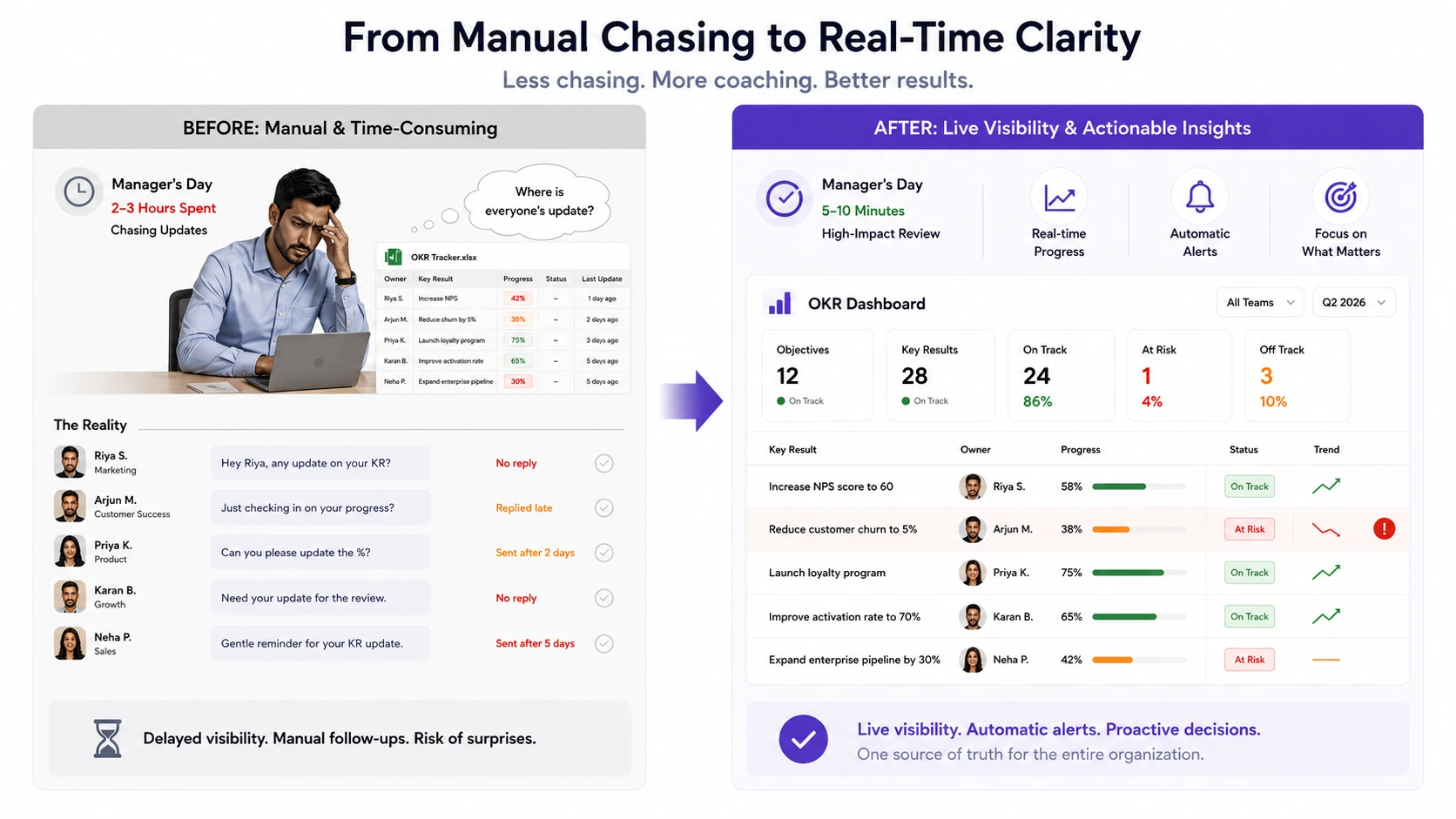
I want to be direct about something most software vendors won’t say plainly: the tool does not create the discipline. But the wrong tool actively works against it. A shared spreadsheet cannot notify anyone, cannot preserve the history of why a goal shifted, and cannot connect a Key Result to the actual task that’s supposed to move it. Every one of those gaps shows up as friction in the check-in itself the manager spends the first ten minutes reconstructing context instead of having the conversation.
This is the exact gap real-time OKR tracking platforms are designed to close. When a Key Result updates automatically from the tools a team already works in, the check-in stops being a data-entry exercise and becomes what it was always supposed to be: a conversation about what’s blocking progress and what needs to happen next. Worxmate’s Execute stage in the DEEP AI framework is built around exactly this shift automated check-ins and at-risk detection that surface a stalling goal before the conversation happens, so the meeting time goes to solving the blocker, not discovering it.
If your team is still deciding between building a better template and adopting dedicated OKR tracking software, our guide on OKR dashboards in real time breaks down exactly what separates a “frequent” dashboard from a genuinely live one and what that distinction is worth in hours saved per quarter.
What This Looks Like in Practice
I worked with a multi-billion-dollar mining engineering group across their Middle East and Europe division, where the leadership team had been running their business almost entirely on KPIs lagging indicators that describe what already happened, not what needs to change. The eye-opener in that engagement wasn’t the OKR framework itself. It was the moment the leadership team connected the dots between a daily, ground-level action on-time service delivery and a regional expansion goal three levels up. Once that chain became visible, check-ins stopped being a reporting formality and became the mechanism for catching a blocker while there was still time to act on it.
That’s the outcome a well-designed OKR check-in produces: not a completed spreadsheet, but a leadership team that can see a problem before it becomes a crisis, because the cadence and the metrics were built to surface leading indicators, not just confirm lagging ones.
OKR Check-Ins for Remote and Distributed Teams
The cadence framework above holds for remote teams, but the stakes are higher. Without the “water cooler” visibility of a physical office, a missed weekly check-in doesn’t just delay a data point it removes the only signal a manager has that a goal is drifting. For distributed teams, the confidence-score-plus-blocker format described earlier isn’t optional; it’s the substitute for everything an in-person team gets for free through incidental hallway conversation.
Our detailed guide on OKR tracking for remote teams goes deeper into building that rhythm across time zones without sliding into check-in overload or, worse, disappearing into radio silence between quarterly reviews.


Written by
An OKR Coach with 20+ years of implementation experience, Madhusudan has guided over 50 organisations through successful OKR transformations, training more than 500 leaders. Learn more about Worxmate.
