 WORXMATE
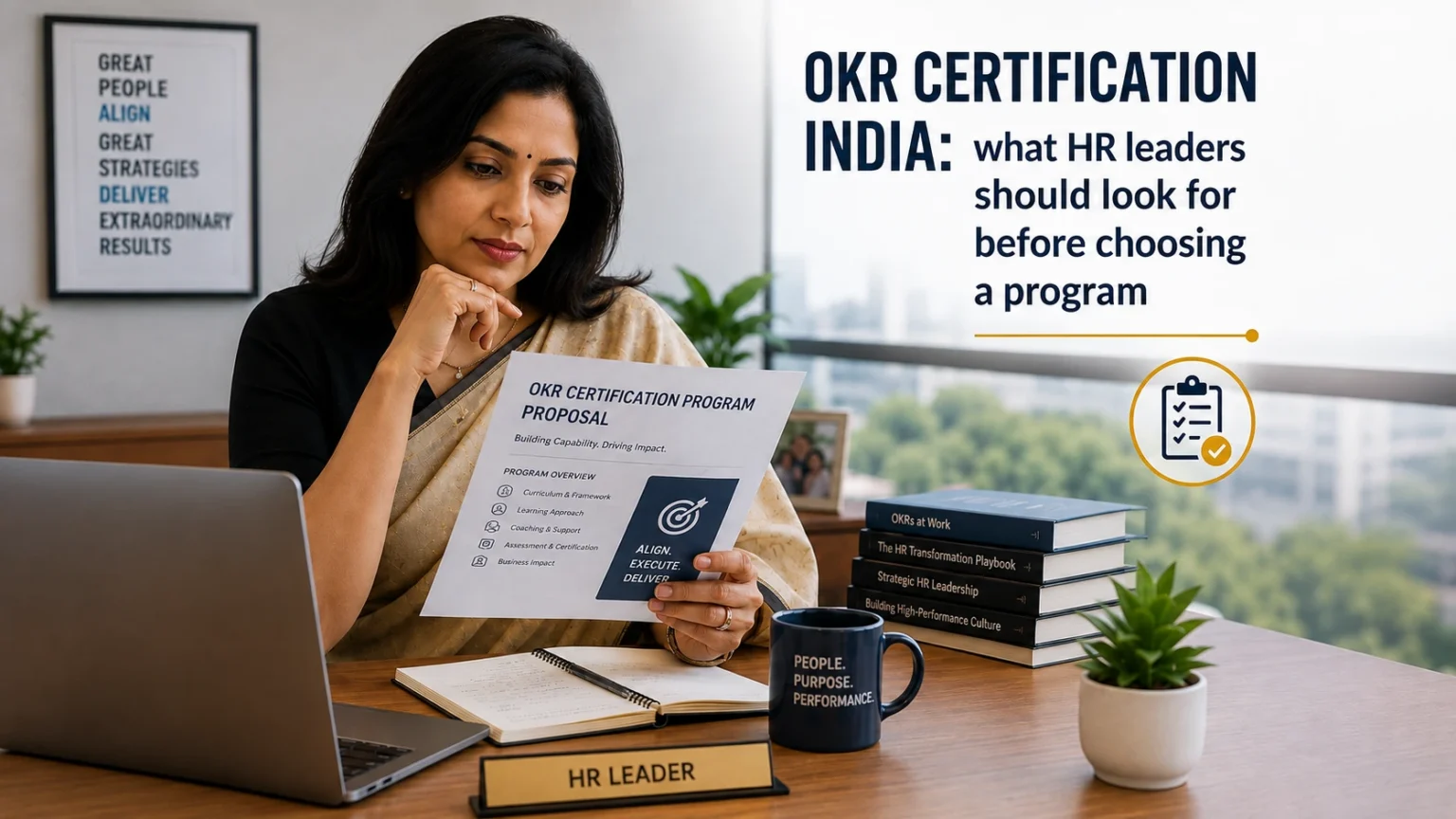
OKR Certification India: Choosing the Best OKR software and certification program requires structural evaluation rather than individual resume building. Indian HR leaders must prioritize batch cohort scalability, enterprise security, and moving from KPIs to OKRs seamlessly across teams.
When an individual professional evaluates an OKR certification, the decision is personal: does this look good on my resume, will I actually learn something useful. When an HR leader evaluates one, the decision is structural: will this actually change how 200 managers set goals, can I defend this budget line to the CFO, and what happens to the culture if it goes wrong. Those are different questions, and most certification content written for individuals does not answer either of them.
This is written for the second group: CHROs, HR Directors, and L&D Heads in India evaluating an OKR certification program for their organisation, not for themselves. When pairing certification with the Best OKR software, HR leaders eliminate tracking friction and drive sustainable team alignment.
Why the Individual Evaluation Criteria Are Not Enough
Most guidance on choosing an OKR certification, including our own earlier piece on the subject, focuses on what makes a credential legitimate: real submitted work, live coaching, a curriculum built from actual implementation experience rather than a textbook. All of that still applies when the buyer is HR. But an organisational rollout introduces questions individual buyers never have to answer: how does this work across a batch rather than one person, what happens to consistency when 30 managers go through the same program at different paces, and how does this get reported upward as a result rather than a training expense.
There is also a political dimension individual buyers do not face. An individual choosing a certification answers only to themselves. An HR leader choosing one for the organisation is making a call that will be judged, months later, against whatever the organisation’s leadership expected to see change. That asymmetry, between what is easy to promise in a sales conversation and what is actually defensible in a results review, is where a surprising number of well-intentioned certification rollouts quietly lose credibility internally.
The Trap HR Leaders Specifically Need to Avoid
There is a failure pattern that shows up almost exclusively when HR owns the OKR rollout, and it is worth naming directly because it is avoidable. When HR selects and administers an OKR certification without a clear mandate from the CEO’s office, the rest of the organisation quietly reads the entire initiative as a performance-review exercise rather than a strategy execution capability. Managers show up because attendance is tracked, not because they believe it will change how they run their teams.
This does not mean HR should not own the certification decision. It means the program needs to be positioned, from the first announcement, as a strategy execution capability that HR is administering on behalf of the business, not an HR initiative that the business is being asked to participate in. That distinction sounds subtle in a planning meeting. It is not subtle in how a room full of managers actually shows up for the first session.
| The program needs to be positioned as a strategy execution capability that HR is administering, not an HR initiative the business is asked to participate in. |
What Indian HR Leaders Who Have Actually Done This Say
Rather than describe this in the abstract, it is worth hearing from HR leaders who have gone through OKR coaching with their own teams.
“The experience was very good. We got an excellent breakaway practical session with more focussed inputs and deeper discussions, working towards scenario based business-relevant OKRs. Maddy was very sharp, and ensured that there was individual attention given to each participant,” said Venugopal A, Chief People Officer at WROGN.
“It was a clear and practical session that helped connect OKRs to real HR challenges. OKRs can be a powerful tool to align HR initiatives with business goals. Maddy was engaging, knowledgeable, and kept the session focused and interactive,” said Galina Turcan, CHRO at UMO.
“It was a great enriching learning experience and understanding the deeper aspects of OKR. Maddy demonstrated his teaching with humility, patience, and a deep understanding of the subject. His calm approach and clarity made the learning experience truly impactful,” said Kanchan Khedekar, Head HR – APAC at HCL Tech.
Notice what each of these has in common: individual attention inside a group session, a direct connection to real business challenges rather than abstract theory, and clarity delivered with patience rather than rushed through a fixed curriculum. None of those three things happen by accident in a certification format built purely around exam throughput.
Timing the Rollout Against Your Planning Cycle
One consideration specific to Indian organisations is worth planning around deliberately: most HR calendars are anchored to the April to March financial year, with annual appraisal and increment conversations typically landing in the final quarter and the first few weeks of the new year. Launching an OKR certification rollout in the middle of that window competes directly for leadership attention with performance reviews and compensation planning, and risks the exact perception problem already discussed: OKRs read as another performance-adjacent exercise rather than a distinct strategy execution capability.
The stronger sequencing, where possible, is to launch certification early in the financial year, once appraisal season has closed and before the next one begins, giving the organisation two to three clear quarters to build capability and show early results before the next round of performance conversations starts. This is a scheduling decision, not a curriculum one, but it materially affects how the initiative gets received internally.
A Practical Checklist for HR Buyers
Does it work for a batch, not just an individual?
A program built around individual enrolment and self-paced modules will struggle to produce consistent capability across 30 managers on different schedules. Ask specifically how the provider handles group cohorts, and whether the outcome is comparable across participants or dependent on individual pace.
Can you explain the ROI to your CFO in one sentence?
If the honest answer is “managers will understand OKRs better,” that sentence will not survive a budget review. If it is “Execution Maturity Rate moves from roughly 10% to 30% within a year, meaning three times as many leaders can independently write a goal that actually drives the business,” that sentence will.
Does the curriculum distinguish between manager-level and champion-level capability?
Not every certified person needs to run the program. Some need to write good OKRs for their own team; a smaller group needs to coach others through it. A single undifferentiated certification tier for both roles under-serves one of them.
Will this get positioned internally as strategy, or as training?
Before the program launches, decide who announces it. If it comes from HR alone, plan communications carefully to avoid the performance-review perception. If it comes jointly from the CEO’s office and HR, that problem mostly resolves itself.
My Take
I would not tell an HR leader to avoid owning the OKR certification decision. HR is very often the right function to administer it, particularly for the logistics of running a cohort through a shared program. What I would push back on is HR owning it in isolation, without visible sponsorship from the business side. Based on Worxmate’s 2026 OKR Benchmark Report, most organisations sit at a 5% to 15% Execution Maturity Rate after a first cycle. That number moves when the certification is treated as a strategy execution investment. It moves much more slowly when it is treated as a training line item HR is asked to deliver.
Where to Go From Here
If you are evaluating a certification program for your organisation, OKR Certification – DEEP Framework is built around tiered, real-work assessment, not a single undifferentiated exam, with a Foundation tier specifically designed for batch rollout across a team.
If your organisation needs the execution gap closed directly while internal capability is being built, Worxmate’s OKR consulting for India is delivered by the same team, from Worxmate’s home base in Pune.
And if you are not yet sure which of these your organisation actually needs, Worxmate’s free Organization Performance Audit will tell you directly, with no product pitch attached.
The right OKR certification for an organisation is not the one with the best individual reviews. It is the one that can survive contact with 30 managers, a CFO’s budget review, and the CEO asking six months later whether anything actually changed.
Further Reading


Written by
An OKR Coach with 20+ years of implementation experience, Madhusudan has guided over 50 organisations through successful OKR transformations, training more than 500 leaders. Learn more about Worxmate.