 WORXMATE
Goal setting software is a platform built to help teams define, cascade, track and execute goals but the tool itself does not create alignment. The right goal setting software forces outcome language over output lists, supports cascading goals with named ownership, surfaces at-risk goals before the cycle ends, and maps to a defined execution framework such as Define, Execute, Evaluate, Plan. Dedicated OKR software differs from an HRIS goal module because goal execution is the entire product, not one feature among many. Before shortlisting any goal setting software, get clarity on your organisation’s top 3 priorities first the software cannot manufacture that clarity for you. If you want a ranked comparison of top platforms, see our best goal setting software guide.
Goal Setting Software: 10 Proven Steps to Avoid Costly OKR Failures in 2026
A 70,000-person IT services and consulting organisation brought me in to work with the leadership team reporting into their Media, Entertainment and Telecom SBU Head. Every strategic meeting and monthly business review produced the same frustration: people in the room with no idea what was actually blocking progress, no visibility into the real state of execution, no ability to connect day-to-day work to business expectations. Goal setting software wasn’t even the starting conversation the starting conversation was that nobody could agree on what “progress” meant.
The breakthrough came from a live exercise, not a slide deck. I walked the leadership team through a game using real scenarios from their own business asking them to identify which of their existing goals were output-led and which were genuinely outcome-driven. It broke a myth the entire room had been operating under without realising it. Once that distinction was visible, I ran what I call the Thinking Process: helping them identify 2–3 SBU-level priorities and write OKRs against those priorities in real time, so the learning happened through doing, not theory.
That is the story I tell every leadership team before they shortlist goal setting software. The tool was never the problem. The absence of a shared definition of “outcome” was and no amount of features fixes that gap.
I have spent more than 20 years in strategy execution, the last 10 coaching organisations through OKR implementation over 50 organisations, 500+ leaders trained, across IT services, fintech, APAC retail, and an $45Bn+ Middle East energy enterprise. I have watched teams license goal setting software, run it for two quarters, and quietly abandon it because the software was asked to do a job that belonged to leadership first. What follows is the checklist I actually use before recommending any platform to a client. Not a features list. A filter for whether the software survives contact with your organisation.
Not sure where your organisation actually stands?
Run a free Organization Performance Audit before you shortlist a single tool — see the real gaps first.
The Goal Setting Software Trap Every Fast-Growing Team Falls Into
Most organisations buy goal setting software believing the purchase itself creates alignment. It does not. Alignment is agreement between teams on what matters, why it matters, and how each team’s work connects to the teams around them. You cannot set that in a tool. You can display it once it exists. A platform showing a beautifully cascaded goal tree is showing you the record of an agreement that either exists or does not. If the agreement does not exist, the cascade display is a fiction.
There is a signal I look for in the first week of every engagement, and it predicts adoption more reliably than any feature comparison table: how many support queries is the team raising? If a team is raising 15–20 product queries a day in week one of using new goal setting software, adoption will break within the next few weeks. Not might break will break. High query volume in week one means the tool has more friction than the team’s current goal setting literacy can absorb. The tool and the team are mismatched, and no customer success call fixes a mismatch. This is the same pattern I write about in why OKRs fail and in the field notes behind OKR implementation hurdles.
This is also why goal alignment and goal management so often get treated as software problems when they are actually clarity problems. Before you compare a single vendor, read goal setting strategies and get your organisation’s priorities into three sentences a stranger could repeat back to you. Software adopted after that exercise behaves completely differently from software adopted before it
Achieve Your Goals Faster
See how Worxmate can help your team set clear goals and achieve faster results. Book your free demo today and experience the power of AI-driven OKRs in action.
What Goal Setting Software Actually Needs to Do
Once the priorities exist, evaluating goal setting software becomes a much narrower exercise. Four things matter more than any pricing page or feature checklist.
1. It Should Force Outcome Language, Not Just Accept It
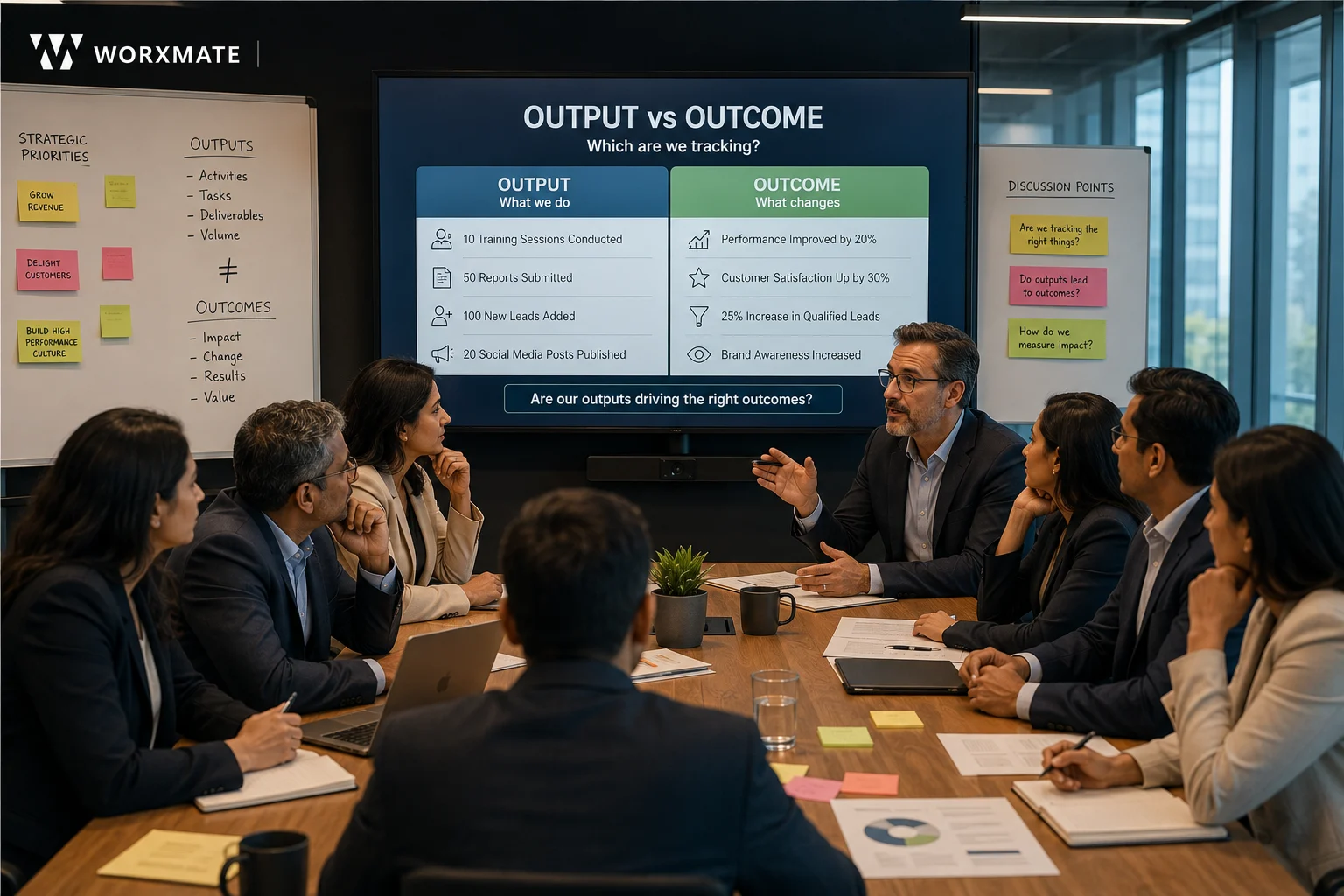
Most teams write goals in output language by default a habit built from decades of task-based performance reviews. Good goal setting software flags an output disguised as an outcome before it ever gets published, the way you’d want any coach to. If your shortlist can’t tell the difference between “launch the new feature” and “increase feature adoption by 20%”, it will let your team write five completable OKRs that move nothing. See how to write OKRs and output vs outcome for the distinction I coach leaders through in week one.
2. It Should Support Real Cascade Logic, Not a Flat List
A goal-setting tool that only stores a flat list of individual goals cannot show you where cross-functional dependency lives. You need to see how a Business Unit Head’s goal connects to a CFO’s goal, and where that connection is claimed but not actually agreed. Read cross-functional team alignment and organizational alignment for what real cascade logic needs to expose.
3. It Should Surface At-Risk Goals Before the Cycle Ends
Most teams discover a missed goal in the retrospective three months too late to change course. Goal setting software should flag risk in week six, not week twelve. This is the entire premise behind how to track OKRs and OKR tracking tools tracking is not a dashboard you check. It’s an early-warning system.
4. It Should Map to a Defined Execution Framework
A tool without a framework behind it is a form with fields. At Worxmate, every product decision is built around a four-stage cycle Define, Execute, Evaluate, Plan — what we call the DEEP AI framework. Goal setting software that skips straight from “write a goal” to “score a goal” with nothing structured in between is missing the two stages where most programs actually fail.
The 7-Point Goal Setting Software Evaluation Checklist
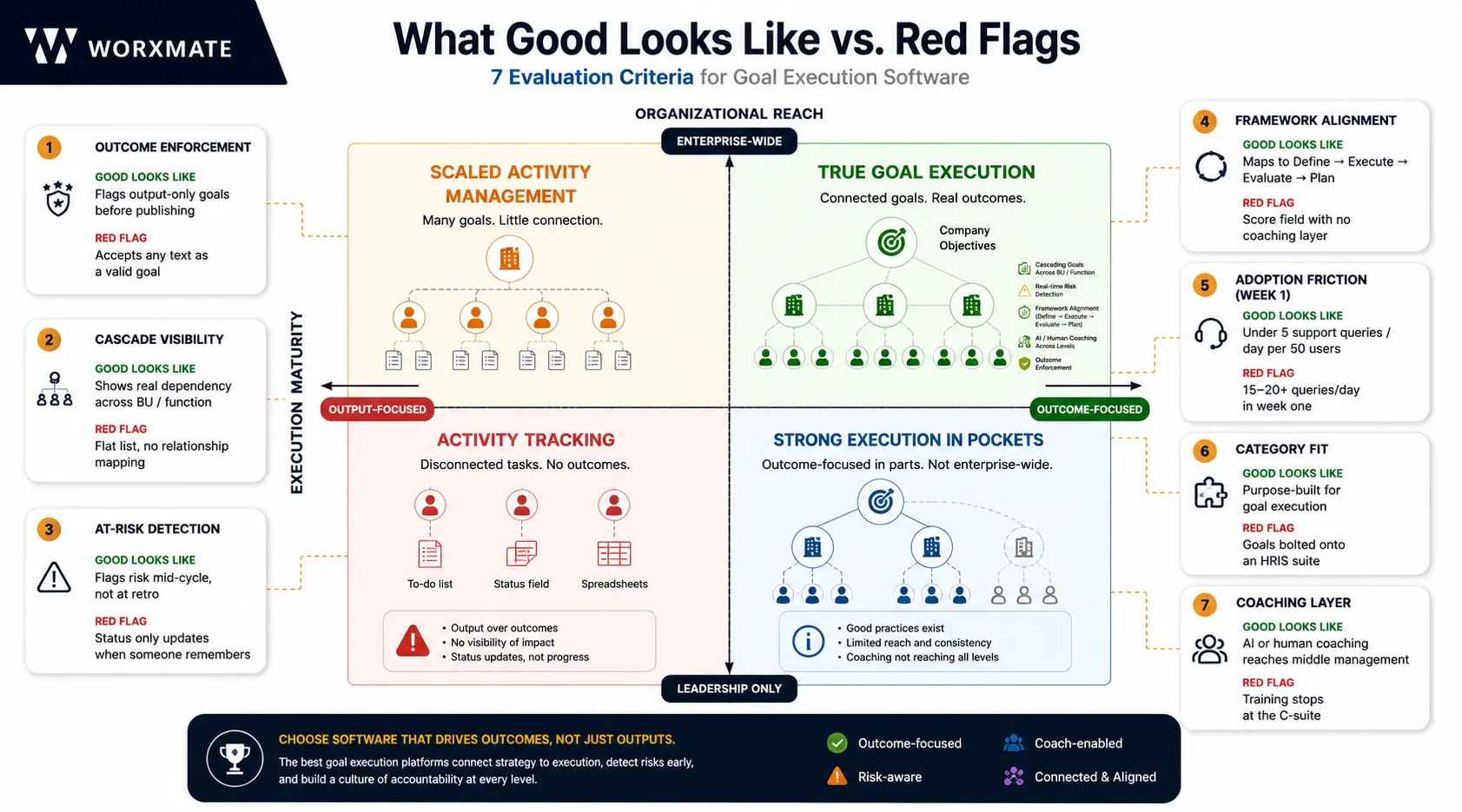
| Evaluation Criteria | What Good Looks Like | Red Flag |
|---|---|---|
| Outcome enforcement | Flags output-only goals before publishing | Accepts any text as a valid goal |
| Cascade visibility | Shows real dependency across BU/function | Flat list, no relationship mapping |
| At-risk detection | Flags risk mid-cycle, not at retro | Status only updates when someone remembers |
| Framework alignment | Maps to Define–Execute–Evaluate–Plan | Score field with no coaching layer |
| Adoption friction (week 1) | Under 5 support queries/day per 50 users | 15–20+ queries/day in week one |
| Category fit | Purpose-built for goal execution | Goals bolted onto an HRIS suite |
| Coaching layer | AI or human coaching reaches middle management | Training stops at the C-suite |
Goal Setting Software vs Dedicated OKR Software: Why the Category Matters
HRIS platforms the Zoho People, Keka HR, Darwinbox type of system are built around HR workflows. Goal setting is, for them, one feature among dozens. For dedicated OKR software, goal execution is the entire product. Every engineering sprint, every support conversation exists because of one question: does this make goal execution better? That is not a criticism of HRIS platforms they can be excellent HR systems. It is a category distinction, and it is the single biggest factor in whether goal setting software gets used past quarter one.
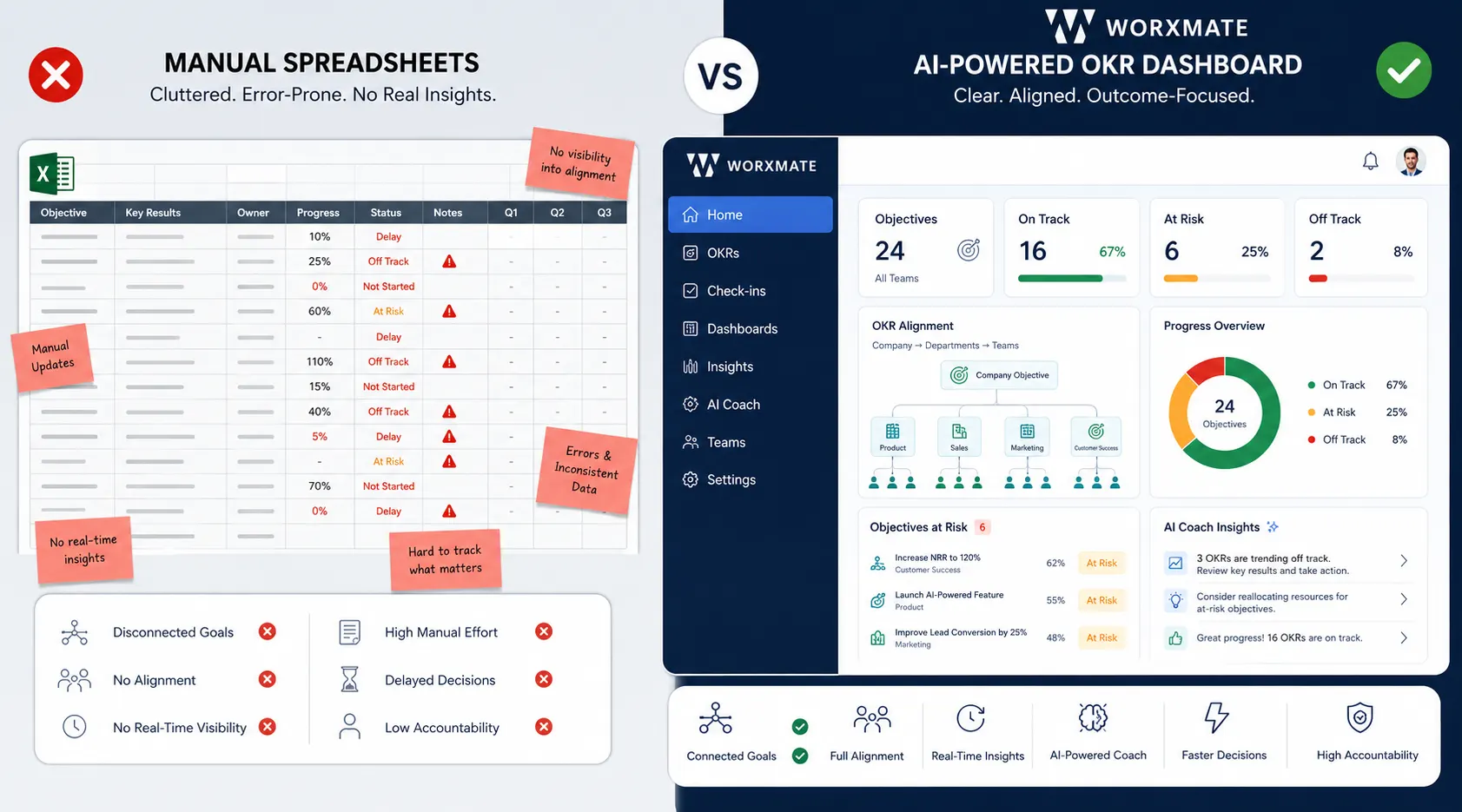
The same distinction applies to spreadsheets, which is where most goal-setting attempts start and where most quietly die. Read spreadsheet vs OKR software for the specific failure points, and evaluate performance management system if goalsetting sits inside a broader performance conversation at your organisation. If you’re comparing named platforms, best OKR tools and how to choose OKR management software walk through the shortlist process I run with clients or see our full ranked comparison in best goal setting software.
Spreadsheets vs HRIS Goal Modules vs Dedicated OKR Software
| Factor | Spreadsheets | HRIS Goal Module | Dedicated OKR Software |
|---|---|---|---|
| Built for goal execution | No | No — one feature | Yes — core product |
| Cascade & dependency mapping | Manual, breaks fast | Limited | Native |
| At-risk detection | None | Rare | AI-driven, real time |
| Coaching / quality scoring | None | Rare | Built-in |
| Best fit | Under 10 people, cycle one | Compliance-first orgs | Orgs serious about execution |
3 Signals That Predict Whether Your Goal Setting Software Will Work
These are the signals I check in week one of every engagement. They predict success or failure more reliably than any demo call.
Signal 1 : Was This Pushed, or Was This Chosen?
There is a meaningful difference between an organisation that has been sensitised to OKRs where leaders understand the why and have chosen to commit and one where a go-live date and a software login just showed up in someone’s inbox. The second scenario collapses between weeks four and six. Not because people are resistant, but because nobody answered the question every employee is silently asking: what is in it for me? That question is answered by leaders who have aligned in advance not by goal setting software.
Signal 2 : How Many Product Queries Is the Team Raising?
Covered above, and worth repeating because it is the single most reliable early-warning metric I have. High query volume in week one is not a training gap you patch later. It is a mismatch between the tool and the team’s current literacy one that compounds instead of resolving. See moving from KPIs to OKRs for how to close that literacy gap before rollout, not after.
Signal 3 : Does the Coaching Stop at the C-Suite?
This is the failure mode the consulting industry is most reluctant to name, because it implicates the most common engagement model. When coaching ends at the C-suite, the program dies below the leadership layer within one quarter. The middle-management layer where goal management programs actually live or die was never equipped to run meaningful check-ins, surface blockers honestly, or coach outcome thinking downward. I call this the Coaching Cliff, and it is the reason why OKR coaching fails more often than the software does.
Achieve Your Goals Faster
See how Worxmate can help your team set clear goals and achieve faster results. Book your free demo today and experience the power of AI-driven OKRs in action.
What Good Goal Management Looks Like in Practice
A European fintech, around 100 people, already generating revenue, brought OKRs in to drive its next stage of growth. When I spoke to the CEO and CPO, it was immediately clear their goals were KPI-led tracking metrics that produced numbers without telling anyone what actually needed to change. The room was full of activity. None of it was clearly connected to what the organisation needed to achieve.
In the first coaching session, I asked one question: what is the one big thing you want to resolve? The answer was product demo experience. Then the real work started a sequence of “so what” questions pushing the team to define what fixing that experience would actually produce. “If you implement this so what? What happens next?” Repeated until the team landed on a genuine outcome statement, that sequence changed the quality of every goal written after it.
I also asked the Product Lead to co-own a Key Result with the Account Executive jointly accountable for demo experience driving conversion. Cross-functional co-ownership of a single KR had never happened in that organisation before. It created accountability neither function could escape, and it forced a dependency conversation that had never been had. Three quarters later: strong synergy between product and commercial teams, goals grounded in reality instead of assumption, and an organisation that had stopped duplicating effort because it had started sharing ownership. Not one line of that outcome came from a software feature. It came from a coaching sequence the software then made visible and trackable.
“You cannot set alignment in a tool. You can display it. You cannot create it.”
How Worxmate’s DEEP AI Framework Turns Goal Setting Software Into an Execution Engine
Every criterion in this guide maps directly to how Worxmate is built. The DEEP AI framework — Define, Execute, Evaluate, Plan — is not a slogan. Each stage is a product.
- Define :- AI OKR writing tool uses an AI co-pilot and OKR Studio to write precision OKRs with built-in quality scoring, so output-language goals get caught before they’re published.
- Execute :- OKR check-in software runs AI-guided task coaching and structured check-ins that keep goals on track between reviews, not just at them.
- Evaluate :- OKR scorecard software uses AI forecasts and scorecards to separate real progress from vanity metrics before the retrospective.
- Plan :- OKR retrospective tool runs AI-facilitated retrospectives, turning each cycle’s data into next-cycle recommendations instead of a forgotten slide deck.
Three AI models sit underneath that cycle. Orbit AI is Worxmate’s employee performance intelligence layer it detects attrition risk, burnout, and high-potential talent 4–8 weeks before a review would ever surface it. Axis AI is the business performance intelligence layer it reads your OKR data and isolates the fastest lever to pull when revenue or execution falls behind. Nexus AI is the organisational intelligence layer it maps strategy cascade failures and structural misalignment before they stall execution. None of the three replace the coaching conversation described above. They make it faster to know where that conversation needs to happen next.
If goal setting sits inside a wider performance management software decision at your organisation, that distinction matters even more the framework needs to connect goal execution to feedback and review data, not sit next to it as a separate system. And if you’re migrating off a discontinued platform, note that Viva Goals was retired in December 2025; see Microsoft Viva Goals retirement for the migration pat
The Checklist Before You Sign Anything
Before you shortlist goal setting software, get your top 3 priorities into three sentences a stranger could repeat back to you. Then run every vendor through the seven criteria in Table 1. Then check whether the coaching — yours or theirs — reaches middle management, because that is where every program I have ever coached either took root or quietly died.
The software is the infrastructure. The coaching is the capability. You need both — and in the right order.
If you are ready to evaluate a platform built around that sequence, see Worxmate’s OKR software, explore pricing, or book a walkthrough of the live intelligence experience to watch Orbit, Axis and Nexus activate against a real business scenario. Or start with our ranked comparison of the best goal setting software on the market today.
If what you recognise in this guide is not a software gap but a capability gap a leadership team that cannot yet compress its vision into three outcomes — that is a different conversation. Our OKR consulting and OKR certification programs exist for exactly that starting point, delivered by practitioners, not generic theory.


Written by
An OKR Coach with 20+ years of implementation experience, Madhusudan has guided over 50 organisations through successful OKR transformations, training more than 500 leaders. Learn more about Worxmate.