 WORXMATE
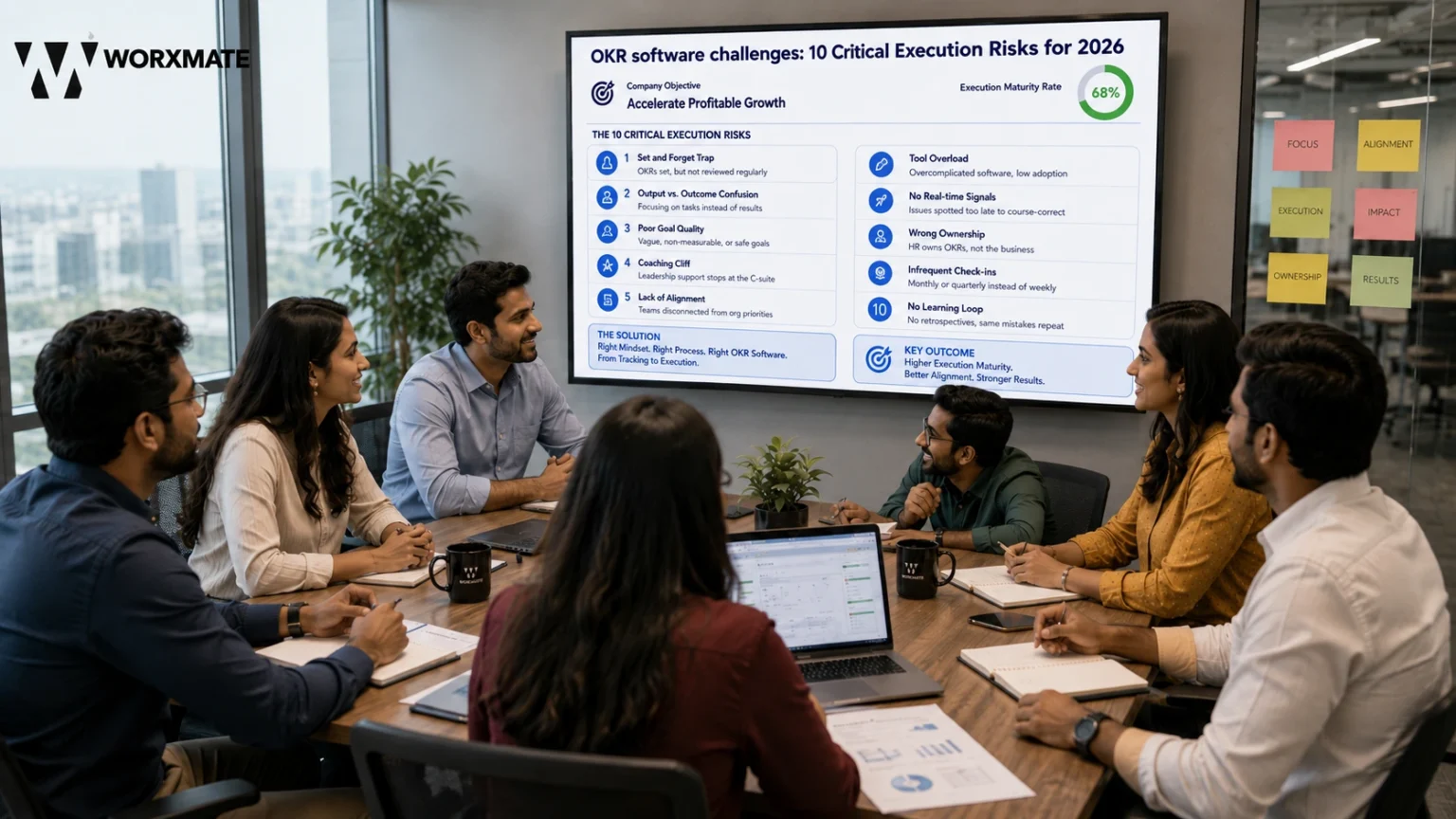
OKR software challenges typically stem from a “tool-first” mentality that ignores the cultural shift required for outcome-thinking. Most programs fail due to the Coaching Cliff, where support stops at the C-suite, or structural misalignments like HR ownership. Solving these requires moving from static tracking to real-time execution signals and AI-assisted coaching.
Alignment is agreement between teams on what matters, why it matters, and how each team’s work connects to the teams around them. You cannot set that in a tool. You can display it. You cannot create it. This is the fundamental truth that most leaders ignore when they first encounter OKR software challenges. They buy a platform expecting it to fix a broken strategy process, only to find that a digital version of a mess is still just a mess.
I have sat in boardrooms where the CEO could not name three clear priorities in 45 minutes, yet the organization was already evaluating high-end software. In one APAC retail company, the leadership team spent six weeks debating which platform to buy, only to realize in month three that their managers were still writing tasks instead of outcomes. The software didn’t fail; the implementation strategy did. When you treat a strategy execution engine like a simple task tracker, you invite systemic failure.
The most common OKR software challenges aren’t technical bugs or missing features. They are “people problems” disguised as software problems. If your middle management layer views the tool as a digital tax they have to pay once a quarter, no amount of UI polish will save the program. Genuine adoption requires moving past the “set and forget” cycle and into a rhythm of weekly execution where the software serves the team, not the other way around.
My Perspective on Strategy Execution
My convictions are built on 50+ implementations and 135+ HR leader conversations across industries ranging from Fintech to Energy and Utilities. I have seen 70,000-person IT services organizations struggle with the same OKR software challenges as 50-person startups: the inability to distinguish between doing work and achieving results. This experience has led to the development of the Execution Maturity Rate (EMR), a proprietary metric that measures the percentage of leaders who can independently write a genuine outcome-driven goal.
Across the organizations I have coached, the starting EMR is almost always between 5% and 15%. This means 85% of your leadership team is likely writing “safe” or “output-based” goals that do not move the needle. Without addressing this gap through dedicated coaching and purpose-built okr software, the program will inevitably stall. The software is the infrastructure, but the coaching is the capability. You need both, and in the right order.
5–15%
Initial Execution Maturity Rate
The typical percentage of leaders who can write high-quality, outcome-driven OKRs in their first cycle without external intervention.
The Specific Pain of Broken OKR Implementations
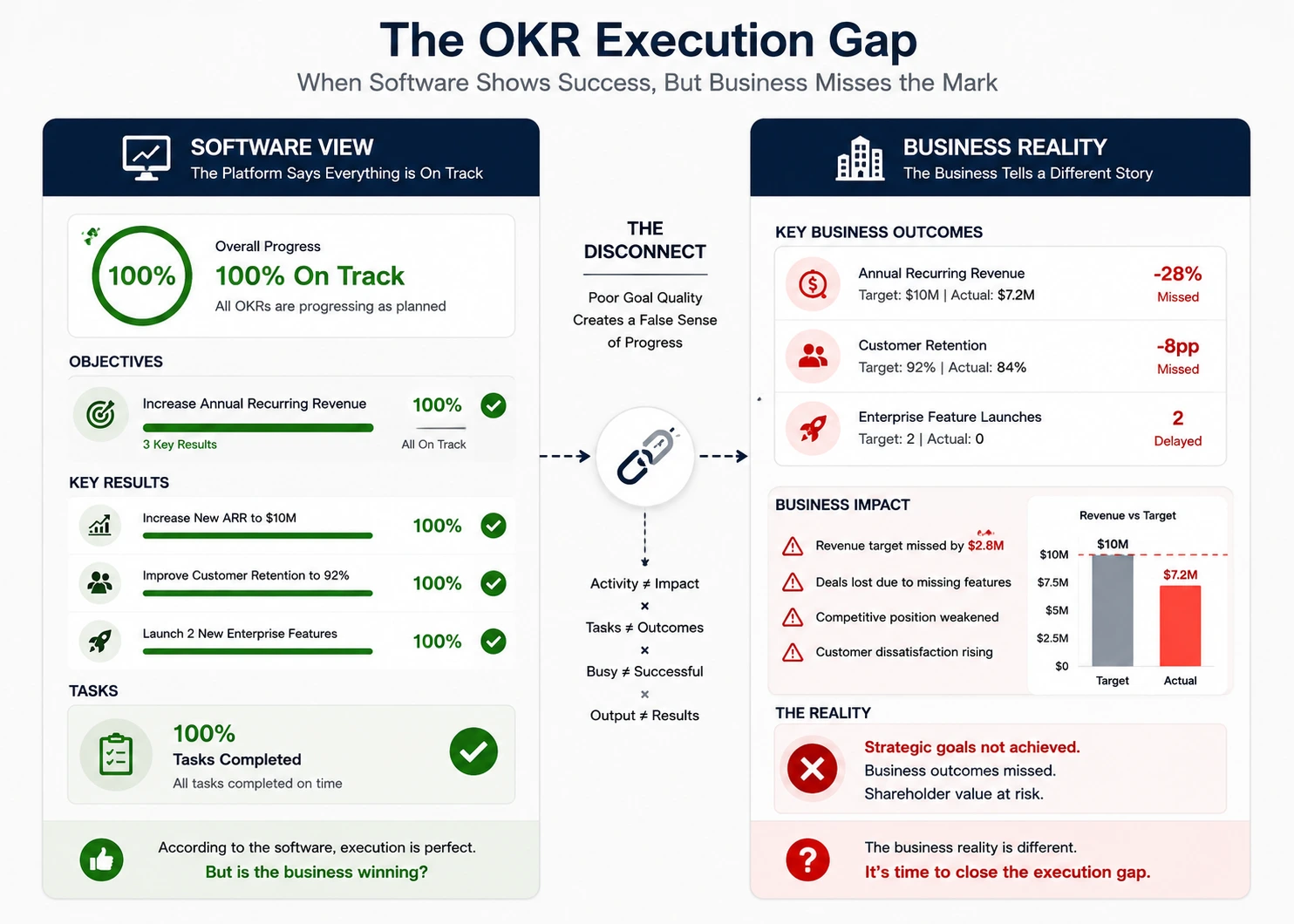
The moment a CEO feels the weight of OKR software challenges is usually during a Monthly Business Review (MBR). You look at a dashboard that shows 90% completion on Key Results, yet the revenue target is lagging, or the product launch is six months behind. This is the “Execution Gap.” The software says everything is green, but the business reality is red. This happens because the tool has become a repository for “business as usual” tasks rather than a driver of strategic change.
When you encounter these OKR software challenges, the frustration is palpable. You see teams spending hours in meetings debating the wording of a goal, only to never look at the software again until the end of the quarter. This “Set and Forget” behavior is a signal that the software is disconnected from the daily workflow. If your managers are still using spreadsheets on the side because the official tool is too cumbersome, you have a systemic adoption failure. This is often why leaders look for worxmate vs betterworks comparisons to find a tool that actually fits their execution rhythm.
Furthermore, the pain intensifies when cross-functional dependencies break. A Product team sets an OKR to launch a new feature, but the Marketing team has no visibility into it and hasn’t planned the campaign. In a tool that doesn’t facilitate “Alignment = Agreement,” these gaps only surface when it’s too late to fix them. This lack of transparency is one of the most cited OKR software challenges in large enterprises.
10 Critical OKR software challenges and How to Solve Them
To move from a failing program to a high-velocity execution engine, you must address these ten OKR software challenges directly. Each one represents a point where strategy typically leaks out of the organization.
1. The “Set and Forget” Trap
Most OKR software challenges begin here. Teams spend two weeks in a planning frenzy, enter their goals into the system, and then ignore them for 80 days. Without a weekly rhythm, the software becomes a graveyard of good intentions. The fix is to implement Execute OKR check-in software that prompts for updates and surface-at-risk signals before they become crises.
2. Output vs. Outcome Confusion
Managers often write “Launch the website” (an output) instead of “Increase organic leads by 20%” (an outcome). When software doesn’t guide this distinction, the quality of your data plummets. Understanding what is okr at a deep level is essential. Using a Define AI OKR writing tool can help coach managers in real-time to pivot from tasks to results.
3. The Coaching Cliff
This is one of the most dangerous OKR software challenges. Coaching often stops at the C-suite, leaving middle managers to figure it out on their own. The program dies in the middle. You must ensure that coaching reaches the “engine room” of the company. Without it, the software is just an empty shell.
4. HR Ownership vs. CEO Ownership
When HR owns OKRs, they often become a performance appraisal tool. When the CEO’s office owns them, they are a strategy execution engine. This structural mistake is a primary driver of OKR software challenges. OKRs should be about moving the business, not just filling out forms for a review. This is why many okr software for ctos focuses on technical delivery rather than HR compliance.
5. Integration Friction and Data Silos
If your OKR software challenges include manual data entry, your adoption will fail. Leaders want to see real okr examples that update automatically from Jira, Salesforce, or HubSpot. If a manager has to log into five different tools to update one Key Result, they simply won’t do it.
6. Lack of Cross-Functional Alignment
Alignment is not a platform configuration; it is a human agreement. Many OKR software challenges arise because the tool assumes that “cascading” is the same as “aligning.” It isn’t. You need a process where teams negotiate co-ownership of Key Results. This is especially true when looking at engineering okrs that must align with Product and DevOps.
7. Low Execution Maturity Rate
As mentioned, most teams start with an EMR of 5-15%. Expecting high-quality execution in cycle one is a recipe for disappointment. You must measure maturity over 12 months, not 90 days. This long-term view helps mitigate the frustration of early OKR software challenges.
8. Tool Over-Complexity
If the software requires a three-day certification just to navigate the UI, your team will revolt. Friction is the enemy of adoption. When comparing worxmate vs mooncamp, look for how many clicks it takes to perform a weekly check-in. If it’s more than three, it’s too many.
9. Disconnected Performance Management
One of the biggest OKR software challenges is the gap between business goals and individual performance. If a team hits their OKRs but gets a poor performance rating, the system is broken. Using Orbit AI employee performance intelligence can bridge this gap by providing real-time signals on how individual contributions drive business outcomes.
10. Lack of Real-Time Signals
Most tools only show you what happened in the past. To solve OKR software challenges, you need predictive signals. Is a goal at risk because of a lack of activity? Is there a burnout risk in a high-performing team? Without these signals, you are flying blind. This is where the distinction between strategy vs tactics becomes critical in your software choice.
Execution Maturity Rate: First Cycle vs 12 Months of Coaching
Benchmark Data
5–15%
30–40% (+185% Lift)
The Practitioner Insight: Why Software Alone Fails
In my experience across 50+ implementations, the organizations that succeed are those that treat the software as a secondary concern to the rhythm of execution. A European fintech startup I worked with reached genuine outcome-thinking not through a feature list, but through repeated “so what” questioning during their weekly check-ins. They used the software to document the conversation, not to replace it. This is a crucial lesson for anyone facing OKR software challenges.
The “Coaching Cliff” is real. When coaching stops at the C-suite, the middle management layer—where the work actually happens—is left to interpret the strategy on their own. This leads to fragmented execution and a lack of alignment. According to research from Harvard Business Review, the ability to execute strategy is often more about the horizontal coordination between teams than the vertical cascade from the top. If your software doesn’t facilitate this horizontal “agreement,” you will continue to face significant OKR software challenges.
Another week-one warning signal that predicts failure: how many product support queries the team raises. If a team is raising 15-20 queries per day in week one, it often predicts that the adoption will break. It means the tool is either too complex or the team hasn’t been properly onboarded into the methodology of OKRs, leading them to fight the tool rather than use it. This is why we emphasize that the software is the infrastructure, but the coaching is the capability.
“The real ROI metric of an OKR program is Execution Maturity Rate, not goal completion rate. In a typical first cycle it sits between 5% and 15%. In organisations coached consistently over 12 months, it reaches 30% to 40%.”
The Framework for Solving OKR software challenges: DEEP AI
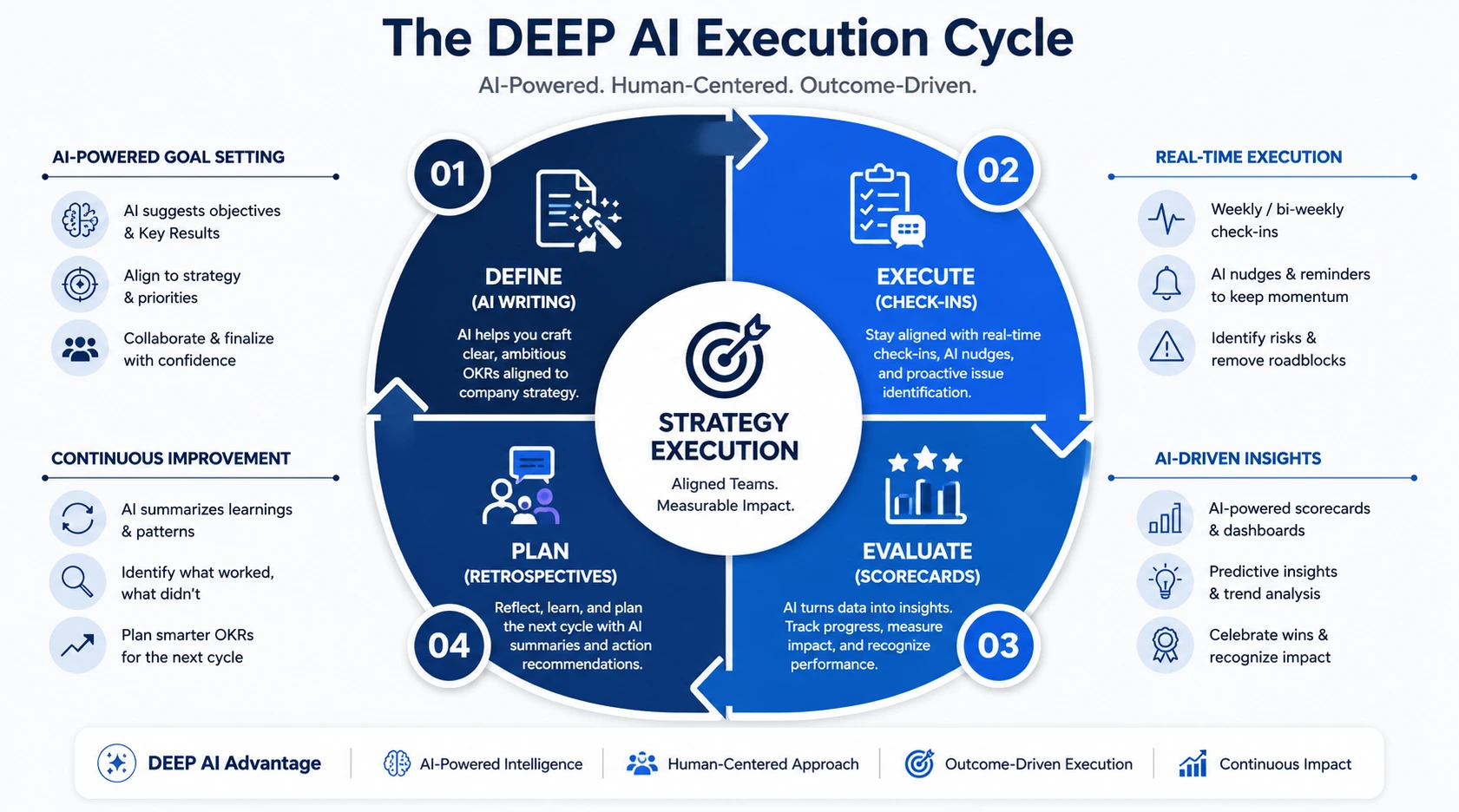
To systematically address OKR software challenges, we use the DEEP AI framework. This isn’t just a set of features; it’s a methodology for strategy execution that maps directly to the lifecycle of an OKR cycle.
- Define: This stage uses AI-assisted tools to help leaders write high-quality, outcome-driven goals. It addresses the EMR gap by providing a quality score for every OKR before it is published. This is where you look for okr examples for bfsi companies in india or other specific industries to ensure relevance.
- Execute: This is the heartbeat of the program. It involves automated check-ins and at-risk detection. If a Key Result hasn’t been updated in 10 days, the system signals a potential execution failure. It moves the team away from the “Set and Forget” trap.
- Evaluate: At the end of the cycle, the software facilitates data-backed retrospectives. Instead of just looking at the final score, teams look at the process of execution. What did we learn? Why did we miss? This is critical for kpi to okr conversion and long-term learning.
- Plan: The final stage uses the insights from the previous cycle to plan the next one. It ensures that organizational learning is captured and applied, preventing the same OKR software challenges from resurfacing quarter after quarter.
| Framework Stage | Problem Solved | Key Metric | Software Feature |
|---|---|---|---|
| Define | Poor Goal Quality | Execution Maturity Rate | AI Quality Scoring |
| Execute | Set and Forget Trap | Check-in Compliance | Automated Nudges |
| Evaluate | Lack of Learning | Retrospective Depth | Data-Backed Reviews |
| Plan | Broken Cascade | Alignment Index | Dependency Mapping |
Field Observation: The Middle Management Layer
The middle management layer is where OKR programs live or die. I recently worked with a 1,500-employee IT services organization that was struggling with OKR software challenges. Their managers were technically proficient but culturally resistant to the transparency that OKRs require. They saw the software as a way for leadership to micromanage them. We had to pivot the coaching to show how OKRs actually protect them from shifting priorities by creating a clear “no” to distractions.
This is why we focus on personal okrs for designers or engineers-to show that OKRs are a tool for focus, not just a tool for reporting. When a manager realizes that a well-written OKR can help them defend their team’s capacity, the OKR software challenges begin to dissolve. They stop fighting the tool and start using it as a shield. This shift in perspective is what moves an organization from a 10% EMR to 40% over a year.
Furthermore, we observed that the most successful teams were those that integrated OKRs into their existing 1:1s. Instead of having a separate “OKR meeting,” they used the software to drive the first 10 minutes of every weekly sync. This integration into the daily flow of work is the single best way to overcome OKR software challenges related to adoption and engagement.
🎯 Practitioner Field Note
Fear of failure is an invisible adoption blocker. Leaders will write safe, easily completable Key Results rather than genuinely ambitious outcomes unless the coaching makes explicit that cycle-one failure is for learning, not performance punishment.
Overcoming the Structural Barriers to Success
To truly solve OKR software challenges, you must look at the structural barriers. Is your software choice aligned with your organizational goals? For example, okr software usa implementations often face different regulatory or cultural hurdles than those in India or Europe. The tool must be flexible enough to handle these nuances while maintaining a rigorous focus on outcomes.
One of the most common OKR software challenges is the “Rating Inflation Drift” seen in performance management. When OKRs are tied too tightly to compensation, everyone hits 100%, but the business doesn’t move. This is why we recommend a Tiered Accountability Model (100% / 40% / 20% OKR weighting by level) to ensure that strategic goals remain ambitious without unfairly penalizing individuals for taking risks. This structural fix is often more important than any specific software feature.
Finally, consider the “Week-One Warning Signals.” If your leadership team is not actively using the tool in the first seven days, the program is at high risk. Successful implementations involve the CEO being the most active user in the system. When the CEO comments on a Key Result or asks a question in the software, the rest of the organization follows. Leadership by example is the ultimate cure for OKR software challenges.
OKR Execution Maturity Framework 2026
Download our comprehensive benchmarking framework to assess your organization’s readiness to overcome OKR software challenges and reach 40% maturity.
What I’d Tell a Client About OKR software challenges
If you are currently evaluating platforms or struggling with an existing one, my advice is simple: stop looking at the features and start looking at the friction. OKR software challenges are almost always a symptom of a process that is too heavy, too disconnected, or too safe. You need a tool that makes it easier to do the right thing than the wrong thing. That means AI that coaches you to write better goals, automated check-ins that save you time, and real-time signals that tell you where to focus your energy.
Remember that the software is the infrastructure, but the coaching is the capability. You can buy the best infrastructure in the world, but if your team doesn’t know how to drive, you won’t get anywhere. Focus on building the Execution Maturity Rate of your leaders. Measure it, track it, and reward it. When your managers can independently write and execute outcome-driven goals, the software will finally do what it was meant to do: accelerate your strategy.
The path to 40% maturity is not found in a feature list. It is found in the discipline of weekly execution and the courage to move from outputs to outcomes. Address the OKR software challenges by putting the business first and the tool second. That is how you bridge the execution gap and turn your strategy into reality.
Adoption Rate
85%
Average failure rate of tool-only implementations
Execution Lift
3.2x
Increase in goal quality with AI-assisted coaching
The Bottom Line on Strategy Execution
Solving OKR software challenges requires a shift from administrative tracking to strategic execution. The software should be a partner in your growth, providing the signals you need to make better decisions. Whether you are looking at okr software for the first time or trying to rescue a failing program, focus on the human element of alignment and the technical element of real-time data.
The software is the infrastructure. The coaching is the capability. You need both, and in the right order. If you are ready to evaluate a platform that was built for execution, explore our OKR Software and check our Pricing to see how we fit your scale. For a deeper look at how we can transform your execution, Get a Demo today.
If you recognize that the platform is not your first problem and you need to build the underlying capability of your leadership team, our OKR Consulting services provide the hands-on coaching required to move your Execution Maturity Rate from 5% to 40% within 12 months.


Written by
An OKR Coach with 20+ years of implementation experience, Madhusudan has guided over 50 organisations through successful OKR transformations, training more than 500 leaders. Learn more about Worxmate.
