 WORXMATE
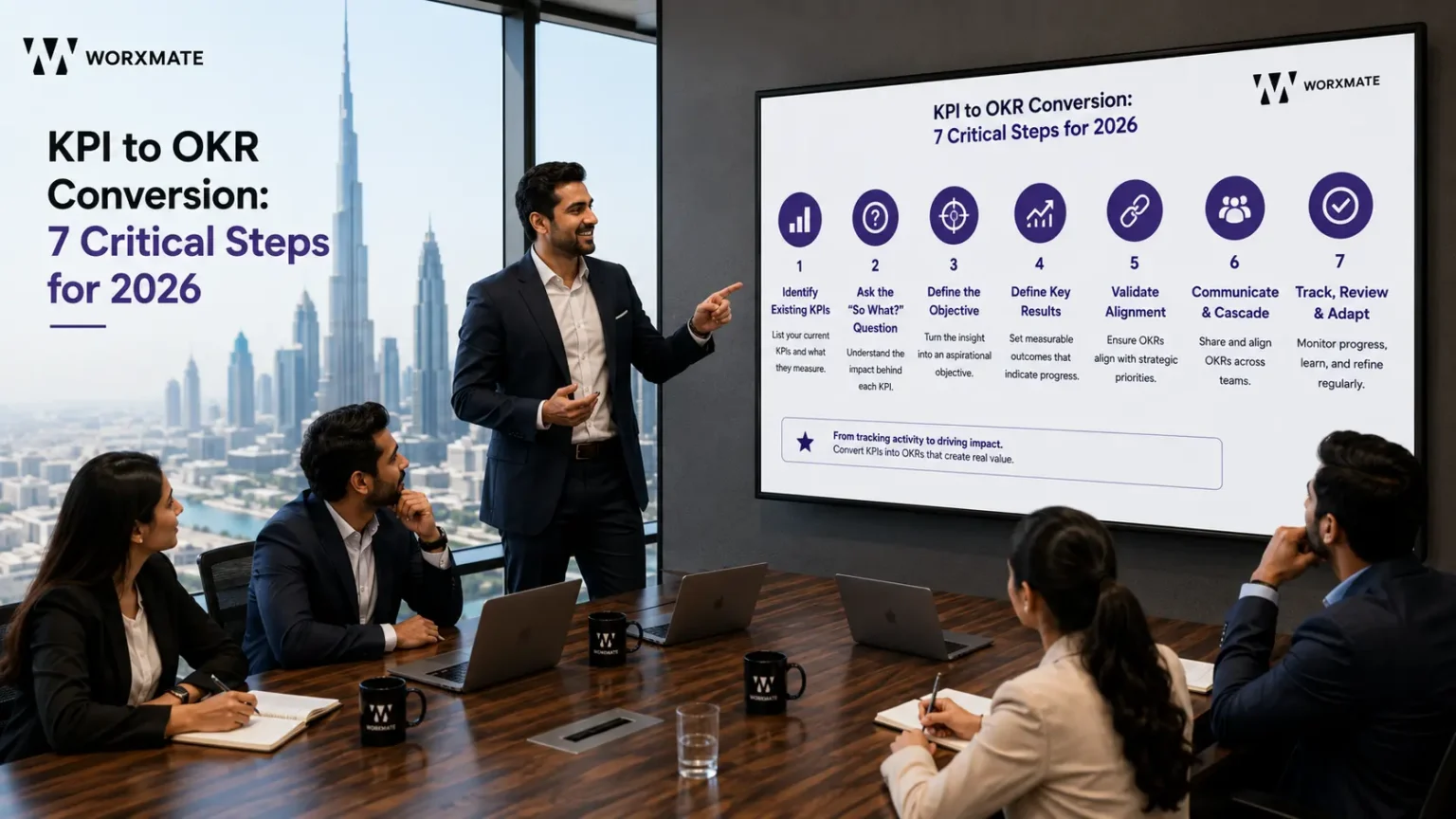
KPI to OKR Conversion: Successfully transitioning operational metrics into strategic objectives requires shifting from static output tracking to outcome-driven execution. By deploying advanced performance management software, organizations bridge the gap between daily KPIs and measurable business growth.
The Head of Product at a European fintech startup once showed me their “OKRs” for the quarter. They looked solid on paper: “Increase feature usage by 15%,” “Reduce bug reports by 20%,” “Improve onboarding completion rate to 90%.” These were all valuable metrics, but they were still KPIs, simply rebranded. When I asked him, “So what? What business outcome does increasing feature usage actually drive?”, he paused. He could tell me how they’d achieve it, but not why it mattered beyond the metric itself. This isn’t an isolated incident. Many organisations, when attempting KPI to OKR conversion, fall into the trap of simply relabeling existing operational metrics. They miss the crucial shift from measuring outputs to defining measurable outcomes. The result is a goal-setting framework that feels like busywork, not a strategic accelerator.
This challenge reveals a deeper issue: the struggle to connect daily activities to overarching business strategy. Without a clear understanding of the desired outcome, teams can be incredibly busy, yet completely misaligned on what truly moves the needle. This is where the real work of OKRs begins, not in the mechanics of writing them, but in the strategic clarity that underpins them. It’s about asking the uncomfortable “so what” questions until the true business impact emerges.
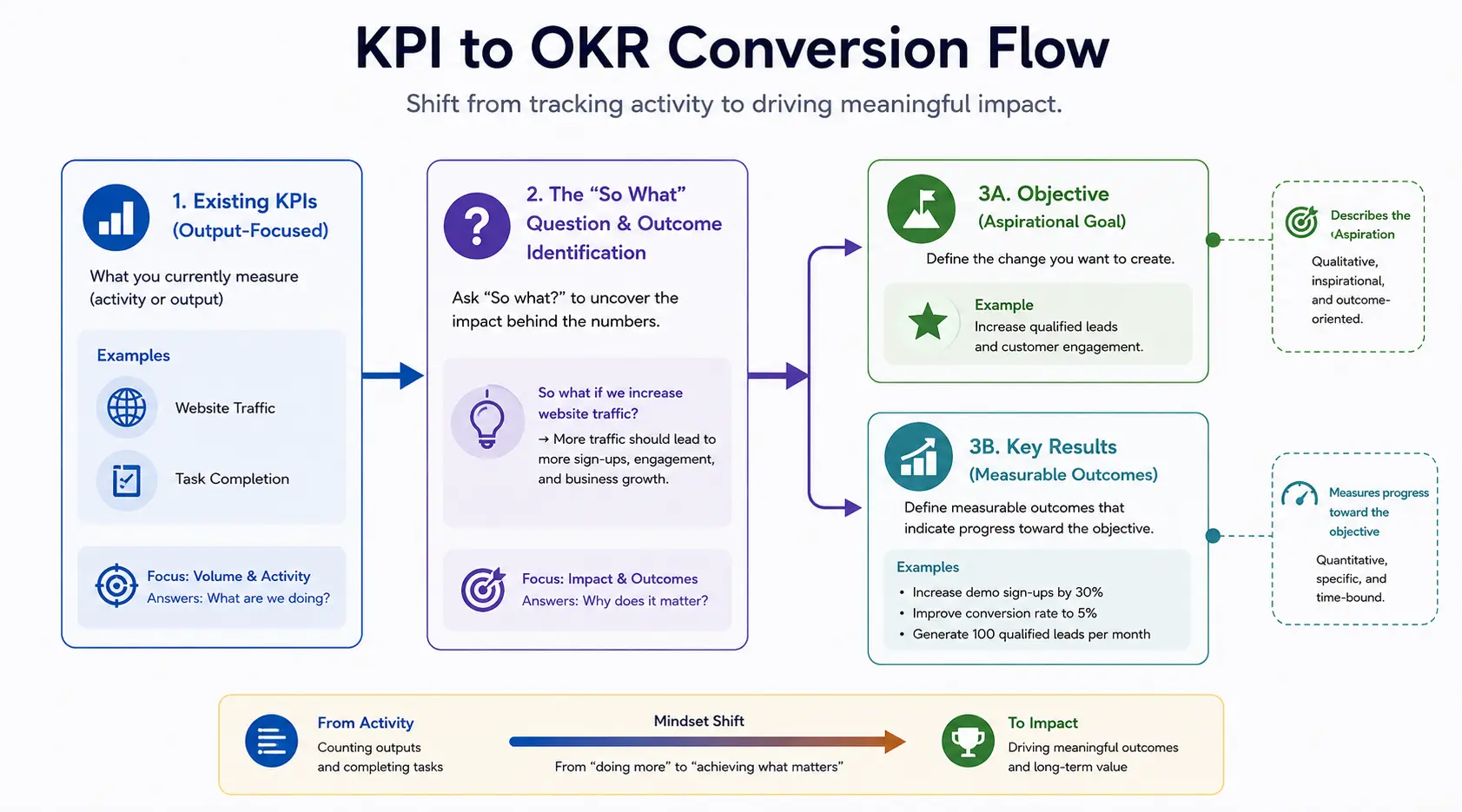
The Critical Shift: From Output Tracking to Outcome Driving
Across the 50+ OKR implementations I’ve led, and the 500+ leaders trained, the most common hurdle isn’t understanding the syntax of OKRs but internalising the philosophy behind them. OKRs are not simply a new way to track performance; they are a strategy execution engine. KPIs, by their nature, are often indicators of past performance or operational health. They tell you what happened. OKRs, especially the Key Results, are designed to tell you whether you moved the business forward in a specific, measurable way.
The distinction is subtle but profound. A KPI like “Number of customer support tickets resolved” is an output. It measures activity. An OKR, however, would frame this differently. An Objective might be “Enhance Customer Trust and Loyalty,” with a Key Result like “Increase customer satisfaction (CSAT) score from X to Y” or “Reduce customer churn rate from A% to B%.” The resolution of tickets is an activity that contributes to the outcome of increased satisfaction or reduced churn. This fundamental difference is why a direct KPI to OKR conversion by simply renaming metrics rarely works. It requires a deeper interrogation of purpose and impact.
Execution Maturity Rate: This proprietary metric tracks the percentage of leaders who can independently write a genuine outcome-driven goal without coaching or templates. In a typical first cycle, it’s 5-15%, but can reach 30-40% after 12 months of consistent coaching.
Why Most KPI to OKR Conversions Fall Flat
The primary reason organisations struggle with effective KPI to OKR conversion is a lack of outcome-thinking discipline. Leaders and teams are accustomed to measuring what is easy to count: website traffic, number of leads, features shipped, tasks completed. These are outputs, and while important for operational oversight, they don’t inherently tell you if you’re achieving strategic impact. The problem is exacerbated when HR owns OKRs, as they often become an appraisal tool, focusing on individual activity rather than collective strategic movement. As I often tell clients, “OKRs owned by HR become a performance appraisal tool. OKRs owned by the CEO’s office become a strategy execution engine.” This isn’t a criticism of HR, but an observation of how the ownership structure impacts the intent and outcome of the framework.
Another common pitfall is the “Coaching Cliff.” When coaching stops at the C-suite, the program dies below it within one quarter. The middle management layer is where OKR programs truly live or die. These managers are the ones translating strategic Objectives into actionable Key Results for their teams. If they haven’t been adequately coached on the distinction between output and outcome, their “converted” OKRs will simply be renamed KPIs, perpetuating the problem. This is why a consistent, layered coaching approach is non-negotiable for successful adoption and genuine outcome-thinking.
“Alignment is agreement between teams on what matters, why it matters, and how each team’s work connects to the teams around them. You cannot set that in a tool. You can display it. You cannot create it.”
Fear of failure also acts as an invisible adoption blocker. Leaders write safe, easily completable Key Results rather than genuinely ambitious outcomes unless the coaching makes explicit that cycle-one failure is learning, not performance failure. If a KPI like “Maintain 99.9% system uptime” is directly translated to an OKR, it becomes a baseline expectation, not an ambitious outcome. OKRs are meant to stretch, to identify what’s truly important and measure progress towards it, even if the target is not fully hit. This requires a culture that embraces learning from misses, a concept often alien to KPI-driven environments focused on hitting targets at all costs. For more on the foundational distinctions, refer to our article on OKR vs KPI.
Achieve Your Goals Faster
See how Worxmate can help your team set clear goals and achieve faster results. Book your free demo today and experience the power of AI-driven OKRs in action.
The Practitioner’s Insight: Cultivating Outcome Thinking for Effective KPI to OKR Conversion
The transition from output to outcome thinking cannot happen in a single quarter, regardless of seniority. It is a 12-month journey. This is a hard-won lesson from the field. I saw this firsthand with an APAC retail company whose CEO initially struggled to articulate even three clear priorities in a 45-minute session. Their default was always operational metrics and outputs. It took intensive 1:1 coaching, not group training, and a two-day “war room” session to break through that ingrained output-first mindset. The turning point was relentless “so what” questioning: “You want to increase conversion rate by 5%. So what? What does that do for the business? How does that impact customer loyalty or market share?” This iterative process is crucial for effective KPI to OKR conversion.
The real ROI metric of an OKR program isn’t goal completion rate; it’s the Execution Maturity Rate. This measures the percentage of leaders who can independently write a genuine outcome-driven goal without coaching, a template, or a quality review. In typical first cycles, this rate sits between 5% and 15%. After 12 months of consistent, targeted coaching, we see it reach 30% to 40%. This growth isn’t about software features, it’s about shifting mindsets and building capability.
Coaching must map to a leader’s career background, not a generic slide deck. A finance leader thinks in budget cycles, a product leader in sprints, a sales leader in pipeline. Tailoring the “so what” questions to their specific operational context is key to unlocking genuine outcome thinking.
One of the most powerful techniques for cultivating outcome thinking during KPI to OKR conversion is cross-functional Key Result co-ownership. In that European fintech startup, we found success by having Product and Commercial teams jointly own Key Results related to customer adoption and revenue growth. This forced them to move beyond their departmental KPIs and agree on shared business outcomes. Product couldn’t just ship features (output); they had to ensure those features drove commercial results (outcome). Commercial couldn’t just focus on sales (output); they had to influence product development to create features that resonated with the market (outcome). This shared accountability for outcomes transforms how teams view their work and how they interact.
Execution Maturity Rate: First Cycle vs 12 Months of Coaching
A Structured Approach to KPI to OKR Conversion: The DEEP AI Framework
Effective KPI to OKR conversion isn’t about discarding your existing KPIs. It’s about recontextualizing them within an outcome-driven framework. The DEEP AI framework (Define, Execute, Evaluate, Plan) provides a systematic way to approach this.
| DEEP AI Phase | How it aids KPI to OKR Conversion | N/A | N/A |
|---|---|---|---|
| Define | This phase uses AI-assisted goal writing to interrogate existing KPIs. It helps teams move from “Increase website traffic by 20%” to “Achieve market leadership through enhanced digital presence (Objective)” with Key Results like “Increase qualified organic leads from X to Y” (outcome-driven). This is where the “so what” questions are critical. It’s not just about writing; it’s about clarity of intent and measurable business outcomes. | ||
| Execute | Automated check-ins and at-risk detection ensure that the new outcome-driven Key Results are being actively pursued. Instead of merely reporting on KPI progress, teams discuss the actions driving (or hindering) the desired outcome. This shifts focus from reporting on activity to discussing impact. Regular OKR check-ins are vital here. | ||
| Evaluate | Data-backed retrospectives assess not just whether a Key Result was achieved, but why. This is where the learning from “failure” (not hitting an ambitious KR) becomes invaluable. It allows teams to refine their understanding of which activities truly drive which outcomes, informing future goal setting. | ||
| Plan | Cycle-over-cycle organisational learning ensures that the insights gained from evaluation feed directly into the next planning cycle. This iterative process is how organisations build genuine outcome-thinking muscle, progressively improving their ability to convert strategic intent into measurable results. |
Here’s a practical breakdown of how to approach KPI to OKR conversion:
- Identify Core Strategic Priorities: Before looking at any KPI, define your 3-5 most critical strategic Objectives for the next 12-18 months. These should be aspirational, qualitative, and time-bound.
- Map Existing KPIs to Strategic Objectives: For each strategic Objective, list all relevant KPIs that could contribute to it. Don’t worry about direct conversion yet; just identify potential connections. For example, “Website Traffic” might map to an Objective about “Expanding Digital Reach.”
- Ask “So What?” for Each KPI: This is the most crucial step. For every KPI, ask: “If we improve this KPI, what specific, measurable business outcome does it lead to?” If the answer is vague or simply “it’s good,” dig deeper. This process helps you differentiate between outputs and outcomes.
- Transform Outcomes into Key Results: Once you’ve identified the true outcomes, craft them into Key Results. Key Results must be measurable, time-bound, aggressive yet realistic, and directly tied to the Objective. They measure the impact of the work, not just the work itself. For instance, if “Reduce server downtime” (a KPI) leads to “Improved customer satisfaction,” then a KR could be “Increase customer satisfaction (CSAT) related to service availability from 85% to 92%.”
- Align and Co-Own Key Results: Ensure cross-functional Key Results are genuinely co-owned. This forces agreement and drives collaborative action towards shared outcomes, preventing siloed thinking. Organizational alignment isn’t a feature in a tool; it’s an agreement between people.
- Cascade with Intent, Not Just Metrics: When cascading OKRs, focus on explaining the why behind the Objectives and Key Results, not just presenting the metrics. Middle managers need to understand how their team’s work contributes to the larger strategic picture.
- Iterate and Learn: OKR adoption is a journey. Your first cycle’s converted OKRs won’t be perfect. Use the Evaluate and Plan phases of DEEP AI to continuously refine your outcome-thinking. Measure your OKR tracking metrics and learn from them.
OKR Execution Maturity Framework 2026
Benchmark your organisation’s OKR execution capabilities and identify critical areas for improvement to drive genuine outcome-driven results.
What Successful KPI to OKR Conversion Looks Like in Practice
When a KPI to OKR conversion is done correctly, the change in an organisation is palpable. Discussions in weekly check-ins shift from “What did you do?” to “What impact did that action have on our Key Result?” and “Are we still on track to achieve our Objective?” This creates a culture of accountability for outcomes, not just activity.
I recall an 8,000-employee energy and utility company in the Middle East, with a $45Bn valuation. Their initial challenge was scattered strategic ownership, where different departments had their own KPIs, but no clear, unified view of strategic progression. Through coordinated leadership alignment and a focused effort on converting their myriad operational KPIs into a concise set of outcome-driven OKRs, they began to see real change. The process involved:
- Leadership Alignment: The executive team spent dedicated time agreeing on 3-4 overarching company Objectives. This wasn’t a quick meeting; it was a series of workshops to ensure genuine agreement, not just compliance.
- “So What” Workshops: Departmental leaders brought their most critical KPIs. In facilitated sessions, we drilled down on the “so what” for each, uncovering the underlying business outcomes they were truly trying to achieve. For example, a KPI around “reducing maintenance costs” was converted into a KR about “increasing operational efficiency, leading to a 5% improvement in asset uptime.”
- Cross-Functional KR Ownership: Teams were encouraged to co-own Key Results that spanned their departmental boundaries. The IT team, for instance, worked with Operations on a KR related to system reliability, directly impacting operational efficiency.
The shift was evident in their quarterly business reviews. Instead of a series of departmental reports on completed tasks, the conversation focused on the progress of shared Objectives, the health of Key Results, and what collective actions were needed to course-correct. This enabled them to identify at-risk goals much earlier.
Week-One Warning Signals: If a team raises 15-20 product support queries per day in week one of an OKR program, it’s a strong predictor that adoption will break. This signals a lack of clarity, poor onboarding, or that the program was pushed rather than chosen. Tracking a real-time confidence score helps identify at-risk targets before quarter-end. Surfacing operational blockers early ensures leadership can clear obstacles quickly. Strong goal alignment eliminates siloed efforts and connects daily work to strategic outcomes.
This isn’t just about better reporting; it’s about better decision-making. When leaders understand the true outcomes their teams are driving, they can allocate resources more effectively, identify dependencies, and respond to challenges with strategic intent. The focus shifts from merely hitting numbers to creating tangible business value.
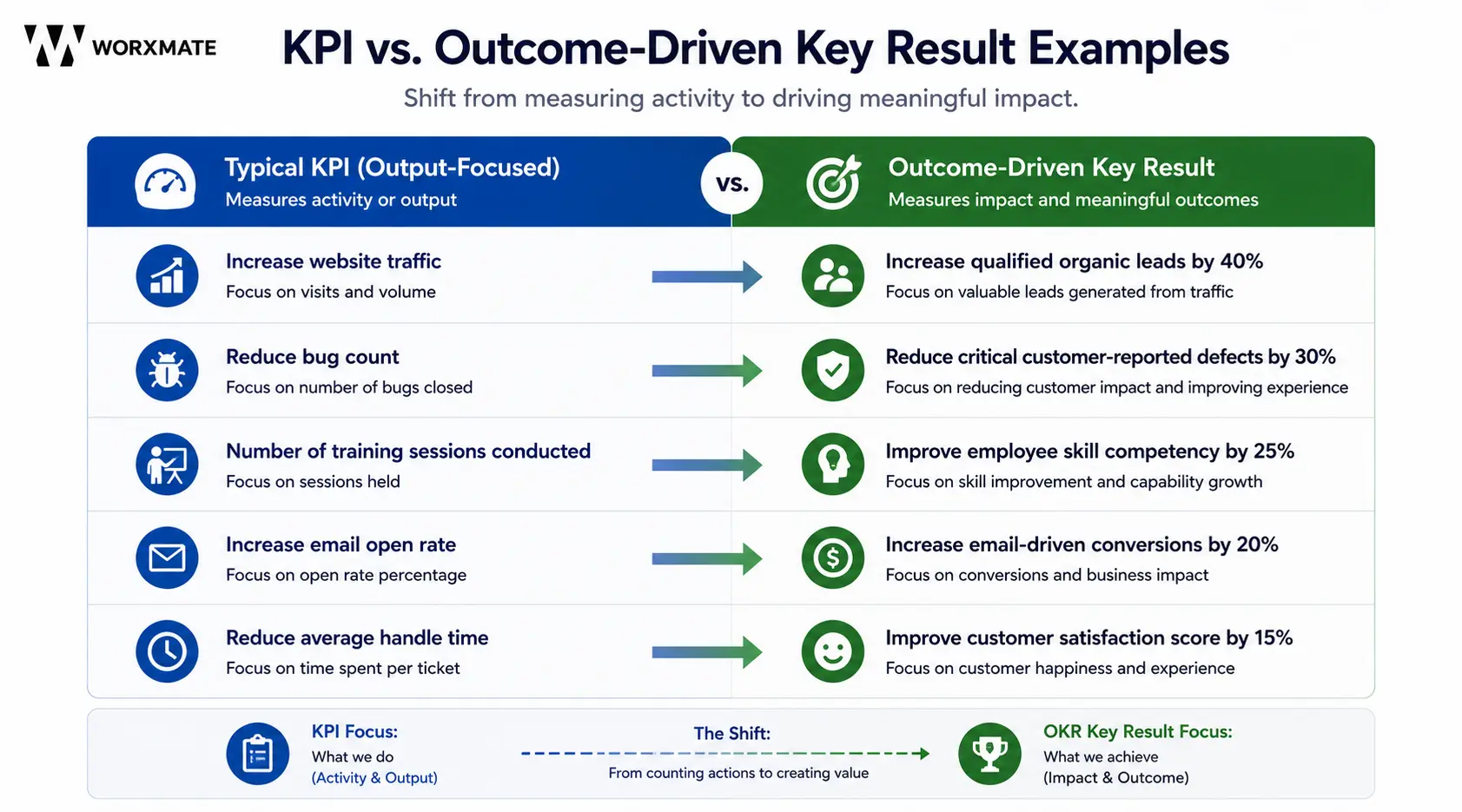
My Take: Making the Shift to Outcome-Driven Execution
The journey of KPI to OKR conversion is less about a technical migration and more about a cultural transformation. It demands a rigorous discipline of asking “why” and “so what” until you uncover the true business outcomes you’re striving for. This isn’t a one-off exercise; it’s an ongoing process of learning and refinement, supported by consistent coaching and the right infrastructure.
The software is the infrastructure. The coaching is the capability. You need both, and in the right order. If you’re looking to truly embed outcome-driven execution into your organisation, start by fostering the mindset shift, then enable it with technology.
If your organisation is ready to move beyond output tracking and embrace genuine outcome-driven execution, the path is clear. For those seeking the infrastructure to manage, track, and align your new outcome-driven goals, explore our OKR software, understand our pricing, or get a demo to see it in action. If you recognize that the shift requires more than just a tool that it demands a fundamental change in how your leaders think and operate then consider partnering with us for OKR Consulting to build that capability from the ground up.

Written by
An OKR Coach with 20+ years of implementation experience, Madhusudan has guided over 50 organisations through successful OKR transformations, training more than 500 leaders. Learn more about Worxmate.