WORXMATE
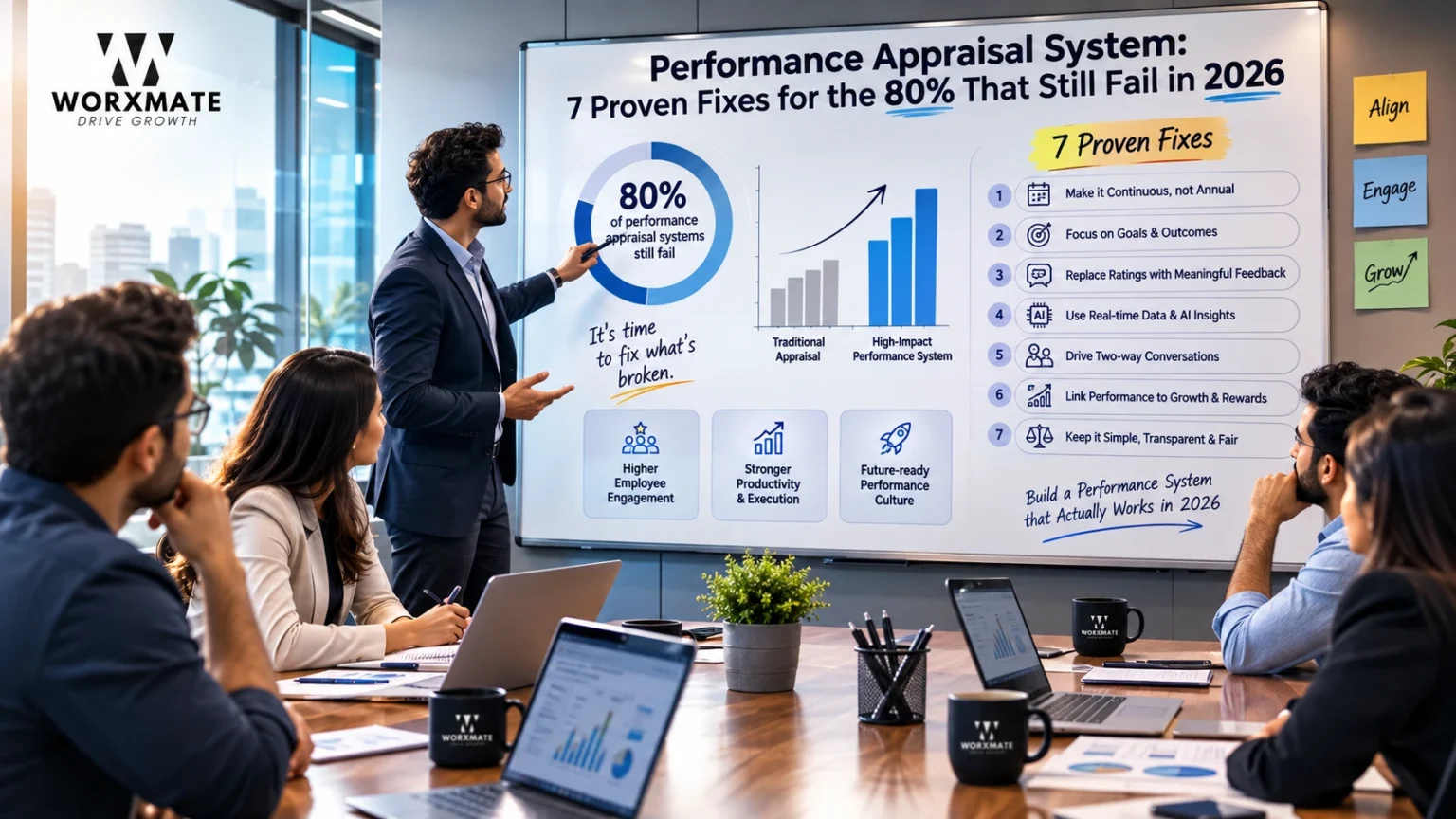
Performance Appraisal System: A structured framework for evaluating employee contributions against strategic benchmarks. Modern systems move beyond annual forms to integrate employee performance software with real-time OKRs, continuous feedback loops, and AI-driven bias mitigation to ensure equitable growth and operational alignment. Roughly 80% of appraisal systems fail because they run once a year, rely on a single manager’s memory, and skip the ongoing feedback loop. The fix is a continuous, multi-source system – 360-degree input, clear benchmarks, and AI-assisted tracking through platforms like Worxmate’s Orbit AI, Axis AI, and Nexus AI – instead of one dreaded annual form.
While most HR leaders recognize that the traditional annual review is broken, the transition to a high-impact performance appraisal system remains a hurdle. In 2026, the gap isn’t just about the frequency of reviews—it’s about the disconnect between high-level strategy and daily execution, especially for organizations managing remote or frontline operational teams.
Without a structured appraisal system, performance assessments can be biased and inconsistent, leading to frustration among employees. How can HR leaders implement a fair, data-driven evaluation method?
Companies now use performance reviews as a strategic tool. Employees benefit since it provides them with the opportunity to assess their professional development and strengths and limitations.
Naturally, this results in the organization receiving the information it requires to oversee its people resources and achieve its goals more effectively. It’s a difficult process that calls for a well-defined approach and few resources. However, it’s worth the effort because it allows you to maximize the organization’s most valuable asset- its people.
This 2026 refresh dives deeper into how a modern performance appraisal system compares to a full performance management platform, why the bell curve is falling out of favor, and how AI models like Orbit, Axis, and Nexus – built on Worxmate’s DEEP AI framework – are replacing the once-a-year form with continuous, evidence-based tracking. If you’re short on time, start with the quick answer above.
What is performance appraisal?
An employee’s performance is reviewed on a regular basis through a set of actions called a performance appraisal. Its main objective is to evaluate a person’s performance in relation to the position for which they were employed.
It entails workers speaking with their immediate bosses one-on-one. The two talk about the future roadmap, prospective improvement areas, strengths, and limitations during these talks.
It enables staff members to obtain a better understanding of their performance in comparison to the company’s expectations. Employers also have a clear picture of how relevant and diverse their workforce is.
Employers can use the performance appraisal process as a crucial tool to make sure their staff members are fulfilling their objectives and expectations.
Additionally, it gives workers a chance to evaluate their work and pinpoint areas in need of development. Employees’ hard work and dedication can be acknowledged and rewarded through the performance appraisal process, which is crucial for assessing performance.
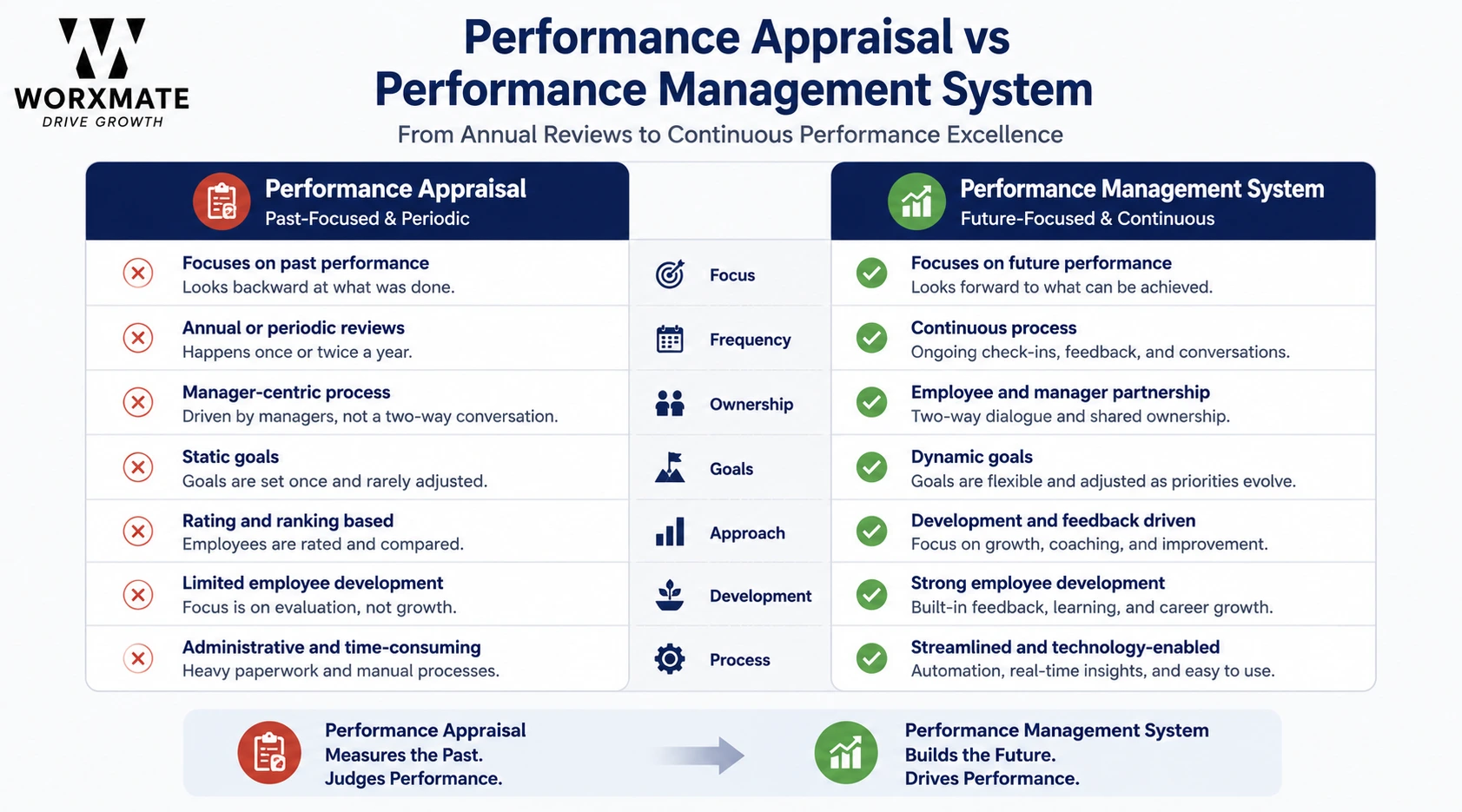
This is also where a lot of confusion starts. Many HR teams treat their annual review form as their entire performance appraisal system, when in reality an appraisal is only one component of a broader performance management system vs appraisal software comparison – the two are related but not identical, and knowing the difference is step one in fixing a broken process.
7 Proven Fixes for the 80% of Appraisal Systems That Fail
If your current process feels like a compliance checkbox rather than a growth engine, you are likely suffering from the ‘Annual Decay’ syndrome. To move into the top 20% of high-performing organizations, your performance appraisal system must undergo these seven surgical shifts.
1. Decouple Compensation from Coaching
When a review is tied directly to a salary increase, employees stop listening to feedback and start defending their ‘rating.’ The fix is to separate the developmental continuous feedback cycle from the annual compensation review. This allows for honest growth conversations without the financial pressure clouding the dialogue.
2. Integrate Real-Time OKRs with Task Tracking
Legacy tools like Lattice often bolt OKRs onto reviews as an afterthought. A modern system links key results directly to daily tasks. Worxmate’s Nexus AI ensures that when a milestone is hit in the field, it automatically populates the appraisal evidence trail, eliminating the ‘what did I do six months ago?’ amnesia.
3. Prioritize Frontline and Operational Visibility
Most appraisal software is built for desk-bound workers. For industries like Logistics, Healthcare, and IT Services, the system must capture operational frontline data. Tracking performance where the work actually happens—on the warehouse floor or in the field—ensures that your most vital workers aren’t evaluated on subjective manager vibes.
4. Deploy AI-Driven Bias Mitigation
Recency bias and ‘halo effects’ destroy trust in appraisals. By using Orbit AI to track weekly check-ins and sentiment across the entire year, Worxmate provides an objective evidence log. This shifts the manager’s role from ‘judge’ to ‘coach,’ backed by a year’s worth of data points rather than a week’s worth of memories.
5. Transition to Multi-Source 360 Feedback
A single manager’s perspective is a narrow lens. Implementing 360-degree feedback that includes peers, direct reports, and even cross-functional partners provides a holistic view of an employee’s impact. This is critical for strategic alignment in matrixed organizations where employees often report to multiple project leads.
6. Automate the 1:1 Cadence Tuning
The biggest reason systems fail is lack of consistency. If 1:1 check-ins are skipped, the appraisal system loses its fuel. Automated reminders and AI-generated talking points ensure that managers stay on track without the HR team having to manually police every department.
7. Shift to Predictive Performance Analytics
Don’t just look backward. Use your appraisal data to predict future potential. Axis AI analyzes historical performance trends to identify ‘flight risks’ or ‘high-potential’ leaders before the annual cycle even ends, allowing for proactive staff development goals and retention strategies.
The following are the main goals of performance appraisals:
- Increasing performance on both an individual and organizational level by establishing clear objectives and expectations
- Finding areas of strength and room for development to direct staff
- Using performance data to inform decisions about retention, promotion, and pay
- Matching personal aspirations with more general organizational goals enhancing the exchange of information between supervisors and staff
- Firms must implement effective performance management to involve, expand, and ultimately keep top personnel.
Unlock Goal Clarity & Accelerate Employee Growth
Looking to drive goal clarity and employee growth? Discover how Worxmate’s AI-powered Performance Management Software can help.
Performance Appraisal System vs. Performance Management Software: What’s the Real Difference?
Why Mid-Market Leaders are Migrating from Enterprise HR Bloat
While platforms like Lattice offer robust features, they often come with mandatory platform fees and a complexity that slows down agile teams. For organizations focused on strategy execution and operational efficiency, the ‘total cost of ownership’ involves more than just the monthly subscription.
| Feature Capability | Legacy Enterprise Tools (Lattice) | Worxmate Agile PMS |
|---|---|---|
| Primary Philosophy | HR-centric compliance & reviews | Strategy-centric execution & growth |
| OKR-to-Task Link | Manual/Bolted-on integration | Native, real-time task alignment |
| Frontline Tracking | Limited / Desk-worker focused | Native mobile/field force capability |
| AI Capabilities | Basic generative text aids | DEEP AI (Orbit, Axis, Nexus) |
| Pricing Model | High per-user + Platform fees | Transparent, 50% lower TCO |
| Ease of Use | Steep learning curve for managers | Intuitive, mobile-first interface |
| Best For | Large Enterprise (1,000+ desk staff) | Agile Mid-Market & Frontline Ops |
The Point: Choosing a performance appraisal system isn’t just about the features on a sales deck; it’s about whether the tool actually gets used by your managers in the field.
This is one of the most searched questions among HR leaders shopping for new tools, and the performance management system vs appraisal software distinction matters more than it sounds. An appraisal system is event-based – it looks backward at a fixed review period. A performance management platform is continuous – it tracks goals, feedback, and coaching all year and uses the appraisal as one checkpoint among many, not the whole process.
| Dimension | Performance Appraisal System | Performance Management Software |
|---|---|---|
| Frequency | Annual or bi-annual | Continuous, real-time |
| Data source | Manager memory + a form | Check-ins, OKRs, 360 feedback, AI signals |
| Bias risk | High — recency bias dominates | Lower — evidence trail across the year |
| Best used as | A checkpoint / compliance record | The operating system for performance |
| Worxmate fit | Structured appraisal templates | Orbit AI, Axis AI, Nexus AI + DEEP AI cycle |
If your organization is still deciding between the two, our how to evaluate a performance management system guide walks through a practical checklist, and you can grab our free performance appraisal template if you just need to standardize the form itself while you plan the bigger switch.
What benefits can performance appraisals offer?
Systems for performance reviews are essential for promoting employee growth, performance, and corporate success.
Performance appraisal systems support a corporate culture that prioritizes involvement and continual improvement by identifying development needs, identifying accomplishments, setting targets that are in line with broader business objectives, and offering constructive criticism.
Data from performance appraisal systems is examined to find patterns and trends where the business may improve. These insightful observations support ongoing efforts at improvement as well as data-driven, well-informed decision-making.
Read More: 7 Ways to Foster a Growth Mindset Among Employees
Case Study- Baker Tilly’s Performance Management Overhaul
Baker Tilly, a leading CPA firm, encountered significant challenges in implementing a structured performance management system. Prior to the overhaul, the firm struggled with incomplete performance reviews, inconsistent feedback, and low engagement in the appraisal process.
To address these issues, Baker Tilly adopted Quantum Workplace’s performance management solutions, which introduced a streamlined and data-driven approach to employee evaluations.
The results were transformative:
- Performance review completion rates surged from 70% to 100%.
- Employees received more structured and constructive feedback, leading to improved engagement.
- The organization benefited from better alignment between employee performance and business goals.
This case underscores the importance of effective change management and the adoption of user-friendly appraisal systems. By leveraging the right technology and fostering a culture of continuous feedback, Baker Tilly successfully enhanced its performance management process, demonstrating how structured appraisals can drive both employee and organizational success.
Disadvantages of Performance appraisals
Performance appraisals have the potential to inspire and involve your team, but they can also have unfavorable effects on you. This is particularly true if the employee’s expectations are not met by the appraisal system. Improper handling of the performance review might result in:
Demotivation
Badly conducted performance reviews can not only demotivate employees, but they will also cause them to leave the company.
Trust Issues
Employees may feel underappreciated if they are criticized for being unfair, and partial, without any connection to their real performance. This further fuels discontent and lowers morale. This could intensify the team’s already-existing rumors, which could result in decreased staff involvement or even a decline in the team’s overall performance.
Concentrate Only on Quantitative Profits
When assessing an employee’s performance, many companies use quantitative data. Employees feel that they are merely numbers rather than distinctive people who contribute to success. Employees may become demotivated as a result of this instead of seeing that it all came down to being good team players.
Such evaluations must be conducted with tact. Success would be ensured by an evaluation system that takes these cultural quirks into account without sacrificing equity.
Unlock Goal Clarity & Accelerate Employee Growth
Looking to drive goal clarity and employee growth? Discover how Worxmate’s AI-powered Performance Management Software can help.
The Bell Curve Trap: A Fourth Reason Appraisal Systems Backfire
One specific appraisal method deserves its own callout because it causes more of the trust and demotivation problems above than any other: forced ranking, better known as the bell curve. A quick look at the bell curve appraisal pros and cons makes it clear why so many companies – including GE, its original popularizer – have quietly walked it back.
| Pros | Cons |
|---|---|
| Forces managers to differentiate performance instead of rating everyone “meets expectations” | Assumes performance is normally distributed across every team, which it rarely is in small groups |
| Simplifies compensation and promotion budgeting | Creates internal competition instead of collaboration |
| Easy to explain and audit at scale | Punishes strong performers stuck on a strong team |
For a deeper dive into why the curve breaks down mathematically for teams under ~30 people, see our full breakdown of bell curve in performance management. Most companies moving away from it replace forced ranking with continuous, evidence-based scoring instead – which is exactly the shift covered in the next section.
Stages of the performance appraisal procedure
- Set performance benchmarks
- Share the performance criteria
- Assess real performance
- Evaluate performance standards against actual performance.
- Talk about the findings and provide comments.
- Choose a plan for follow-up
Performance appraisal types
Choosing the best performance appraisal system is crucial to fostering employee development and a productive workplace. Here are a few well-liked techniques to think about:
360-degree appraisal
A 360-degree appraisal provides a thorough view of an employee’s performance by collecting input from coworkers, managers, subordinates, and even customers.
Management by Objectives (MBO)
MBO emphasizes managers and staff working together to establish specific, quantifiable goals and evaluate performance according to how well these goals are being met.
Peer Assessment
By encouraging colleagues to assess one another’s work, this approach promotes cooperation and teamwork among coworkers.
Self-Assessment
Workers can gain confidence and a feeling of control over their performance by considering their own accomplishments, difficulties, and potential growth areas.
Rating Scales
This method regularly rates an employee’s performance in a number of areas, including teamwork, communication, and work quality, using pre-established scales. This directly accelerates measurable key results across the entire organization. Tracking a real-time confidence score helps identify at-risk targets before quarter-end. Surfacing operational blockers early ensures leadership can clear obstacles quickly. Seamless cascading ensures department milestones stay synchronized with company strategy. Strong goal alignment eliminates siloed efforts and connects daily work to strategic outcomes.
Critical Incidents
Employers can spot trends and quickly resolve any problems by concentrating on particular, noteworthy instances in a worker’s performance.
Remember to approach performance reviews with compassion and understanding, establishing a nurturing atmosphere that encourages staff development
The Bell Curve Trap: A Fourth Reason Appraisal Systems Backfire
One specific appraisal method deserves its own callout because it causes more of the trust and demotivation problems above than any other: forced ranking, better known as the bell curve. A quick look at the bell curve appraisal pros and cons makes it clear why so many companies – including GE, its original popularizer – have quietly walked it back.
| Pros | Cons |
|---|---|
| Forces managers to differentiate performance instead of rating everyone “meets expectations” | Assumes performance is normally distributed across every team, which it rarely is in small groups |
| Simplifies compensation and promotion budgeting | Creates internal competition instead of collaboration |
| Easy to explain and audit at scale | Punishes strong performers stuck on a strong team |
For a deeper dive into why the curve breaks down mathematically for teams under ~30 people, see our full breakdown of bell curve in performance management. Most companies moving away from it replace forced ranking with continuous, evidence-based scoring instead – which is exactly the shift covered in the next section.
In conclusion
There is more to performance appraisals than meets the eye. They give decision-makers useful data on worker performance, which they can use to determine how best to distribute funds, incentives, pay increases, and promotions. This data is also essential for identifying areas that want development and those that are functioning properly.
Comprehensive performance appraisal systems that enable businesses to maximize the use of the data gathered should be developed and designed by HR departments. In this manner, they assist businesses in fostering employee development, improving decision-making, and eventually increasing organizational performance.
Ready to enhance your performance appraisal process and drive employee growth? A well-structured system can boost engagement, productivity, and retention.
Explore how Worxmate’s Performance Management Software can help you streamline appraisals and make data-driven decisions.
Not sure whether to fix your existing appraisal form or replace the whole system? Start with our free performance appraisal template, benchmark it against our performance management frameworks guide, and if the gap is bigger than a form fix, look at how Worxmate compresses the entire performance management cycle into one continuous, AI-assisted workflow.


Written by
An OKR Coach with 20+ years of implementation experience, Madhusudan has guided over 50 organisations through successful OKR transformations, training more than 500 leaders. Learn more about Worxmate.