 WORXMATE
Quick Answer
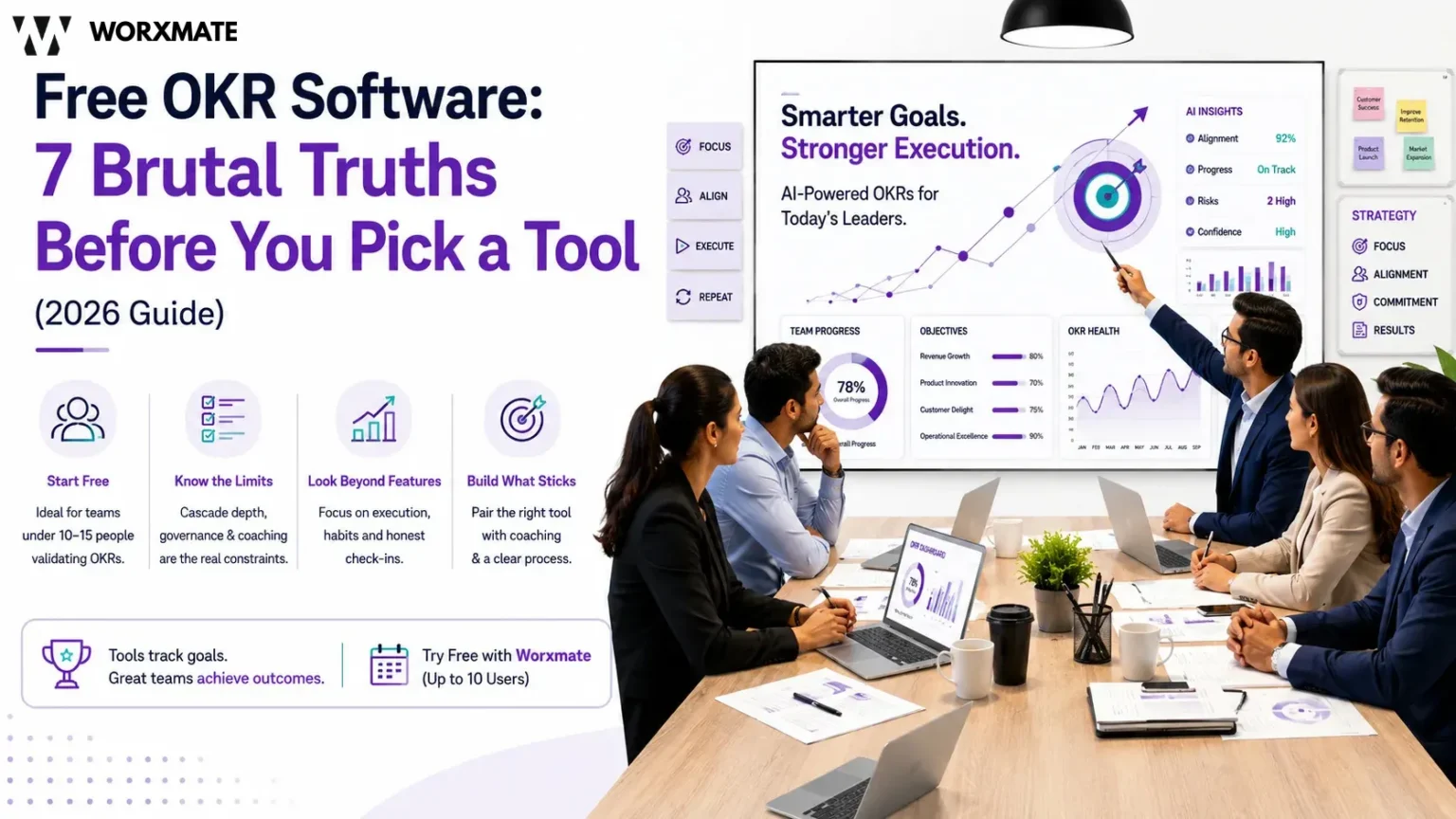
Free OKR software gets a team through goal-setting for a quarter not through the habits that make goals stick. Most free plans (Worxmate included, at up to 10 users) are genuinely useful for teams under 10–15 people who want to try the OKR framework before committing budget. The trade-off isn’t features it’s coaching, cascade depth, and what happens after week six, when the novelty wears off and check-ins start slipping. If you’re a 5–10 person team validating whether OKRs fit your culture, start free. If you’re past 15 people with cross-functional dependencies, the free tier will show its edges fast and that’s the signal to move, not a flaw to work around.
Three weeks into a free OKR rollout at a 40-person fintech startup, the CEO stopped using the tool. Not because it broke. Because nobody had told his team what “at risk” meant, the check-in cadence had no owner, and the free plan’s ten-user cap meant half the leadership team wasn’t even inside the tool. The spreadsheet they’d abandoned six weeks earlier came back within the month not because it was better, but because everyone already knew how to use it.
That’s the pattern I see with free OKR software more than any other. The tool isn’t the problem. The assumption that a tool solves an adoption problem is.
Why I’m Writing This
I’ve spent 20+ years in strategy execution and the last 10 specifically inside OKR implementations more than 50 organisations, across pharma, fintech, manufacturing, retail, IT services, and energy, training 500+ leaders directly. I’ve watched free tools work brilliantly for five-person teams and completely fail eight-hundred-person divisions using the exact same feature set. The difference was never the software tier. It was whether anyone had built the muscle to run the cycle honestly.
This isn’t a listicle ranking free plans by star count. It’s what I’d tell a founder or a Strategy Head who messaged me this morning asking whether free OKR software is worth their time before they talk to procurement.
The Real Question Free OKR Software Answers
Most people searching for free OKR software are really asking one of two different questions, and conflating them is where the trouble starts.
Question one: “Can I try the OKR framework without spending money?” Yes — almost every serious vendor, Worxmate included, offers a genuinely free tier for small teams. This is a legitimate, low-risk way to see whether outcome-based goal-setting fits how your leadership team actually thinks.
Question two: “Can I run OKRs across my whole organisation for free, forever?” This is where most searches quietly go wrong. Free plans are built to prove value at small scale, not to carry cross-functional cascade, dependency mapping, or check-in governance across departments. I’ve watched leadership teams sign onto a free plan believing it would scale with them, only to discover at 20 people that the cascade tree they needed didn’t exist in that tier.
One signal I look for in the first week of any engagement, free tool or paid: how many support queries is the team raising per day? If it’s climbing past 15–20 a day, adoption breaks within weeks not because the team is resistant, but because the tool and the team’s current OKR literacy are mismatched. A free plan doesn’t fix that mismatch. It just delays when you notice it.
What “Free” Actually Buys You: A Category Breakdown
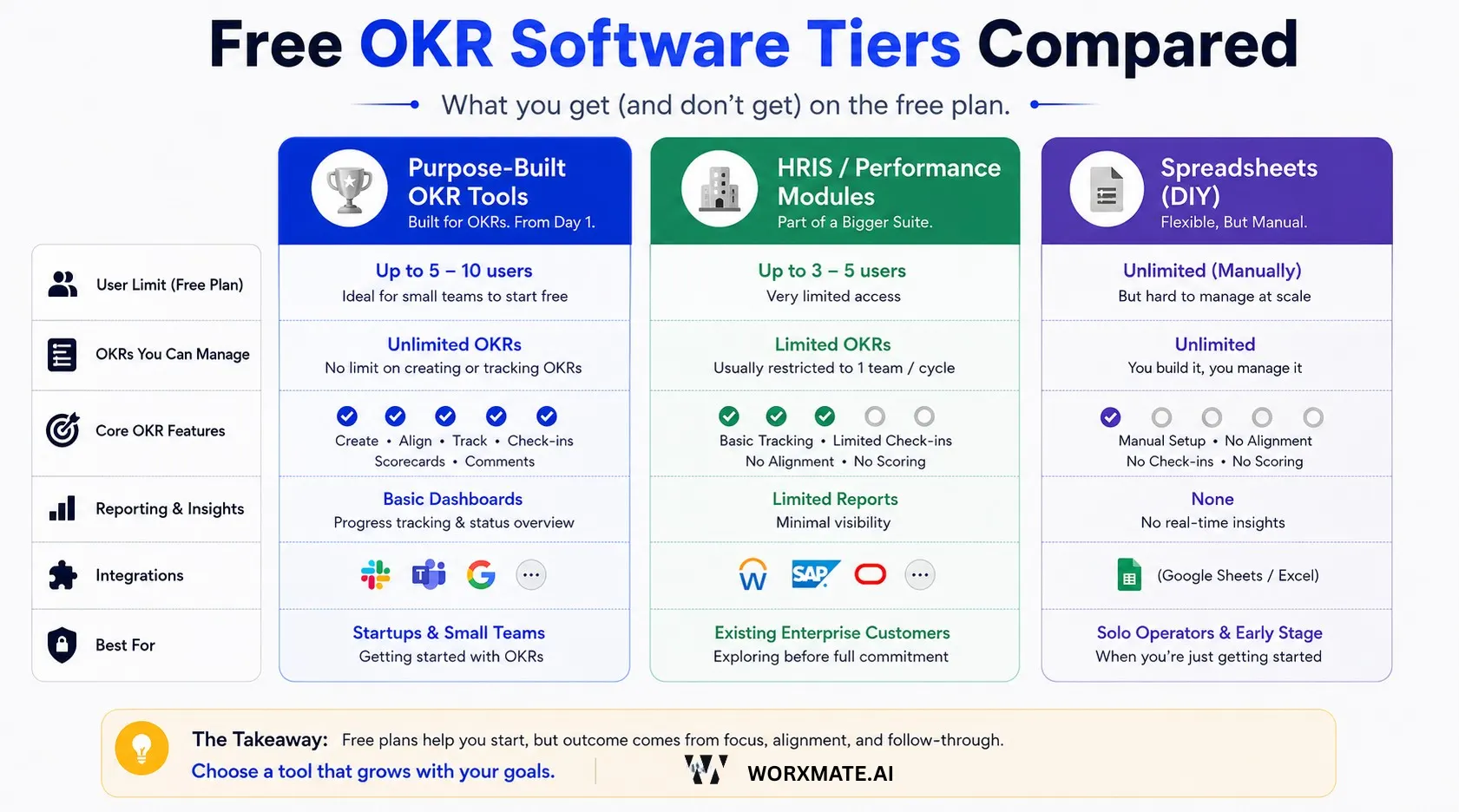
Before comparing specific tools, it helps to separate what “free” means across three different categories of software because they are not interchangeable, and most comparison articles blur this line.
Purpose-built OKR software, free tier. Worxmate offers a free license for up to 10 users – full access to the DEEP AI™ workflow (Define, Execute, Evaluate, Plan) at small scale, not a stripped demo. Tools like this exist specifically so a leadership team can run one real cycle before deciding whether to commit budget.
HRIS platforms with a bolted-on OKR module. Zoho People, Keka HR, and similar suites include goal-tracking as one feature among many. For a dedicated OKR platform, OKRs are the entire product every engineering sprint exists to make execution better. That singular focus produces cascade architecture and check-in infrastructure that an HR module was never designed to carry. This distinction matters more than most buyers realise, and it’s worth reading in more depth: OKR software vs PMS software.
Spreadsheets, dressed up as “free.” Google Sheets and Excel templates cost nothing and require the most maintenance of any option on this list. No automated tracking, no real-time collaboration, and a hard ceiling around 10 people before manual upkeep eats more time than the OKR process itself saves.
Seeing what a completed cycle actually looks like helps more than any feature comparison. Worth a look before you commit to a tier: OKR examples.
Free OKR Software for Different Team Stages
The right free tool depends entirely on what stage your organisation is at and this is where most generic buying guides give the same advice to a 5-person team and a 300-person division.
Under 15 people, first cycle ever. This is exactly what free tiers are built for. Use the free plan to learn the difference between output-led and outcome-led goals before you scale the framework to anyone else. Don’t overthink the tool choice here overthink whether your leadership team can articulate three priorities clearly, because that’s the actual constraint.
15–50 people, first cross-functional cycle. This is where free plans start showing seams. Dependencies between teams need to be visible, not managed in a side conversation. If your organisation is at this stage, read cross-functional team alignment before you assume the free tier will carry you through it.
Revenue and go-to-market teams specifically. Sales, marketing, and customer success OKRs behave differently from product or engineering OKRs the outcomes are lagging by nature and the temptation to write KPI-disguised-as-KR is highest here. If this is your team, this is worth the read: revenue operations OKRs.
500-person and 5-person organisations are not the same buying decision. The comparison that actually matters when evaluating any software, free or paid: OKRs for 5 people vs 500 people.
If Talent or HR owns the rollout. One of the costliest structural mistakes I see: HR-owned OKR programs get treated by the rest of the leadership team as “one more performance framework” rather than a strategy execution operating system. If Talent is driving this evaluation, this is built specifically for that seat: OKR software for Talent Heads.
The Practitioner Insight: What Free Tools Reveal
A few years ago I worked with a European fintech, around 100 people, generating revenue, introducing OKRs for the first time. When I spoke with the CEO and CPO, their goals were KPI-led tracking numbers that moved without telling anyone what actually needed to change. The room was full of activity. None of it connected to what the organisation needed to achieve.
The tool they’d been using a free plan on a lightweight platform hadn’t caused that problem. But it hadn’t surfaced it either. It let the team keep writing goals that looked complete on a dashboard while producing no clarity underneath.
The fix wasn’t a software upgrade. In the first coaching session, I asked one question: “What is the one big thing you want to resolve?” The answer was product demo experience. Then came a sequence of “so what” questions – if you fix this, so what happens next repeated until the team reached a genuine outcome statement. I asked the Product Lead to co-own a Key Result with the Account Executive, jointly accountable for conversion. Cross-functional co-ownership of a single KR had never happened there before. Three quarters later, product and commercial teams were operating with real dependency mapping instead of assumption.
No free plan or paid one writes that question for you. Alignment is agreement between teams on what matters, why it matters, and how each team’s work connects to the teams around them. You cannot set that in a tool. You can display it once it exists.
Free vs Paid: The Real Trade-off
The honest answer to “should I stay on a free OKR plan or upgrade” isn’t about feature lists. It’s about what you’re trying to build.
Free tiers are excellent for proving the framework works. What they consistently under-deliver on is coaching infrastructure the layer that determines whether goal-setting becomes a real operating rhythm or a quarterly compliance exercise. I track this with a metric I call the Execution Maturity Rate: the percentage of leaders who can independently write a genuine outcome-driven goal without a template or coaching support. In a typical first cycle, that number sits between 5% and 15%, free tool or paid. What moves it to 30–40% over 12 months isn’t better software. It’s consistent coaching applied to real cycles.
Execution Maturity Rate: First Cycle vs 12 Months of Coaching
This is why one completed OKR genuinely completed, with honest check-ins and a OKR retrospective the organisation actually carries forward is worth more than five written ones scored generously and never seriously reviewed. A free plan will let you write five. It won’t stop you from completing one properly. That part is on the team.
If your organisation has moved past the pilot stage and cross-functional dependency is now the bottleneck, it’s worth seeing a real implementation outcome: Elevating tech excellence through OKRs.
Running Effective Check-ins on a Free Plan
Most free OKR software includes basic check-in functionality but the structure of the check-in matters more than which button triggers the reminder.
A useful starting template, whatever tier you’re on: OKR check-in meeting template. The mechanics of running these consistently, especially once a program is a few weeks old, are covered here: OKR check-ins.
For teams working across time zones or hybrid schedules increasingly the default rather than the exception the check-in cadence needs deliberate design, not just a recurring calendar invite: hybrid team OKRs.
One distinction I push every team to make early: the difference between lagging indicators (what already happened) and leading indicators (what tells you a problem is coming before it becomes a crisis). Free dashboards almost always default to lagging views because they’re easier to build. Understanding the difference is worth more than any dashboard feature: leading indicators.
Elements Every Free OKR Tool Should Have
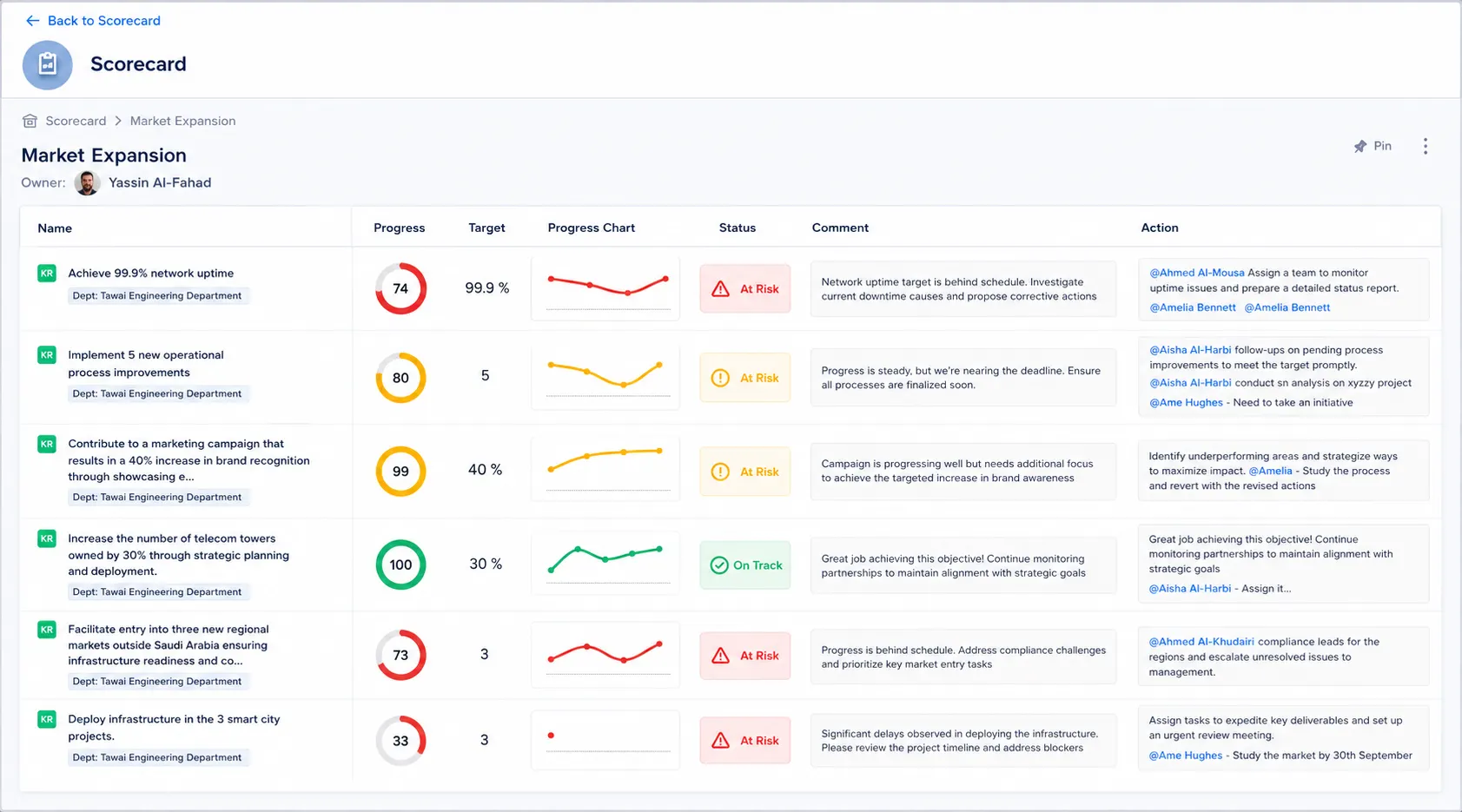
Not every free plan is built the same way, and the feature gaps are rarely obvious until week three. Before you commit, check that the tool actually supports the core elements of OKR — objective clarity, measurable key results, a visible cascade, and a check-in rhythm rather than just a place to type goals and watch a progress bar move.
A free OKR tracking tool without genuine progress percentage visibility isn’t tracking anything it’s storing text. And a free plan without at least a basic reminder system for check-ins will quietly die by week six, because nobody owns the follow-up.
Beyond the Tool: When Free Software Isn’t the Bottleneck
This is the part most free OKR software comparisons skip entirely, and it’s the part that actually determines whether your quarter succeeds.
Before you write a single OKR free tool or enterprise platform run a basic gap analysis between where the organisation is and where it needs to be. Goals written without that grounding are aspirational guesses, not outcome statements.
Every objective should be traceable back to a business impact analysis — what actually changes for the organisation if this is achieved. If you can’t answer that in one sentence, the goal isn’t ready to be tracked in any tool, free or paid.
Customer-facing teams specifically benefit from a more targeted application of the framework: use OKRs for enhanced customer success.
And the discipline that separates organisations that sustain OKRs from those that abandon them after one cycle isn’t goal-setting — it’s planning and execution as a continuous loop, not a quarterly event. For the fuller picture of how OKRs function as a strategic instrument rather than a task list, this is worth the deeper read: OKRs in strategy — leveraging objectives and key results for strategic clarity and focus.
Common Mistakes When Evaluating Free OKR Software
I see the same handful of mistakes repeat across almost every organisation evaluating free OKR software, regardless of industry or size.
1. Choosing based on the demo, not the sixth week. A free OKR software demo always looks clean — the sample data is tidy, the dashboards are pre-populated, and nobody has yet asked a hard question about a missed key result. The real test is week six, when the initial enthusiasm has faded and someone has to chase three managers for an overdue check-in. Ask any vendor what their free OKR software plan looks like at week six with real, messy data — not what it looks like on day one.
2. Assuming free OKR software with unlimited users exists at real functional depth. A handful of vendors market free OKR software with unlimited users as a headline feature. In practice, “unlimited” free tiers are almost always feature-capped instead — no cascade view, no dependency mapping, limited reporting. There is no such thing as free OKR software that is simultaneously unlimited in users and full-depth in features; the constraint always shows up somewhere. Read the feature list, not just the user cap, before you assume free OKR software with unlimited users solves your scaling problem.
3. Picking free OKR software integrated with performance management before the OKR habit exists. It’s tempting to look for free OKR software integrated with performance management from day one, on the theory that it saves an integration step later. In my experience, this backfires in cycle one — teams that haven’t yet learned to write genuine outcome-driven goals end up with performance reviews anchored to poorly written OKRs, which damages trust in the framework before it’s had a chance to prove itself. Get the OKR habit right first. Integrate with performance management in cycle two or three, once the goals themselves are trustworthy.
4. Treating a free OKR software free trial the same as a free OKR software free forever plan. These are not the same offer, and vendors are not always upfront about which one you’re signing up for. A free OKR software free trial is designed to convert you to a paid plan within 14–30 days. A genuine free OKR software free forever plan, like Worxmate’s 10-user license, is designed to let a small team run indefinitely without paying. Confirm which one you’re actually being offered before you build a rollout plan around it.
5. Evaluating free OKR templates and software as interchangeable. Free OKR templates and software solve different problems. A template gets a single planning session organised. Software gets an entire quarter tracked, checked in on, and retrospected. Teams that start with a free OKR template often assume they’ve “done OKRs” once the template is filled in — but a filled-in template with no check-in rhythm behind it is a document, not an operating system.
Global Considerations
OKR adoption patterns differ by geography and company stage, and free tools rarely account for either.
Early-stage founders in the UK evaluating goal-setting frameworks for the first time often need a different starting conversation than an established enterprise team worth reading if that’s you: OKR coaching for UK founders.
For organisations in India evaluating whether to pair software with structured coaching rather than adopt the framework unsupported, this is the relevant resource: OKR consulting India.
Beyond Free: Building a Sustainable OKR Program with DEEP AI
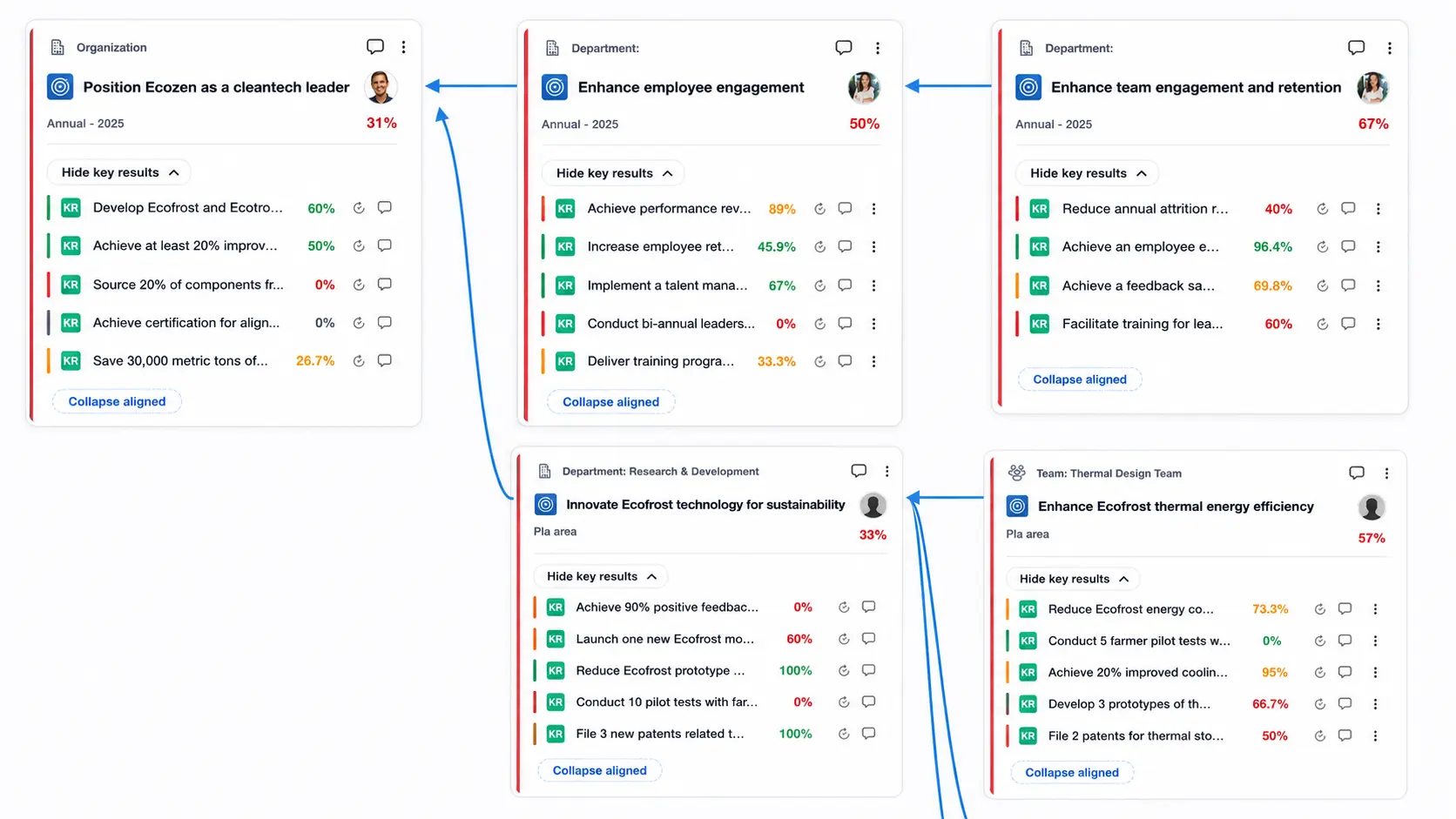
The solution isn’t just “paid software.” It’s a structured approach that combines purpose-built technology with expert coaching and a clear methodology. This is where frameworks like DEEP AI come into play: Define, Execute, Evaluate, Plan. A dedicated OKR software is designed to support this cycle, not merely to track it.
Define: From Ambiguity to Clarity
Free software offers a text box. A dedicated platform with AI assistance, like Worxmate’s Define module, helps leaders write genuine outcome-driven goals. It can suggest Key Results based on Objectives, provide quality scoring, and identify potential pitfalls. This moves teams away from output-focused KRs towards measurable, impactful outcomes. This is the difference between writing “Launch 3 marketing campaigns” and “Increase MQL-to-SQL conversion rate by 10% through targeted campaigns.” The former is an activity, the latter is a business outcome.
Execute: Real-Time Signals, Not Just Status Updates
Free tools often rely on manual updates, leading to outdated information and a lack of real-time visibility. Dedicated platforms, like Worxmate’s Execute, automate check-ins and provide at-risk detection. This means leaders aren’t just reporting progress; they’re receiving signals when a goal is off track, allowing for timely interventions. This is crucial for managing dependencies, especially in complex cross-functional environments. It shifts the conversation from “what did you do?” to “what outcome are we driving, and what do we need to do differently?”
Evaluate: Data-Backed Learning, Not Blame
At the end of a cycle, free tools typically provide a simple completion percentage. Dedicated platforms, through modules like Evaluate, enable data-backed retrospectives. This means analysing why goals were hit or missed, identifying patterns, and learning from the experience. It fosters a culture of continuous improvement rather than a blame game. It connects the dots between activities, outcomes, and the overall strategic impact.
Plan: Organisational Learning and Iteration
The final, and often overlooked, stage of the OKR cycle is Plan. Free tools offer no mechanism for this. Dedicated platforms, through modules like Plan, help organisations embed cycle-over-cycle learning. This ensures that insights from one quarter inform the next, building strategic muscle over time. It’s how an organisation moves from simply tracking goals to mastering strategy execution.
The distinction between free tools and dedicated OKR software isn’t just about features; it’s about whether the tool supports a strategic process or simply offers a digital whiteboard.
What This Looks Like in Practice
I worked with an 8,000-person energy and utilities company in the Middle East, a $45 billion organisation, where every leader had their own agenda and no collective buy-in. The instinct in the room was to bring in a consulting firm for an 8-week SWOT exercise. I redirected them: go agile, brainstorm for one week, agree on the 2–3 things that would move the business most if they didn’t happen.
That reframe not a software feature was the first real intervention. Free or paid, no tool tells a leadership team to compress eight weeks of analysis paralysis into one focused week. Three quarters later, the organisation had clarity most enterprise-scale teams never reach: leaders could name exactly what wasn’t working and why, and their confidence in supporting organisation-wide goals was measurably higher.
The Dual Path: Platform + Coaching
Here’s where most free OKR software searches should end up, honestly: with a decision about what you actually need next, not just which tool has the best free tier.
If you’re ready to run a real cycle. Start on a free plan built for small teams, then evaluate the full OKR software platform, current pricing, or book a demo once cross-functional cascade becomes the constraint.
If the platform isn’t actually your first problem. If your leadership team can’t yet articulate three shared priorities, or check-ins keep slipping regardless of which tool you’re using, that’s a capability gap, not a software gap. OKR consulting fills that space specifically.
The software is the infrastructure. The coaching is the capability. You need both — and in the right order.

Written by
An OKR Coach with 20+ years of implementation experience, Madhusudan has guided over 50 organisations through successful OKR transformations, training more than 500 leaders. Learn more about Worxmate.