 WORXMATE
Quick Answer
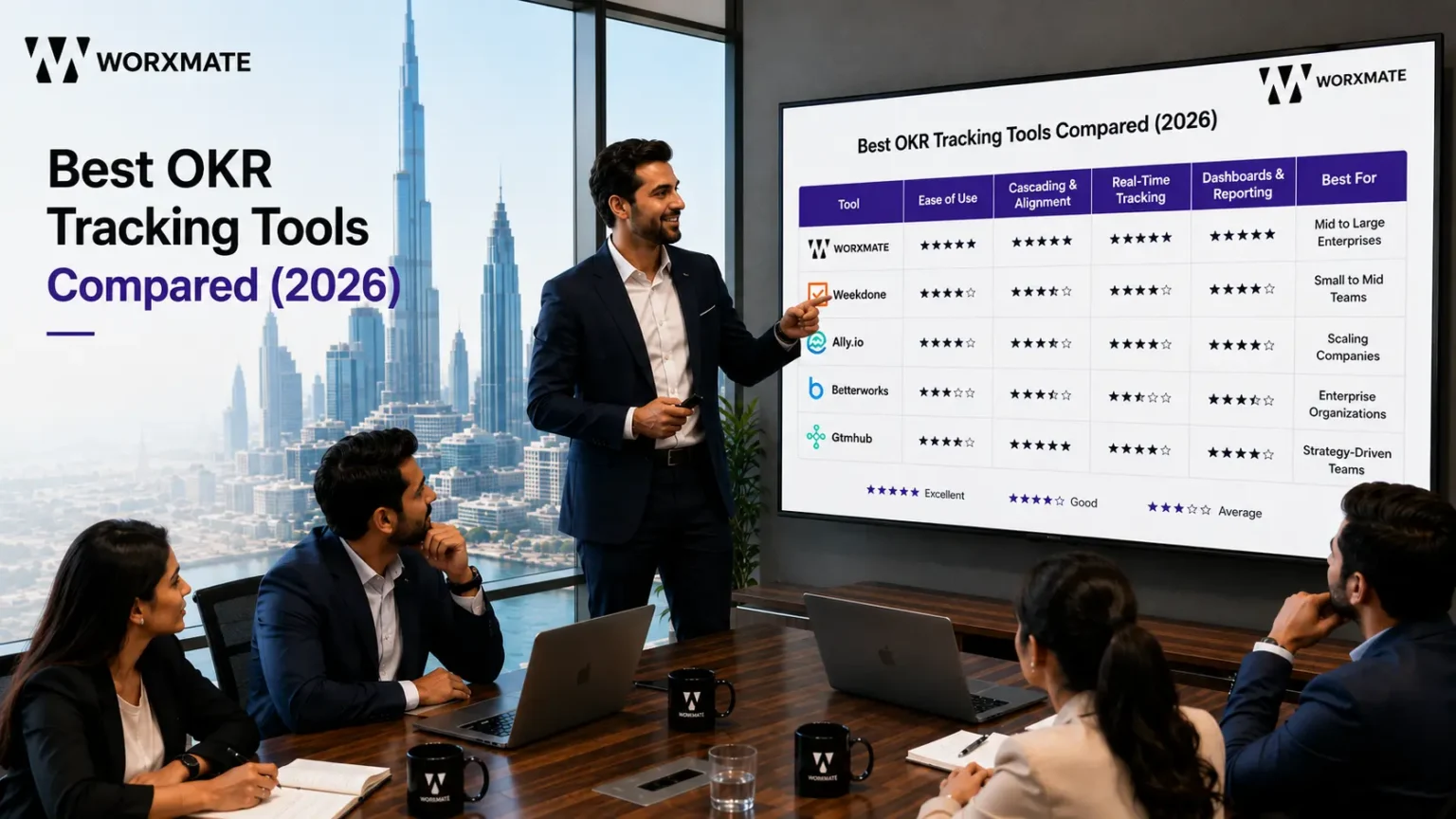
The best OKR tracking tools in 2026 combine three things: low-friction weekly check-ins, cascading that holds up across departments, and live reporting that doesn’t need manual reconciling. For most mid-market and enterprise teams, Worxmate stands out for pairing software with built-in coaching through its DEEP AI framework; Tability and Weekdone suit small teams building the habit; Betterworks and Quantive fit large enterprises needing deep cascading and analytics. Teams under 15 people in their first OKR cycle are often better off starting with a well-run spreadsheet before adopting a dedicated tool.
Most “best OKR tracking tools” roundups are written by people who have never sat in a quarterly business review watching a leadership team argue about whose number is correct. I have. Across 20+ years in strategy execution and 50+ implementations, I’ve watched the same pattern play out: a company buys OKR tracking tools expecting the software to fix misalignment, and six months later they’re frustrated that the dashboard looks great and nothing has actually changed.
So, this comparison isn’t ranked on feature count. It’s ranked on the thing that actually determines whether OKR tracking survives past the first quarter whether the tool supports the behaviors that make OKRs work,or just digitises a process that was already broken.
What “OKR Tracking Tools” Actually Need to Do
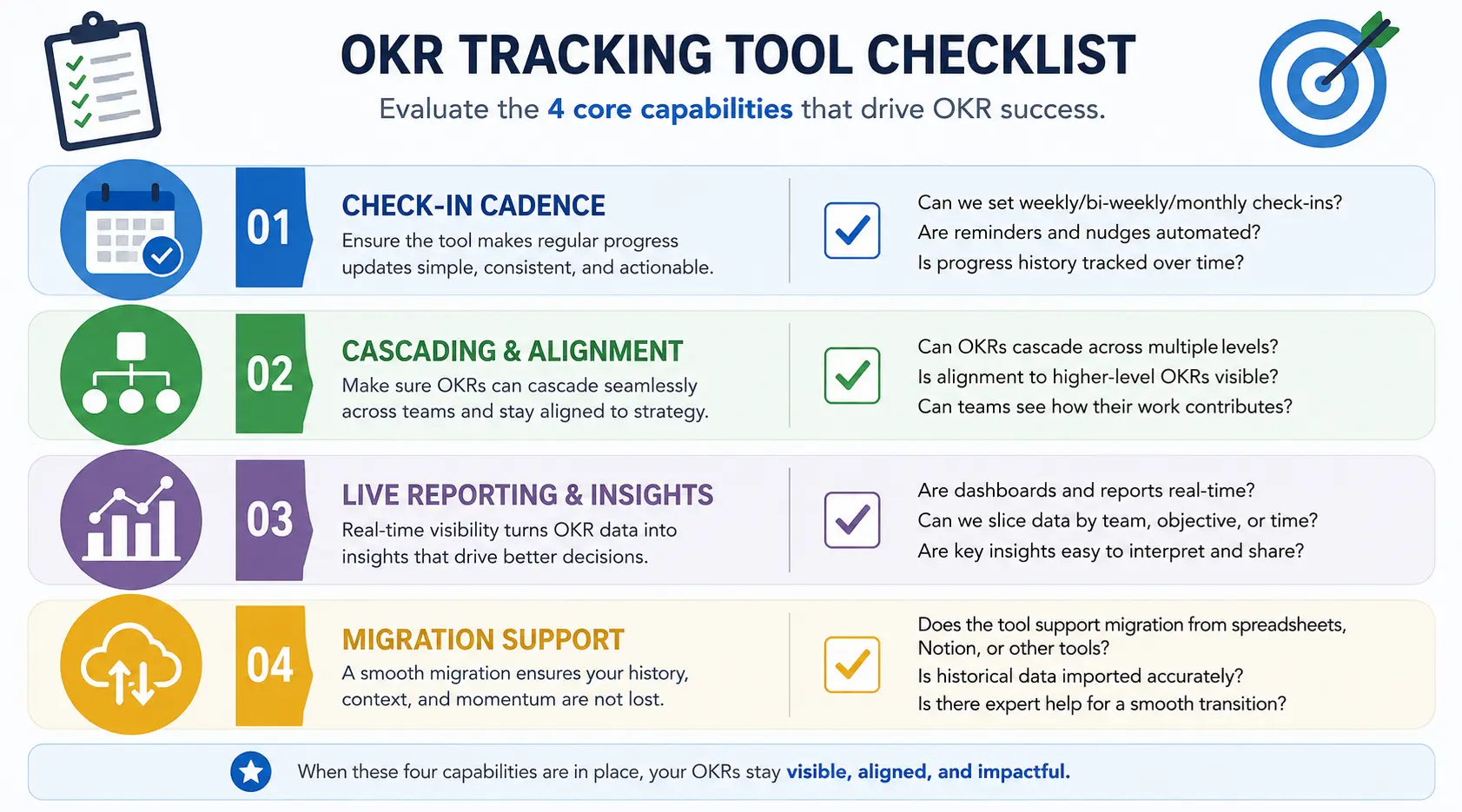
Before comparing platforms, it’s worth being precise about what you’re evaluating. An OKR tracking tool is not the same thing as a project management tool with a “Goals” tab bolted on, and it’s not the same thing as a performance review platform that happens to store Key Results. Four capabilities separate a genuine OKR tracking tool from an adjacent product wearing the label:
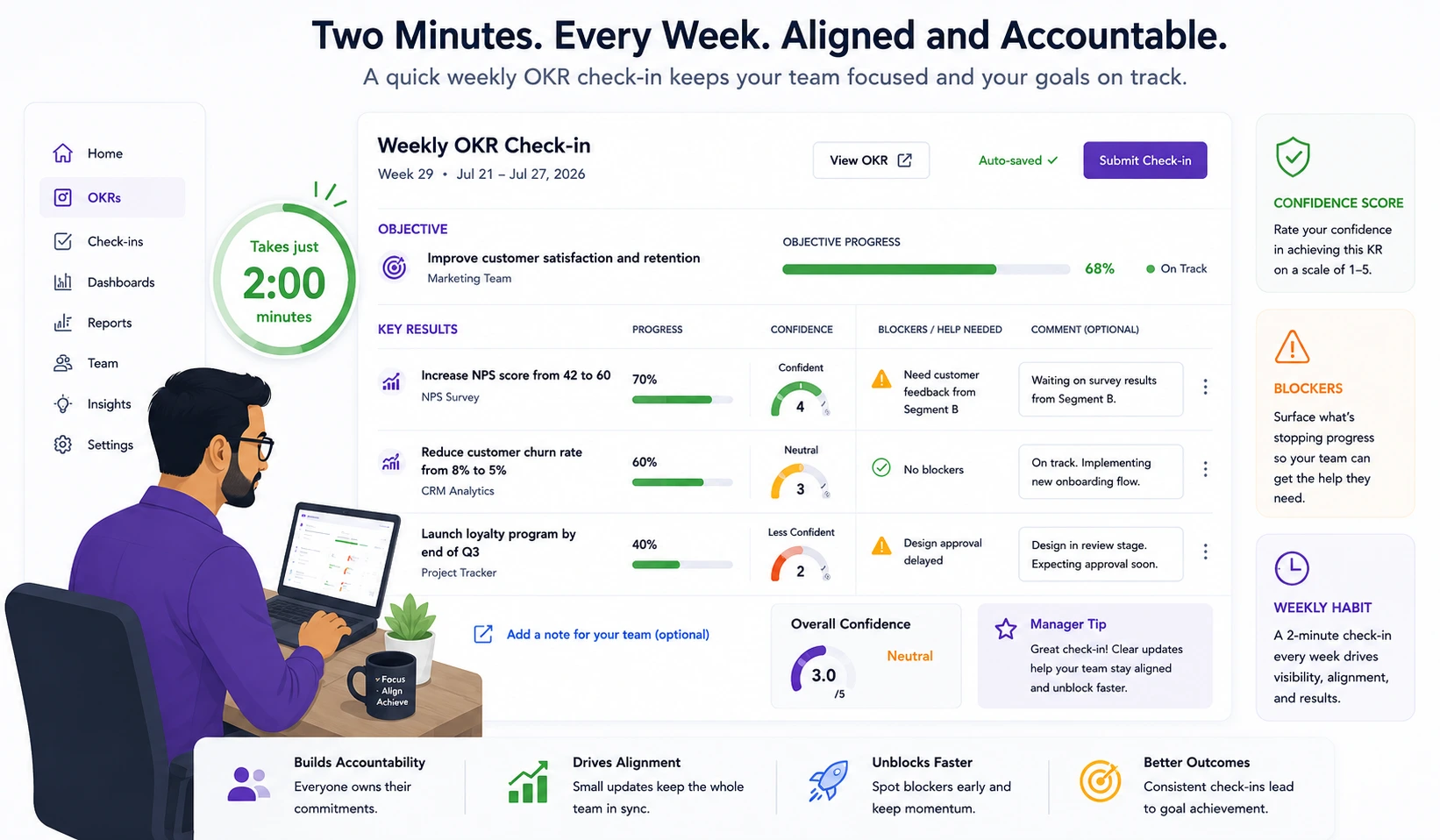
- Structured check-in cadence. The tool should make a weekly OKR check-in the path of least resistance a two-minute update, not a form nobody wants to fill in. If the check-in flow feels like admin work, adoption dies by week eight regardless of how good the dashboards look.
- Cascading without collapsing. Company objectives need to connect to departmental and individual goals without becoming a rigid waterfall that ignores how cross-functional work actually happens. This is the exact gap that breaks most team OKR tracking the moment more than two departments share a Key Result.
- Live, trustworthy reporting. A dashboard that updates automatically from real check-ins, not one that requires someone to manually reconcile five tabs before a leadership meeting. We cover what this should actually look like in live OKR dashboards.
- A path out of spreadsheets that doesn’t lose the discipline you already built. Many teams evaluating tools are migrating off a shared document. If you haven’t already decided whether you’ve genuinely outgrown a spreadsheet, our comparison of an OKR tracking spreadsheet versus dedicated software is worth reading before you shortlist anything below.
How I Evaluated These Tools
I didn’t run every platform through a lab test. I evaluated each one against what I actually see separate successful implementations from stalled ones across 50+ organisations: does the tool support weekly OKR check-ins without friction, does it distinguish outcomes from KPIs instead of just storing numbers, does cascading hold up past two organisational layers, and does it integrate with the systems where work already happens rather than asking teams to maintain a second source of truth. Pricing shifts often enough that I’ve kept it directional rather than quoting figures that will be stale by the time you read this check each vendor’s site for current plans.
One more filter I apply that most comparison articles skip: does the tool assume your organisation already knows how to write a genuine outcome-driven Key Result, or does it help you get there? Most platforms assume the former. That assumption is exactly why so many OKR software rollouts produce a beautifully cascaded tree of goals that are, on closer inspection, just a restated task list. A tool that only stores what you give it will faithfully digitise a bad habit. The tools worth paying for either build coaching into the workflow or are honest that you’ll need to bring that discipline from elsewhere through training, a consultant, or a framework like DEEP AI.
Best OKR Tracking Tools Compared (2026)
| Tool | Best For | Standout Strength | Watch Out For |
|---|---|---|---|
| Worxmate | Mid-market and enterprise teams that need coaching built into the platform | The DEEP AI framework pairs software with guided goal-writing, check-ins, and retrospectives in one flow | Best suited to teams ready to commit to a structured cadence, not a casual trial |
| Lattice | Companies that want performance reviews and goals in one HR suite | Deep integration between OKRs and performance management | Goals functionality is secondary to its HR core, not built OKR-first |
| Betterworks | Enterprises needing AI-assisted goal alignment at scale | Strong AI-driven suggestions for cascading and goal quality | Can feel heavy for teams under 100 people |
| Profit.co | Organisations wanting an all-in-one strategy execution suite | Broad feature set spanning OKRs, task management, and performance | Breadth can mean a steeper learning curve during rollout |
| Weekdone | Small teams wanting a lightweight, low-friction starting point | Simple weekly check-in structure that’s fast to adopt | Limited depth for complex, multi-department cascading |
| Tability | Startups building a weekly goal-tracking habit | Habit-first design that nudges consistent check-ins | Lighter on enterprise reporting and governance features |
| Quantive (formerly Gtmhub) | Enterprises wanting dedicated OKR depth with strong analytics | Purpose-built OKR data model and advanced reporting | Enterprise pricing and setup complexity |
| Asana Goals | Teams already living inside Asana for daily project work | Native link between tasks already being tracked and company objectives | Goals are an extension of project management, not a dedicated OKR engine |
A Closer Look at Where Each Tool Actually Fits
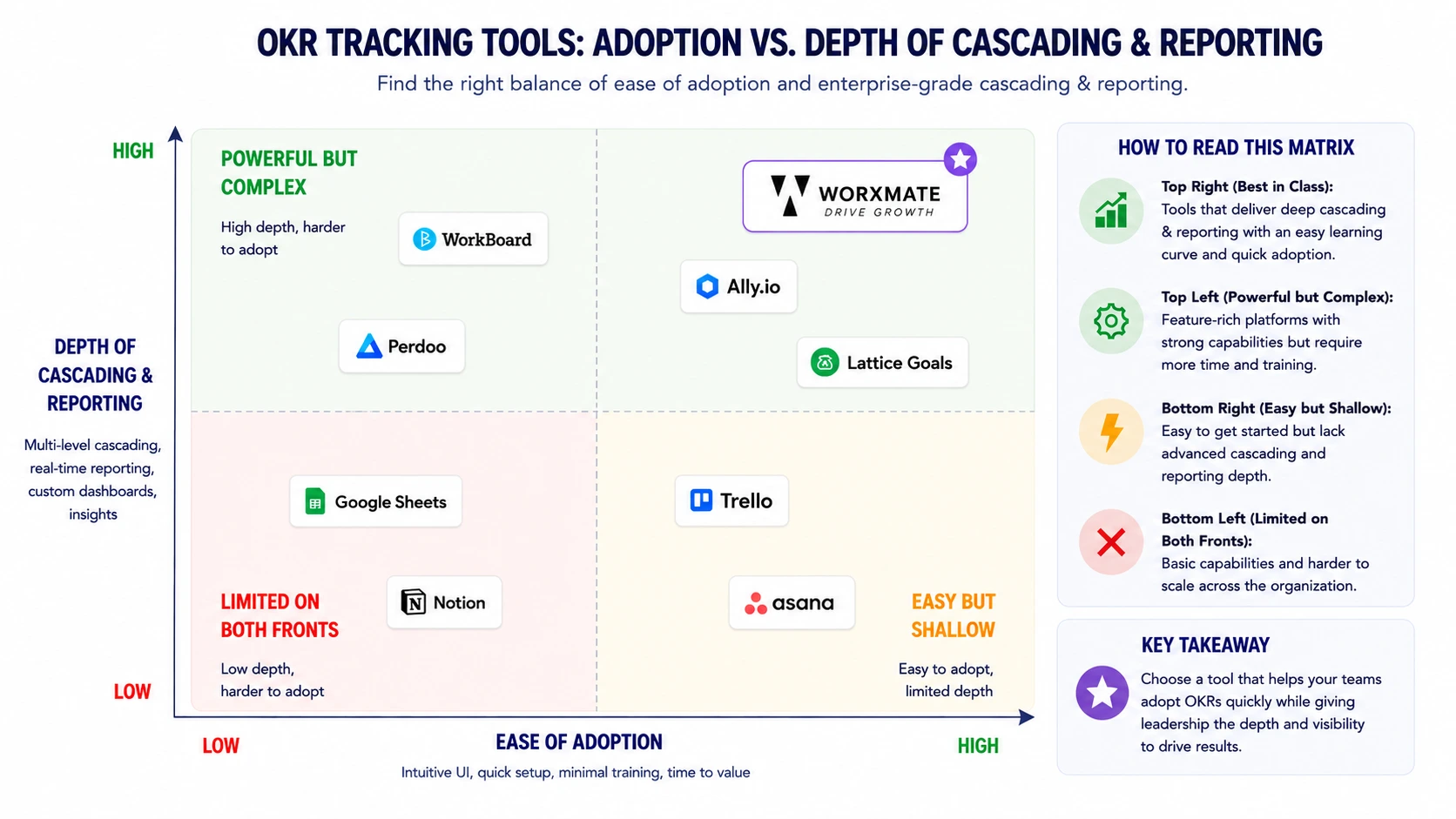
- Worxmate is built around a simple premise: software alone doesn’t create alignment, and coaching alone doesn’t scale. The DEEP AI framework structures the full cycle Define, Execute, Evaluate, and Plan so OKR progress tracking isn’t a separate habit teams have to remember, it’s the natural next step after goal setting. It’s the right fit for organisations that have already recognised the tool isn’t the whole answer and want a platform that reinforces genuine outcome-thinking rather than just displaying whatever gets typed in.
- Lattice and similarly-positioned HR suites make sense if performance reviews, 1:1s, and OKRs living under one login matters more to you than OKR-specific depth. The tradeoff is that goal cascading and check-in design tend to be “good enough,” not built from the ground up around OKR tracking metrics.
- Betterworks leans into AI-assisted goal writing and alignment suggestions, which can genuinely help larger organisations catch cascading gaps a human reviewer might miss. It’s worth evaluating if you’re past 200 people and need alignment surfaced automatically across many teams.
- Profit.co bundles OKRs with broader strategy execution and task features. That breadth is an advantage if you want fewer vendors in your stack, and a disadvantage if your team needs a fast, focused rollout rather than a platform with a learning curve.
- Weekdone and Tability both serve the same underlying need well: getting a small or early-stage team into a weekly check-in habit without a heavy setup process. Neither is built for deep, multi-layer cascading which is fine, until your team OKR tracking spans more than two or three departments.
- Quantive (formerly Gtmhub) is a strong option if you want OKR-specific depth and are prepared for enterprise-grade setup and pricing. Its analytics are genuinely strong for organisations that need to slice OKR data multiple ways.
- Asana Goals works best as an extension of a team that already runs its daily work inside Asana. The native connection between tasks and objectives is real value the tradeoff is that Goals will always be a feature of a project management tool, not a dedicated OKR system with its own opinionated cadence.
Where Spreadsheets Still Beat Any Tool on This List
It’s worth saying plainly: if you’re a single team of 15 people or fewer running your first OKR cycle, none of the tools above may be worth the switching cost yet. A well-run spreadsheet is a legitimate way to build the muscle of writing outcome-driven goals before you add platform complexity. We break down exactly where that line sits and the specific signs you’ve crossed it in OKR tracking spreadsheet vs. software. If your team is distributed, that line usually arrives faster than it would in person; see OKR tracking for remote teams for what changes when nobody shares a hallway.
A tool can display alignment. It cannot create it. That’s still the leadership team’s job.
Does Company Size Change the Answer?
Most comparison articles treat “best OKR tracking tool” as a single answer. It isn’t. The right choice shifts meaningfully depending on where your organisation actually sits.
Under 15 people, first OKR cycle. Skip the tool search entirely for now. The scarce resource at this stage isn’t software, it’s shared understanding of what an outcome-driven goal even looks like. A spreadsheet, run with discipline, teaches that faster than a platform with a learning curve of its own.
15–100 people, one or two departments. This is where lightweight tools like Weekdone or Tability earn their keep low setup friction, a habit-forming check-in rhythm, and none of the enterprise configuration overhead you don’t need yet. The risk at this stage isn’t picking the “wrong” tool; it’s picking one so heavy that the rollout itself becomes the reason OKRs stall.
100–500 people, multiple departments with real dependencies. This is where team OKR tracking starts to break without dedicated cascading logic. A shared Key Result between Product and Sales needs to be visible to both teams natively, not reconstructed from two separate spreadsheet tabs or two disconnected tool instances. This is the range where Worxmate, Profit.co, Betterworks, and Quantive start to separate themselves from lighter tools not because they have more features, but because their cascading and reporting were built to hold up under real cross-functional complexity.
500+ people, enterprise governance needs. At this scale, integration depth, security, and reporting granularity matter as much as the check-in experience. Betterworks and Quantive tend to be evaluated seriously here, alongside enterprise tiers of Lattice and Worxmate. The evaluation question shifts from “will my team adopt this” to “will this hold up across twelve business units with different reporting needs” a very different test, and one worth running with your actual org chart, not a vendor’s sample account.
None of this changes the underlying principle: company size determines which tool fits your current complexity, not whether OKR tracking software is worth adopting at all. A 40-person company forcing itself into enterprise software is solving a problem it doesn’t have yet. A 400-person company still coordinating OKR progress tracking through a shared spreadsheet is absorbing a coordination cost that’s usually far more expensive than the software it’s avoiding.
Common Mistakes When Choosing an OKR Tracking Tool
Buying for the demo, not the rollout. Every platform looks clean with three sample Objectives loaded in by a sales engineer. The real test is whether a manager who has never used the tool can complete a check-in in under two minutes on week six, when the novelty has worn off.
Skipping the integration check. If the tool doesn’t connect to where work already happens Jira, Salesforce, Slack, or your task management system someone will end up manually updating two systems, and the second one will fall behind first. Worxmate’s own integrations exist specifically to close that gap, and it’s a question worth asking of any vendor on this list.
Assuming the tool will fix unclear objectives. No platform can tell the difference between a genuine outcome-driven Key Result and a lagging KPI wearing an OKR label. If your organisation hasn’t yet separated strategic goals from measurable goals from plain performance metrics, fix that first our guide to Objectives and Key Results is a good place to start.
Rolling out top-down without coaching the managers who’ll run check-ins. The tool is only as good as the habit it supports. If the managers responsible for weekly check-ins haven’t been coached on what a good confidence score or blocker actually looks like, the software just automates inconsistent input faster than a spreadsheet did. This is exactly the gap OKR tracking: The Complete Guide to Tools, Metrics, and Why Most Systems Fail is written to close.
Ignoring organisational readiness. A tool cascades goals through whatever structure you feed it. If that structure doesn’t reflect real accountability see organizational alignment and goal alignment the software will faithfully display a broken hierarchy in higher resolution than the spreadsheet ever could.
My Take
I have implemented OKRs with and without dedicated software, across pharma, fintech, manufacturing, retail, IT services, and energy. The organisations that succeed are never the ones with the most sophisticated tool. They’re the ones where a genuine agreement exists about what matters and why and where the software’s job is simply to make that agreement visible in real time instead of burying it in a spreadsheet nobody trusts by week six.
Evaluate every tool on this list against that standard, not against its feature list. If it makes a weekly check-in effortless, shows you the truth without someone manually cleaning the data first, and connects to the systems where work already happens, it will serve your OKR tracking well. If it just looks impressive in a demo, it’s a more expensive spreadsheet.
Where to Go From Here
If you’re ready to see what coached, software-backed OKR tracking looks like: explore Worxmate’s OKR software, see how real-time OKR tracking works in practice, and check how task management and performance management connect inside the same platform. Browse pricing or book a demo to see it against your own goals rather than a sample account.
If you’re not sure your organisation is ready for a tool yet: that’s a coaching problem, not a shopping problem. Our OKR consulting work builds the outcome-thinking and check-in discipline first, so that whichever tool you eventually choose — ours or otherwise — has something real to display. Explore more in our full articles library.


Written by
An OKR Coach with 20+ years of implementation experience, Madhusudan has guided over 50 organisations through successful OKR transformations, training more than 500 leaders. Learn more about Worxmate.