 WORXMATE
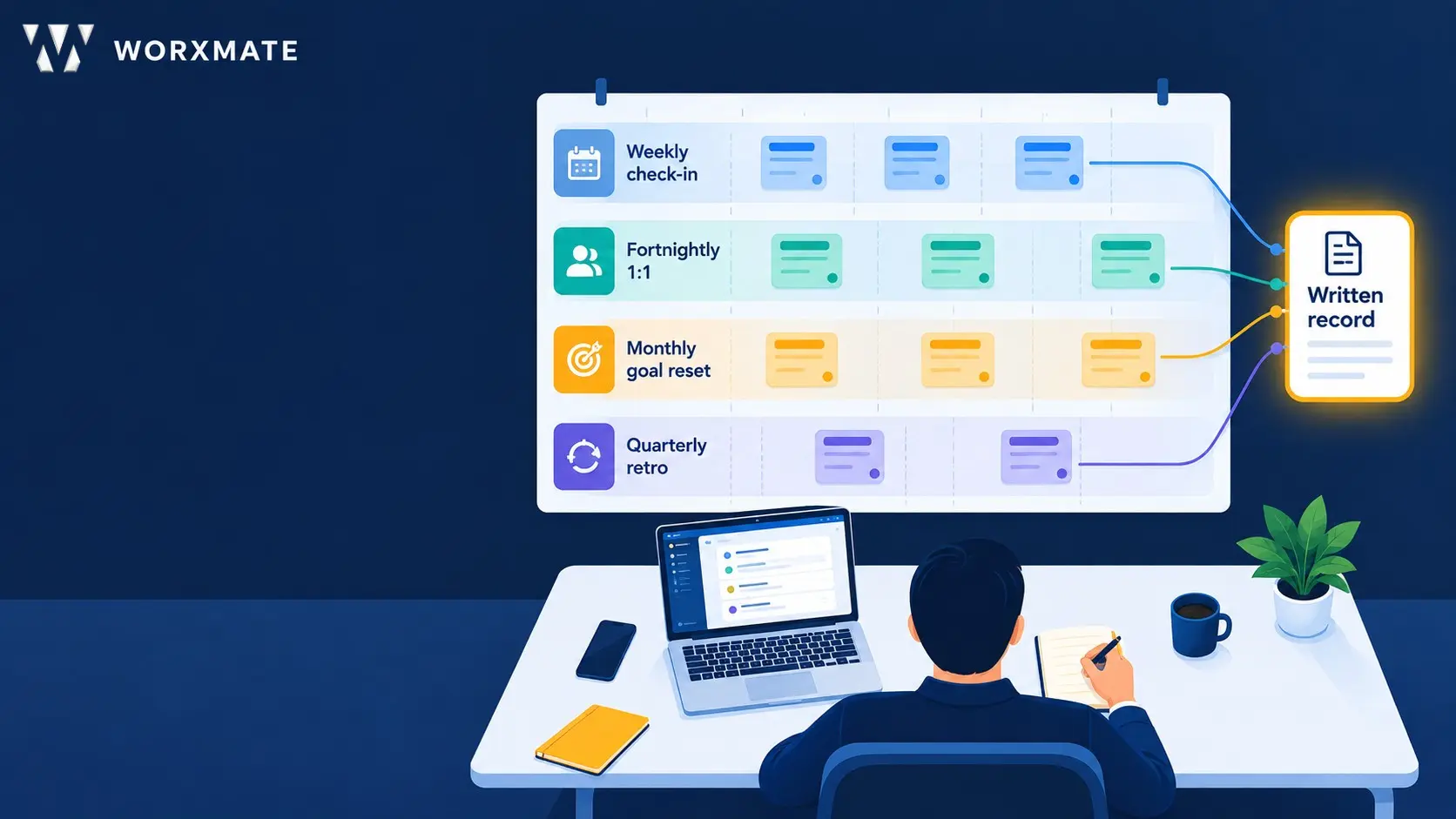
What do effective continuous performance management examples look like? The continuous performance management examples that work share one pattern: a 15-minute weekly check-in tied to a live goal, a fortnightly 1:1 that asks about blockers first, feedback logged within days, a dashboard the manager opens every Monday, and a monthly goal reset. Startups run it lean. Enterprises run it in tiers. Remote teams run it asynchronously. In all 12 examples below, the meeting is the smallest part. The written record it leaves behind is what feeds calibration, development plans and OKR scoring.
Ask an HR leader whether they run continuous performance management and the answer is almost always yes. Ask to see last Tuesday’s check-in and you get a calendar invite, not a conversation.
That is the pattern I see consistently across my conversations with HR leaders. The intent and the template are there. What is missing is a picture of the thing working on an ordinary Tuesday, in a team of eight, with a manager who has three other fires.
So this piece is a set of continuous performance management examples, not a definition. Twelve set-ups, three tables, two real implementation stories and the exact rhythm I would hand a manager on day one. If you want the model itself, start with our guide to continuous performance management. If you want phrases to say in the moment, our continuous feedback examples page has them. This article is the working layer between the two.
🎯 Who is writing this
I have spent 20+ years in strategy execution and 10+ years implementing OKRs across 50+ organisations, training 500+ leaders. I have also held 135+ conversations with HR leaders in fintech, pharma, retail, manufacturing, energy, IT services, SaaS and gaming. Every example below comes from that work. Where one is an illustrative set-up rather than a client story, I say so.
Why Most Continuous Performance Management Examples Miss the Point
Most published continuous performance management examples show you the meeting. Almost none show you what the meeting produces. That is backwards. A check-in that leaves no record and changes no decision is a status update with a nicer name.
Two of the nine systemic failures I track in performance management show up right here. First, one-on-one meetings get treated as optional rather than core process, so they are the first thing cancelled in a busy quarter. Second, KRAs sit disconnected from business goals, so even a well-run conversation is about the wrong things. Both look like discipline problems. They are design problems.
There is a number worth naming. I track the Execution Maturity Rate: the percentage of leaders who can independently write a genuine outcome-driven goal without coaching, a template or a quality review. In a typical first-cycle implementation it sits between 5% and 15%. After 12 months of well-coached practice it reaches 30% to 40%. That matters for check-ins. In cycle one, most of the people running your continuous conversations cannot yet tell a good goal from a busy one. The examples below are built for that reality.
Unlock Goal Clarity & Accelerate Employee Growth
Looking to drive goal clarity and employee growth? Discover how Worxmate’s AI-powered Performance Management Software can help.
Real Examples of Continuous Performance Management From the Field
These continuous performance management case study examples are anonymised, and I have kept to what actually happened.
A European fintech that fixed the question, not the meeting
About 100 people, generating revenue, introducing OKRs to drive growth. Goals were KPI-led: plenty of numbers, no clarity on what needed to change. In the first coaching session I asked one question: what is the one big thing you want to resolve? The answer was product demo experience. Then came a chain of “so what” questions until the team reached a genuine outcome statement.
The move no textbook suggests: the Product Lead co-owned one Key Result with the Account Executive, jointly accountable for a demo experience that led to conversion. Nobody in that organisation had co-owned a Key Result before. Two to three quarters later the goals were practical rather than assumed, dependencies were mapped, and the company moved faster because it had stopped duplicating effort and started sharing ownership.
The example to steal is the co-owned Key Result. Two owners means neither can quietly skip the weekly conversation.
An APAC retailer that started with three priorities
A product retailer in aggressive expansion, hiring leaders at every level. The framework and the intent were in place. The foundation was missing. In the first alignment call I asked the CEO for his top three priorities. In 45 minutes he could not define them clearly. He was not short of sharpness. Nobody had ever asked him to compress his vision into three outcomes an organisation could cascade from.
A two-day war room followed before a single OKR was written. Then I ran 1:1 coaching with each leader, not group training, and had each one read the CEO’s goals and derive their own OKRs from them. Two to three quarters later: alignment across the board, cross-functional dependencies surfaced in advance rather than mid-cycle, and budget linked directly to the growth and revenue model.
The lesson for continuous performance management is that it starts before the first check-in. If the top of the house cannot state its priorities, every check-in below it is noise.
One completed OKR is worth more than five written ones.
How many of your leaders can write an outcome-driven goal unaided?
Every example below assumes they can. The Execution Maturity Framework shows where your organisation actually sits before you build the rhythm.
Continuous Performance Management Examples for Managers: The Four-Week Rhythm
If you give a manager one thing, give them this. These continuous performance management process examples are the smallest version of the system that still works, and they fit a manager with eight reports and no spare time.
| Cadence | What happens | Time | What it leaves behind |
|---|---|---|---|
| Weekly | Goal check-in: progress, confidence score, one blocker | 15 minutes | Updated confidence score and a named blocker |
| Fortnightly | Structured 1:1: blockers first, development second, feedback third | 30 minutes | Notes that persist and one agreed action |
| Monthly | Goal reset: keep, change or drop each goal | 45 minutes | Revised goals with the reason recorded |
| Quarterly | Retrospective and calibration input | 90 minutes | Learning carried into the next plan |
Two rules hold this together. The blocker is always asked first, because progress can be read on a dashboard. And every meeting ends with a written action, because a conversation without an owner is a pleasant chat. This rhythm is what keeps the formal performance management cycle from going dormant between reviews.
For the agenda itself, use a standing structure. The OKR check-in meeting template is a good start, and standardizing 1:1 meetings explains why the same structure and persistent notes matter. If remembering to schedule is the problem, 1:1 meeting automation removes it. Managers who carry the heaviest load will also find how performance management software reduces manager workload useful.
Continuous Performance Management System Examples: Four Practices That Carry the Load
These are the practices I expect to find in any working continuous performance management system, whichever tool sits underneath.
Example 1: Continuous performance management check-in examples
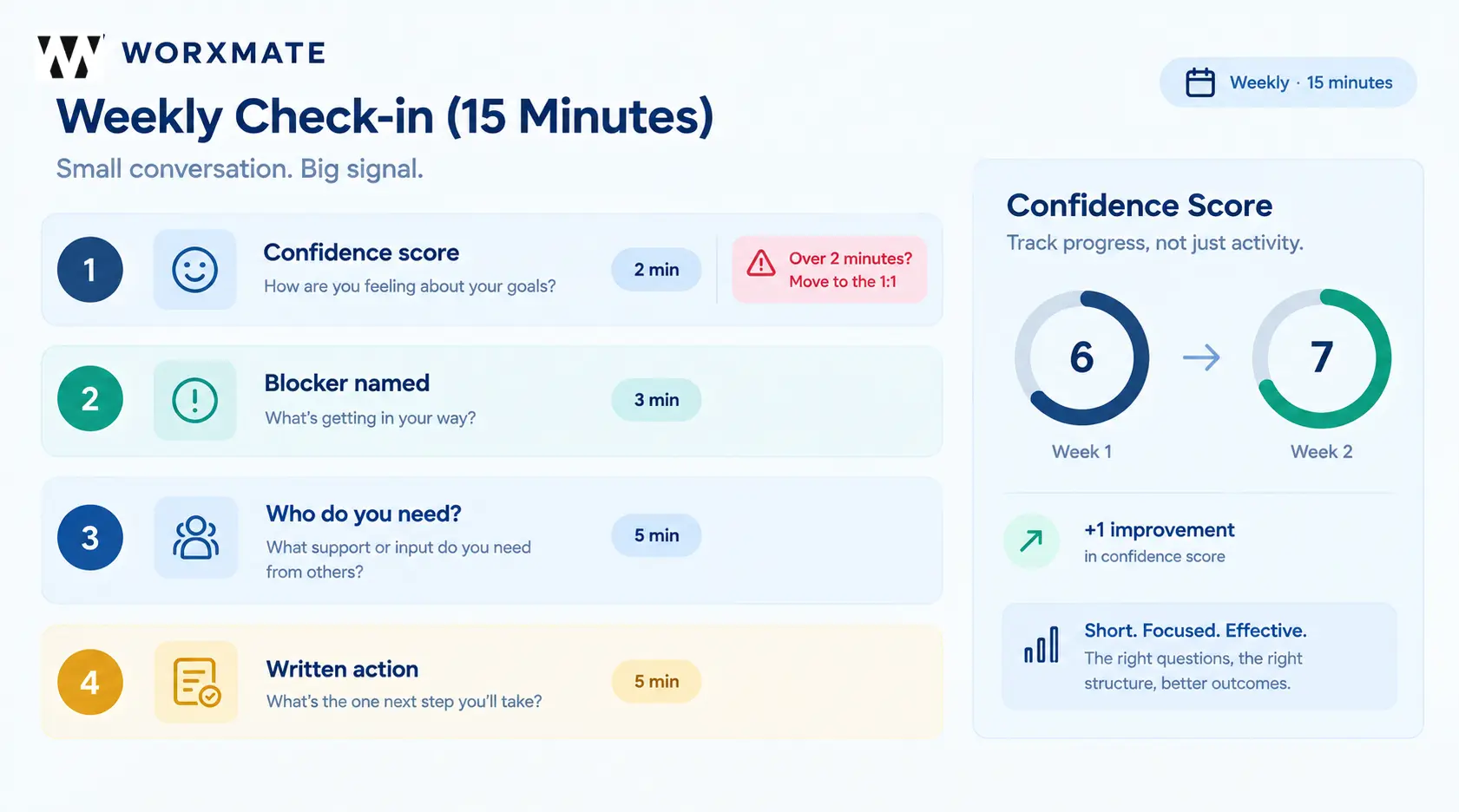
Illustrative set-up: a sales team of nine runs a 15-minute Monday check-in. Each person reports a confidence score from 1 to 10 on their Key Result and one blocker. The manager asks two questions only: what would move your confidence up a point, and who do you need? Anything longer than two minutes moves to the 1:1.
OKR check-ins survive a bad week only when they are short. In DEEP AI this is the Execute stage, where automated check-ins and at-risk detection surface a slipping goal before the monthly reset does.
Example 2: Continuous performance management goal-setting examples
The monthly reset. Every goal gets one of three labels: keep, change or drop, with a one-line reason. Picture an engineering team that drops a feature-count Key Result in month two because the outcome has already moved. Goals written in January cannot be trusted in June.
Test each goal against output vs outcome before it survives the reset, and borrow wording from performance goals examples for work. This is the Define stage of DEEP AI: AI-assisted goal writing with quality scoring, so a weak goal is caught at the writing stage rather than the scoring stage.
Example 3: Continuous performance management examples with OKRs
The goal-linked 1:1. The agenda sits on the OKR, not on the person: Objective, two Key Results, confidence trend, blocker. Feedback attaches to the Key Result it relates to, so a note like “strong client call” becomes evidence on a goal instead of a compliment that disappears.
I call this the PMS-OKR Bridge: the structural connection between performance management and business execution. Without it, HR learns whether people completed the process, not whether they moved the business. OKRs and performance management makes the full argument, and OKR vs PMS software covers what that means for tool choice.
Example 4: Continuous performance management dashboard examples
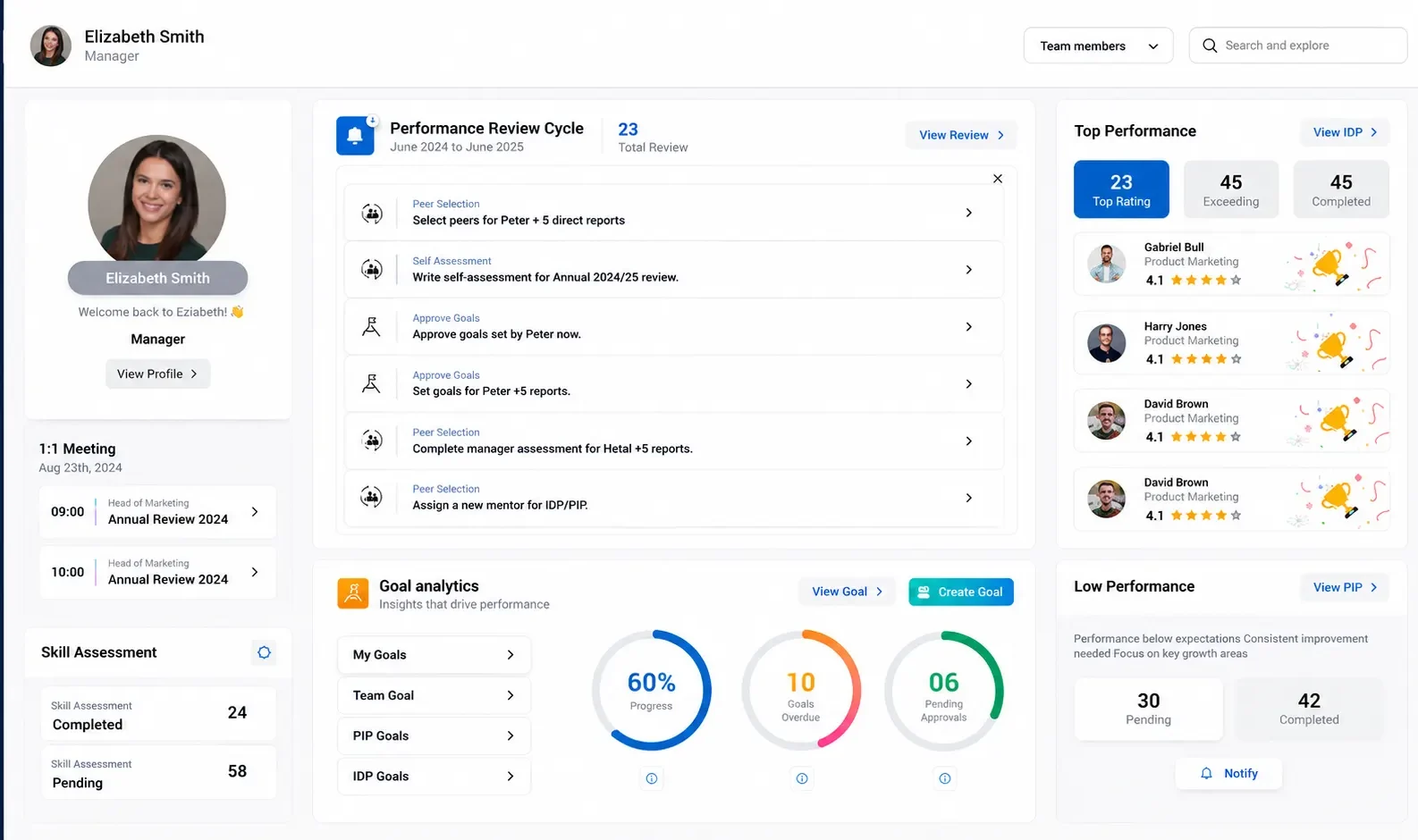
The Monday view: one screen, five items per team. Goals off-track, confidence trend, last 1:1 date per report, feedback logged this fortnight, and blockers open longer than ten days. If a manager cannot see when they last met each report, they are managing by memory.
Real-time performance dashboards matter because they let a manager coach in the moment. Axis AI is built for the execution side of this, surfacing leading indicators instead of the lagging ones most dashboards default to.
Continuous Performance Management Examples by Company Type
The rhythm stays the same. The weight of each part changes with size, geography and the kind of work.
Example 5: Continuous performance management examples for startups
At 30 people there is no HR function, so the founder is the system. Run one weekly company check-in on three outcomes and one 1:1 per fortnight. Skip ratings for the first year. Write feedback down, because it becomes your first calibration record. See what startups need from performance management and founder OKR examples for the goals side.
Example 6: Continuous performance management examples for small teams
Under 15 people, drop the dashboard and keep two habits: a Monday check-in and a monthly reset in one shared document. One stale row and people stop trusting the rest. Performance management for small business covers the lighter-weight set-up.
Example 7: Continuous performance management examples for remote teams
Make the weekly check-in asynchronous: a written update by Friday noon with confidence score and blocker. Keep the fortnightly 1:1 live on video, because tone does not survive text. Time zones make one big annual moment impossible, and continuous touchpoints work across them. For tooling, see continuous performance management software for remote teams, performance tracking tools for remote teams and remote OKRs.
Example 8: Continuous performance management examples for enterprise
The enterprise failure is uneven cadence: one business unit fortnightly, another quarterly. The fix is the Tiered Accountability Model. OKR weighting runs at 100% for the C-suite, 40% for middle management (with 60% KRA) and 20% for individual contributors (with 80% KRA), and check-in cadence follows the weighting. Executives review OKRs weekly. Managers run a mix fortnightly. Individual contributors focus on KRAs and growth monthly.
Alignment is agreement, and a dashboard only displays it. Nexus AI checks the structural question underneath: whether the organisation is built to carry the goals cascaded through it. For scale, read enterprise performance tracking and global performance management.
Example 9: Continuous performance management examples in tech companies
Engineering teams already live in an agile sprint rhythm, so attach the check-in to the retro instead of adding a meeting. Pull Key Results from tools the team already uses, Jira above all, so nobody re-types status. The trap is measuring only output such as tickets closed. Output measures are fine when they serve a visible outcome like reliability or cycle time. See tech industry performance metrics, measuring engineering productivity with OKRs and the Jira integration.
Unlock Goal Clarity & Accelerate Employee Growth
Looking to drive goal clarity and employee growth? Discover how Worxmate’s AI-powered Performance Management Software can help.
Examples of Continuous Performance Management in the Workplace: HR Teams and AI Signals
Example 10: Continuous performance management examples for HR teams
HR’s job here is not refereeing. When verbal feedback was never written down, it resurfaces as calibration conflict and HR ends up in the middle. The alternative is a monthly cadence-health report built on performance management metrics: share of 1:1s held, share of goals updated in 30 days, managers with zero feedback logged. HR steps in on those, not on ratings.
Calibration then opens with a year of written notes, which makes the performance calibration process calmer and shrinks performance review bias. The Third Eye Layer adds real-time bias monitoring before calibration begins. More on the HR-side set-up in performance management software for HR teams.
Example 11: AI-driven continuous performance management examples
Orbit AI reads the signals a continuous programme should be producing. It tracks six named signals: Burnout Risk, Attrition Trigger, Engagement Decline, Top Performer Flight Risk, Rating Inflation Drift and Skills Decay. Illustrative case: a top performer skips two 1:1s while confidence scores trend down, an Attrition Trigger fires, and the manager gets a nudge before the resignation letter.
AI works only on a record that exists. On an empty one it is a guess. For the wider picture, see AI-driven performance management software and predictive performance management.
Deciding where AI belongs in your performance process?
Our AI for HR ebook looks at how AI is reshaping performance for the future workforce, written for HR leaders deciding where to start.
Continuous Performance Management vs Traditional Review Examples
The clearest continuous performance management vs traditional review examples are situations, not definitions. Same event, two systems.
| Situation | Traditional annual review | Continuous performance management |
|---|---|---|
| A client escalation in March | Surfaces in a December self-review, half remembered | Logged in March against the goal, coached that week |
| A goal becomes irrelevant in month three | Stays on the form and is scored as a miss | Dropped at the monthly reset with the reason recorded |
| A top performer disengages | Discovered in the exit interview | Flagged by falling confidence scores and skipped 1:1s |
| The calibration meeting | Built on the last eight weeks of memory | Built on a year of written notes |
| A manager’s ratings drift high | Nobody notices until ratings are compared | Rating Inflation Drift flagged before calibration |
This is not an argument to abolish the annual review. Most organisations keep a lighter formal review that draws on the record. For the software-side comparison, read continuous performance management software vs annual review. For cadence trade-offs, see quarterly vs annual vs continuous, and for the feedback angle, continuous feedback vs performance reviews.
Continuous Performance Management Framework Examples You Can Copy
Pick one of these to organise the rhythm. Do not adopt all four at once.
| Framework | What it structures | How it shows up in a check-in |
|---|---|---|
| DEEP AI (Define, Execute, Evaluate, Plan) | The goal lifecycle from writing to retrospective | Weekly Execute check-ins feed Evaluate scoring and the Plan retrospective |
| Tiered Accountability Model | OKR and KRA weighting by seniority (100% / 40% / 20% OKR) | Cadence and goal type change by level |
| PMS-OKR Bridge | The link between people conversations and business goals | Every 1:1 agenda starts from a live Key Result |
| Third Eye Layer | Bias monitoring before calibration | Bias flags surface before ratings are locked |
DEEP AI closes the loop through Evaluate, which turns check-in data into scored, data-backed retrospectives, and Plan, which carries learning cycle over cycle. The DEEP AI framework page explains the whole loop, and mastering the OKR cycle covers the goal side in depth. For the wider landscape beyond these four, see performance management frameworks and the strategic performance management system guide.
Continuous Performance Management Rollout Examples: The First 90 Days
Example 12: A 90-day rollout that survives a busy quarter
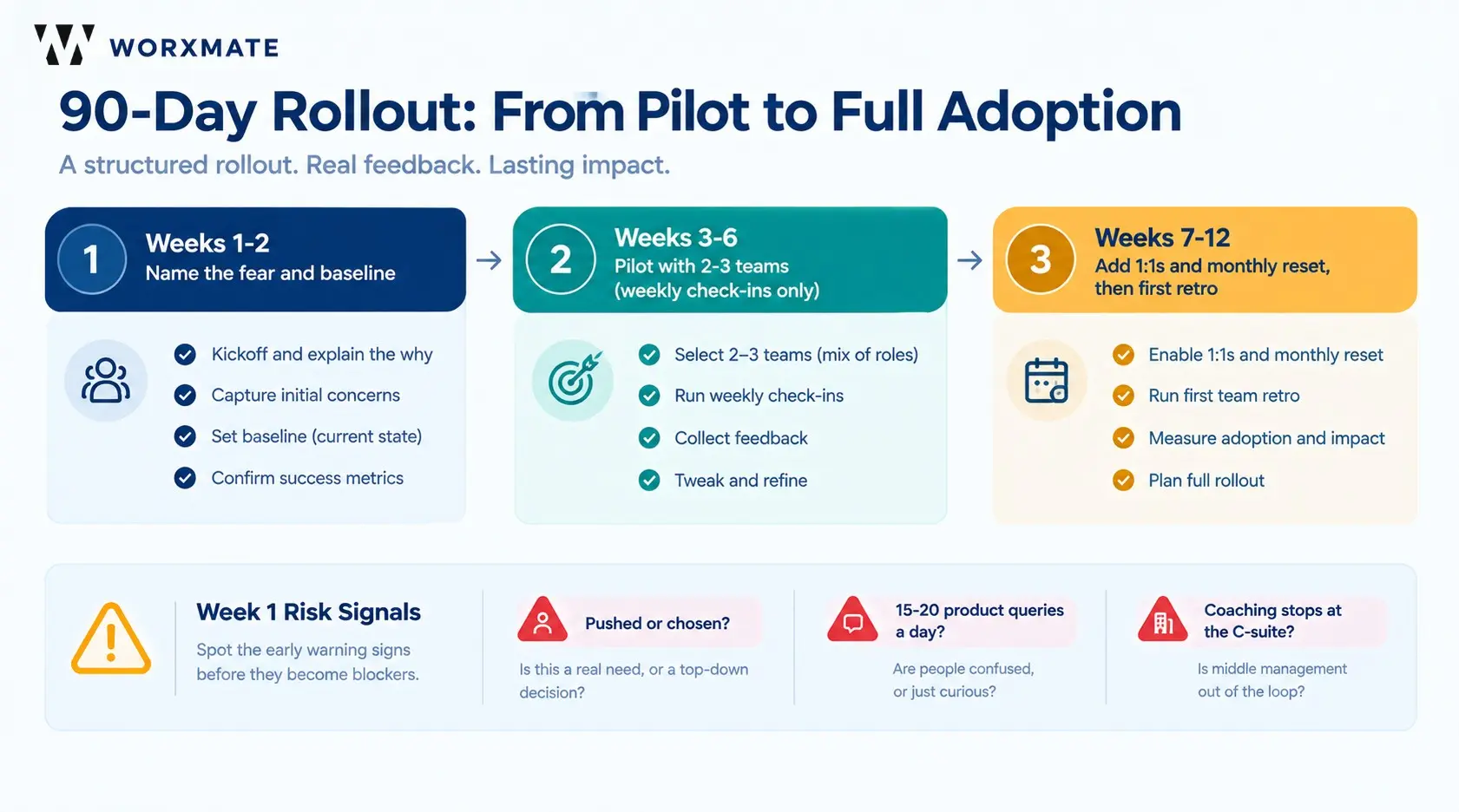
Illustrative plan. Weeks 1 to 2: name the fear out loud (a missed stretch goal is a learning event, not a rating) and baseline where leaders actually are. Weeks 3 to 6: pilot with two or three teams, weekly check-ins only. Weeks 7 to 12: add the fortnightly 1:1 and monthly reset, then run the first retrospective before expanding.
Watch three signals in week one. Was this pushed or was it chosen? Organisations that announce a go-live date and a login collapse between weeks four and six, because nobody answered what is in it for me. How many product queries is the team raising? At 15 to 20 a day in week one, adoption will break within weeks. And does the coaching stop at the C-suite? That is the Coaching Cliff, where most programmes die below the leadership layer within one quarter.
Diagnose the gap before you roll anything out
The Organization Performance Audit is a strategy gap diagnostic. Run it before the pilot so you know which teams need coaching first.
Rollouts fail in predictable ways. Performance management system implementation, PMS adoption challenges and why OKR implementation fails are worth reading before the pilot, not after it.
Continuous Performance Management Best Practices Examples
- Write the fear down. Say it in session one: a missed stretch goal is a learning event, not a rating. Then behave that way when someone misses one in month two.
- Coach managers before individual contributors. Employee coaching starts with the middle layer, and it is where programmes live or die. Skip it and you have built the Coaching Cliff yourself.
- Attach feedback to goals. A real-time feedback note logged against a Key Result is evidence. The same note in a chat thread is gone by Friday. Ongoing feedback only compounds when it is recorded.
- Go top-down first, bottom-up later. In my experience across 50+ implementations, bottom-up in the first two quarters produces noise, not alignment. Add it once capability exists. Mastering OKR best practices goes deeper.
- Finish one cycle before scaling. One team, one full cycle, one honest retrospective beats five teams running half a cycle.
Two Ways Forward
The software is the infrastructure. The coaching is the capability. You need both, and in the right order.
The Platform Path. If you are ready to see how performance management software built around this rhythm works in practice, book a Worxmate demo, check pricing or explore our OKR software. If you are comparing platforms first, our guides to the best performance management software and the best OKR software are the neutral starting points, and our continuous performance management software guide covers the evaluation criteria.
The Consulting Path. If the real gap is leadership alignment, goal quality or managers who check boxes instead of coaching, our OKR consulting work is built for that. The outcome is leaders who can run a real check-in without you in the room.

Written by
An OKR Coach with 20+ years of implementation experience, Madhusudan has guided over 50 organisations through successful OKR transformations, training more than 500 leaders. Learn more about Worxmate.