 WORXMATE
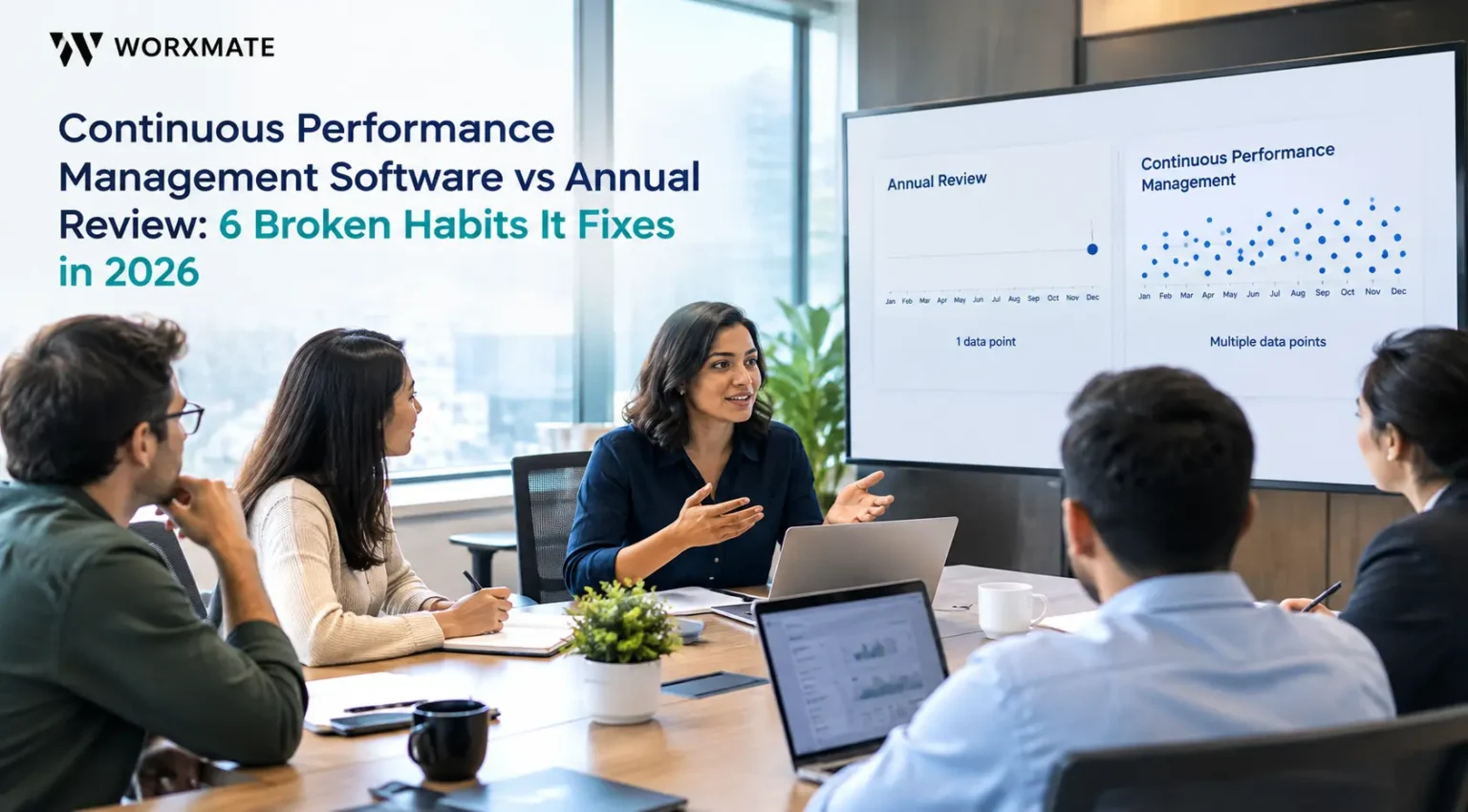
Continuous performance management software vs annual review is not a debate about which philosophy of feedback is superior. It’s a system-architecture question: does your organisation run performance data through one platform that captures signal year-round, or does it run through a single annual event that reconstructs a year from memory in a two-week window? Continuous performance management software replaces that reconstruction with structured, ongoing check-ins, real-time feedback, and AI-driven signals that a manager can act on immediately. An annual review process, even a well-run one, is a snapshot; a continuous platform is a record. For most organisations comparing the two as a buying decision, the real question isn’t whether continuous is philosophically better. It’s whether their current annual-review software can even hold the kind of data a continuous system needs to function.
The Review That Reconstructed a Year From Memory
I once watched a manager sit down to write an annual review for someone she genuinely rated highly, and struggle to remember what the person had actually worked on in April. Not because she didn’t care. Because eleven months had passed, three reorganisations had happened in between, and the only record of that work was whatever survived in her memory and a handful of scattered Slack threads.
That moment is the entire case for continuous performance management software vs annual review, reduced to its simplest form. An annual review isn’t a feedback philosophy failing. It’s a data architecture failing. You cannot accurately evaluate twelve months of work using a system that only captures data once, at the end, from memory. The problem was never that managers don’t care about accuracy. It’s that nothing in an annual-cycle system was built to preserve the record they’d need to be accurate.
This is why comparing continuous performance management vs annual performance review as software categories, rather than as management philosophies, gets you to the right buying decision faster. One system stores performance data as it happens. The other reconstructs it once a year and hopes the reconstruction is close enough.
Still relying on an annual cycle to catch what’s actually happening?
An Organization Performance Audit shows you exactly where your current review process is losing signal before you evaluate any new platform.
What Each System Is Actually Built to Do
Before going further, I want to name the framing I’d use with any CHRO evaluating this decision, because most vendor pages muddy it. This isn’t a comparison of two management styles. It’s a comparison of two data architectures, and the architecture determines everything downstream: what a manager can see, how accurate a rating is, and how much a review conversation can actually help someone improve.
| Dimension | Annual Review Software | Continuous Performance Management Software |
|---|---|---|
| Data capture frequency | Once per cycle, typically 12 months | Ongoing, through ongoing feedback and check-ins |
| Manager visibility | Retrospective, reconstructed from memory | Real-time, visible as work happens |
| Bias exposure | High, recency bias dominates the record | Lower, distributed data reduces reliance on recall |
| Employee experience | One high-stakes conversation per year | Regular, lower-stakes touchpoints |
| Risk detection | After the fact, usually at the review itself | Early, through AI-driven signals |
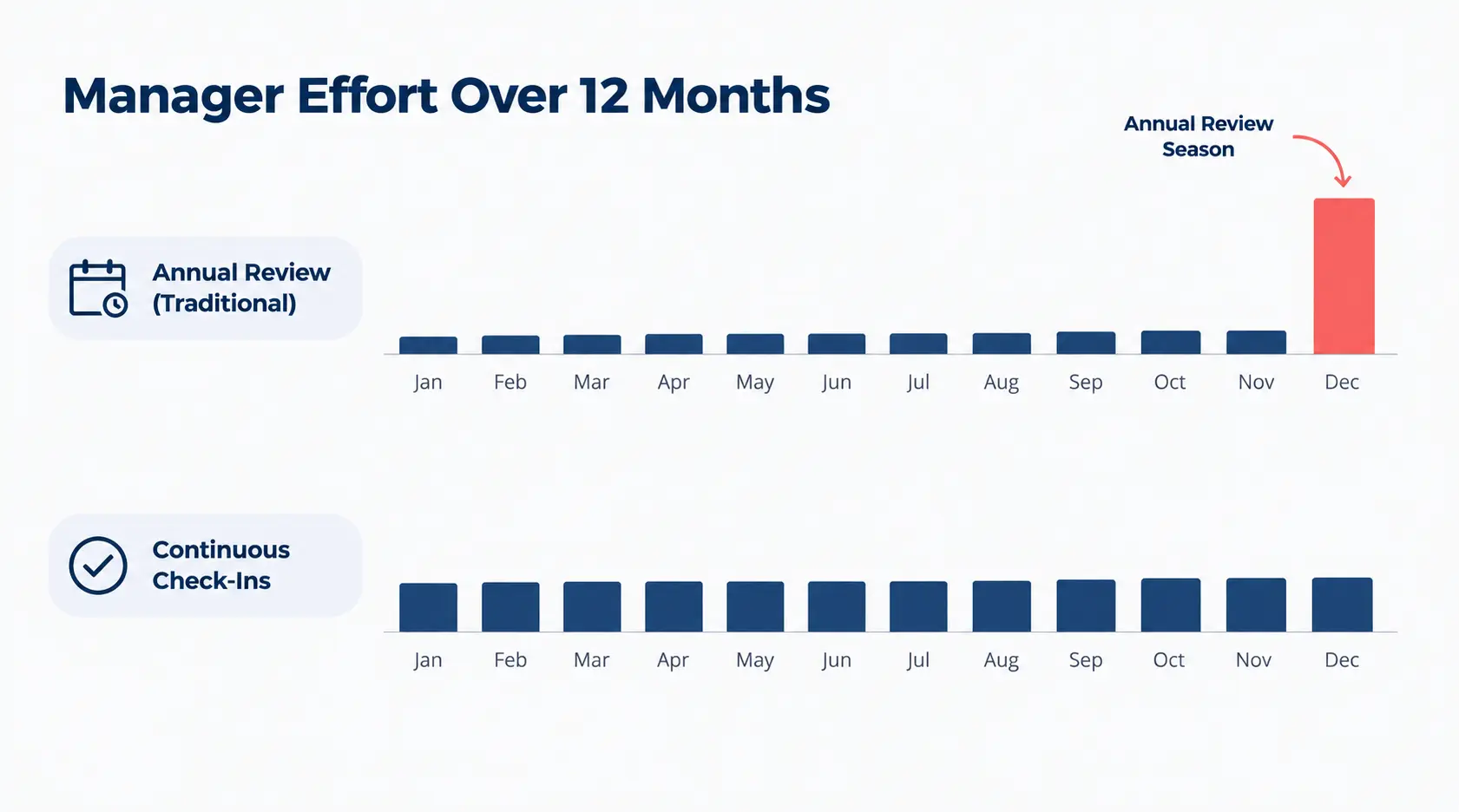
| Manager workload pattern | Concentrated spike before each cycle | Distributed across the year |
If you’re weighing this specifically against a 360-degree appraisal vs traditional performance review decision, that comparison sits one layer below this one; it’s about who provides the input, not when the input is captured. This article is about the capture frequency itself, which is the deeper architectural choice.
Unlock Goal Clarity & Accelerate Employee Growth
Looking to drive goal clarity and employee growth? Discover how Worxmate’s AI-powered Performance Management Software can help.
Why Annual Performance Reviews Fail as a Data System, Not as an Idea
I want to be fair to the annual review here, because the intent behind it was never wrong. Organisations wanted a structured moment to evaluate performance, connect it to compensation, and have an honest conversation about growth. The idea holds up. The software architecture built around executing that idea, once a year, from memory, does not.
Here’s what breaks, specifically:
Recency bias becomes structural, not accidental. When the only performance record is what a manager remembers, work from the last six weeks of the cycle dominates the evaluation, regardless of what happened in the first ten months. This isn’t a manager failing at objectivity. It’s what happens when a system provides no other data source.
Feedback becomes an annual event instead of a habit. If a platform only prompts a conversation once a year, that’s the only time a conversation happens, structurally. Annual review vs continuous feedback software is really a question about whether your system creates the conditions for regular conversation or removes them by design.
HR has zero pre-cycle visibility into who’s actually struggling or excelling. By the time an annual review surfaces a performance problem, months of it have already happened invisibly. A continuous system with named AI signals, like Worxmate’s Orbit AI flagging engagement decline or attrition risk, surfaces the same pattern in weeks instead of months.
Manager workload concentrates into a punishing spike. Annual review season is universally dreaded because the entire year’s evaluation work gets compressed into a two-to-three-week window. Manager workload annual review vs continuous comparisons consistently show the same pattern: continuous systems distribute the same total effort across the year in smaller, less painful increments.
For the fuller list of what this looks like from an HR operations lens, our guide on why annual reviews fail and the specific bias mechanics in performance review bias are the deeper resources.
 What Continuous Performance Management Software Actually Replaces
Is continuous performance management better than annual reviews is the question I get asked most directly, and my honest answer is that it’s the wrong framing. The better question is: what does continuous performance management software need to replace structurally for it to work at all?
It has to replace three specific mechanisms, not just add a feature on top of an existing annual cycle:
- The memory-dependent record. Ongoing feedback captured as it happens replaces a manager’s memory as the system of record. This is the single biggest architectural shift, and it’s the one most “continuous performance management software replacing annual reviews” vendors underdeliver on, because they add check-in features without actually making that data the primary evaluation input.
- The single evaluation moment. Real-time feedback replaces the idea that evaluation happens once. A continuous system treats every check-in as a small data point that compounds into an accurate picture, rather than deferring all judgment to one high-stakes conversation.
- The reactive discovery of risk. This is where the continuous performance management software category earns its name properly. Instead of discovering a disengaged or struggling employee at the annual review, AI-driven signals surface the pattern while there’s still time to act on it.
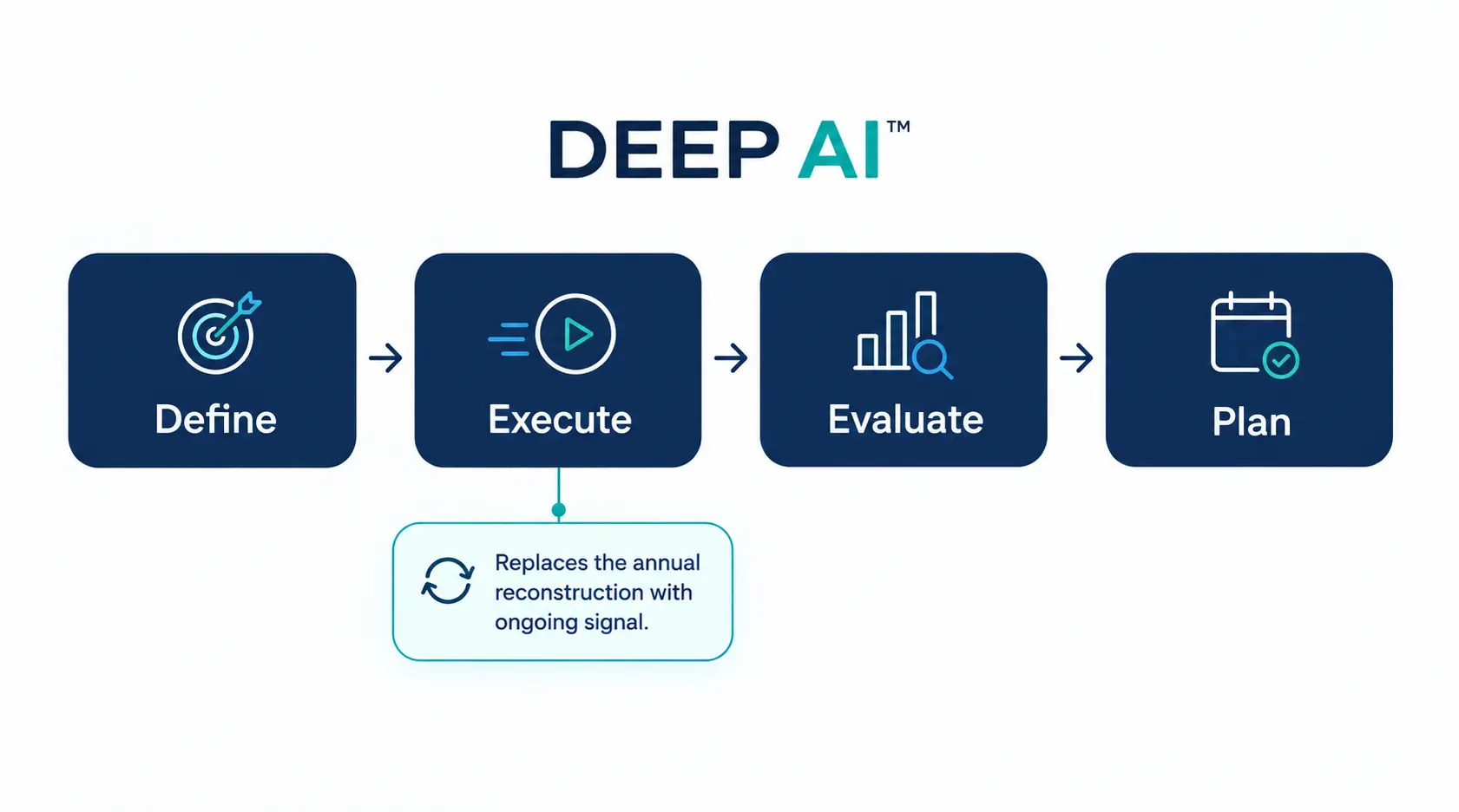
This is exactly the architecture behind Worxmate’s DEEP AI™ framework. Define sets the goal quality bar upfront. Execute is where the ongoing check-ins and at-risk detection actually replace the annual reconstruction, powered by Orbit AI on the people side. Evaluate turns that accumulated data into a genuinely data-backed retrospective instead of a memory exercise, and Plan carries what was learned into the next cycle.
Making the internal case to move off annual cycles?
This ebook covers how AI-driven, data-backed performance practice replaces reconstructed reviews with a real record leadership can trust.
The Employee Experience Nobody Puts on the Comparison Chart
Employee experience continuous performance management vs annual review rarely gets its own line item in a vendor comparison, and it should, because it’s often the deciding factor once leadership actually sits with both models. An annual review, however well-delivered, asks an employee to absorb twelve months of feedback in a single conversation, often including things they’ve never heard before because nobody mentioned them until the stakes were highest.
A continuous system changes the emotional shape of that experience entirely. Feedback arrives in smaller doses, closer to the moment it’s relevant, which means nothing in the annual conversation is truly a surprise. Our guide on dealing with negative performance reviews covers exactly why surprise is the mechanism that makes annual reviews feel punitive even when the underlying feedback is fair. Continuous systems don’t eliminate hard conversations. They eliminate the ambush quality that makes hard conversations land so badly.
Where the Real Cost Sits
| Cost Category | Annual Review Model | Continuous Performance Management Model |
|---|---|---|
| Manager preparation time | Concentrated, high-stress spike | Distributed, lower per-instance cost |
| Employee trust impact | Erodes when feedback surprises | Builds through predictable, ongoing dialogue |
| Data accuracy | Degrades with recency bias | Improves with continuous capture |
| Risk detection speed | Months delayed | Weeks, often earlier with AI signals |
| Cost of a missed at-risk signal | Full attrition or failed deliverable | Caught and addressed early |
The Fintech Story Everyone Skips: What Happens When You Try to Retrofit Continuous Onto Annual
Not every organisation gets this decision right on the first attempt, and I want to be honest about where it goes wrong. I worked with a roughly 100-person European fintech that had been running strictly annual reviews and decided, correctly, to move toward continuous performance management. Where they stumbled wasn’t the decision itself. It was assuming they could bolt continuous check-ins onto their existing annual-review software as a feature, rather than treating it as the architectural shift it actually is.
The team kept the annual review as the “real” evaluation and treated the new check-ins as optional colour commentary nobody was required to act on. Within two cycles, the check-ins had turned into exactly the KPI-tracking-without-outcome-thinking problem I see constantly: activity being logged, with nobody connecting it back to what actually needed to change. The fix wasn’t more check-ins. It was a single pointed question in a coaching session: “What is the one big thing you want to resolve?” That question, followed by a sequence of “so what happens next” pushes, was what turned the continuous data from noise into something the team actually used to catch problems early, months before the review would have surfaced them on its own.
Switching from annual reviews to continuous performance management only works when the continuous layer becomes the primary record, not a supplementary feature sitting next to an annual process that still holds the real authority. That’s a continuous performance management software adoption after annual reviews mistake I see repeated across industries: buying the software without retiring the old system of record alongside it.
Unlock Goal Clarity & Accelerate Employee Growth
Looking to drive goal clarity and employee growth? Discover how Worxmate’s AI-powered Performance Management Software can help.
Data-Driven Performance Management vs. the Once-a-Year Snapshot
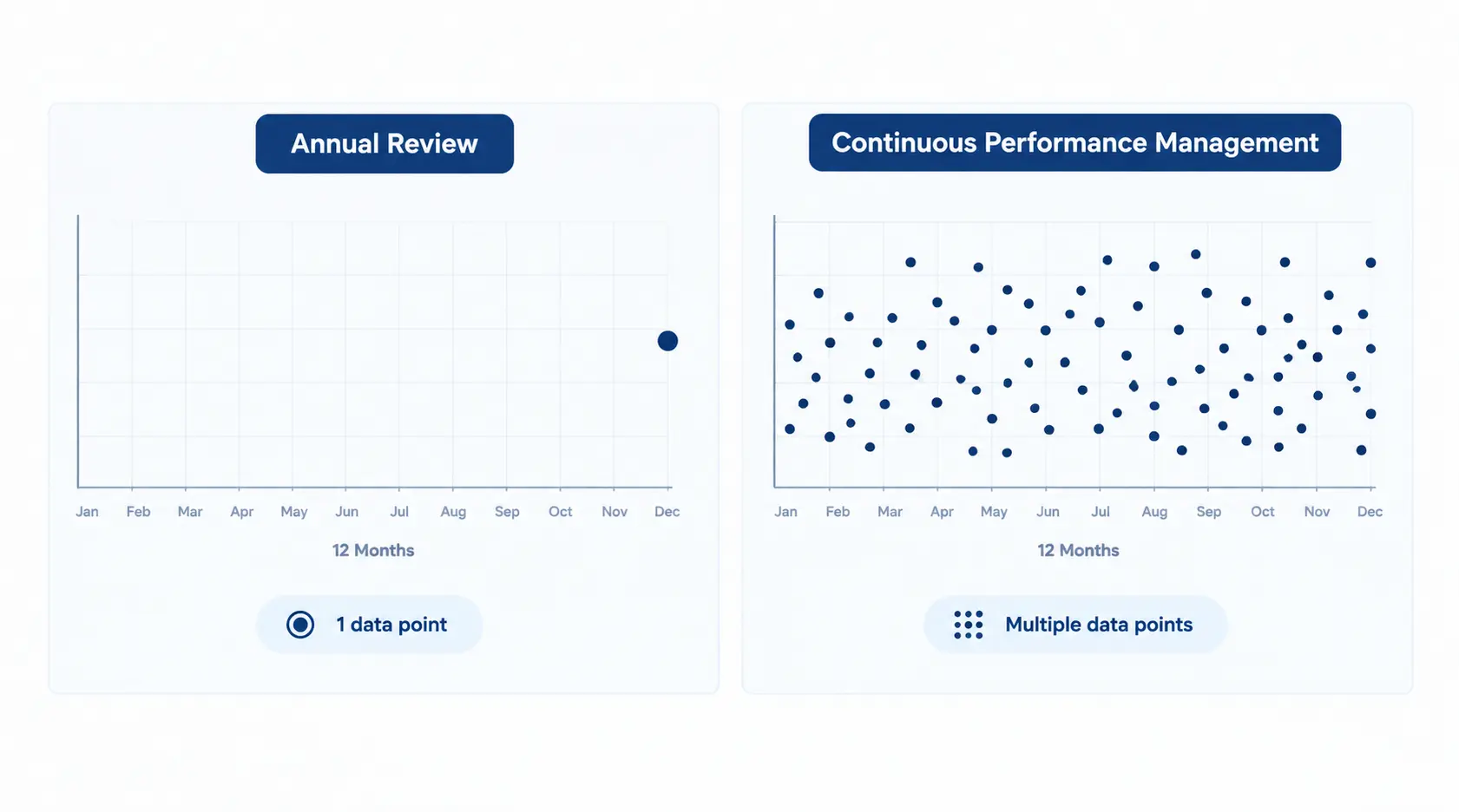
Data-driven performance management vs annual review is where the architecture argument becomes concrete rather than philosophical. A once-a-year review produces exactly one data point per employee, per year. Real-time performance data vs once-a-year review comparisons show the obvious mathematical gap: a continuous system produces dozens of data points across the same period, each smaller and less consequential individually, but collectively far more accurate than a single high-stakes recollection.
This matters most at the moment a rating gets disputed or a calibration conversation gets contentious. Annual review bias vs continuous performance data is a real, documented gap: reviewers relying on memory consistently overweight recent events and underweight early-cycle contributions, a pattern that continuous data simply cannot replicate because nothing about it depends on what a manager happens to remember in December.
If HR leadership needs the internal case for why this matters beyond individual fairness, our performance appraisal system guide and performance management ROI breakdown both build out the business argument in more depth than this comparison alone can carry.
How to Evaluate Continuous Performance Management Software for Eliminating Annual Reviews
If you’re building the case to move off an annual cycle, here’s the sequence I’d walk a CHRO or Strategy Head through:
- Confirm the platform makes continuous data the system of record, not a side feature sitting next to an annual review that still carries formal weight. If both exist, decide explicitly which one wins when they conflict, and say so in writing before rollout.
- Ask how AI-driven risk signals actually work, not just whether the platform has “insights.” A named signal like burnout risk or engagement decline is meaningfully different from a generic dashboard.
- Check how the platform handles the transition period. Employees and managers used to annual cycles need a deliberate onboarding into continuous habits, or the check-ins will get treated as busywork, exactly as happened in the fintech story above.
- Confirm calibration still works on continuous data. Some organisations worry continuous check-ins make formal calibration harder. In practice, more data points make calibration more defensible, not less, provided the platform aggregates it cleanly.
- Ask what happens to compensation conversations. Cost of annual review cycles vs continuous software isn’t just about manager hours; it’s also about whether compensation decisions get made on one snapshot or on a fuller year of evidence.
Our how to transition teams from annual reviews to continuous check-ins resource covers the rollout sequence in more operational detail than a comparison article can carry, and our fixing broken performance management systems guide is the right next stop if the annual process has already broken down before you’ve chosen a replacement.
The Bottom Line on Continuous Performance Management Software vs Annual Review
If you take one thing from this comparison, take this: continuous performance management software vs annual review was never really a debate about which one respects employees more. It’s a question about whether your organisation’s performance data lives in a system built to capture it as it happens, or in a manager’s memory reconstructed once a year under deadline pressure. One of those is a record. The other is a guess dressed up as a rating.
The Platform Path: If you’re ready to see how ongoing check-ins, real-time feedback, and Orbit AI’s signal detection replace the annual reconstruction entirely, explore Worxmate’s performance management software or book a demo to see the DEEP AI™ engine mapped against your current review cycle.
The Consulting Path: If the deeper issue is that your managers have never been coached to give feedback outside a scheduled review, no platform fixes that on its own. Our OKR consulting work addresses that coaching gap directly. The software is the infrastructure. The coaching is the capability. Organisations that move successfully off annual cycles usually need both, in that order.


Written by
An OKR Coach with 20+ years of implementation experience, Madhusudan has guided over 50 organisations through successful OKR transformations, training more than 500 leaders. Learn more about Worxmate.