 WORXMATE
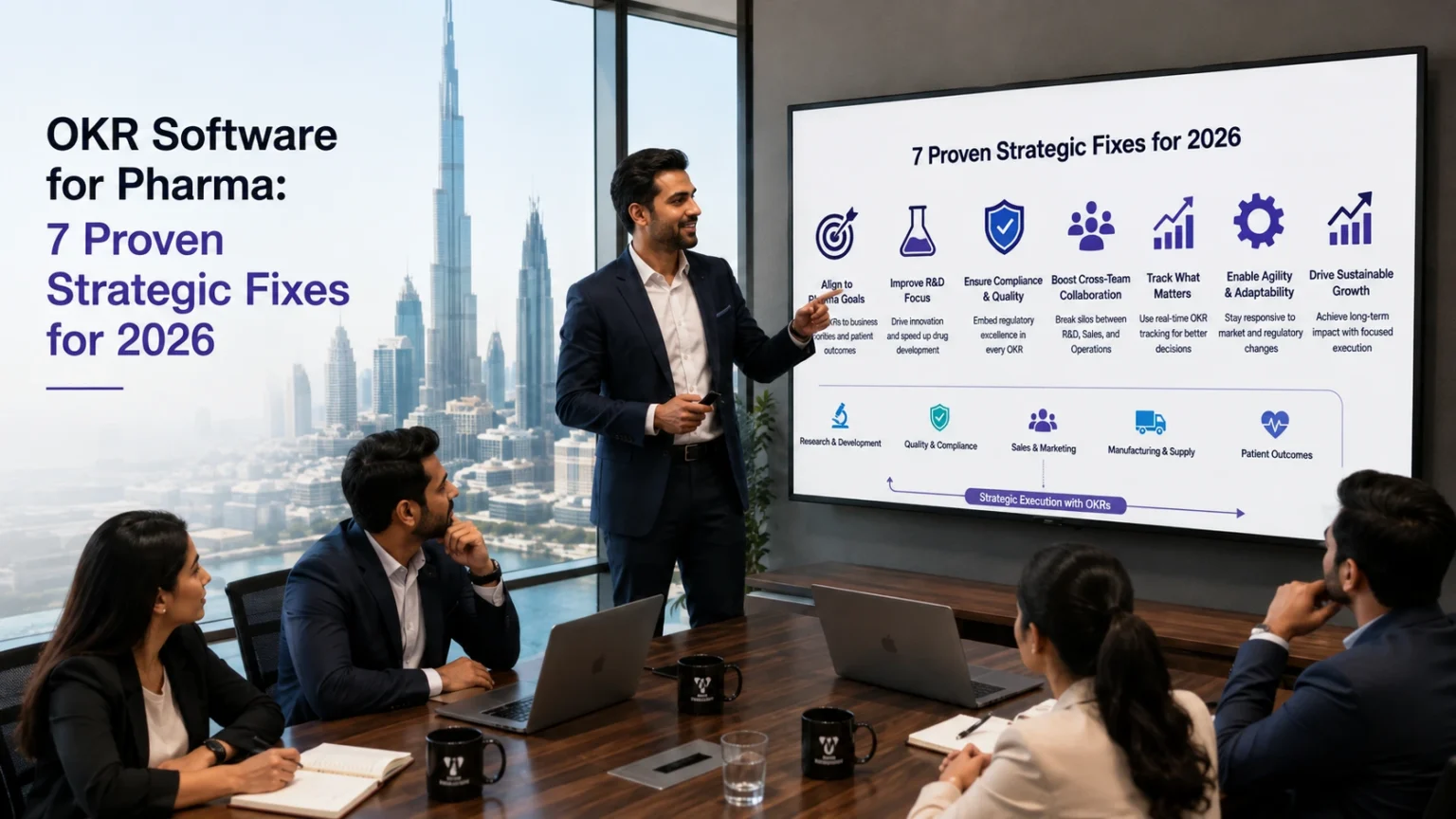
OKR software for pharma bridges the gap between long-term R&D cycles and quarterly commercial execution. By aligning clinical milestones with market access and sales velocity, pharmaceutical leaders can maintain strategic OKR alignment across complex global supply chains, ensuring that regulatory compliance and innovation move at the same speed as business growth.
I recently sat in a boardroom with the CEO of a mid-sized pharmaceutical firm who could not name his top three priorities for the next six months. He had a 40-page strategy deck, but his R&D team was chasing molecules that the commercial team hadn’t even prepared the market for. This is the “cascade of silence” common in life sciences. When strategic OKR alignment is missing, the cost isn’t just missed revenue; it is years of wasted clinical development and expired patent windows. In my experience across 50+ implementations, the transition from output-based tracking to outcome-driven results is the only way to survive the tightening regulatory and competitive landscape.
The pharmaceutical industry operates on a different clock than SaaS or retail. You are managing 10-year drug development lifecycles while being judged on quarterly sales performance. Most generic tools fail here because they don’t understand the dependency between a Phase III trial and a marketing launch plan. Using a dedicated OKR software allows you to visualize these dependencies, moving beyond the static spreadsheets that usually hide the real risks until it is too late. We often see an Execution Maturity Rate of just 5-15% in the first cycle, but with the right coaching, this climbs to 40% within a year.
One of my core convictions is that alignment is agreement, not a software configuration. You can buy the best okr software for pharma, but if your Head of Clinical and Head of Commercial haven’t agreed on what “market ready” looks like, the tool will only document your dysfunction. Real success comes when the software acts as the infrastructure for these difficult conversations. For those looking for a Betterworks alternative, the focus must be on whether the platform provides the team performance metrics necessary to spot a clinical delay before it impacts the annual bottom line.
30-40%
Execution Maturity Rate
The percentage of pharma leaders who can write high-quality outcomes independently after 12 months of consistent coaching and platform use.
Why Generic Goal Setting Fails in Life Sciences
Pharma organizations often confuse strategy vs tactics, leading to Key Results that look like a to-do list. “Complete the trial” is an output; “Achieve a 20% reduction in patient recruitment time” is an outcome. When you implement okr software for pharma, the goal is to shift the culture toward the latter. I have seen 8,000-employee energy companies and global pharma giants struggle with the same issue: the “Coaching Cliff.” If the OKR methodology stops at the C-suite, the middle management layer-where the actual science happens-reverts to safe, easily completable tasks.
The OKR software for pharma metric benchmarks we track show that organizations using automated check-ins see a 25% higher goal attainment rate than those relying on monthly manual updates. In a high-stakes environment, waiting 30 days to realize a regulatory filing is at risk is unacceptable. You need a system that surfaces team performance metrics in real-time. This is where Orbit AI performance intelligence becomes critical, identifying burnout or attrition risks in high-pressure R&D teams before they derail a project.
Furthermore, HR owning the OKR process is a structural mistake. In pharma, when HR owns the program, it becomes a performance appraisal tool. When the CEO’s office owns it, it becomes a strategy execution engine. The distinction is vital. You want your scientists focused on breakthroughs, not on how their OKRs will affect their year-end bonus. By decoupling these, you allow for the “stretch” thinking that drug discovery requires. For a deeper look at the basics, you can read our guide on what is OKR to understand the framework’s core tenets.
🎯 Practitioner Field Note
In pharma, 15-20 queries per day in the first week of implementation is a healthy signal of engagement. If your team is silent, they aren’t using the tool; they are ignoring it.
Strategic OKR Alignment for R&D and Clinical Operations
R&D is the heart of pharma, but it is often the hardest to align with business goals. Strategic OKR alignment here means connecting lab-level progress to corporate valuation. If a molecule fails a safety test, the entire organization needs to pivot instantly. Using a Define AI OKR writing tool helps researchers frame their technical milestones as business-relevant outcomes. Instead of “Run 50 assays,” the KR becomes “Validate target hit rate of 15% to move to lead optimization.”
Clinical operations also benefit from quarterly goal examples that focus on efficiency. We have seen teams reduce trial site activation time by 30% simply by making the bottleneck visible in their OKR software for pharma. When everyone from the CRO to the internal clinical lead sees the same team performance metrics, the “blame game” stops and problem-solving begins. This is similar to how we’ve seen QA engineering OKRs transform software delivery by focusing on bug prevention rather than just detection.
The following table illustrates how OKR software for pharma compares to traditional management methods in a clinical setting:
| Feature | Traditional PMS | Pharma OKR Software | Business Impact |
|---|---|---|---|
| Update Frequency | Annual/Bi-annual | Weekly Check-ins | Faster pivot on trial data |
| Goal Type | Task-based (KPIs) | Outcome-based (KRs) | Focus on drug efficacy |
| Visibility | Private/Siloed | Cross-functional | Aligned launch readiness |
According to research by McKinsey, organizations that align their R&D and commercial strategies early in the lifecycle see significantly higher peak sales. This alignment is exactly what OKR software for pharma is designed to facilitate. By using OKR software for pharma key results that bridge these two worlds, you ensure that the science is always serving the patient and the shareholder.
Quarterly Goal Examples for Pharmaceutical Teams
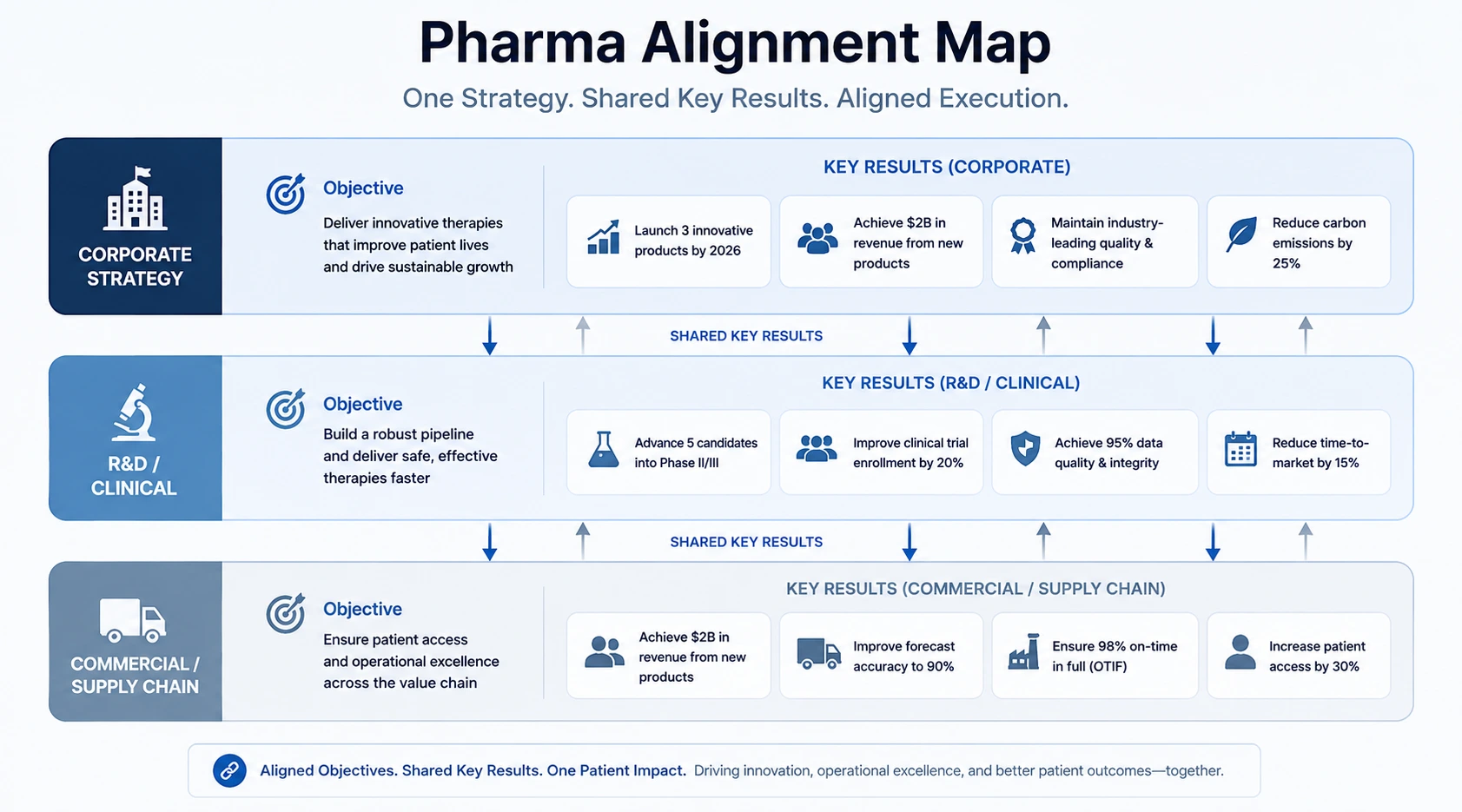
To move from theory to execution, let’s look at some real OKR examples tailored for the pharma sector. These examples demonstrate how to use OKR software for pharma key results to drive meaningful change. Whether you are a OKR software for ctos user in a biotech startup or a BU Head in a global major, these patterns hold true.
Commercial Excellence & Market Access
The commercial team’s pain is often a lack of strategic OKR alignment with the medical affairs department. If the medical data isn’t ready, the sales team can’t make their claims. A well-structured OKR fixes this by making the dependency explicit.
Objective: Accelerate Market Penetration for New Oncology Therapy
Key Results
- Secure Tier 1 formulary placement in 15 major hospital networks by end of Q3.
- Increase “Intent to Prescribe” score among targeted KOLs from 6.5 to 8.2 through 3 medical education symposia.
- Achieve 95% supply chain readiness with zero stock-outs in the first 90 days of launch.
Regulatory Affairs & Compliance
Regulatory teams often feel like they are “policing” the rest of the company. By using OKR software for pharma, they can turn compliance into a competitive advantage. This is similar to how BFSI OKR examples focus on risk mitigation as a growth enabler.
Objective: Streamline Global Regulatory Submission Process
Key Results
- Reduce average time from “Data Lock” to “NDA Submission” from 120 days to 90 days.
- Maintain 100% “First-Time Right” submission rate with zero major queries from the FDA/EMA.
- Implement automated compliance tracking across 4 global regions using Execute OKR check-in software.
“Alignment is agreement between teams on what matters, why it matters, and how each team’s work connects to the teams around them. You cannot set that in a tool. You can display it. You cannot create it.”
Metric Benchmarks: Measuring What Matters in Pharma
Setting goals is easy; setting the right ones is hard. OKR software for pharma metric benchmarks should focus on velocity and quality, not just activity. In my experience, pharma companies that track “Execution Velocity”-the speed at which KRs move from 0% to 70%-outperform their peers in market share growth. If your team performance metrics show that goals are only moving in the last two weeks of the quarter, you have a “sandbagging” problem, not an execution problem.
We use the DEEP AI framework to evaluate the health of these metrics. Define ensures the KRs are measurable; Execute tracks the weekly rhythm; Evaluate uses data-backed retrospectives; and Plan ensures the next cycle is smarter. For a US-based firm, using OKR software usa helps maintain this rhythm across time zones, ensuring that the “Execution Maturity Rate” stays high even in decentralized teams.
Pharma Tiered Accountability Model
100% Weight
40% Weight
20% Weight
This weighting model ensures that while individual contributors have “stretch” goals, the organization remains focused on the Therapeutic Area strategy. If you are currently using a Mooncamp alternative, ensure your platform can handle these complex weighting structures. Without them, you risk “social loafing,” where teams hide behind the success of others while their own critical KRs languish.
Overcoming Adoption Blockers in Pharma
The biggest blocker to OKR software for pharma adoption is the fear of failure. In a highly regulated industry, “failure” is often equated with “non-compliance” or “loss of license.” Coaching must make it explicit that an OKR “failure”-hitting 60% of an ambitious goal-is a learning event, not a disciplinary one. I have seen this play out in a 70,000-person IT services org and it applies equally to pharma: if you don’t reward the “so what” questioning, people will only write safe goals.
Another common issue is the “Data Silo.” Your clinical data is in one system, your sales data in another, and your OKRs in a third. This is why OKR software for pharma must integrate with your existing tech stack. When a KPI to OKR conversion happens automatically through an integration, the “admin burden” disappears. Scientists can stay in the lab, and sales reps can stay in the field, while the software handles the reporting.
Finally, consider the team performance metrics that indicate health beyond just the numbers. Are people commenting on each other’s OKRs? Are cross-functional dependencies being flagged early? If your OKR software for pharma isn’t facilitating these interactions, it’s just a digital filing cabinet. We often suggest looking at personal OKRs for designers or other creative roles to see how they handle subjective quality-pharma researchers can learn a lot from how other high-output “knowledge workers” track their progress.
The Pharma Execution Report
Download our study on how 135+ HR leaders are bridging the gap between R&D and Commercial success.
The Path to Execution Maturity
Moving your organization toward high performance isn’t a one-quarter sprint. It is a 12-month journey. In the first quarter, focus on strategic OKR alignment at the leadership level. In the second, roll it out to the Therapeutic Area heads. By the third quarter, your OKR software for pharma should be the “single source of truth” for every major initiative. This is how you move from a 5% Execution Maturity Rate to a world-class 40%.
The software is the infrastructure. The coaching is the capability. You need both, and in the right order. If you try to implement the tool without the mindset shift, you will end up with a very expensive list of tasks. But if you combine a purpose-built platform with expert guidance, you can turn your pharmaceutical strategy into a predictable execution engine.
Ready to bridge the gap between science and strategy?
If you are looking for a platform built for high-stakes execution, explore our OKR software and check our pricing to see how we scale with your organization. For a tailored walkthrough of how we handle pharma-specific dependencies, get a demo today.
If you recognize that your team needs the mindset shift before the toolset, our OKR consulting services provide the hands-on coaching required to reach 40% execution maturity within your first year. We don’t just teach the framework; we build the capability.


Written by
An OKR Coach with 20+ years of implementation experience, Madhusudan has guided over 50 organisations through successful OKR transformations, training more than 500 leaders. Learn more about Worxmate.