 WORXMATE
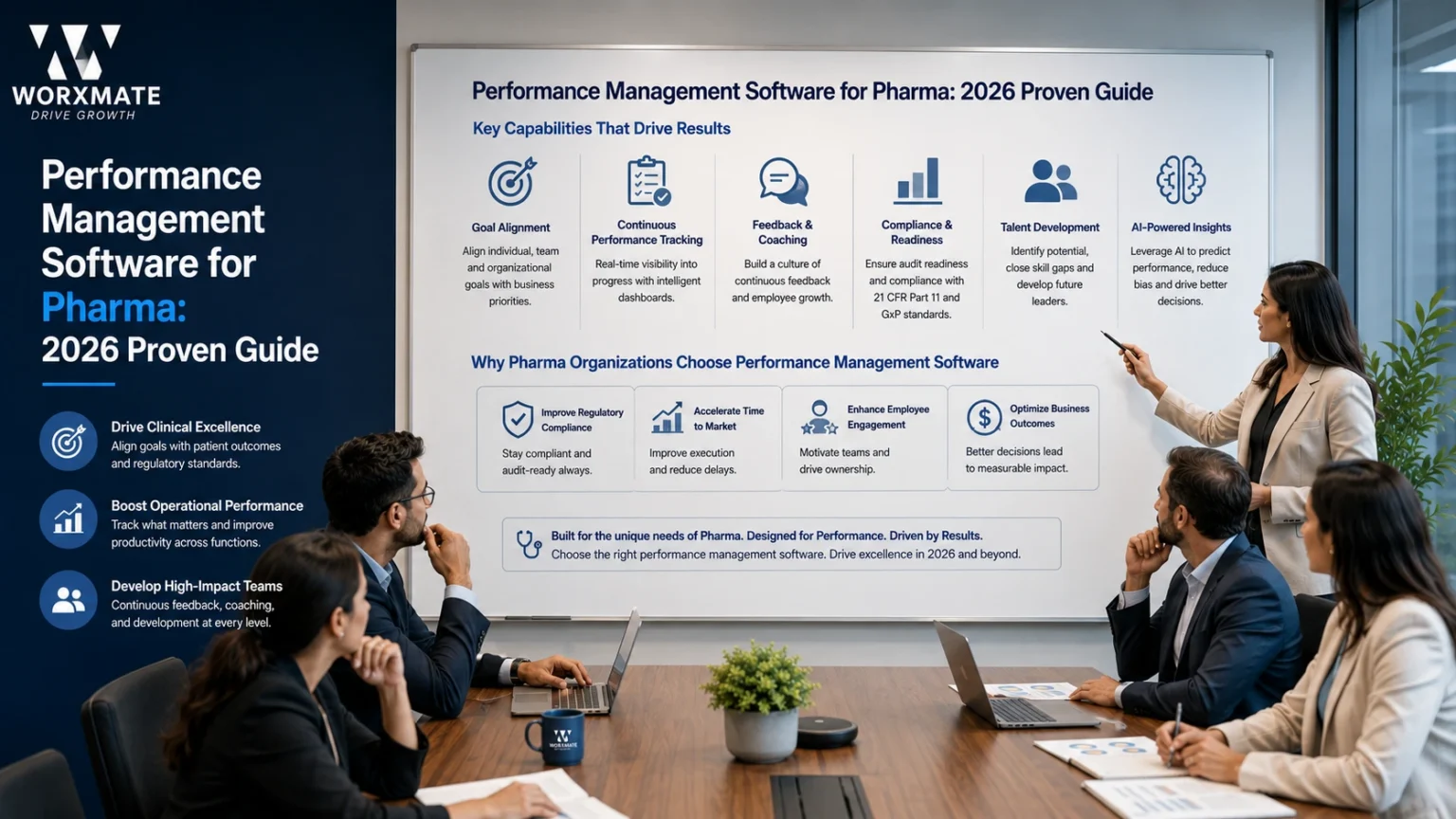
Performance management software for Pharma must bridge the gap between rigid regulatory compliance and the high-velocity execution required for drug discovery and market access. Success requires moving beyond static annual reviews toward a PMS-OKR Bridge that aligns R&D milestones with commercial excellence while maintaining a high Execution Maturity Rate.
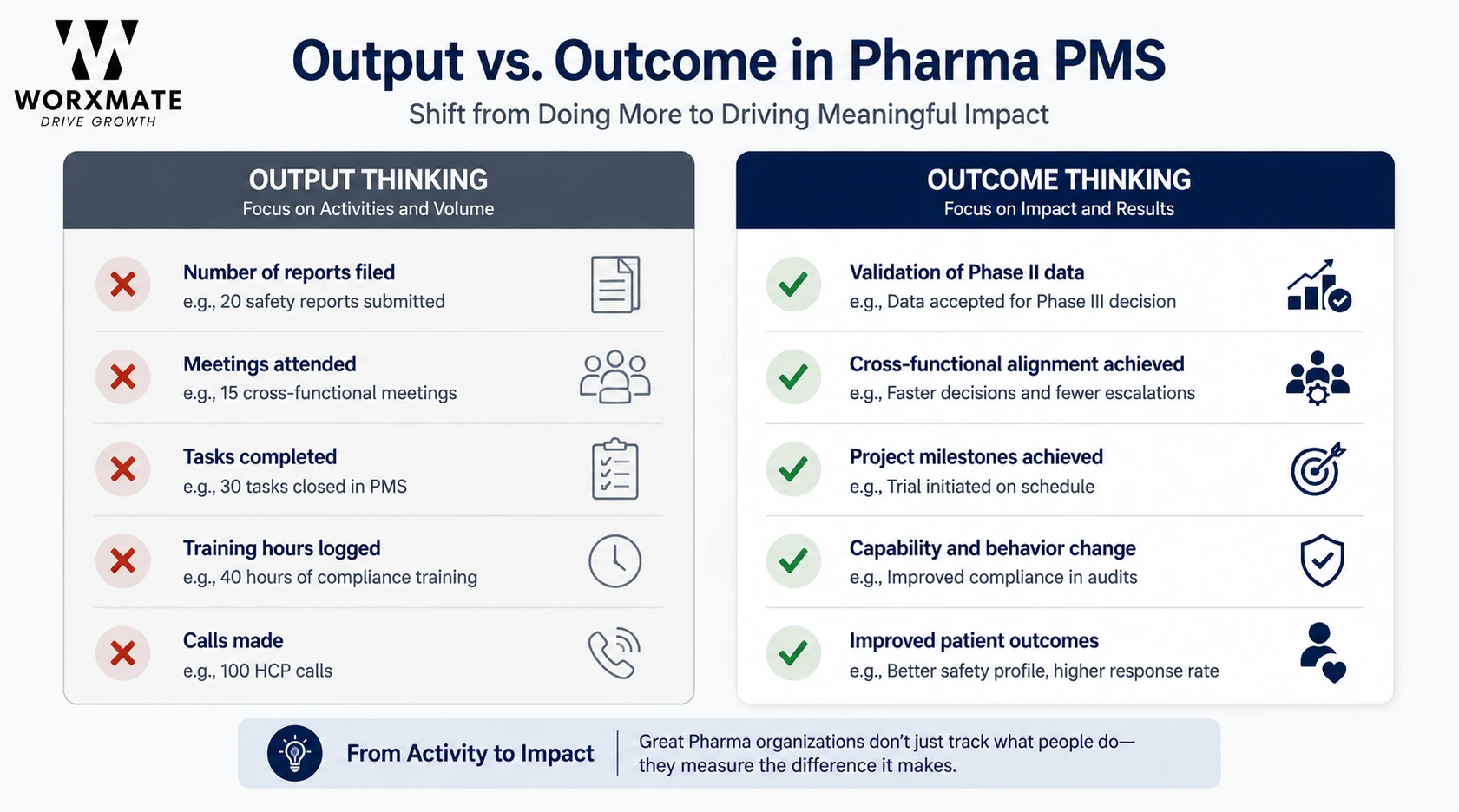
A CHRO at a mid-sized pharmaceutical firm recently sat across from me, frustrated by a “successful” system rollout that had yielded zero impact on their clinical trial timelines. They had implemented a standard HRIS module, yet their scientists were still treating performance reviews as a bureaucratic tax rather than a strategic lever. The scientists were focused on “output-the number of tests run-while the business was dying for “outcome”- the validation of a viable compound. This is the exact moment the limitations of generic HR tools become a liability; when the software tracks the person but ignores the progress of the science.
I have spent years in the room with leadership teams across 135+ HR leader conversations, specifically navigating the complexities of high-stakes industries like Pharma, Fintech, and Manufacturing. My observations come from 50+ implementations where we moved the needle on Execution Maturity Rate from a baseline of 5-15% to a high-performance 30-40% within a year. In Pharma, the stakes are not just about productivity; they are about the Execution Maturity Rate of teams navigating a 10-year product lifecycle where a single alignment error in year three can cost billions in year ten.
The High-Stakes Reality of Performance Management Software for Pharma
The pharmaceutical industry operates under a unique paradox: it requires the most rigid adherence to SOPs and QA standards, yet it demands the most agile, innovative thinking in R&D. Most performance management software fails here because it treats a Lab Manager the same way it treats a Retail Associate. In Pharma, performance is not a linear path; it is a complex web of regulatory hurdles, patent clocks, and cross-functional dependencies. This makes it essential for organizations to connect performance systems with broader quality-management practices. For additional context, the FDA’s Q10 Pharmaceutical Quality System guidance outlines a model for effective quality management in the pharmaceutical industry.
When we look at Performance management software for Pharma best practices, the first realization is that “compliance” is not a goal-it is the floor. The ceiling is how quickly you can pivot a team when a clinical trial phase fails. If your PMS is disconnected from your strategic goals, you are essentially flying a plane where the pilot and the navigator are speaking different languages. This is where HR challenges become business bottlenecks.
30-40%
Execution Maturity Rate
The percentage of Pharma leaders able to write outcome-driven goals independently after 12 months of DEEP AI goal coaching.
Systemic Failures in Pharma Performance Systems
Across the 135+ HR leader conversations I have conducted, one pattern repeats: the “Calibration Conflict.” In Pharma, this usually happens when R&D teams are rated on subjective manager “gut feel” because the performance management software for Pharma being used has no visibility into the actual milestones achieved in the lab.
The most common systemic failure is that KRAs are disconnected from business goals. A scientist might have a KRA to “Maintain Lab Safety Standards,” which is essential, but if they don’t have a goal tied to “Reducing Time-to-Data by 15%,” the business doesn’t move. This is why a Performance management software for Pharma implementation framework must include a PMS-OKR Bridge. Without it, you are just measuring if people showed up, not if they moved the molecule forward.
“An OKR Coach evaluating a PMS platform asks one question: does this platform tell HR whether their people are moving the business, or does it tell HR whether their people completed the process?”
Unlock Goal Clarity & Accelerate Employee Growth
Looking to drive goal clarity and employee growth? Discover how Worxmate’s AI-powered Performance Management Software can help.
Comparing Performance Management Software for Pharma
Not all tools are built for the rigors of the life sciences. When evaluating specialized enterprise performance management software for Pharma, you must distinguish between a generic “System of Record” (HRIS) and a purposeful “System of Execution” (OKR-integrated PMS).
| Feature Set | Legacy HRIS (e.g. Darwinbox) | Worxmate Pharma Edition | Pharma Impact |
|---|---|---|---|
| Goal Alignment | Top-down cascade (Static) | Bi-directional OKR Alignment | Connects Lab work to Market Access |
| Feedback Loop | Annual/Semi-annual | Weekly Execute OKR check-in software | Immediate course correction for trials |
| Bias Control | Manual Calibration | Third Eye Layer (AI Monitoring) | Removes favoritism in R&D ratings |
The difference is stark. A legacy HRIS is designed for the HR administrator to ensure the “Performance Review” checkbox is ticked. A purpose-built performance management software for Pharma is designed for the BU Head who needs to know why the oncology pipeline is stalled.
The DEEP AI Framework: Driving Enterprise OKR Adoption
In my experience, the “Coaching Cliff” is the primary reason enterprise OKR adoption fails in Pharma. Leadership sets the goals, but the middle management layer-the Senior Scientists and Plant Managers-don’t know how to translate those into daily actions. They revert to what they know: task lists.
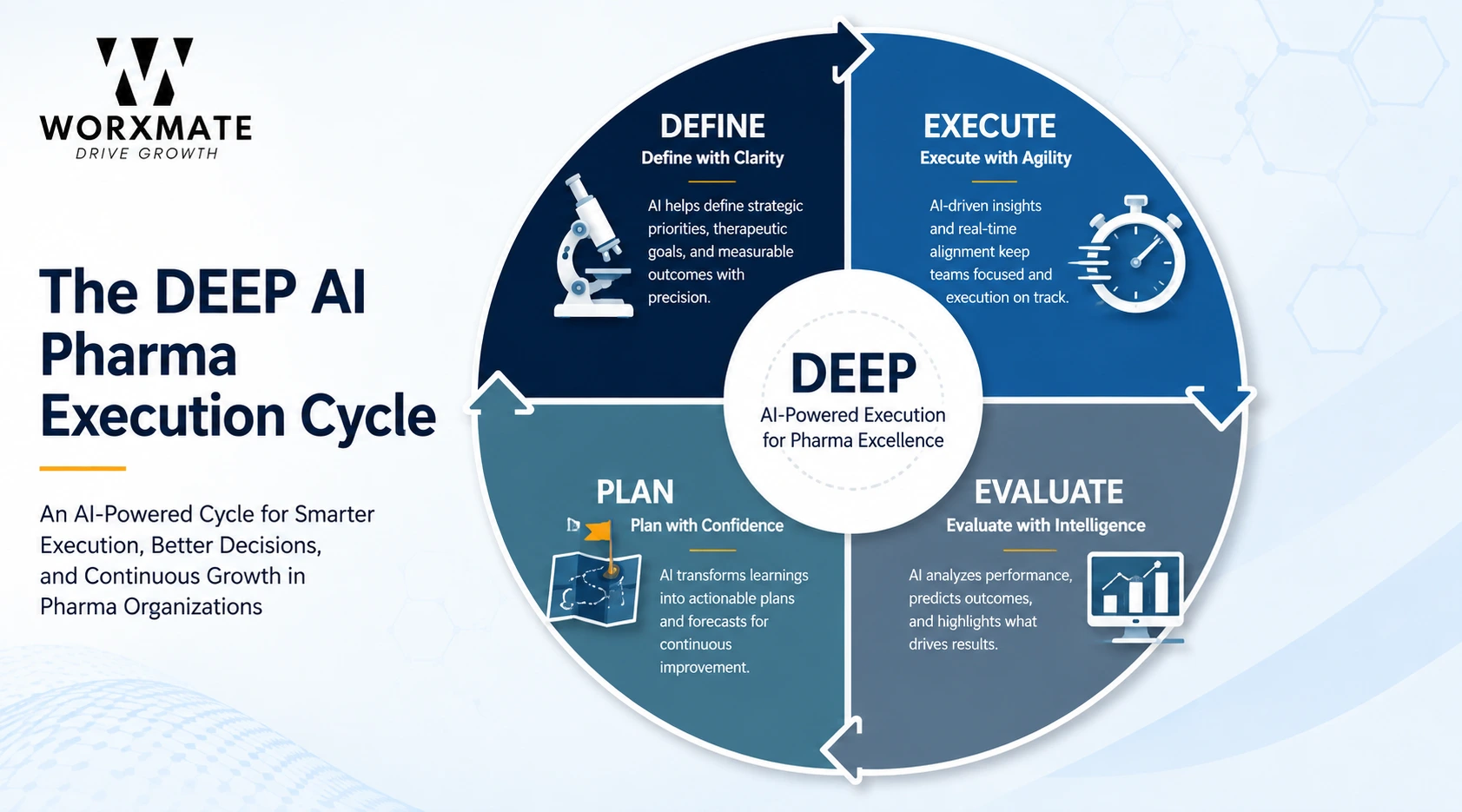
This is where the DEEP AI goal coaching framework changes the game. DEEP stands for Define, Execute, Evaluate, and Plan.
- Define: Using the Define AI OKR writing tool, managers move from writing “Do more research” to “Increase compound stability by 20% by Q3.”
- Execute: This involves automated check-ins that flag “at-risk” goals before they become “failed” milestones.
- Evaluate: Data-backed retrospectives that look at business performance management rather than just individual behavior.
- Plan: Cycle-over-cycle learning that improves the Execution Maturity Rate.
Pharma Best Practices: Avoiding the “Appraisal Trap”
One of my hard-won convictions is that HR owning OKRs is a structural mistake. When HR owns the goals, they inevitably become a performance appraisal tool. In Pharma, this leads to “Safe Goal Setting.” Scientists won’t set ambitious “Stretch Goals” if they think a 70% achievement will result in a lower bonus.
To achieve true enterprise OKR adoption, the CEO’s office must own the strategy execution, while HR owns the capability building. This means integrating Id with performance management so that when a skill gap is identified in a check-in, the system automatically suggests the relevant training. This is how you build long term vision examples that actually materialize.
🎯 Practitioner Field Note
In a 1,500-employee Pharma org, we found that 15-20 queries per day in the first week of implementation was the “Success Signal.” If queries were lower, it meant people weren’t even logging in. If higher, the system was too complex. Adoption lives in that sweet spot of active engagement.
The PMS-OKR Bridge: Linking Performance to Outcomes
For a Pharma company, the performance management ROI is found in the reduction of “Dead Time” between clinical phases. A standard PMS tracks if the manager had a 1:1. A Performance management software for Pharma with an integrated OKR bridge tracks if that 1:1 resolved a dependency with the Regulatory Affairs team.
We use a Tiered Accountability Model to ensure alignment:
- C-Suite: 100% OKR-driven (Strategic Outcomes).
- Middle Management: 40% OKRs / 60% KRAs (Execution + Operational Excellence).
- Individual Contributors: 20% OKRs / 80% KRAs (Contribution + Compliance).
This model prevents the “Alignment = Agreement” trap. Alignment isn’t just everyone saying “yes” in a meeting; it’s the technical and psychological agreement on what matters most. You can’t create this in a tool, but you can use Orbit AI employee performance intelligence to display where that agreement is breaking down.
Execution Maturity Lift: Pharma Case Study
Benchmark Data
12% Maturity
38% Maturity (+216% Lift)
Unlock Goal Clarity & Accelerate Employee Growth
Looking to drive goal clarity and employee growth? Discover how Worxmate’s AI-powered Performance Management Software can help.
Avoiding Common Implementation Mistakes
The biggest mistake in Performance management software for Pharma implementation framework design is treating it as a software launch rather than a change management initiative. I have seen enterprise OKR adoption stall because the “Coaching Cliff” hit the middle management layer.
Another critical error is ignoring performance review bias. In Pharma, where specialized knowledge is high, managers often favor those who “speak their language,” even if their output is lower. Using a “Third Eye Layer” for real-time bias monitoring before calibration is essential. It flags if a manager is consistently rating their “inner circle” higher despite tech industry performance metrics suggesting otherwise.
Finally, don’t forget the PIPs (Performance Improvement Plans). In many Pharma firms, PIPs are misused as firing tools. A modern performance management software in India or globally should treat a PIP as a genuine development tool, linked to the Orbit AI’s 6 Named Signals like “Skills Decay” or “Burnout Risk.”
Conversations Conducted
135+
HR Leaders in Pharma & Tech
Maturity Growth
+200%
Average lift in execution velocity
What This Looks Like in Practice: A Field Observation
I recently worked with a global Pharma giant that was struggling with cultural goals. They wanted to foster “Innovation,” but their performance system only rewarded “Compliance.” We implemented a Performance management software for Pharma solution that allowed scientists to tag 20% of their time to “Moonshot OKRs.”
By using business performance management principles, we could see which “Moonshots” were actually gaining traction. The result wasn’t just more ideas; it was a 30-40% increase in the Execution Maturity Rate of the R&D department because they finally had a system that recognized the value of “productive failure.” They moved from when to use KPI for basic safety to using OKRs for breakthrough discovery.
The Bottom Line for Pharma Leaders
If you are evaluating enterprise performance management software for Pharma, stop looking at the feature list and start looking at the philosophy. Does the tool understand the difference between a KPI to OKR conversion and a simple task list? Does it provide the DEEP AI goal coaching necessary to bridge the gap between your strategy and your scientists?
The software is the infrastructure. The coaching is the capability. You need both, and in the right order. For Pharma companies looking to dominate the next decade of drug discovery, the choice of performance system is no longer an HR decision-it is a strategic imperative.
The Pharma Execution Maturity Report
How 50+ Pharma firms moved from 15% to 40% execution maturity in 12 months.
The Path Forward
Path 1: If your organization is ready to move beyond static reviews and implement a system built for high-stakes execution, explore our OKR Software and Pricing, or Get a Demo to see the PMS-OKR Bridge in action.
Path 2: If you recognize that your leadership team needs to build the muscle of outcome-thinking before the software can be effective, our OKR Consulting provides the DEEP AI goal coaching required to transform your culture from the top down.


Written by
An OKR Coach with 20+ years of implementation experience, Madhusudan has guided over 50 organisations through successful OKR transformations, training more than 500 leaders. Learn more about Worxmate.