 WORXMATE

Summary
Work goals are specific, measurable objectives that employees set to improve their performance, develop new skills, and contribute to organizational success. These goals provide direction, boost motivation, and create a clear roadmap for professional growth. By establishing well-defined work goals, employees can prioritize tasks effectively, track progress systematically, and align their individual efforts with broader company objectives. Whether focused on skill development, leadership advancement, or performance improvement, work goals serve as essential tools for career progression and workplace satisfaction. Understanding how to set, manage, and achieve work goals is fundamental to long-term professional success and organizational effectiveness.
In today’s fast-paced business environment, work goals have become the cornerstone of professional success. According to Deloitte research, companies that revisit goals quarterly experience threefold greater improvement in performance and retention compared to those reviewing goals annually. Yet only 51% of companies even attempt to develop aligned goals.
Work goals are more than just annual targets written during performance reviews—they’re dynamic, strategic objectives that drive daily actions, boost engagement, and accelerate career growth.
Gallup’s 2024 research reveals that highly engaged employees achieve 23% higher profitability and 17% higher productivity. The connection is clear: effective work goals translate directly into better business outcomes and enhanced career prospects.
Setting work goals helps employees understand their purpose, prioritize effectively, and measure progress toward both personal and organizational success. From frontline workers to C-suite executives, everyone benefits from clearly defined objectives that provide focus and motivation throughout the workday.
What Are Work Goals?
Work goals are specific, measurable objectives that employees establish to guide their professional development and job performance. These goals serve as benchmarks for measuring progress, evaluating success, and driving continuous improvement in the workplace.
Work goals typically encompass:
- Performance targets tied to core job responsibilities
- Skill development objectives for professional growth
- Career advancement milestones for long-term progression
- Collaborative initiatives that enhance teamwork
- Innovation-focused goals that drive organizational change
Unlike vague aspirations, effective work goals follow structured frameworks like SMART goal (Specific, Measurable, Achievable, Relevant, Time-bound) or OKRs (Objectives and Key Results) to ensure clarity and accountability.
Research from MIT indicates that best-practice goal setting involves joint creation by employees and managers, clear alignment with organizational mission, and regular revisitation with ongoing feedback.
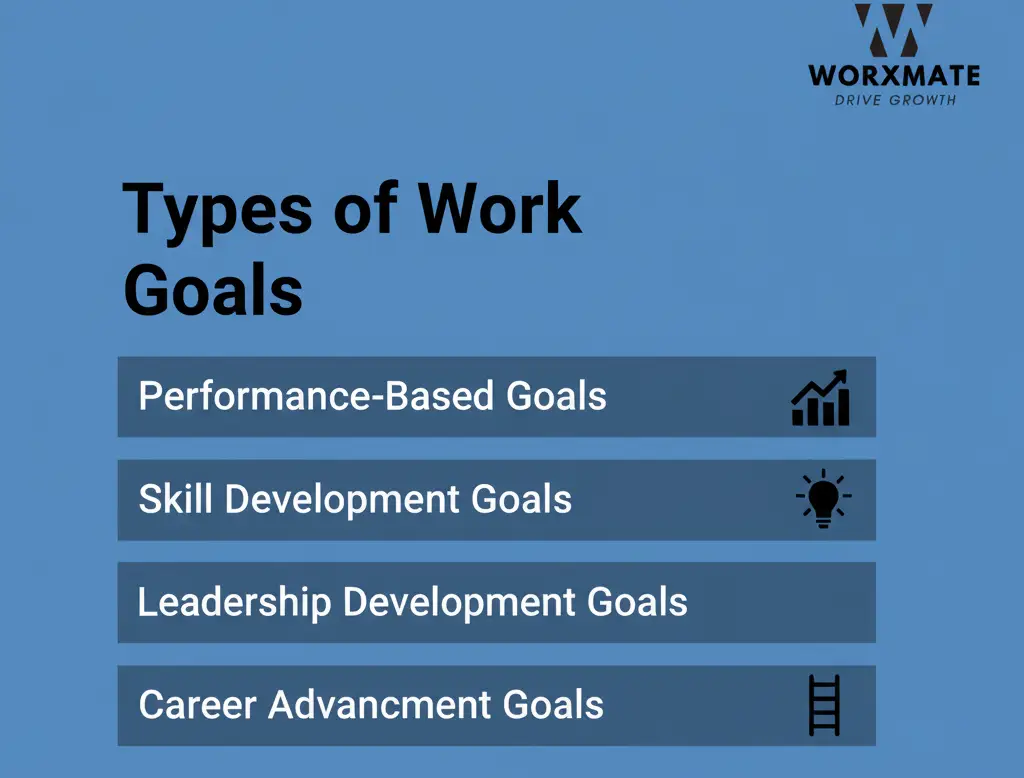
Types of Work Goals
-
Performance-Based Goals
Performance goals focus on improving job-specific outcomes and meeting role expectations. These objectives address key performance indicators, productivity metrics, and quality standards directly tied to an employee’s responsibilities.
Examples of goals for work performance:
-
- Increase sales revenue by 15% within the next quarter
- Reduce customer response time from 24 hours to 12 hours
- Improve project completion rate to 95% on-time delivery
- Achieve a customer satisfaction score of 4.5 out of 5
-
Skill Development Goals
Skill enhancement goals concentrate on acquiring new competencies or refining existing abilities to perform more effectively in current roles or prepare for future opportunities.
Examples of work goals for skill building:
-
- Complete advanced Excel certification within six months
- Master project management methodologies by year-end
- Develop proficiency in data analytics tools within three months
- Achieve conversational fluency in a second language relevant to business needs
-
Leadership Development Goals
Leadership goals nurture the qualities necessary for effective management and strategic thinking, preparing employees for greater responsibilities.
Examples:
-
- Mentor two junior team members throughout the year
- Lead a cross-functional project involving three departments
- Complete a leadership development program within 18 months
- Improve conflict resolution skills through targeted workshops
-
Career Advancement Goals
These goals target specific milestones that propel employees toward their desired career trajectory and higher-level positions.
Examples of goals for work advancement:
-
- Earn a professional certification to qualify for promotion
- Take ownership of a major initiative demonstrating leadership readiness
- Expand professional network by attending four industry conferences
- Shadow senior executives to understand strategic decision-making
Why Work Goals Are Essential
-
Drives Employee Engagement and Motivation
Clear, achievable work goals provide employees with a sense of purpose and direction. According to McKinsey research, 70% of surveyed employees said their individual purpose was defined by their work, and clarity of purpose increases companies’ return on assets by 3.8%.
Gallup’s extensive research demonstrates that engaged employees—those with clear goals—produce 21% higher profitability and experience 41% lower absenteeism. When employees understand what they’re working toward and why it matters, motivation increases dramatically.
-
Enhances Productivity and Performance
PwC’s yearlong study of 12,000 employees revealed that workers who regularly set modest short-term goals were more likely to achieve broader company performance targets and reported being happier at work. Employees who completed at least one goal daily reduced task completion time by 10% compared to colleagues without daily goals.
The research is compelling: companies with highly engaged workforces achieve 17% higher productivity and 20% higher sales than those with disengaged teams.
-
Provides Clear Direction and Focus
Work goals help employees prioritize tasks and concentrate on activities that directly contribute to success. This focus reduces time wasted on non-essential activities and ensures energy is directed toward high-impact work.
Research shows that only 21% of organizations conduct frequent check-ins with employees on at least a weekly basis, and less than half actively involve employees in developing operational improvements. Regular goal reviews address this gap, keeping teams aligned and focused.
-
Enables Performance Measurement and Feedback
Well-defined work goals create objective criteria for evaluating progress and success. This measurement capability allows organizations to identify improvement areas, celebrate achievements, and provide meaningful feedback.
Deloitte’s research emphasizes that companies revisiting goals quarterly see threefold greater improvement in performance and retention than those reviewing goals annually.
-
Aligns Individual and Organizational Objectives
When individual work goals align with company strategy, everyone moves in the same direction. PwC research indicates that aligned organizations are four times more likely to execute well and generate better profits.
Google’s transparent OKR system exemplifies this alignment—every employee’s objectives are visible company-wide, creating clarity about how individual work contributes to larger organizational goals.
How to Set Effective Work Goals: A Step-by-Step Guide
-
Step 1: Understand Your Organization’s Strategic Priorities
Start by reviewing your company’s strategic objectives, mission and vision, and . Effective work goals must support broader organizational priorities to create meaningful impact.
-
Step 2: Use the SMART Framework
Structure your goals using SMART criteria:
Specific: Define exactly what you want to achieve
Measurable: Establish quantifiable metrics for tracking progress
Achievable: Set challenging yet realistic targets
Relevant: Ensure alignment with role responsibilities and company goals
Time-bound: Set clear deadlines and milestones
-
Step 3: Collaborate with Your Manager
Research shows that 67% of employees whose managers help them set goals report being engaged at work. Collaborative goal-setting creates ownership, ensures alignment, and provides managerial support for success.
-
Step 4: Break Down Large Goals into Milestones
Divide ambitious goals into smaller, manageable milestones with specific deadlines. This approach maintains momentum and provides opportunities to celebrate progress along the way.
-
Step 5: Document Your Goals
Writing down goals cements them as tangible commitments and improves clarity. Avoid tentative language like “perhaps” or “might” that undermines commitment and perceived attainability.
-
Step 6: Establish Regular Check-ins
Schedule weekly or monthly reviews to track progress, address challenges, and adjust strategies as needed. Consistent monitoring keeps goals relevant and maintains accountability.
Case Study: Adobe’s Check-In Revolution
In 2012, Adobe transformed its approach to work goals by eliminating annual performance reviews and introducing the “Check-in” system. Previously, managers spent 80,000 hours annually on reviews—time that added little value.
Adobe’s new framework focuses on quarterly goal-setting using SMART criteria, continuous feedback conversations, and ongoing career development discussions.
Employees create one-page expectation documents outlining specific, measurable objectives aligned with organizational priorities.
-
Results were remarkable:
Adobe saved over 100,000 manager hours annually, voluntary turnover decreased significantly, and 75% of departing employees now recommend Adobe as a great workplace—an increase from previous years. The company rose 47 spots on Interbrand’s Top Global Brands ranking since implementing Check-ins.
Adobe’s success demonstrates that ditching rigid annual reviews for flexible, ongoing goal conversations creates accountability, engagement, and measurable business impact.
Conclusion
Work goals are fundamental to professional success and organizational effectiveness. By setting specific, measurable objectives using proven frameworks like SMART goals or OKRs, employees gain clarity, focus, and motivation to excel in their roles.
The research is conclusive: organizations that prioritize structured goal-setting achieve higher productivity, better engagement, and stronger financial performance.
Companies like Google demonstrate that transparent, ambitious goals reviewed regularly create alignment and drive innovation at scale.
Whether you’re establishing performance targets, developing new skills, or advancing your career, effective work goals provide the roadmap for achievement.
Start by understanding organizational priorities, collaborate with your manager, document your objectives clearly, and commit to regular progress reviews.
With the right approach and supportive tools like Worxmate OKR Software, you can transform your work goals from aspirations into accomplished realities.


Written by
An OKR Coach with 20+ years of implementation experience, Madhusudan has guided over 50 organisations through successful OKR transformations, training more than 500 leaders. Learn more about Worxmate.