 WORXMATE
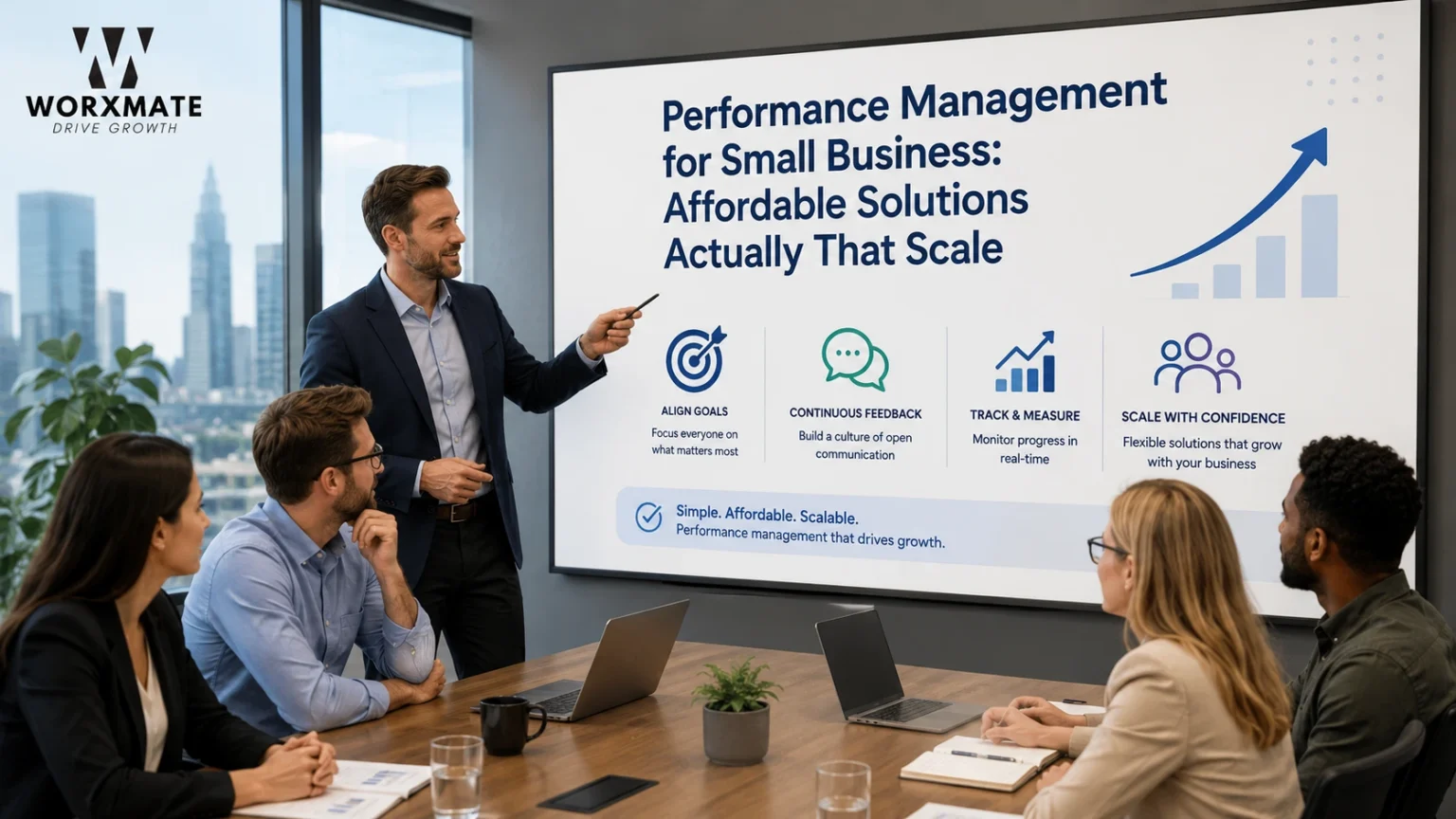
Performance Management for Small Business: Implementing lightweight employee performance software and continuous feedback loops allows lean teams to drive strategic alignment without enterprise HR bloat. Modern platforms combine agile OKRs and 1:1 check-ins for half the cost of legacy tools.
Introduction: Why Small Businesses Can’t Afford to Ignore Performance Management
Running a small business is exciting – and exhausting. With lean teams, tight budgets, and constant pressure to grow, people management often falls to the bottom of the priority list. But here’s the hard truth: ignoring performance management for small business is one of the most expensive mistakes you can make.
Companies that focus on their people’s performance are 4.2 times more likely to outperform their peers, realizing an average 30% higher revenue growth and experiencing attrition five percentage points lower (McKinsey & Company). That’s not just a big-company advantage – it is an every-business opportunity. The challenge has always been cost and complexity. But today, affordable PMS software and scalable HR tools are levelling the playing field for start-ups, SMBs, and small teams.
This guide has been refreshed for 2026 with a deeper look at how OKR vs KPI for startups actually plays out for lean teams, the most common performance-management mistakes small businesses make, and how AI-powered platforms like Worxmate’s Orbit AI, Axis AI, and Nexus AI intelligence models – all built on the DEEP AI framework – are changing what “affordable” really means. If you only have five minutes, read the quick answer above, then skim the comparison table and the step-by-step framework further down.
What Is Performance Management and Why Does It Matter for Small Teams?
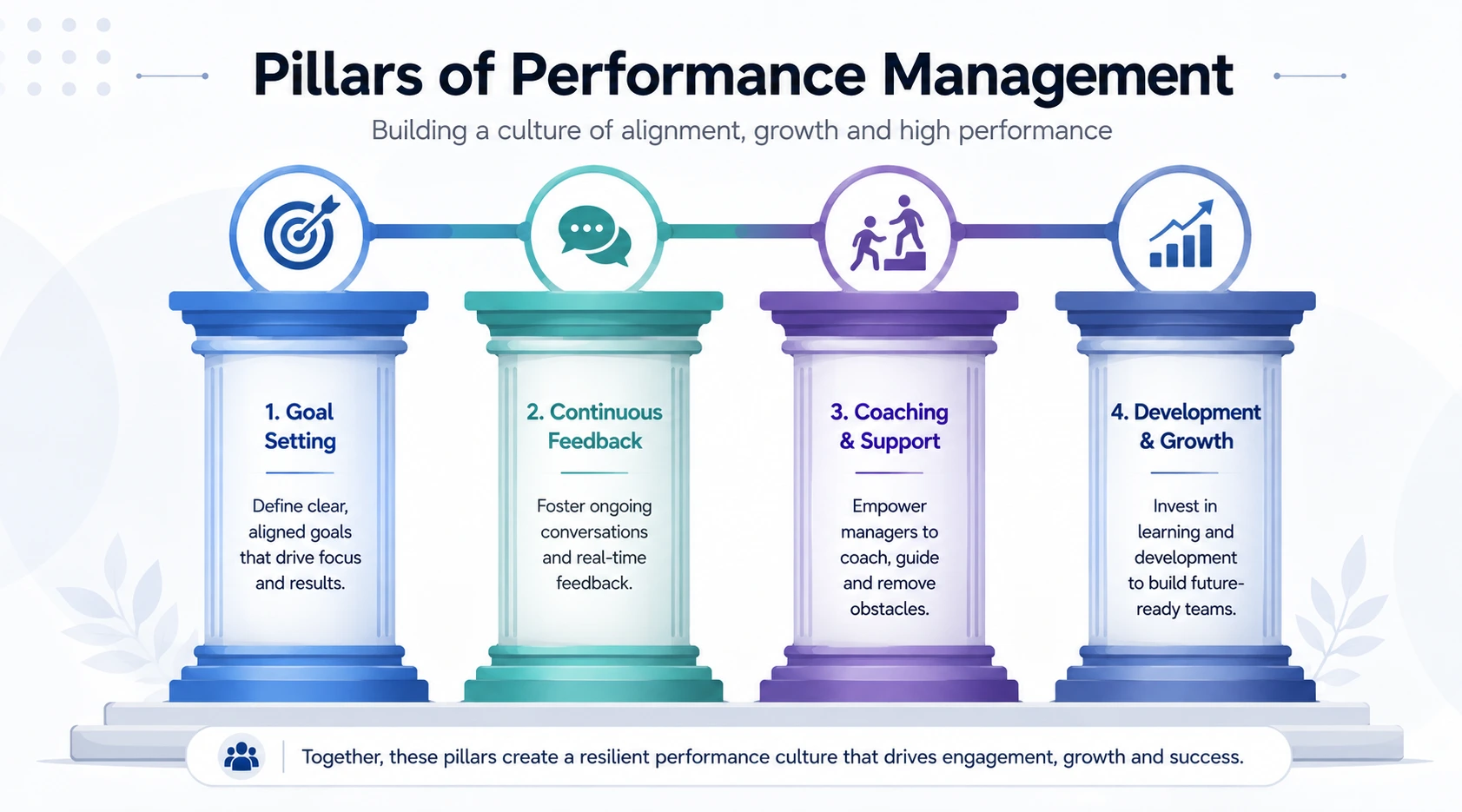
Performance management is more than annual reviews. It is a continuous system of goal-setting, feedback, coaching, and development that keeps every team member aligned with business objectives.
For a small company, misalignment is catastrophic. When a team of 10 pulls in different directions, there is no buffer – every misstep directly impacts the bottom line. Structured small team management prevents this by creating clarity, accountability, and a culture of improvement.
According to Gallup research, an overwhelming 80% of employees report being more engaged at work when they have received meaningful feedback in the past week. For small businesses, engagement is not just a feel-good metric – it directly determines whether your best people stay or leave for a competitor.
This is exactly where the debate between two goal frameworks comes in. Many founders default to KPIs because they are familiar – but output vs outcome thinking is what separates teams that hit vanity metrics from teams that hit real business results. We unpack this in the next section, along with when a small team should switch from pure KPI tracking to a full OKR system.
The Real Cost of Poor Performance Management in Small Businesses
Small business owners often skip formal HR systems, assuming they are too small to need them. This assumption is costly.
Disengaged employees cost organizations an estimated $1.90 trillion in lost productivity each year (Gallup, 2023). Even at a micro level, one disengaged employee in a team of eight can derail projects, poison culture, and drive away your top performers.
Meanwhile, 58% of companies still rely on basic spreadsheets for tracking employee performance (Select Software Reviews, 2023) – a gap between potential and adoption that leaves significant value on the table. Budget-friendly performance tools now exist specifically to close this gap for small and growing businesses.
An OKR tracking spreadsheet is usually the very first tool a founder reaches for, and it works fine at five people. The trouble starts around headcount 12-15, when nobody remembers to update it, key results go stale, and managers lose the thread on who owns what. That silent breakdown is the single biggest reason why OKR implementation fails in small teams – not the framework itself, but the tooling around it.
OKR vs KPI: Choosing the Right Performance Management for Small Business Approach
One question comes up in almost every founder conversation we have: should a small business run on KPIs, OKRs, or both? The honest answer is that OKR vs KPI for startups isn’t really an either/or debate – KPIs measure ongoing business health, while OKRs drive focused, time-bound change. A five-person team usually needs a handful of KPIs (cash runway, MRR, churn) running quietly in the background, plus 2-3 ambitious OKRs per quarter that force everyone to prioritize.
Founders and early hiring managers can see this in action in real startup founder OKR and startup hiring OKR examples – both show how a lean team turns a single quarterly priority into two or three measurable key results instead of a wish list of ten. If you’re moving off spreadsheets, our guide on moving from KPIs to OKRs walks through the transition step by step, and the benefits of OKR software for startups page breaks down the ROI case for making the switch before you hit 20 employees.
Affordable PMS Software vs. Enterprise Tools: What Small Businesses Actually Need
| Feature / Capability | Enterprise Suites (Lattice/Viva) | Worxmate SMB Platform |
|---|---|---|
| Primary Philosophy | Legacy annual reviews with bolted-on OKRs | Continuous performance management & agile OKRs |
| AI Capabilities | Basic summarization and template generation | DEEP AI framework (Orbit, Axis, Nexus) |
| Performance Management | Heavyweight cyclical reviews | Real-time check-ins & 360 feedback |
| Goal-to-Task Link | Disconnected from operational frontline tasks | Native alignment with strategic priorities |
| Ease of Use | Steep learning curve, requires dedicated HR admin | Intuitive, zero-consultant setup |
| Pricing Model | High starting base fees plus $11+/user/month | Scalable, transparent SMB tiers |
| Best For | Fortune 500 complexity | Growing small businesses & frontline teams |
Enterprise HR platforms are built for Fortune 500 complexity – and priced accordingly. Small businesses need something different: cost-effective HR software that is easy to implement, intuitive to use, and grows with the team.
Here is what to prioritize when evaluating affordable PMS software for your SMB:
- Goal-setting frameworks – OKRs (Objectives and Key Results) or KPIs that cascade from company to individual level
- Continuous feedback loops – Replace annual reviews with regular check-ins
- Simple dashboards – Visibility without complexity, so managers spend less time on admin
- Scalability – Solutions that grow from 5 to 50 to 500 employees without forcing a platform switch
- Affordability – Per-seat pricing or tiered plans built for SMB budgets
Our performance management rankings compare all the platforms specifically on price-to-feature fit for small teams. Scalable HR tools and start-up performance management platforms now offer enterprise-grade features at SMB-friendly prices, making structured performance management accessible to even the earliest-stage companies.
Two things worth checking before you commit: whether the tool offers a genuinely free performance management tools tier or trial (not just a demo call), and whether its continuous feedback software supports lightweight 360-degree feedback out of the box – retrofitting peer feedback later is far harder than switching it on from day one.
Case Study: How Adobe Transformed Performance Management – What Small Businesses Can Learn
The Problem with Annual Reviews:
In 2012, Adobe faced a growing crisis. Its traditional stack-ranking annual review system was creating internal competition instead of collaboration, and employee attrition was spiking every review season.
Donna Morris, then SVP of Customer and Employee Experience, made a bold call: abolish the annual performance review entirely.
The Solution: Continuous Check-Ins with OKRs
Adobe replaced its rigid review cycle with a system called “Check-in” – a lightweight, continuous performance management framework built around three pillars: quarterly Goals and Expectations (essentially OKRs), regular feedback, and career development discussions.
A 2016 estimate showed that Adobe saves more than 100,000 manager hours every year as a result of this system. Three-quarters of employees leaving the company state they would recommend Adobe as a great place to work – an increase over previous years.
Under the Check-in system, contributors receive highly specific performance feedback at least once every six weeks – and in practice, it happens every week.
What Small Businesses Can Apply Today
Adobe is a global enterprise, but the core principle is fully applicable to a team of five. You do not need expensive software to start – you need a consistent rhythm of goal setting and feedback. What you do need is a system that keeps it structured without becoming a burden. This is exactly where scalable HR tools and small company HR systems like Worxmate step in.
Unlock Goal Clarity & Accelerate Employee Growth
Looking to drive goal clarity and employee growth? Discover how Worxmate’s AI-powered Performance Management Software can help.
Key Statistics That Make the Case for Small Business Performance Tools
Here is a snapshot of what the research says about the impact of structured performance management:
- Companies with highly engaged employees experience 21% greater profitability (Gallup).
- Organizations with a strong culture of feedback improve employee engagement by 14.9%, leading to a 59% decrease in employee turnover (Gallup).
- Companies effectively utilizing data analytics in performance processes are 1.5 times more likely to outperform competitors (McKinsey & Company, 2023).
- According to Deloitte, 70% of organizations have moved towards continuous performance management as opposed to traditional annual reviews.
These are not outcomes reserved for large organizations. With the right cost-effective HR software, small businesses can achieve the same results.
Performance Management for Small Business: Mistakes That Quietly Kill Momentum
Before you build your framework, it helps to know where small teams typically go wrong. These patterns show up again and again in early-stage companies:
- Setting too many objectives at once, instead of a handful of actionable goals the team can realistically hit in a quarter
- Confusing output vs outcome – celebrating “shipped 12 features” instead of “cut onboarding time by 30%”
- Treating every objective as a stretch goal, which quietly trains the team to expect failure
- Skipping the one-on-one meetings cadence the moment things get busy – exactly when feedback matters most
- Running only weekly goals with no quarterly or annual thread connecting them to strategy
- Sticking with a Viva Goals-style tool for too long – with the retirement of Microsoft’s platform (see our Microsoft Viva Goals retirement guide), many small teams are migrating this year, and it’s worth choosing the replacement carefully
Most of these mistakes trace back to one root cause: goal-setting frameworks that aren’t fundamentally how OKRs differ from traditional goal-setting methods get bolted onto old annual-review habits instead of replacing them. Fixing the habit matters more than buying software – the software just makes the new habit easier to sustain.
How to Build a Scalable Performance Management System on a Small Business Budget
You do not need a massive HR department or enterprise software to run an effective performance management process. Here is a practical framework for SMBs:
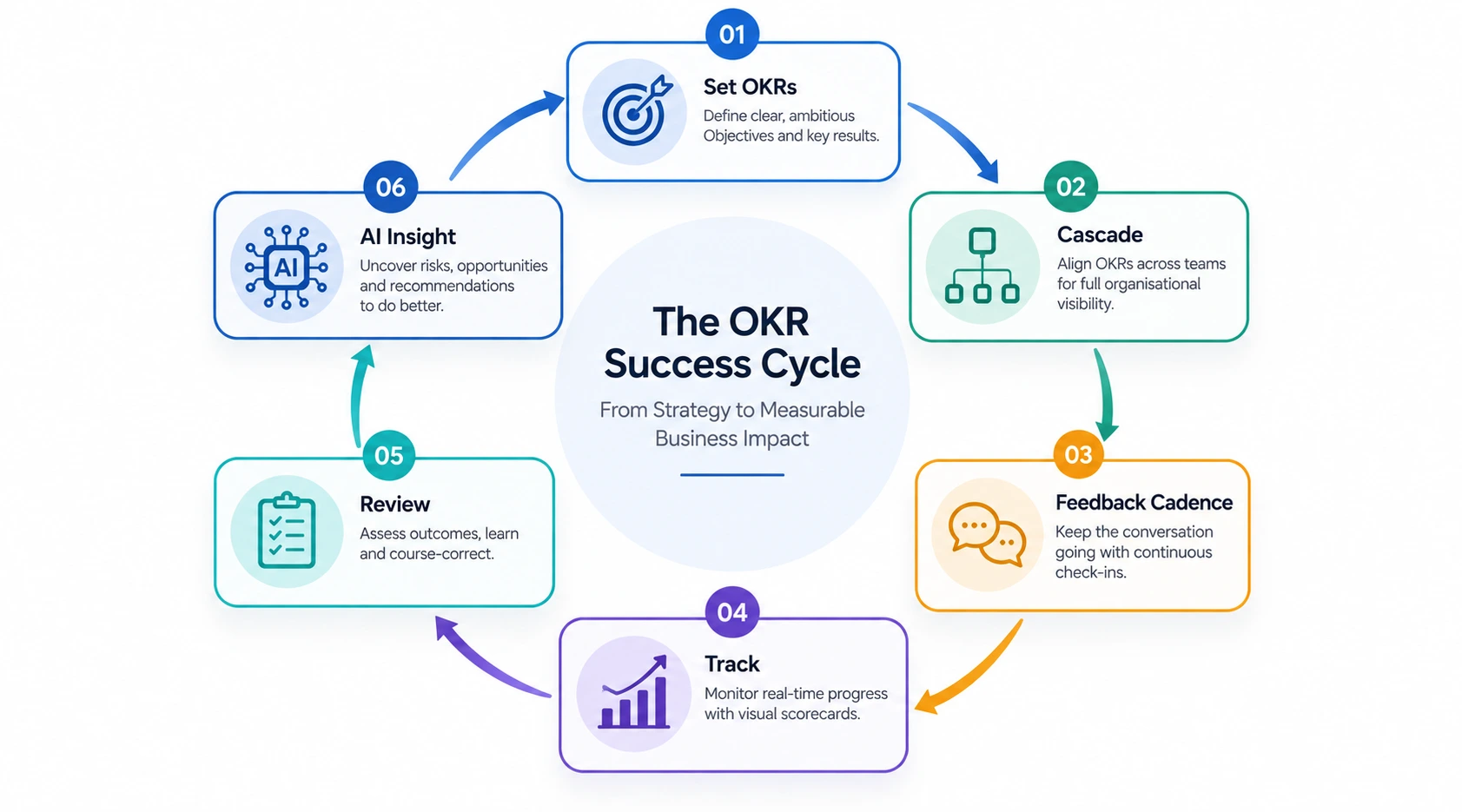
- Step 1: Set Company-Level OKRs
Define 2-3 ambitious company objectives each quarter. Make them visible to everyone on the team. - Step 2: Cascade Goals to Individuals
Each team member should have personal OKRs or KPIs that connect to the company-level objectives. Alignment is everything in a small team. - Step 3: Establish a Feedback Cadence
Move away from annual reviews. Monthly or bi-weekly one-on-ones with structured feedback are far more effective and actionable. - Step 4: Track Progress with a Lightweight Tool
Spreadsheets do not scale. Budget-friendly performance tools like Worxmate offer purpose-built dashboards for goal-tracking, feedback, and reporting — at a price point designed for SMBs. - Step 5: Review and Iterate Quarterly
Use end-of-quarter check-ins to celebrate wins, address gaps, and set the next cycle’s objectives. - Step 6: Let AI Catch What Humans Miss – This is the step most small businesses skip, mainly because it didn’t exist as an affordable option until recently. Orbit AI flags flight-risk and burnout signals 4–8 weeks before your next review; Axis AI reads your OKR data and tells you the single fastest lever to pull when a target is slipping; and Nexus AI catches strategy-cascade breaks before a company objective quietly stops reaching individual OKRs. Together they sit on top of the goal setting strategies you already use – they don’t replace step 1 through 5; they make the humans running those steps faster.
Meet DEEP AI: The Framework Behind Worxmate’s Intelligence Models
Every AI feature mentioned above runs on Worxmate’s DEEP AI framework — four stages that mirror the natural lifecycle of a goal, each with its own purpose-built tool:
| Stage | Tool | What it does for a small team |
|---|---|---|
| Define | AI OKR writing tool | An AI co-pilot and OKR Studio write precision OKRs with built-in quality scoring — no consultant needed |
| Execute | OKR check-in software | AI-guided task coaching and structured check-ins keep OKRs on track between reviews |
| Evaluate | OKR scorecard software | AI forecasts and scorecards separate real progress from vanity metrics |
| Plan | OKR retrospective tool | AI-facilitated retrospectives turn each cycle’s data into next-cycle recommendations |
You can explore each module directly: Define, Execute, Evaluate, and Plan. For HR leads specifically weighing this against a bigger HR suite, our OKR software for CHROs page shows how the same intelligence scales once you move from 8 employees to 80.
Worxmate: Performance Management Built for Small Business Scale
Unlike traditional desk-bound HR suites that struggle outside corporate offices, Worxmate is engineered with native field force and operational frontline task tracking. Whether managing logistics drivers, retail staff, or remote IT talent, continuous feedback and strategic alignment remain unified across every location.
The Point: Small businesses cannot afford software that fails to reach non-desk workers.
The Worxmate Advantage: Purpose-built architecture ensures remote and operational teams participate seamlessly in check-ins and key results tracking.
If you are looking for an affordable, purpose-built solution, Worxmate is designed precisely for businesses like yours.
Worxmate combines OKR management with a full Performance Management System (PMS), giving small teams the clarity and structure of enterprise-grade goal-setting — without the enterprise price tag or complexity.
Here is how Worxmate helps small businesses:
- OKR Framework — Set, track, and align company, team, and individual goals in one place
- Continuous Feedback — Replace clunky annual reviews with real-time check-ins and 360° feedback
- Performance Reviews — Streamlined review cycles that take minutes, not days
- Analytics Dashboard — Data-driven insights that help managers make better decisions faster
- Scalable Pricing — Plans designed to grow with your team, from start-up to scale-up
Underneath these five pillars sit the same Orbit AI, Axis AI, and Nexus AI models covered above, plus the full OKR software and performance management software products — so you’re not buying a stripped-down “lite” edition, just a plan sized for your headcount. Compare tiers on the pricing page and see the current small-business plan yourself.
Whether you are managing a team of 5 or 50, Worxmate gives every employee clarity on what they are working toward — and every manager the tools to coach, recognize, and develop their team effectively. Tracking a real-time confidence score helps identify at-risk targets before quarter-end. Surfacing operational blockers early ensures leadership can clear obstacles quickly. Seamless cascading ensures department milestones stay synchronized with company strategy. Strong goal alignment eliminates siloed efforts and connects daily work to strategic outcomes.


Written by
An OKR Coach with 20+ years of implementation experience, Madhusudan has guided over 50 organisations through successful OKR transformations, training more than 500 leaders. Learn more about Worxmate.