 WORXMATE
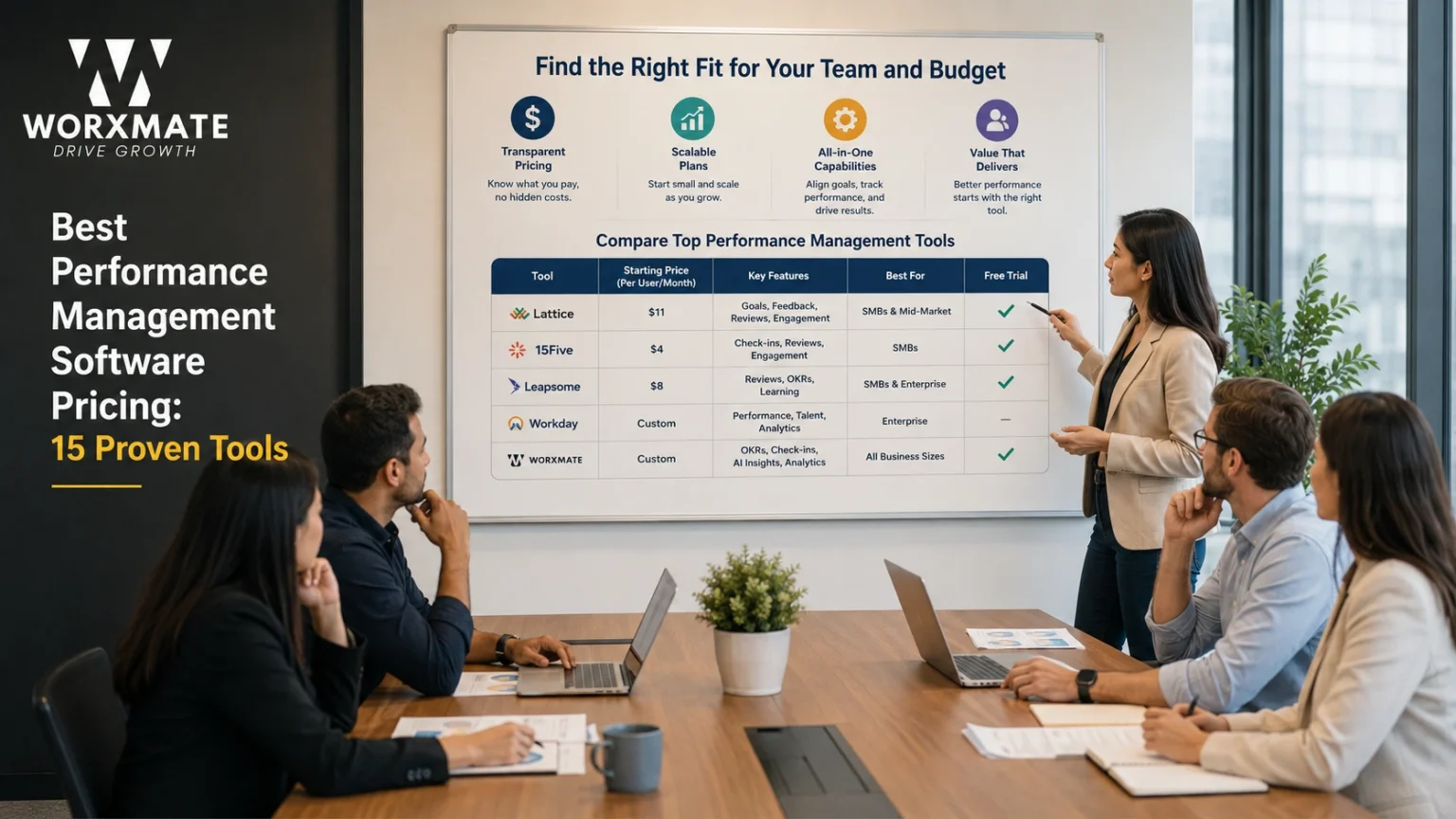
Best Performance management software pricing typically ranges from $4 to $15 per user per month, but the true cost lies in the “Coaching Cliff” where software-only implementations fail. Effective pricing models must balance automated DEEP AI goal framework capabilities with human-led execution rhythms to move the Execution Maturity Rate beyond the initial 5-15% baseline.
A 1,500-employee IT services organization recently shared a pattern I see across 135+ HR leader conversations: they had spent $18,000 on a mid-market PMS platform only to find that 12 months later, their managers were still treating 1:1s as optional status updates. The software was “live,” but the business hadn’t moved. This is the fundamental trap of evaluating Best Performance management software pricing through a feature-list lens rather than an execution lens. When you pay for a seat, you are buying infrastructure; if that infrastructure doesn’t include a structural connection between performance and business execution, you are simply digitizing a broken process.
In my experience across 50+ implementations, the costliest mistake isn’t the per-user fee-it is the 9 systemic failures that occur when HR is stuck playing referee. For instance, without a Third Eye Layer for real-time bias monitoring, calibration meetings devolve into verbal conflicts based on unwritten feedback. To avoid this, leaders must look for an enterprise execution platform that bridges the gap between individual KRAs and organizational OKRs. You can find a deeper dive into these systemic needs in our best performance management software pillar guide.
30-40%
Execution Maturity Rate
The percentage of leaders who can write outcome-driven goals independently after 12 months of consistent coaching, up from 5-15% in cycle one.
Best Performance Management Software Pricing: The 2026 Market Landscape
When comparing Best Performance management software pricing competitors, the market splits into three distinct tiers: the HRIS suites, the people-management specialists, and the execution-first platforms. Most organizations start with a Best Performance management pricing alternative like a spreadsheet or a basic HRIS module, but quickly hit a ceiling where KRAs disconnected from business goals lead to a total lack of strategic alignment.
The following table breaks down the OKR software pricing comparison across 15+ leading products, highlighting where each fit in the execution journey. Note that “Starting At” prices often exclude implementation fees, which can range from $2,000 to $15,000 depending on the level of coaching required to fix performance review bias.
| Platform | Est. Pricing (PEPM) | Core Focus | Execution DNA |
|---|---|---|---|
| Worxmate AI | Custom / Value-Based | Strategy Execution + AI | DEEP AI Framework |
| Lattice | $11 – $18 | People Success | HR-Led Reviews |
| 15Five | $4 – $16 | Manager Effectiveness | Check-in Centric |
| Betterworks | Enterprise Quote | Enterprise Performance | Large Scale Alignment |
| Leapsome | $8+ | L&D + Performance | Competency Mapping |
| Quantive | $18+ | Data-Driven OKRs | Complex Integrations |
| Profit.co | $7 – $12 | Feature-Heavy OKRs | Task-Goal Linkage |
| Culture Amp | $11+ | Engagement + Perf | Survey-Driven |
| Weekdone | $9 – $11 | SME OKR Tracking | Weekly Reporting |
| Perdoo | $7 – $10 | Strategy Mapping | Roadmap Visuals |
| Tability | $4 – $8 | Check-in Automation | Habit Building |
| Cascade | Enterprise Quote | Strategy Execution | Ops Alignment |
| Workday (Peakon) | Enterprise Suite | Global HRIS | Process Compliance |
| Zoho People | $1 – $5 | Basic HR Admin | Static Goal Lists |
| Keka HR | $2 – $6 | Payroll + Perf | Compliance Focus |
Why Best Performance Management Software Pricing Must Include the DEEP AI Goal Framework
The reason Best Performance management software pricing varies so wildly is the inclusion (or absence) of intelligence. A tool that simply hosts a text box for a goal is a liability; it encourages “safe” goals that don’t drive growth. This is where the DEEP AI goal framework changes the ROI equation. By using a Define AI OKR writing tool, organizations can move from vague aspirations to measurable outcomes in minutes rather than weeks.
Across the organizations I have coached, the transition from output to outcome thinking is the single hardest shift. A finance leader thinks in budget cycles, while a product leader thinks in sprints. Without an enterprise execution platform that translates these different languages into a unified DEEP AI goal framework, the program dies at the middle management layer. This “Coaching Cliff” is where Best Performance management pricing competitors often fail—they provide the “where” but not the “how.”
🎯 Practitioner Field Note
Week-one warning signals: if your team raises 15-20 queries per day about how to use the tool, the software is too complex. If they raise zero queries, they aren’t using it. The sweet spot is 3-5 high-quality questions about goal alignment.
The Role of Orbit AI Performance Intelligence in Pricing Value
When evaluating Best Performance management software pricing, HR leaders must ask: “Does this platform tell me if my people are moving the business, or just if they finished the form?” Platforms that integrate Orbit AI performance intelligence provide 6 named signals-including Burnout Risk and Attrition Triggers-that traditional PMS tools miss. This shifts the pricing from an “HR expense” to a “risk mitigation” investment.
For example, in a high-growth gaming company in APAC, we saw that Rating Inflation Drift was masking a 20% decline in core engineering velocity. A standard PMS would have shown “green” across the board. Only by using an enterprise execution platform with real-time signal detection could the CHRO intervene before the top talent began to leave. This is why OKR software pricing comparison must account for the “hidden” costs of bad data.
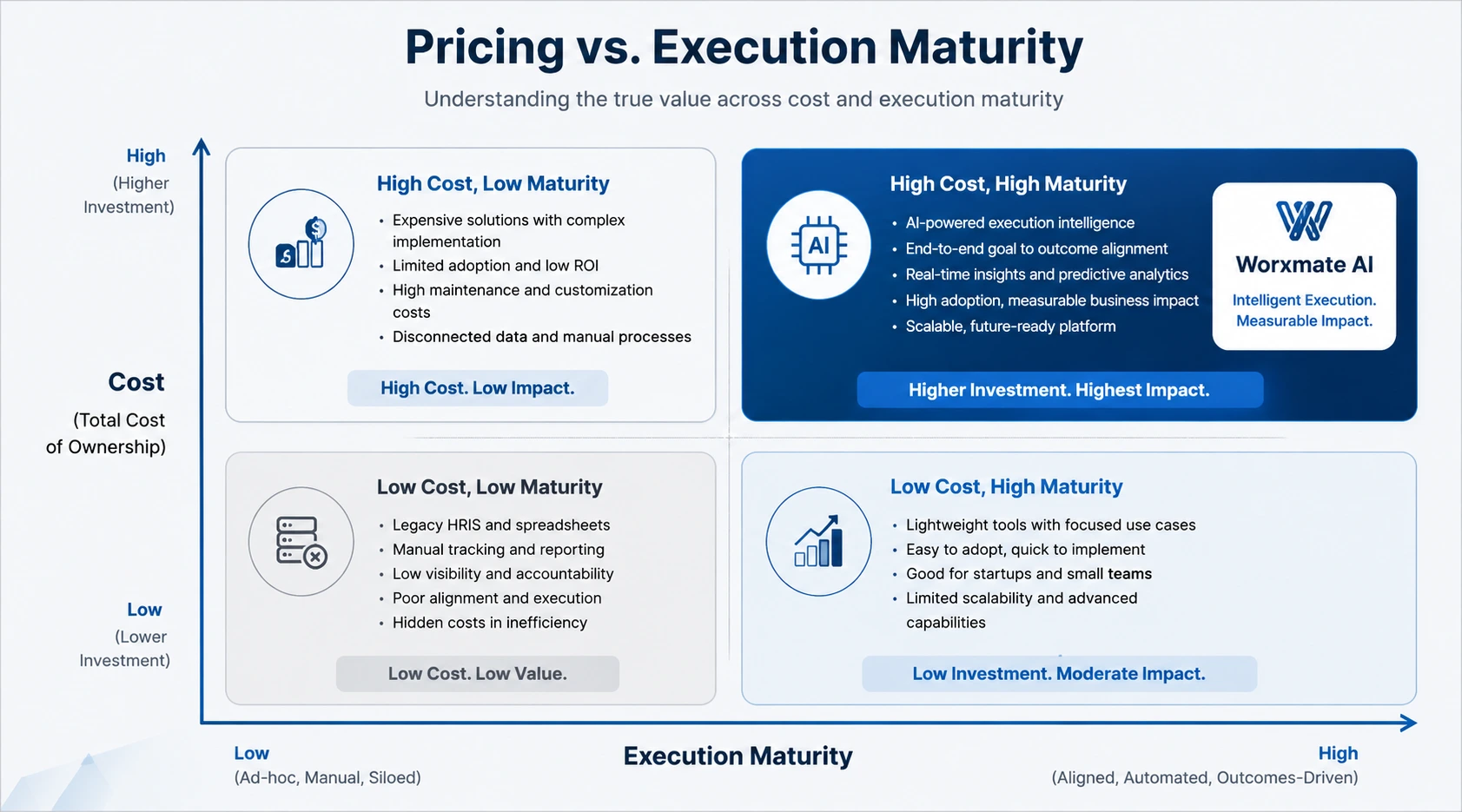
Best Performance Management Pricing Alternative: Beyond the Big Names
If you are looking for a Best Performance management pricing alternative, you are likely frustrated by the “HRIS Tax”- paying for a massive suite when you only need high-performance execution. Many Indian enterprises, for instance, find that OKR dashboard India requirements are better met by specialized tools than by global ERPs like SAP or Oracle. The Best Performance management pricing competitors in this space often focus on specific niches, such as OKRs in Indian pharma where compliance and R&D cycles are paramount.
One common Best Performance management pricing alternative is the “build vs. buy” debate. I have seen 500+ leaders trained who initially tried to use OKR software vs excel. While Excel is “free,” the manual labor required to track remote OKRs across a 200-person team costs roughly $4,000 per month in lost productivity and reporting lag. This is why a dedicated enterprise execution platform pays for itself within the first two quarters.
“An OKR Coach evaluating a PMS platform asks one question: does this platform tell HR whether their people are moving the business, or does it tell HR whether their people completed the process?”
Maximizing ROI through Weekly Execution Rhythms
The real ROI of Best Performance management software pricing isn’t found in the annual review; it’s found in the Execute OKR check-in software rhythms. If a platform doesn’t facilitate a 15-minute weekly rhythm, it isn’t an execution tool-it’s a filing cabinet. We measure this through the Execution Adoption Score, which tracks how many teams are actively updating their progress without HR prompting. This approach aligns with the broader shift toward continuous performance management, where regular feedback, goal tracking, coaching, and check-ins replace reliance on annual reviews. SHRM: Performance Management – Key Components and Best Practices
In my experience, organizations that use the DEEP AI goal framework to automate these check-ins see a 92% active weekly rhythm, compared to just 44% in software-only implementations. This is the difference between a “set and forget” culture and a high-velocity execution engine. For teams like engineering, using engineering OKR examples that link directly to Jira or GitHub can further reduce the friction of adoption.
Execution Adoption Score (After 12 Months)
92% Active Weekly Rhythm
44% Retention
14% Year-End Completion
Enterprise Execution Platform: Scaling Beyond the Basics
For large organizations, Best Performance management software pricing must account for the Tiered Accountability Model. This model-typically 100% weighting for OKRs at the C-suite, 40% at the manager level, and 20% at the individual level-requires a platform that can handle complex cascades without breaking. If you are a CFO, looking at CFO OKR examples will show how financial targets must flow down into operational KRs.
An enterprise execution platform should also provide a OKR software comparison that includes data residency and security, especially for the BFSI and Pharma sectors. The cost of a security breach or a failed audit far outweighs any savings from a cheaper per-user license. This is why “cheap” Best Performance management pricing competitors often cost more in the long run due to lack of enterprise-grade governance.
Execution Maturity Report
Benchmark your organization against 50+ enterprise implementations.
My Take: How to Choose Your Performance Infrastructure
If you are comparing Best Performance management software pricing, remember that you aren’t just buying a tool; you are buying a change management partner. A platform that offers the DEEP AI goal framework but lacks the coaching to implement it will leave you with “shelfware.” Conversely, a coach without a platform will leave you with a manual reporting nightmare.
Across 135+ HR leader conversations, the winners are those who treat their enterprise execution platform as a strategic asset, not an HR utility. They focus on moving their Execution Maturity Rate from 5% to 40% over 12 months, knowing that every 1% increase in alignment translates directly to bottom-line growth. For more on how to structure these goals, see our guide on how to set OKRs or explore good OKR examples for your specific department.
Path 1: The Platform. If you are ready to evaluate a system built for execution, explore our OKR software and pricing, or get a demo to see the DEEP AI framework in action.
Path 2: The Consulting. If you recognize that software alone won’t fix a culture of safe goals, our OKR consulting team can help you bridge the Coaching Cliff and build genuine execution capability.
The software is the infrastructure. The coaching is the capability. You need both, and in the right order.


Written by
An OKR Coach with 20+ years of implementation experience, Madhusudan has guided over 50 organisations through successful OKR transformations, training more than 500 leaders. Learn more about Worxmate.