WORXMATE
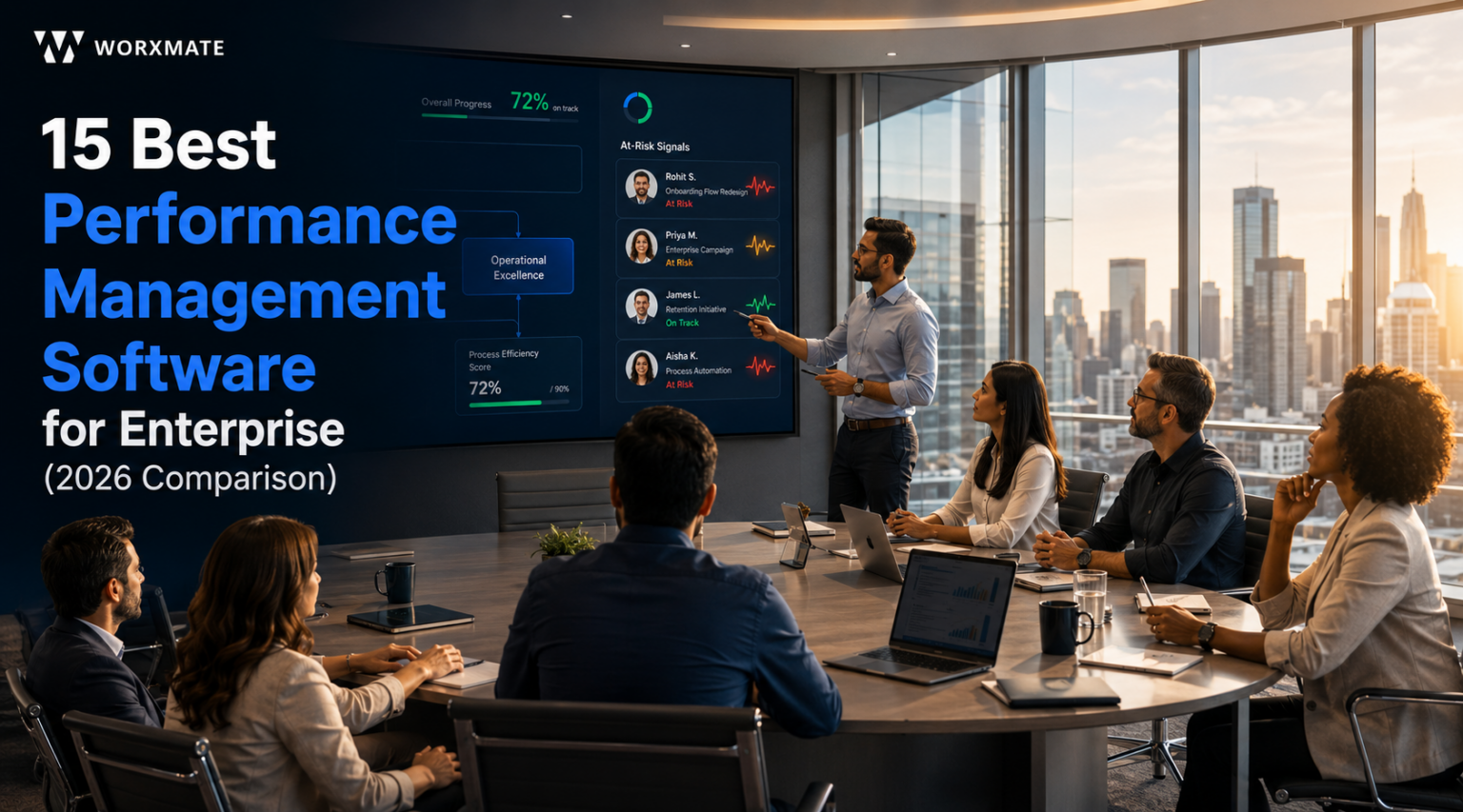
Enterprise Performance Management Software: Choosing the right top performance review tools requires balancing continuous performance management with agile strategy execution. Platforms like Worxmate deliver predictive analytics and combined OKRs for half the TCO of legacy suites.
Three quarters ago I sat inside a monthly business review with the leadership team of a 70,000-person IT services organization’s Media, Entertainment and Telecom business unit. Every MBR produced the same frustration. People in the room had no real visibility into what was blocking execution, and no way to connect the day’s work back to what the business actually needed that quarter. That is the exact moment most enterprise buyers realize their current system was never built to answer the one question that matters: is this genuinely the right performance management software for enterprise scale, or just a bigger spreadsheet with a login screen?
I have spent 20+ years in strategy execution and 10+ years implementing OKR and performance programs across 50+ organizations, including that 70,000-person account. What I have learned from sitting inside enterprise rollouts, rather than reading about them in a report, is that most performance management software for enterprise environments fails for the same handful of reasons. None of them show up on a features comparison table until the contract is already signed.
This is not a features list dressed up as a review. It is what I would tell a CHRO or CPO before they commit to a three-year enterprise agreement. This is not a features list dressed up as a review. It is what I would tell a CHRO or CPO before they commit to a three-year enterprise agreement. Most of what gets marketed as enterprise HR performance software is really an HRIS with a review form bolted on, and that distinction matters more than any feature you’ll see on a sales call.
If you are still narrowing the field across company sizes, start with our full Best Performance Management Software guide. This article picks up from there and goes deep on one question only: which platforms actually hold up once you are running performance cycles across 2,000, 20,000, or 70,000 employees.
Why Enterprise Performance Management Software Comparisons Get It Wrong
Most published comparisons claiming to name the best performance management software for large companies are written by people who have never sat through an enterprise calibration session. They rank tools on module count. Enterprises do not fail at performance management because they lack modules. They fail for three specific, repeatable reasons, and I see the same pattern across fintech, manufacturing, retail, and IT services.
Biased, unwritten verbal feedback resurfaces as calibration conflict. A manager tells a direct report something informal in a hallway conversation months before the review. Nobody wrote it down. By calibration season, that unwritten feedback becomes a dispute nobody can resolve because there is no record, only memory and politics. The tools that solve this build structured, timestamped feedback capture into the weekly rhythm, not just the annual form. Our piece on the performance calibration process walks through what a defensible calibration record actually requires.
HR ends up playing referee instead of running a strategic process. In organizations above 5,000 employees, HR business partners spend calibration season mediating manager disputes instead of analyzing where the actual performance and skills gaps sit. That is not a training problem. It is a system design problem, and it is exactly what our guide on performance management software vs HRIS breaks down: an HRIS bolts performance onto payroll and compliance workflows, while purpose-built performance management software is designed around the review cycle itself.
HR has zero pre-cycle visibility into who is actually at risk. By the time a top performer resigns or a low performer surfaces in a formal review, the signal was available for weeks, sometimes months, and nobody had a system surfacing it. This is the single biggest gap I see across enterprise implementations, and it is the reason AI-driven signal detection now separates the top tier of enterprise performance management software from everything else. Our article on enterprise performance tracking goes deeper into what real-time visibility looks like at scale.
Organization Performance Audit benchmarks 2026
Take our Organization Performance Audit to benchmark your calibration process and manager adoption against the Execution Maturity Rate and see how close you are to the 30-40% mark.
“The software is the infrastructure. The coaching is the capability. You need both, and you need them in the right order.”
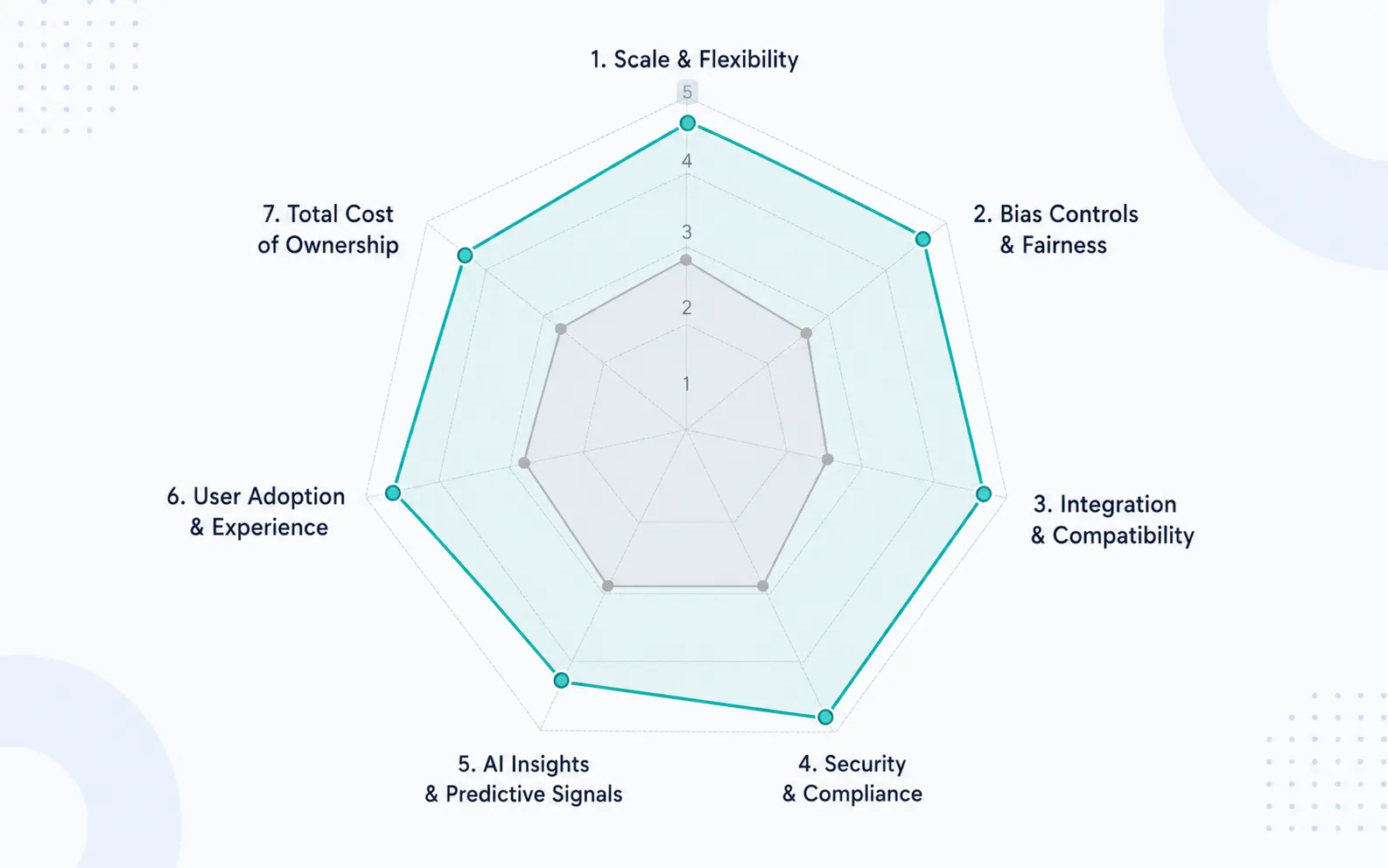
The Seven-Parameter Framework for Evaluating Enterprise Performance Management Software
Before ranking anything, buyers need a consistent bar. Here is the framework I use when advising CHROs and CPOs on enterprise performance management software procurement. Every platform below is scored against these seven parameters, not against a generic features checklist.
| Parameter | What It Actually Tests | Why It Breaks at Enterprise Scale |
|---|---|---|
| Multi-entity and hierarchy support | Can the tool model 5+ business units, matrix reporting, and regional legal entities without breaking cascade logic | Most SMB-first tools collapse once org charts stop being a simple tree |
| Calibration and bias controls | Structured, timestamped feedback capture; visible rating-inflation and bias signals before calibration day | Verbal, unwritten feedback becomes political calibration conflict |
| HRIS and payroll integration depth | Native, bi-directional sync with core HR systems, not a one-way CSV import | Enterprises run on existing HRIS; a PMS that fights it gets shadow-adopted |
| Security and compliance | SSO, SCIM, SOC 2, GDPR, data residency options | Enterprise procurement and legal will block anything short of this |
| AI-driven signal detection | Does it flag attrition risk, burnout, or execution drag before the review, not after | Enterprise procurement and legal will block anything short of this |
| Manager enablement and adoption | Structured 1:1 templates, check-in cadence, and coaching prompts built into the manager’s daily workflow | Enterprise procurement and legal will block anything short of this |
| Total cost of ownership at scale | Per-user pricing behavior above 2,000 seats, implementation timeline, and support model | A tool priced well at 200 seats can become unaffordable or unsupported at 20,000 |
The 15 Best Performance Management Software for Enterprise, Ranked
Every platform below is one I have either implemented, evaluated in a live enterprise procurement process, or reviewed against the seven-parameter framework above. This is not a top-10-okr-software list dressed up in different words. Every tool here is being evaluated specifically on enterprise performance management fitness, not general goal-tracking.
| Rank | Platform | Best For | Enterprise Fit | Standout Capability |
|---|---|---|---|---|
| 1 | Workday | Organizations already on Workday HCM | Strong | Native payroll and compensation linkage |
| 2 | SAP SuccessFactors | Global enterprises with complex compliance needs | Strong | Deep multi-entity and regulatory support |
| 3 | Oracle HCM | Oracle-ecosystem enterprises | Strong | Unified HR data model at massive scale |
| 4 | Worxmate | Enterprises wanting AI-driven prediction, not just tracking | Strong | Orbit AI, Axis AI, Nexus AI signal network |
| 5 | Betterworks | Manager-effectiveness-first enterprises | Strong | Best-in-class calibration workflow |
| 6 | Lattice | HR-led performance and engagement programs | Moderate-Strong | Strong engagement survey integration |
| 7 | Culture Amp | Culture and engagement-first enterprises | Moderate-Strong | Deep people analytics and sentiment data |
| 8 | Darwinbox | India and APAC enterprise HR suites | Strong (regional) | Localized compliance and payroll depth |
| 9 | PeopleStrong | Indian enterprise and GCC HR operations | Moderate(regional) | Strong HRMS-performance integration |
| 10 | Quantive | Strategy-heavy enterprises with dedicated ops teams | Moderate | Sophisticated strategy-to-execution mapping |
| 11 | 15Five | Enterprises with strong existing manager culture | Moderate | Lightweight weekly check-in rhythm |
| 12 | Profit.co | Enterprises with patient, well-resourced rollout teams | Moderate | Feature-complete configuration depth |
| 13 | Perdoo | Strategy-mature enterprises past the adoption curve | Moderate | Strong OKR-KPI-in-one-framework mapping |
| 14 | peopleHum | Mid-to-large enterprises wanting an all-in-one HR suite | Moderate | Broad HR workflow coverage |
| 15 | Leapsome | CHRO-led enterprises prioritizing L&D integration | Moderate | Strong learning and development linkage |
1. Workday
Workday is the strongest choice for enterprises that already run payroll, compensation, and talent management natively inside Workday HCM. The performance module inherits organizational hierarchy and compensation data automatically, which removes an entire integration workstream other tools require. Full breakdown in our Worxmate vs Workday comparison. The tradeoff: performance management is one module inside a much larger HR suite, so OKR execution and cascade depth are not the product’s primary design focus.
2. SAP SuccessFactors
SuccessFactors remains one of the deepest options for global enterprises managing complex regulatory and compliance requirements across dozens of countries. See our Worxmate vs SuccessFactors performance management comparison for a side-by-side. Configuration depth is a strength and a cost; implementation timelines commonly stretch past the fast-cycle-one standard that faster-moving enterprises now expect.
3. Oracle HCM
Oracle HCM offers a genuinely unified data model across HR functions at a scale few competitors match, which matters for enterprises running 50,000+ employees across regions. Read the full Worxmate vs Oracle HCM comparison. Like SuccessFactors, the strength of the broader HCM suite comes with a heavier configuration and change-management burden than purpose-built performance tools.
4. Worxmate
Worxmate is built differently from the rest of this list because it was built by someone who ran enterprise OKR and performance programs before building software, not the other way around. That distinction shows up directly in the product architecture through the DEEP AI framework, Define, Execute, Evaluate, Plan, which structures every performance cycle from goal-writing through retrospective, instead of leaving each stage as a disconnected module.
What actually separates Worxmate as performance management software for enterprise teams is the three-model intelligence layer. Orbit AI is Worxmate’s employee performance intelligence engine, and it detects attrition risk, burnout signals, and high-potential talent four to eight weeks before a formal review surfaces them. Axis AI reads OKR and performance data together to isolate the single fastest lever to pull when execution falls behind, instead of leaving a BU head to guess. Nexus AI maps strategy cascade failures and structural misalignment before they stall an entire quarter, which matters enormously once you are managing 15+ business units instead of three.
For the manager layer, where enterprise programs actually live or die, Worxmate’s OKR check-in software builds structured 1:1 cadence directly into the daily workflow, addressing the exact adoption failure I described earlier. Enterprise buyers evaluating enterprise performance intelligence software elsewhere will find most competitors offer reporting after the fact. Worxmate is built to change the outcome before the review happens.
Where Worxmate is not the right fit: organizations that have not yet decided whether they want OKRs and performance management run as one connected system, versus two separate programs, should read our breakdown of OKR vs PMS software before evaluating any vendor, Worxmate included. And enterprises deep into a five-year SAP or Oracle contract with no appetite to run a parallel system should weigh integration cost honestly.
5. Betterworks
Evaluating Lattice vs Worxmate for Enterprise Scale
While Lattice is a popular choice for HR-led engagement surveys, enterprise buyers frequently encounter cost inflation due to mandatory platform fees and high per-user pricing exceeding $11+/user/month. Furthermore, its OKR functionality is often bolted onto legacy review cycles rather than serving as a unified execution engine.
The Worxmate Advantage: Worxmate provides integrated continuous performance management and OKRs at half the total investment, while supporting complex operational frontline tracking in logistics, healthcare, and IT services where legacy tools fail.
Betterworks is the strongest option on this list purely for manager-effectiveness and calibration workflow at large enterprise scale. It was built for exactly the calibration-conflict problem I described above. There is no meaningful self-serve path and procurement cycles run long, which is a real cost for enterprises that need to move fast. Details in Worxmate vs Betterworks.
6. Lattice
Lattice works best when HR, not the CEO or Strategy Head, is driving the performance and OKR program. Its engagement survey integration is genuinely strong. In enterprises where the CEO or a dedicated Strategy Head wants to own execution directly, OKRs tend to get absorbed into HR’s rhythm rather than the business’s rhythm. See Worxmate vs Lattice.
7. Culture Amp
Culture Amp’s people analytics and sentiment data are best-in-class for enterprises where engagement and culture measurement sit at the center of the performance strategy. It is closer to an engagement platform with performance features than a performance-first system, which matters if execution visibility, not sentiment, is the primary gap you are solving. Comparison here: Worxmate vs Culture Amp.
8. Darwinbox
For India and APAC-headquartered enterprises, Darwinbox offers the deepest localized payroll and statutory compliance coverage on this list. It is genuinely enterprise-grade for the region it serves. Full comparison at Worxmate vs Darwinbox. Our guide on employee performance management software India covers regional buying criteria in more depth.
9. PeopleStrong
PeopleStrong is a strong fit for Indian enterprises and Global Capability Centres that need tight HRMS-performance integration inside one platform. It shares Darwinbox’s regional strength and the same category tradeoff: HR-suite breadth over performance-first depth. See Worxmate vs PeopleStrong.
10. Quantive
Quantive (formerly Gtmhub) offers the most sophisticated strategy-to-execution mapping on this list, genuinely rewarding organizations with a dedicated strategy or ops team who can run its configuration depth. It is the wrong starting point for a first-time enterprise OKR rollout. Full breakdown: Worxmate vs Quantive.
11. 15Five
15Five’s weekly check-in rhythm works well in enterprises that already have a strong manager-employee coaching culture in place. Cascade depth is limited compared to purpose-built enterprise platforms, so it tends to work best as a layer on top of an existing performance system rather than a replacement for one. See Worxmate vs 15Five.
12. Profit.co
Profit.co is feature-complete and configuration-heavy, typically requiring a four-to-six-week implementation before the first cycle runs. It rewards patient, well-resourced enterprise rollouts that can absorb that runway. Comparison here: Worxmate AI vs Profit.co.
13. Perdoo
Perdoo’s strategy map and Combined OKR-and-KPI framework are genuinely useful for strategy-mature enterprises that have already cleared the adoption hurdle. The interface reads as dated next to newer AI-native platforms. Full comparison: Worxmate vs Perdoo.
14. peopleHum
peopleHum covers a broad set of HR workflows in one suite, which suits mid-to-large enterprises that want fewer vendors rather than best-of-breed depth in any single function. See Worxmate vs peopleHum.
15. Leapsome
Leapsome’s strongest asset is L&D integration, making it a solid pick for CHRO-led enterprises building capability alongside performance tracking. It is not the fastest path to pure OKR execution discipline if that is the primary enterprise mandate. Comparison: Worxmate vs Leapsome.
What Enterprise Rollouts Actually Look Like in Practice
In the 70,000-person IT services engagement I opened with, the breakthrough was not a new tool. It was a live exercise distinguishing output-led goals from outcome-driven performance using scenarios pulled directly from their own business, a format that broke a myth the leadership team had been operating under for years. That single exercise unlocked result-oriented thinking that no dashboard had produced on its own.
Two to three quarters later, that leadership team could identify root causes needing immediate attention, give their teams clarity on priorities with real business impact, and eliminate initiatives that were consuming effort without driving outcomes. No performance management software for enterprise scale does that work by itself. It gives the leadership team the visibility to see the pattern; the coaching and the discipline still have to come from the organization. Our article on how performance management software reduces manager workload covers the mechanical side of this; the cultural side is the harder half, and it is why PMS adoption challenges at the manager layer, not the C-suite, is where most enterprise programs actually die.

Choosing the Right Enterprise Performance Management Software by Role
| If You Are | Your Primary Pain | Best-Fit Pick | Relevant Worxmate Solution Page |
|---|---|---|---|
| CHRO | OKR program launched but not adopted below leadership | Worxmate or Lattice | OKR software for CHROs |
| CEO | Execution gap between strategy and what teams deliver | Worxmate or Quantive | OKR software for CEO |
| Strategy Head / Chief of Staff | Cascade breaks, cross-functional alignment is claimed but not real | Worxmate or Quantive | OKR software for Strategy Heads |
| BU Head | Team is busy but not moving the right things | Worxmate or Betterworks | OKR software for Business Unit Heads |
| Talent Head | Retention forecasting and flight-risk detection | Worxmate (Orbit AI) | OKR software for Talent Heads |
If your organization is still deciding whether performance management and OKRs should run as one connected motion, our guide on OKR and performance management software is the right next read before any procurement conversation starts. For enterprises specifically weighing pure HRIS platforms against dedicated performance tools, performance management software vs HRIS lays out the category distinction clearly. And if your rollout spans continuous feedback loops rather than annual cycles, continuous performance management software is worth reading alongside this comparison.
The Bottom Line on Enterprise Performance Management Software
Alignment is agreement, not a configuration setting inside any platform on this list. A tool can display a cascaded OKR tree beautifully and still be showing you the record of an agreement that never actually happened. That is the filter I would apply above every other criterion in this comparison: does this performance management software for enterprise teams help your leaders build genuine agreement on what matters, or does it just make disagreement look organized?
The Platform Path: If you are ready to evaluate performance management software for enterprise scale directly, start with Worxmate’s performance management software and see the DEEP AI framework and three-model intelligence layer in a live environment. Review pricing for Enterprise-tier plans or book a demo. This directly accelerates measurable key results across the entire organization. Regular check-ins maintain momentum and keep strategic priorities front of mind. Tracking a real-time confidence score helps identify at-risk targets before quarter-end. Surfacing operational blockers early ensures leadership can clear obstacles quickly. Seamless cascading ensures department milestones stay synchronized with company strategy. Strong goal alignment eliminates siloed efforts and connects daily work to strategic outcomes.
The Consulting Path: If your organization recognizes that the platform is not the first problem, that the gap is coaching capability at the manager layer, our OKR consulting team runs practitioner-led implementation engagements across India, the UK and Europe, and the Middle East, built from the same field experience behind this comparison.
The software is the infrastructure. The coaching is the capability. Enterprises that buy only the first one usually find that out the hard way, three quarters in.


Written by
An OKR Coach with 20+ years of implementation experience, Madhusudan has guided over 50 organisations through successful OKR transformations, training more than 500 leaders. Learn more about Worxmate.