 WORXMATE

Quick Answer
The most affordable OKR software for startups in 2026 is Worxmate, which offers a free-forever plan for up to 10 users and paid plans from $7/user/month, built on the DEEP AI framework so a first-time founder can write a working OKR without prior training. Other budget picks worth testing are Weekdone (free for 3 users), ClickUp (unlimited free seats with basic OKR features) and Perdoo (free for up to 3 users). The full breakdown below compares all nine tools by free tier, per-user pricing and AI depth so you can pick based on your stage, not just the price tag.
Let’s be real—startup budgets are tight.
You need OKRs to stay focused and aligned. But you also need to watch every dollar. The good news? In 2026, there are more affordable options than ever, including powerful free tiers that actually work, many with AI-powered insights.
This guide covers the best OKR software for startups, with transparent pricing, free tiers, and honest advice on what you actually need at each stage.
Summary
If you’re a bootstrapped founder or an early-stage startup leader, finding affordable OKR software that doesn’t sacrifice quality is critical.
This guide walks through how nine 2026 OKR platforms actually compare once you get past the marketing page free tiers, per-user pricing, and where each one starts to break down as you scale.
Here’s what you’ll discover:
-
Which tools offer the most generous free tiers including one that gives 10 users free forever
-
How can help your team write better goals without prior OKR expertise
-
What to look for at each startup stage from pre-seed to Series A
- The buying mistakes that cost startups the most money after signing the contract, not before
-
Hidden costs to avoid like annual commitments and implementation fees that eat into your budget
Whether you’re testing OKRs for the first time or scaling beyond 25 employees, this guide helps you choose the right affordable OKR software without wasting money on features you don’t need.
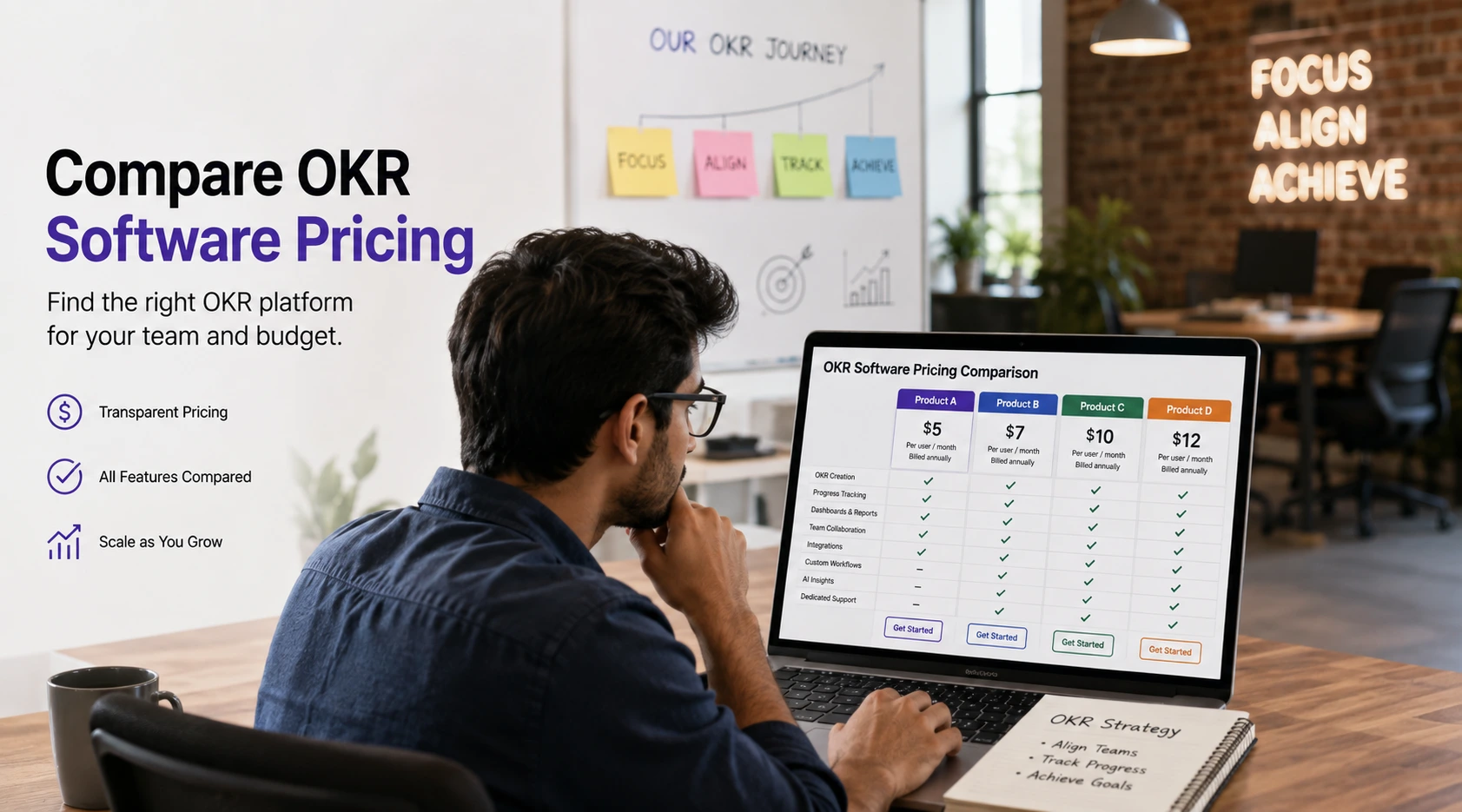
What Startups Should Look for in OKR Software
Before diving into the list, here’s what matters when you’re bootstrapped or early-stage:
| Priority | Why It Matters for Startups |
| Free tier availability | Test before you commit—save budget for what matters |
| Per-user pricing | Scales with you; no huge upfront costs |
| Ease of use | No time for training—needs to “just work” |
| AI assistance | Helps new OKR users write better goals faster |
| No annual contracts | Quarterly / Bi-annual options preserve flexibility |
Of these five, ease of use is the one that actually determines whether OKRs survive past quarter one. Across the startups we’ve watched adopt OKRs, the platforms that fail aren’t the ones missing a feature they’re the ones where the founder has to become the OKR administrator. If you want the full breakdown of how to weigh these five criteria against your specific stage, our complete guide to OKR software for startups walks through the full evaluation framework.
8 Best Affordable OKR Software Options for Startups in 2026
1. Worxmate: Best Overall for Startups
Why it’s #1 for startups: Worxmate offers the most generous free tier in the market 10 users completely free. No credit card required. No time limit.
For bootstrapped startups, this is huge. You can run your entire early team on the free plan and only pay when you grow beyond 10 people.
Startup-Specific Features:
- DEEP-AI helps new OKR users write better goals (no OKR expertise needed)
- Free for 10 users forever
- $7/user/month when you grow—predictable, affordable scaling
- No annual commitment—Quarterly / Bi-annual billing available
What actually makes this hold up past 10 users is the DEEP AI framework underneath it Define, Execute, Evaluate, Plan. Axis AI flags at-risk key results before your weekly check-in instead of after, and Nexus AI keeps cross-team dependencies visible once you’re past a single founding team the point where most spreadsheet-to-software migrations start to matter.
Pricing:
- Free: Up to 10 users
- Team: $7/user/month
- Enterprise: Custom
Best For: Early-stage startups, bootstrapped teams, Startups planning to scale, Enterprise organizations
2. Weekdone: Best for Simplicity
Why it’s great for startups: Weekdone keeps things simple. If you just need basic OKR tracking without bells and whistles, this is your tool.
The free tier covers 3 users—perfect for a founding team testing OKRs for the first time.
Pricing:
- Free: Up to 3 users
- Paid: $90/month for 4-10 users ($9-22.50 per user)
Best For: Tiny founding teams, non-profits, very simple needs
3. ClickUp: Best for All-in-One Productivity
Many startups already use ClickUp for project management. Adding OKRs keeps everything in one place no extra cost, no new tool to learn. However, it is not mature product to practice OKRs.
Pricing:
- Free: Unlimited users (with limits on storage and advanced features)
- Paid: From $7/user/month
Best For: Startups already using ClickUp, teams wanting one tool for everything
4. Profit.co: Best for Structured OKR Methodology
Why it’s good for startups: Profit.co takes OKRs seriously. If you want to learn “proper” OKR methodology, their free tier (5 users) and guided creation are excellent training wheels. However, as per the user’s feedback, it is overwhelming and may feel complicated.
Pricing:
- Free: Up to 5 users
- Growth: $9/user/month
- Enterprise: Custom
Best For: Startups committed to learning OKR methodology correctly
5. Asana: Best for Visual Teams
Asana’s visual interface is intuitive for creative and product teams. The free plan includes basic OKR functionality alongside task management. It is basically meant for Project / Task Management
Pricing:
- Free: Unlimited users (basic features)
- Paid: From $10.99/user/month
Best For: Creative startups, design teams, product-led companies
6. Mooncamp: Best for Custom Workflows
Why it’s great for startups: Mooncamp offers modern design and customization at a reasonable price. The $6/user entry point is competitive, though no free tier means you’ll need budget from day one.
Pricing:
- Free: No
- Paid: $6-$10/user/month (annual billing)
Best For: Startups with specific workflows, design-conscious teams
7. Perdoo: Best Free Tier for Very Small Teams
Perdoo is one of the few tools on this list that still offers a genuinely usable free plan for micro-teams. It pairs OKRs with a lightweight strategy map, which helps a 3-person founding team see how a key result connects back to the company mission without a separate slide deck.
Pricing:
- Free: Up to 3 users
- Premium: From $8/user/month
- Enterprise: Custom
Best For: Pre-seed teams that want strategy mapping alongside OKRs, before they’re ready to pay for anything
8. Tability: Best for AI Check-in Automation
Tability leans hard into automated check-ins its AI drafts weekly update summaries from your key result data, so managers aren’t writing status reports by hand. For a remote-first startup running check-ins async across time zones, that’s a real time saver, though the free tier is narrow.
Pricing:
- Free: Up to 5 users, limited history
- Basic: From $6/user/month
- Enterprise: Custom
Best For: Remote and async startup teams that live in weekly check-ins more than quarterly planning.
Achieve Your Goals Faster
See how Worxmate can help your team set clear goals and achieve faster results. Book your free demo today and experience the power of AI-driven OKRs in action.
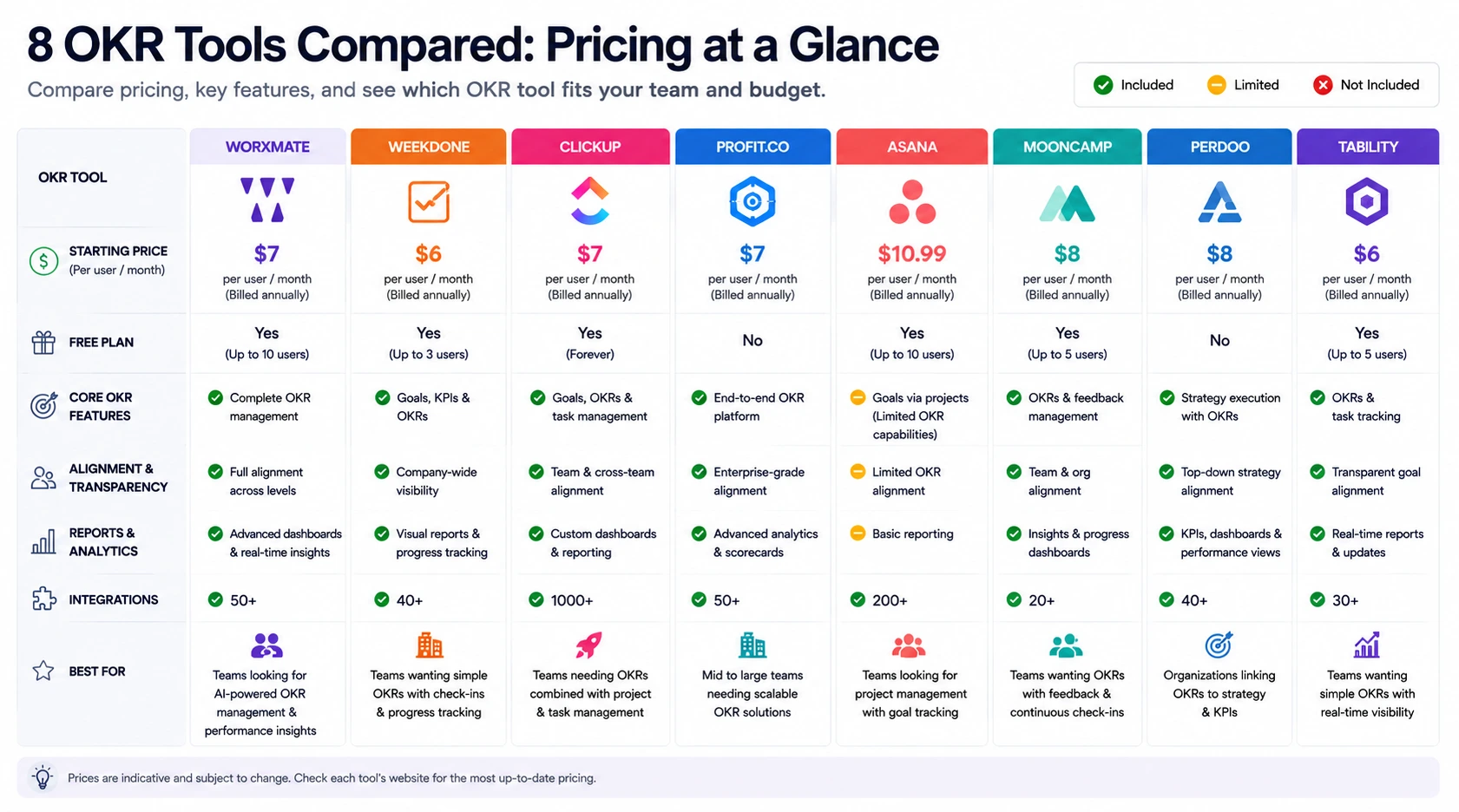
Quick Comparison Table
| Platform | Free Tier | Paid From | Best For |
| Worxmate | ✅ 10 users | $7/user | Overall value, AI assistance |
| Weekdone | ✅ 3 users | $90/month (4-10 users) | Simplicity |
| ClickUp | ✅ Unlimited (basic) | $7/user | Project Management tool, All-in-one productivity |
| Profit.co | ✅ 5 users | $9/user | Learning OKR methodology |
| Asana | ✅ Unlimited (basic) | $10.99/user | Project Management tool, Visual teams |
| Mooncamp | ❌ | $6/user | Custom workflows |
| Perdoo | ✅ 3 users | $8/user | Strategy mapping for micro-teams |
| Mooncamp | ✅ 5 users | $6/user | AI-automated async check-ins |
How to Choose Based on Your Startup Stage
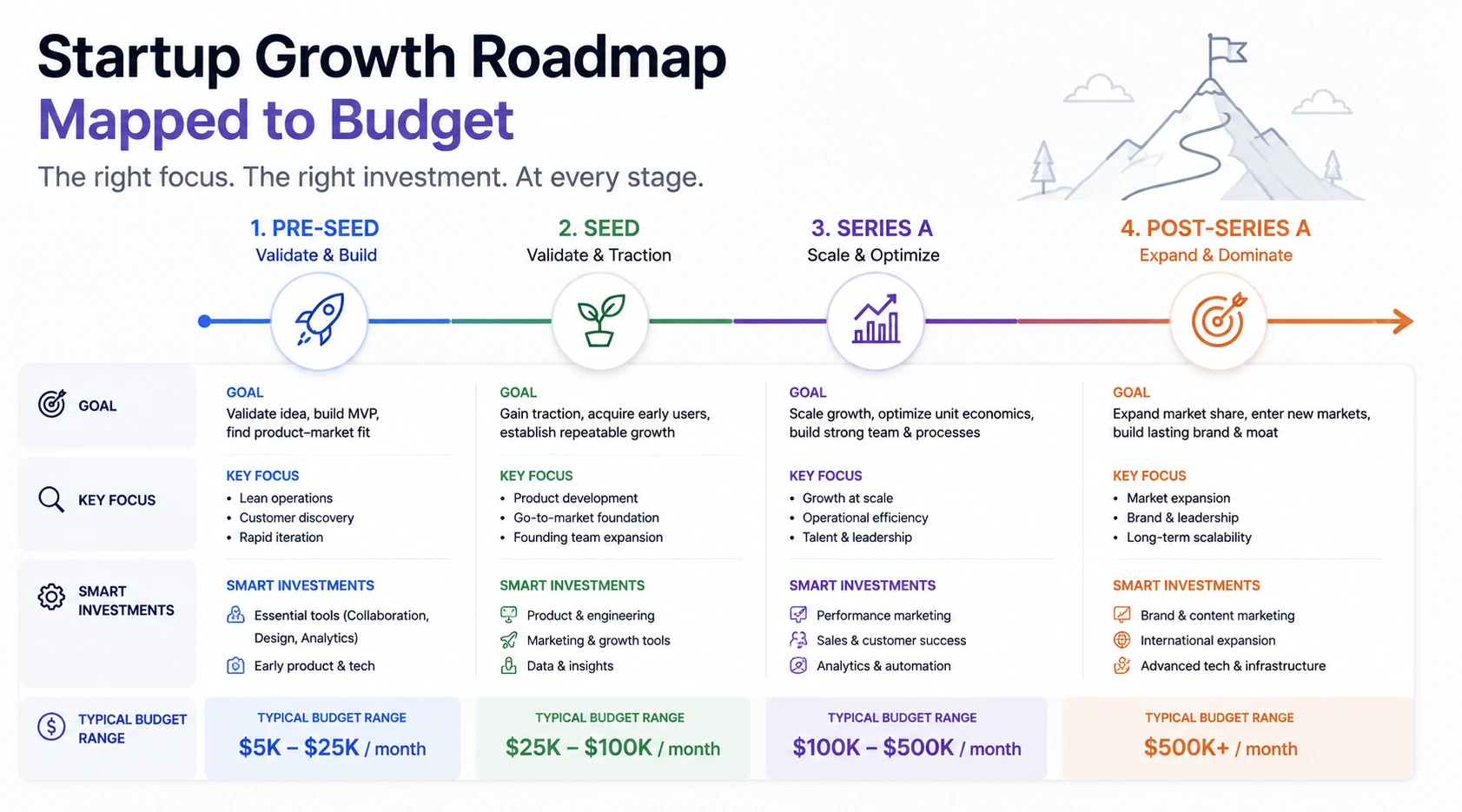
Your startup stage determines your needs. Here’s a simple OKR implementation timeline for growing companies.
Stage 1: Idea / pre-Seed (5 – 10 people)
Budget: $0
Best Choice: Worxmate (free 10 users) or Weekdone (free 3 users)
Why: Test OKRs without spending a dollar. Worxmate’s AI helps you learn.
Stage 2: Seed / Early Traction (10-25 people)
Budget: $50-150/month
Best Choice: Worxmate ($7/user) or ClickUp (if already using it)
Why: Worxmate scales with you—same tool from 1 to 100+ employees.
Stage 3: Series A / Scaling (25-100+ people)
Budget: $200-500/month
Best Choice: Worxmate or Profit.co
Why: You need more structure. Profit.co for methodology focus; Worxmate for AI and Performance Management integration.
Stage 4: Post-Series A / Multi-Department (100+ people)
Budget: $500–2,000+/month
Best Choice: Worxmate, moving from the OKR module into full performance management
Why: At this stage, the risk isn’t picking the wrong OKR tool it’s running OKRs and performance reviews as two disconnected systems. This is usually where teams start comparing performance management software vs. HRIS to figure out which system should own goals versus which should own records.
If you’re still running goals in a spreadsheet at any of these stages, it’s worth reading how the switch from spreadsheet OKRs to software typically goes—and where founders most commonly delay it too long, which is its own item on the mistakes list below.
5 OKR Software Buying Mistakes Startups Make
Price comparisons get all the attention, but price isn’t usually what sinks OKRs at a startup. The pattern we see more often is a founder picks a tool, rolls it out in a Monday all-hands, and by week six nobody’s opened it. Here’s where that goes wrong before the pricing page ever matters.
1. Choosing the tool before the team knows what a good OKR looks like
Buying software doesn’t teach anyone how to write a measurable key result. If your team has never set OKRs before, the free tier of a tool with AI-assisted goal writing like Worxmate’s Define module will save you more time in month one than any feature comparison spreadsheet.
2. Picking the platform with the most features
A 10-person startup does not need 400 KPI templates. Every feature you don’t use is still a menu item someone has to ignore, and that’s where adoption quietly dies. Match the tool’s complexity to your team’s current OKR maturity, not to where you hope to be in three years.
3. Signing an annual contract to save 15%
Startups change shape fast. A platform that fit at 8 people can feel wrong at 30. Quarterly or bi-annual billing costs a little more per month but keeps you free to switch before a bad fit compounds into a year of low adoption.
4. Treating check-ins as optional
The software doesn’t run check-ins your team does. A tool with strong check-in prompts and Slack/Teams reminders closes this gap; a tool without them puts the entire habit on a founder who is already stretched. This is the single biggest predictor of whether OKRs survive past one quarter.
5. No plan for what happens after 10–25 users
Most startups pick a free tool for a 5-person team and never ask what happens at 30. Migrating OKR history, cascades, and check-in habits to a new platform mid-growth is expensive in time, not just money. Pick something with a credible path past your current headcount, even if you won’t need it for a year.
If any of these sound familiar, our step-by-step guide to evaluating a performance management system walks through a structured way to vet a platform before you commit budget to it.
Hidden Costs to Watch For
According to EY’s research on agile organizations, CFOs who successfully integrate OKRs with financial planning create ‘more clarity, faster reactions, and stronger results orientation.’ Without this alignment, hidden costs emerge in reporting overhead and misaligned priorities.
Platform switching – Moving from a simple tool to an enterprise platform later can be costly. Understand the difference between HRIS vs PMS/OKR if you’re planning long-term.
| Cost | What to Check |
| Annual commitments | Some platforms require annual billing (Profit.co, Lattice, Mooncamp). Quarterly / Bi-annual preserves flexibility. |
| Per-feature add-ons | Does the base price include everything? Some charge extra for reviews, surveys, or integrations. |
| Implementation fees | Enterprise plans often have hidden setup costs. Startups should avoid these. |
| Overbuying | Do you really need all features? Start with basics, add later. |
| Support & onbonboarding gaps | Free and low-tier plans often mean email-only support with multi-day response times. Check this before you’re mid-quarter with a broken cascade and no one to ask. |
This last one is the cost founders miss most. A performance review tool pricing comparison usually looks identical to an OKR pricing comparison on the surface—until you check what tier support actually starts at.
Ready to start with OKRs without breaking the bank? Start your free Worxmate trial – 10 users free forever, no credit card required.


Written by
An OKR Coach with 20+ years of implementation experience, Madhusudan has guided over 50 organisations through successful OKR transformations, training more than 500 leaders. Learn more about Worxmate.