 WORXMATE
Strategy Execution Gap: The critical disconnect where executive leadership’s strategic priorities fail to translate into frontline team execution. Bridging this structural divide requires robust strategic execution platform capabilities, aligning key results, weekly check-ins, and continuous performance management to ensure organizational alignment.
There’s a specific moment I look for in the first week of any new engagement, and it’s rarely in the leadership meeting. It’s three floors down, watching a manager run a check-in with their own team for the first time. The leadership team upstairs wrote strong OKRs. They understood the framework. They left the room confident the program was launched. That manager, three layers down, was never in that room and now they’re expected to run an honest conversation about blockers, coach outcome-thinking into their team, and catch a goal quietly going off track, with none of the training that made the people above them capable of doing the same thing.
Nobody in that building lacks motivation. Nobody lacks a plan there’s a strategy, and it’s been communicated downward more than once. What’s missing is something harder to name: the manager running that check-in genuinely doesn’t know the difference between a goal that’s producing real business movement and a goal that just looks fine on a status update. That’s the strategy execution gap in its most common form — not a motivation problem, not a communication problem, a thinking problem, sitting quietly underneath a strategy that everyone in the building believes they already understand.
What the Strategy Execution Gap Actually Is
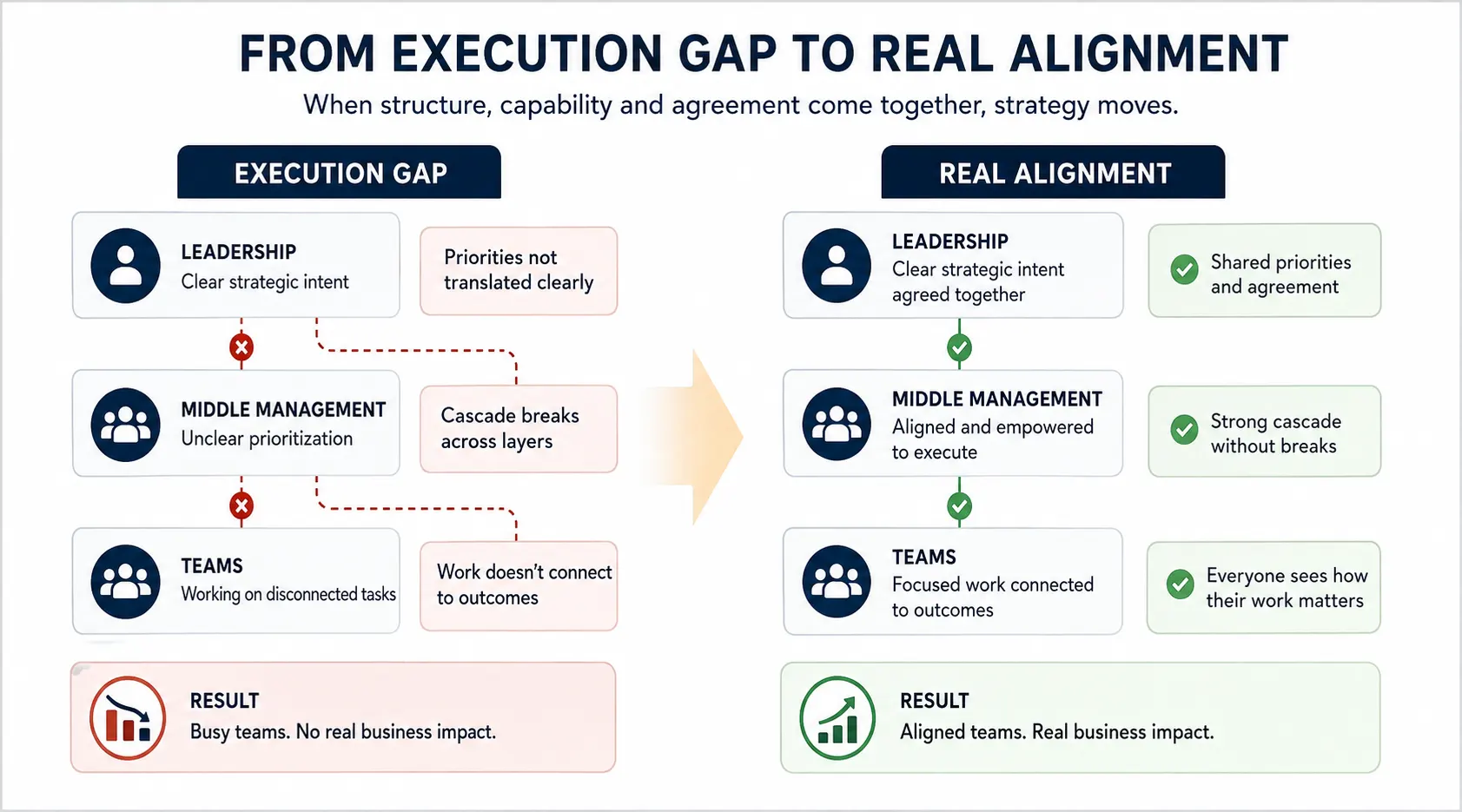
Every strategy document eventually meets the same test: does the work happening in the building this week trace back to it, or has the plan quietly become background noise while teams do whatever feels urgent? The strategy execution gap is the distance between those two things the point where strategic intent stops converting into team-level action. Most conversations about strategy-to-execution alignment stop at the org chart or the goal-setting template. The real distance lives somewhere neither of those things can see.
It’s worth being precise about what this isn’t, because most content on this topic blurs the lines:
- It’s not weak communication. Leaders can explain a strategy clearly in a town hall and still lose the thread completely by the time it reaches a team lead three layers down. Clarity at the top doesn’t survive the cascade on its own – see why OKRs fail for the fuller pattern here.
- It’s not bad KPIs. A team can hit every number on its dashboard and still not have moved the business, if those numbers were never actually connected to a real business outcome. Worth reading the distinction between output vs outcome thinking here this is a different failure than a missing metric.
- It’s not low engagement. Some of the least-engaged programs I’ve coached had leaders working harder than ever just on the wrong things, because nobody had translated the strategy into anything specific enough to work against. This is a common thread across common OKR mistakes I see in first-cycle programs.
The gap is structural. It lives in the handoff between levels of the organization, not in any single person’s effort or intent which is also why okr implementation hurdles tend to repeat across otherwise very different organizations. Most leadership teams frame this as a strategy vs execution problem, as if the two are naturally in tension. They’re not. A strategy that can’t survive contact with a middle manager’s calendar was never really finished.
The Three Real Causes – Not the Textbook Version
Most content on this topic repeats the same generic causes: poor communication, lack of buy-in, insufficient tracking. Ask most consultants why strategy fails at execution and you’ll get one of those three answers, because they’re the ones that fit neatly into a workshop slide. After 50+ implementations, I’d argue the real causes are almost always one of these three instead, and none of them show up on a typical consulting deck.
| Cause | What it actually looks like | Fastest thing to check |
|---|---|---|
| Org structure doesn’t match strategy | Goals cascade cleanly on paper, stall the moment they cross a reporting line that no longer reflects real strategic priorities. | Has the org chart changed as fast as the strategy has? |
| Bottom-up arrives before capability | Team-written goals feel empowering but don’t connect to business priorities or key results. | Do team OKRs trace back to a named leadership priority, or were they invented locally? |
| Coaching stops at the C-suite | Leadership writes strong OKRs; managers three layers down lack continuous performance feedback. | Has anyone below the leadership layer had 1:1 coaching, or only a workshop? |
Cause 1 :- The org structure doesn’t match the strategy. If the organizational structure doesn’t reflect the leadership team’s current growth priorities, you’re cascading goals into an architecture built for a different business than the one you’re running today. Most OKR coaches never raise this, because it sits outside the goal-setting conversation entirely. It comes from strategy execution experience, not from a framework. Cascading goals through a misaligned structure doesn’t reveal the misalignment it embeds it, quietly, into every quarter that follows. This is why goal cascading on its own is never the fix people assume it is a clean-looking cascade through a broken structure produces the appearance of strategic alignment without any of the substance. This is exactly the failure mode Nexus AI is built to surface it maps structural misalignment and cascade breakdowns before they’ve quietly cost an organization an entire cycle, rather than after.
Cause 2 :- Bottom-up goal-setting arrives before the capability does. Every OKR book recommends bottom-up goal-setting as empowerment, and the principle is sound. The timing is usually wrong. In the first two quarters of a new program, bottom-up produces noise, not alignment teams that haven’t yet developed outcome-oriented thinking will write goals that feel empowering and measure things that don’t connect to the organization’s real priorities. Empowerment without capability isn’t empowerment. It’s misalignment dressed up as autonomy. Real outcome-driven goal setting only works bottom-up once teams have already been coached into the thinking that makes it possible not before. This is one of the clearest signs covered in the role of leadership in OKR failures.
Cause 3 :- The coaching stops at the top, and nobody below the C-suite was ever equipped to close it. This is the failure mode from the manager’s side of the desk, not the executive’s. A leadership team gets coached, writes strong OKRs, and walks out of the room confident the program is launched. Three layers down, a team lead who was never in that room is now expected to run honest check-ins, surface real blockers, and develop outcome-thinking in their own team with none of the coaching that made the leadership team capable of doing the same thing. The gap doesn’t open at the top. It opens exactly where the coaching stopped. It’s also, not coincidentally, where retention risk tends to concentrate first Orbit AI exists because a manager left without coaching support and a team quietly disengaging are usually the same signal, showing up in two different reports before anyone connects them. For more on why the workshop-only model doesn’t reach this layer, see why OKR coaching fails.
Alignment is agreement between teams on what matters, why it matters, and how each team’s work connects to the work around them. You cannot create that with a strategy document. You can only create it through a conversation that actually happens.
It’s worth noting that these three causes rarely show up in isolation. In the IT services engagement above, the structural cause and the coaching cause were both present the business unit’s structure hadn’t been revisited in years, and the leaders in that room had never been coached on distinguishing output from outcome. Fixing one without the other produces partial results: a leadership team that suddenly understands outcome-thinking but is still cascading it through a structure built for a different set of priorities will still watch goals stall somewhere in the middle layers. This is why a genuine diagnosis has to look at all three causes together, not treat the first one found as the whole answer and why cross-functional team alignment so often breaks even in organizations that look well-aligned on an org chart.
Achieve Your Goals Faster
See how Worxmate can help your team set clear goals and achieve faster results. Book your free demo today and experience the power of AI-driven OKRs in action.
Not Every Gap Looks the Same
The word “gap” suggests a single, uniform problem, but the severity and shape of it varies a lot depending on where an organization is. A few patterns worth recognizing in your own context:
The founder-led gap. Common in fast-growing companies under roughly 150 people. The founder or CEO holds the strategy almost entirely in their own head, and the gap opens the moment the company grows past the point where that knowledge can transfer through casual hallway conversations. This is close to what happened in a retail expansion I coached recently, where the CEO genuinely couldn’t compress his own vision into three priorities an organization could cascade from not because the strategy wasn’t there, but because it had never needed to be that explicit before.
The scale-transition gap. Shows up in organizations moving from roughly 200 to 1,000 people, where the informal alignment that used to work everyone in a few shared meetings, decisions made in real time stops scaling. The strategy hasn’t changed. The organization’s ability to transmit it has. This is where organizational alignment tends to break first, often before leadership notices anything is wrong.
The legacy-structure gap. Most common in large, established enterprises, including the 70,000-person example above. The strategy has evolved to match a changing market, but the org structure underneath it is years, sometimes a full reorg cycle, behind. This is the hardest version to close, because fixing it usually means confronting decisions about reporting lines and ownership that go well beyond a goal-setting conversation. Our guide on levels of strategic management covers how this disconnect compounds across each layer.
Recognizing which pattern you’re in matters more than most generic advice on this topic acknowledges, because the fix looks different in each case. A founder-led gap closes through a structured priority-setting exercise with the CEO directly. A legacy-structure gap doesn’t close until someone is willing to have the harder conversation about the org chart itself see organizational strategy framework for how to approach that conversation without it stalling in committee.
How to Diagnose Your Own Gap This Week
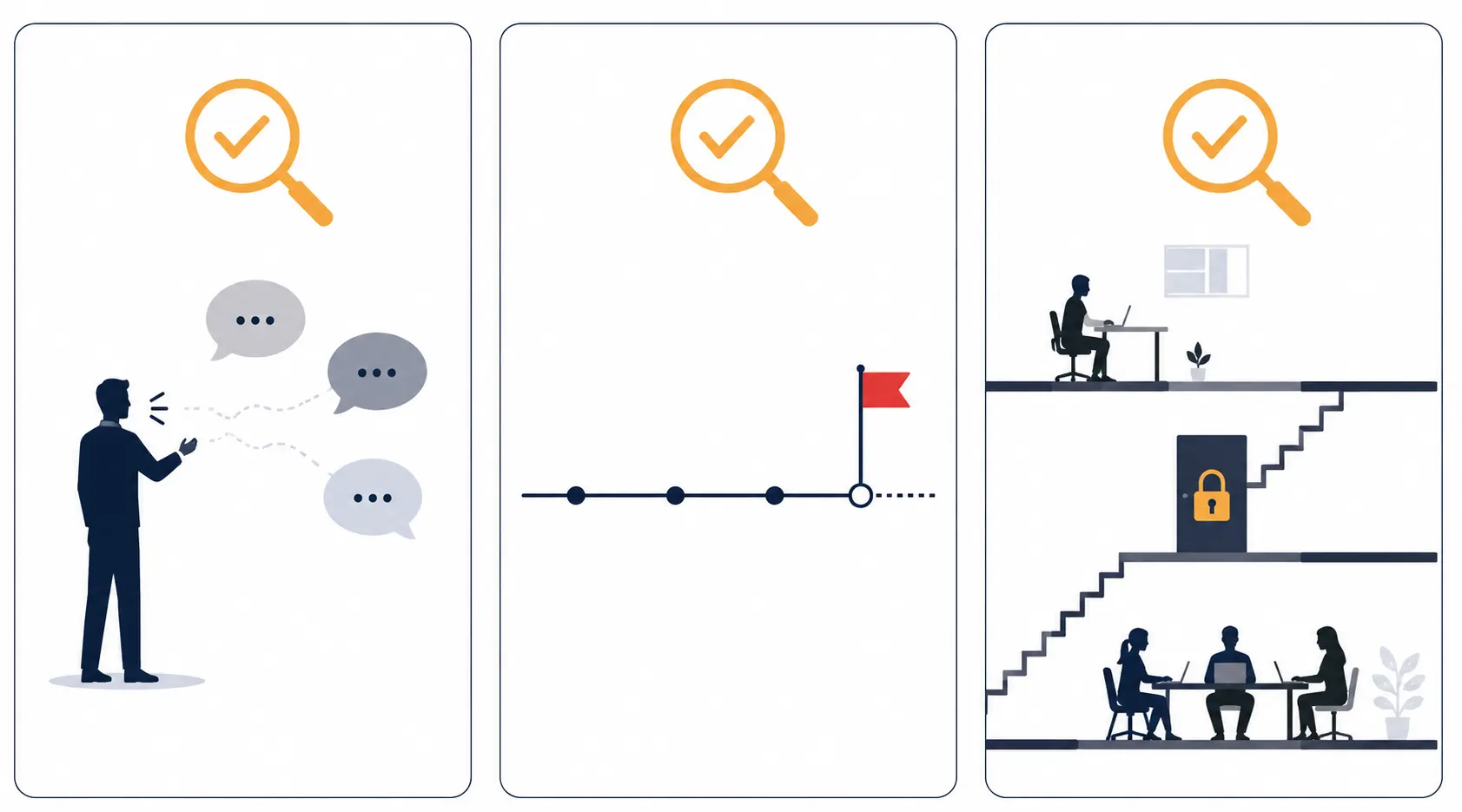
You don’t need a consultant in the room to find out whether this exists in your organization. These are the same three signals I check in the first week of any new engagement, adapted here as a self-assessment rather than a vendor evaluation.
| Diagnostic check | What a negative answer reveals | Do this instead |
|---|---|---|
| Ask 3 team leads (separately) to name this quarter’s top priority | The cascade isn’t real agreement—it’s a document nobody’s reading the same way. | Run a shared organizational strategy framework session before writing a single goal. |
| Count how many at-risk flags surfaced mid-cycle vs. only in retrospectives | The execution cadence isn’t producing honest, real-time signal or weekly check-ins. | Shorten check-in intervals and make “at risk” a safe thing to say early. |
| Check whether anyone below leadership has had 1:1 coaching | The Coaching Cliff is active and strategic priorities are disconnected from daily tasks. | Prioritize manager-layer coaching before rolling out further OKRs. |
If two or more of these come back negative, the gap isn’t a risk. It’s already operating.
What It Costs When the Gap Stays Open
A European fintech, around 100 people, generating revenue, introducing OKRs specifically to drive growth. When I spoke with the CEO and CPO, it was immediately clear they couldn’t articulate outcomes in the right direction goals were KPI-led, tracking numbers that moved without providing any clarity about what actually needed to change. The room was full of activity. None of it was clearly connected to what the organization actually needed to achieve.
That’s the real cost of an open strategy execution gap: not failure, exactly, but expensive motion. Teams stay busy. Dashboards stay full. Nothing about the underlying trajectory of the business changes, and by the time leadership notices often via a business impact analysis that finally connects the dots a full quarter, sometimes two, has gone into work that never had a clear line back to the strategy in the first place. Most organizations only discover this because strategy implementation and monitoring happened as two separate, disconnected activities implementation reviewed in one meeting, monitoring reported in another, with nobody responsible for reconciling the two in real time.
Closing the Gap – Capability First, Tooling Second
Fix the structural causes above and something changes: the cascade starts to reflect real agreement instead of a diagram someone built in a dashboard. That’s the moment a tool actually starts to matter, because now there’s something real for it to make visible. Closing the execution gap was never about finding the right dashboard first it’s about having something true for the dashboard to finally show.
This is also exactly where the confusion sets in for most leadership teams they go looking for strategy execution software before doing this diagnostic work, hoping the platform will produce the alignment on its own. It won’t. Once you’ve genuinely worked through the structural and coaching causes above, the right software becomes a multiplier for capability that already exists not a substitute for capability that doesn’t. This is the entire premise behind DEEP AI™, Worxmate’s execution framework: Define, Execute, Evaluate, Plan isn’t a feature layer sitting on top of a goal tracker, it’s built around the assumption that capability has to exist before the tool can amplify it. On the business side, Axis AI reads OKR data specifically to isolate the fastest lever to pull once real priorities exist to measure against it can’t invent alignment that isn’t there, but once it is, it removes the guesswork about where to act first.
Achieve Your Goals Faster
See how Worxmate can help your team set clear goals and achieve faster results. Book your free demo today and experience the power of AI-driven OKRs in action.
The Tool That Actually Builds Agreement Not Just Displays It
Everything above points to the same conclusion: the strategy execution gap closes through genuine agreement, not through a better-looking dashboard. The hardest part of that is practical, not conceptual how do you actually get a room full of leaders and their teams to reach real consensus on priorities, instead of the loudest voice in the meeting deciding for everyone while the rest nod along?
This is the specific problem OKR Studio is built to solve. It’s a structured collaborative session the leader creates it, shares the link, and the team joins in real time. Proposed OKRs are displayed to every participant simultaneously, not presented one at a time to whoever happens to be paying attention. Structured voting and threaded debate replace the usual dynamic where the most senior or most confident person in the room sets the goal and everyone else quietly agrees. The session output publishes directly into the OKR cycle, with no rework or manual re-entry afterward.
| Traditional leadership workshop | OKR Studio session |
|---|---|
| Loudest or most senior voice tends to set the goal | Structured voting surfaces genuine consensus, not just confident opinions |
| Goals presented sequentially, one at a time | All proposed OKRs visible to every participant simultaneously |
| Disagreement often goes unspoken in the room | Threaded debate makes disagreement visible and resolvable |
| Output requires manual write-up and re-entry into the tracking tool | Session output publishes directly into the OKR cycle |
This matters specifically because of Cause 2 and Cause 3 above. Bottom-up goal-setting fails early not because teams shouldn’t have input, but because there was never a structured way to turn that input into something the whole team actually agreed on it either got ignored in favor of the leader’s version, or it turned into noise because nobody reconciled competing priorities. A Studio session forces that reconciliation to happen in the room, in real time, with a facilitation system that ensures a decision actually gets made within the time allocated rather than deferred to a follow-up email thread that never quite resolves anything.
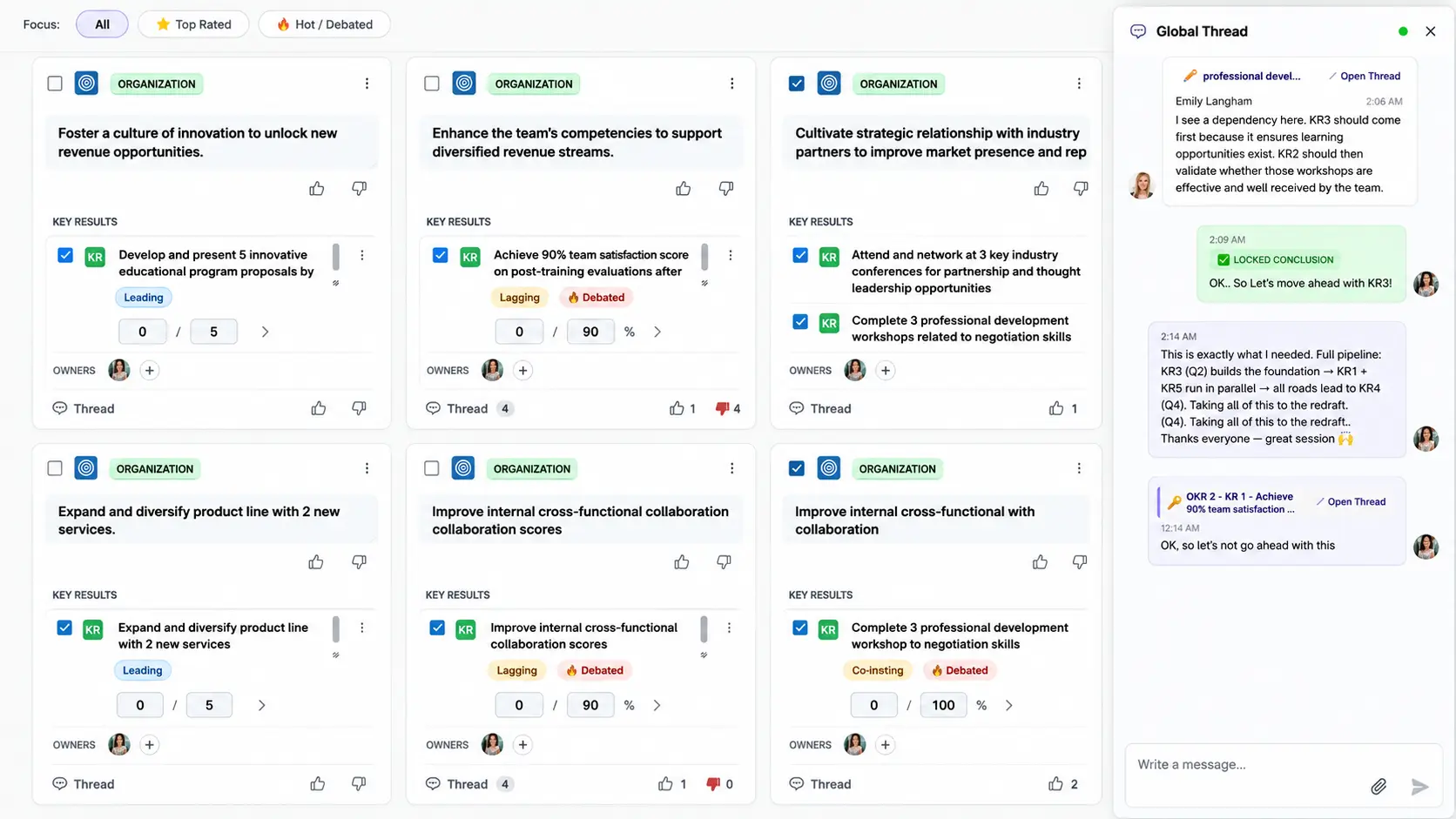
The connection back to the core argument of this piece is direct, not incidental: alignment is agreement, and agreement only exists when it’s built through an actual conversation not announced from the top and displayed afterward in a dashboard. Worxmate’s OKR Studio is that conversation, structured well enough that it produces a real decision instead of a meeting that ends in “let’s take this offline.” Once that decision exists, tools like Nexus AI can display and monitor the resulting cascade with confidence, because there’s a genuine agreement underneath it to display.
Where This Leaves You
If what you found in the diagnostic above points to structure or coaching not a missing tool that’s a conversation worth having before anything else. OKR consulting exists for exactly this: identifying which of the three causes is actually operating in your organization and closing it directly, the way we did with the fintech example above, rather than layering a new platform over the same structural gap. Tracking a real-time confidence score helps identify at-risk targets before quarter-end. Strong goal alignment eliminates siloed efforts and connects daily work to strategic outcomes.
If the diagnostic instead confirms your foundation is solid and you’re specifically missing the visibility layer or a genuine way to build consensus in the room a way to see the cascade breaking in real time rather than discovering it in the MBR, or a structured session that gets a team to real agreement instead of passive approval that’s where Worxmate’s OKR software fits, and a demo is the fastest way to see whether it matches what you actually need.
The software is the infrastructure. The coaching is the capability. Most organizations searching for a way to close their strategy execution gap need to know which one they’re actually missing before they buy anything.


Written by
An OKR Coach with 20+ years of implementation experience, Madhusudan has guided over 50 organisations through successful OKR transformations, training more than 500 leaders. Learn more about Worxmate.