 WORXMATE
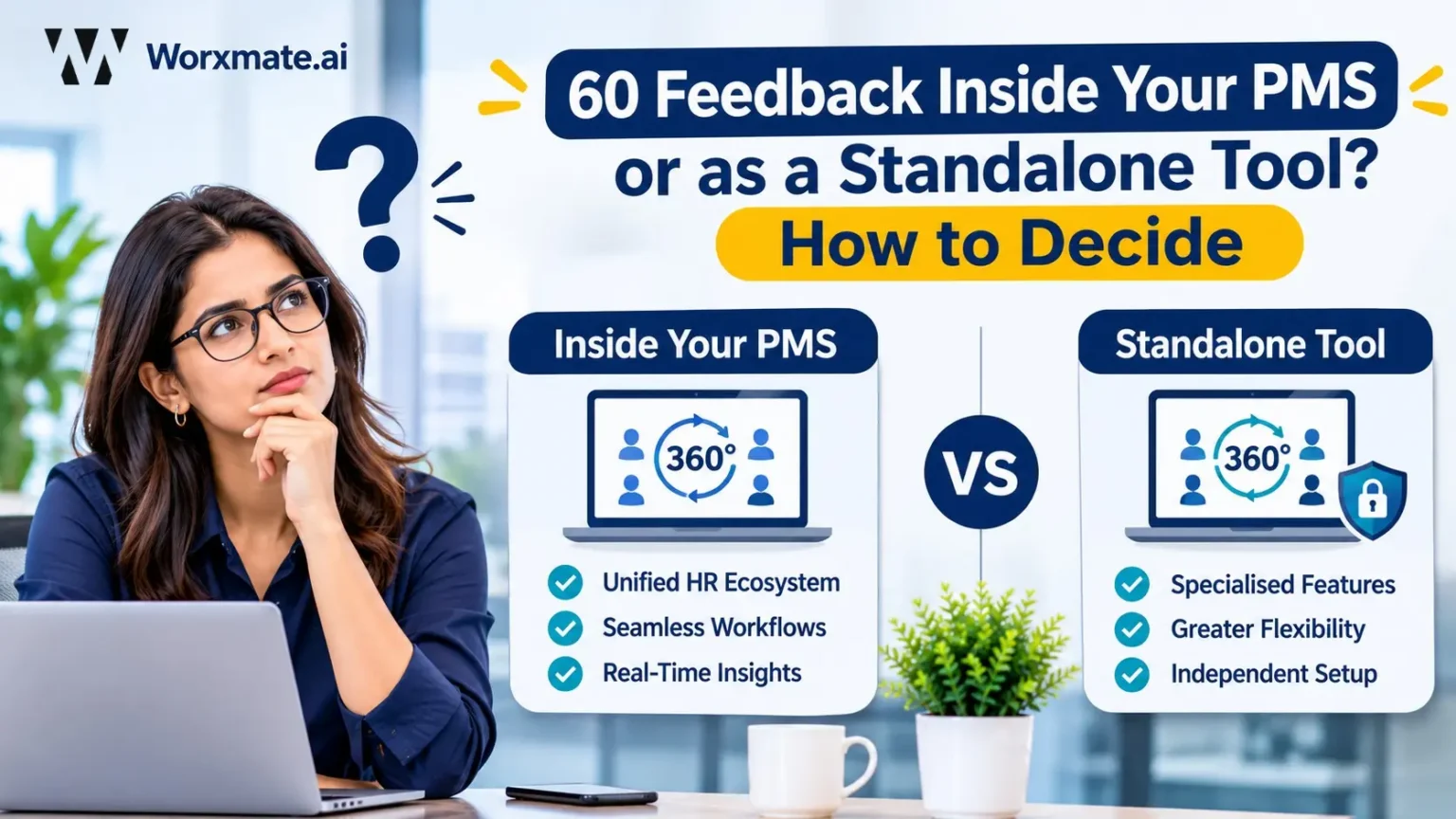
Is a standalone 360 feedback tool better than a 360 module inside your PMS?
Choose a 360 module inside your PMS when your main goal is to connect feedback to goals, reviews and development plans in one system. Choose a standalone 360 feedback tool when you need strict anonymity, deep reporting or leadership assessment run separately from performance ratings. Decide using seven checks: purpose, anonymity, goal linkage, rater load, reporting depth, integration and total cost.
The two 360 quotes that looked identical and were not
A CHRO once showed me two quotes side by side. One was for a 360 feedback module bundled into the company’s performance management platform. The other was for a standalone 360 feedback tool with beautiful reports. “Same cost, roughly,” she said. “Which one do I pick?”
That was the wrong question, and it took us twenty minutes to find the right one: what is the 360 supposed to change in how your leaders behave, and who has to trust it for that to happen?
If you are weighing a standalone 360 feedback tool against a PMS module right now, you are probably staring at the same two quotes. I have sat with that decision across 50+ implementations, and the pattern I see consistently is this: the architecture you choose for your 360 degree feedback matters less than the purpose you have not written down. Still, architecture is where the money and the risk sit, so let’s get it right. (If you want the feature-by-feature view of 360 feedback software itself, our 360 feedback software guide covers it. This article is only about where it should live.)
This guide walks through when a module inside your performance management software wins, when a standalone 360 feedback tool earns its place, and the seven checks I use before telling a client which way to go.
Who is writing this
I’m Madhusudan Nayak (Maddy), Co-Founder and CEO of Worxmate. I have spent 20+ years in strategy execution and 10+ years implementing OKRs, coaching 500+ leaders across 10+ industries in APAC, the Middle East and Europe. Before Worxmate, I was Business Head at Profit.co. Feedback tools have crossed my desk in almost every one of those engagements, usually after something went wrong.
Unlock Goal Clarity & Accelerate Employee Growth
Looking to drive goal clarity and employee growth? Discover how Worxmate’s AI-powered Performance Management Software can help.
Why most standalone 360 feedback tool decisions go wrong before the demo
Most buying committees start with features. Rater workflows, report templates, benchmark scores. Then they compare two vendors on who has more of them.
Here is what that skips. A 360 feedback process fails for people reasons long before it fails for tool reasons:
- Raters do not believe their comments are anonymous, so they write safe, useless feedback.
- Managers receive a report and have no idea what to do on Monday morning.
- The results land in a different system from the goals, so nobody connects behaviour to outcomes.
- Survey fatigue sets in by the second cycle, and response rates fall quietly.
None of these are solved by a better report template. All of them are shaped by where the 360 lives and who sees what.
So before you compare tools, write one sentence: “We are running 360 feedback to ______, and the person receiving it will ______.” Fill the blanks honestly. Development of senior leaders? Input into promotion decisions? Culture diagnosis? Each answer points to a different architecture, and I will show you which.
What “inside your PMS” actually gets you
When 360 feedback lives inside a performance management system, feedback shares data with goals, check-ins, reviews and development plans. That is the genuine advantage, and it is a big one.
What this looks like in practice:
- A manager sees peer feedback next to goal progress in the same place, so the conversation is about behaviour and results together.
- Cycle setup, employee lists and reporting lines come from the system you already maintain. Nobody uploads a spreadsheet of raters at midnight.
- One login, one audit trail, one vendor contract, one set of permissions.
- Development actions from the 360 can flow straight into the next review cycle.
What breaks without it: when 360 feedback sits in a separate tool, someone has to carry its findings back into your reviews and goals by hand. In my experience, that handoff is the first thing that quietly stops happening in cycle two.
The tradeoff is depth. A module is usually one feature among many. Question libraries, rater-selection logic and reporting are often thinner than what a specialist offers, and anonymity controls can be harder to configure when the same system also feeds ratings and pay decisions. If you want the shortlist view of which platforms are worth evaluating at all, our guide to the best performance management software is the right place to start, and it keeps the vendor comparison in one spot so this article can stay focused on the decision.
When a standalone 360 feedback tool earns its place
A standalone 360 feedback tool exists for one job, and it does that job with more care than a bundled module usually can.
I recommend a standalone tool when at least two of these are true:
- The 360 is for development only, and you want a hard wall between it and ratings, pay or promotion.
- You assess a small leadership group (say 20–60 leaders) with rich, narrative, coach-led reports.
- You run multi-rater feedback across several business units with different competency models and need flexible question logic.
- Your PMS is not changing soon but its 360 module is clearly weak for your needs.
- External coaches or consultants need access to results without touching your core HR data.
The cost of this choice is integration debt. Two systems means two employee masters, two permission models and a handoff you must design on purpose. If you choose standalone, put the integration plan in writing before you sign.
Side-by-side: standalone 360 feedback tool vs 360 inside a PMS
| Dimension | Inside your PMS | Standalone 360 feedback tool |
|---|---|---|
| Primary strength | Feedback linked to goals, reviews, development | Depth of questions, rater logic, reporting |
| Anonymity control | Depends on how ratings and pay data share the system | Strong separation by design |
| Goal and review linkage | Native | Manual or via integration |
| Rater and employee data | Reused from existing system | Needs sync or upload |
| Reporting depth | Usually standard | Often richer and coach-ready |
| Setup and admin load | Lower | Higher (two systems) |
| Total cost shape | One bundle, simpler | Licence plus integration and admin time |
| Best fit | Continuous performance culture, all-employee cycles | Targeted leadership development, assessment-style programmes |
Pull quote: “A 360 report that lives apart from the goals it should be changing is a very expensive mirror.”
Is your culture ready for 360 feedback at all?
Before you pick a tool, check whether your organisation can actually act on honest feedback. The Performance Culture Maturity Framework shows you where you stand.
Standalone 360 feedback tool or PMS module: the 7 checks I run before recommending a route
Run these in order. Score each one “PMS”, “standalone” or “either”. The pattern in your answers usually settles the decision faster than any demo.
Check 1: What is the 360 for?
Development, promotion input and culture diagnosis are three different programmes. Development-only programmes lean standalone because the separation from ratings protects honesty. Continuous, all-employee feedback leans toward a module inside your PMS because it needs to run every cycle without heavy admin.
Check 2: How anonymous does it have to be?
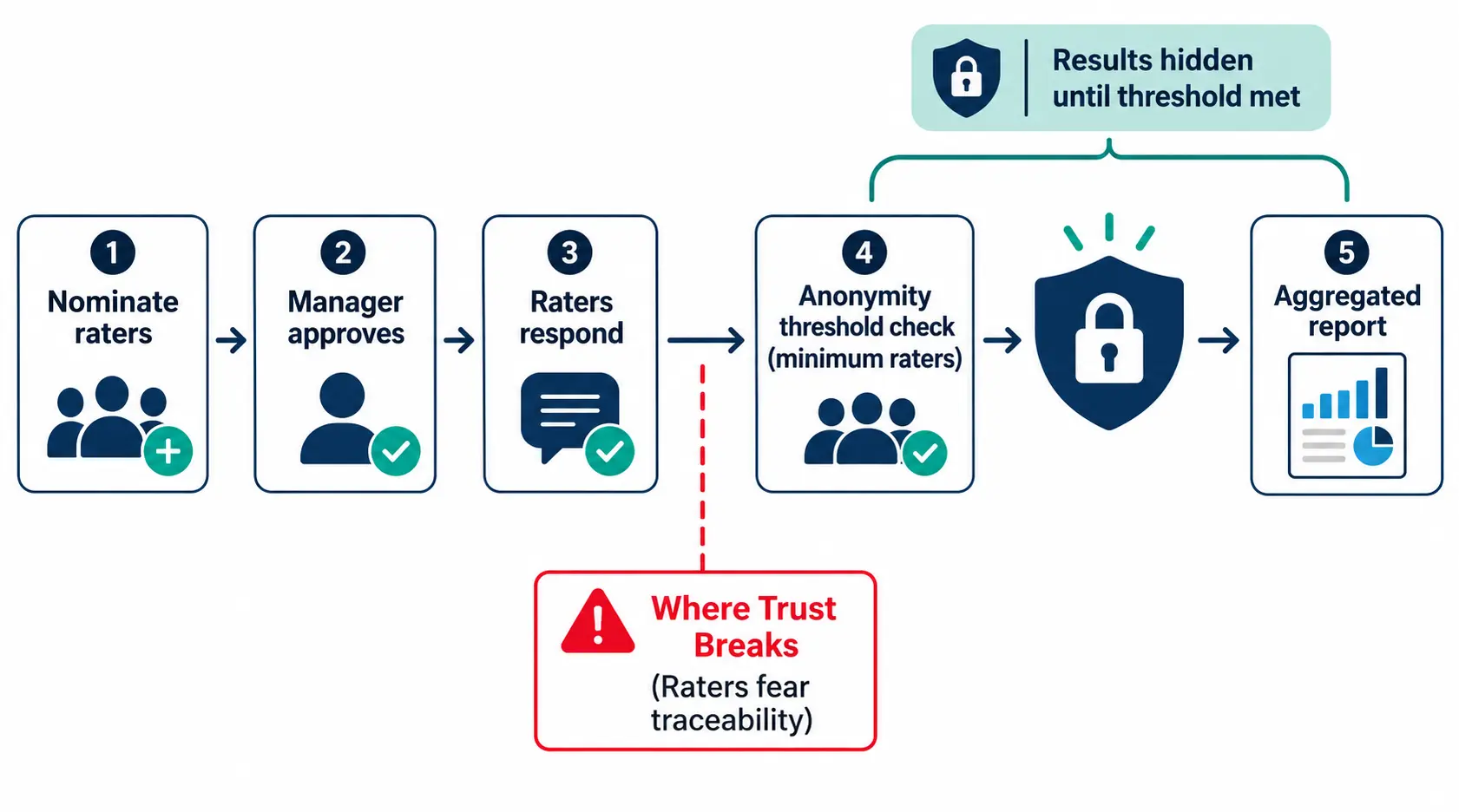
Anonymity is the single biggest driver of useful 360 feedback. If raters suspect that comments can be traced, or that the same data touches compensation, they hedge. Ask each vendor three questions: What is the minimum number of raters before results display? Who can see raw comments, and can admins? Is 360 data stored separately from rating data?
Check 3: Does feedback need to connect to goals?
If your leaders must see behaviour feedback next to goal delivery, the module inside your PMS wins by a wide margin. In organisations that run OKR software alongside performance reviews, the real insight comes when peer feedback is read against how a leader’s measurable goals are actually moving. A report with no goal context tells you how someone is perceived. It does not tell you why results are stalling.
Check 4: What is the rater load?
Ten raters per person across 200 people is 2,000 feedback requests. That is survey fatigue waiting to happen. Look for rater caps, smart rater suggestions and reminders that do not nag. A tool with beautiful reports and a brutal rater workflow loses in cycle two.
Check 5: How deep must reporting go?
If you need narrative reports, self-versus-others gap analysis and coach-ready summaries for 40 senior leaders, a specialist tool may justify itself. (If you only need a template, start with our 360 degree feedback report template.) If managers just need clear themes and three actions, a module’s standard reporting is enough.
Check 6: How will it integrate with your systems?
Ask about HRIS integration, single sign-on, and whether employee data syncs automatically. Every manual upload is a future failure. If HRIS fit is the sticking point, read performance management software vs HRIS first. Review the integrations available in any platform you consider, not just the headline feature list.
Check 7: What is the total cost, not the licence cost?
Count the licence, implementation, admin hours, integration work and manager time spent in each cycle. A standalone tool with a cheap licence can cost more once you add the integration and the person who babysits it. Ask for 360 feedback cost per employee across a three-year view.
Decision matrix: which route does your situation point to?
| Your situation | Likely best route | Why |
|---|---|---|
| All employees, every cycle, tied to goals and reviews | Inside your PMS | One system, lower admin, feedback meets goals |
| 20–60 senior leaders, development only, coach involved | Standalone | Hard wall from ratings, richer reports |
| Weak existing PMS module, PMS replacement not planned | Standalone | Fix the gap without a platform swap |
| Strong need for goal-linked feedback and one audit trail | Inside your PMS | Avoids manual handoffs |
| Multiple competency models across business units | Standalone (or advanced module) | Flexible question logic |
| Small HR team, limited admin capacity | Inside your PMS | Fewer systems to maintain |
Unlock Goal Clarity & Accelerate Employee Growth
Looking to drive goal clarity and employee growth? Discover how Worxmate’s AI-powered Performance Management Software can help.
The hidden costs nobody puts in the RFP
I have never seen a buying committee score these, and they decide whether the 360 survives past cycle two.
Anonymity theatre. The vendor says “anonymous”. Your people say “they can see who wrote that”. If the second sentence is what employees believe, the first sentence is irrelevant. Be explicit about minimum rater thresholds and who can read raw comments, and say so to employees before launch.
Rater selection bias. (This is separate from performance review bias, though the two compound.) When employees pick their own raters, they pick friends. When managers pick, people suspect a stitch-up. The best programmes combine employee nominations with manager approval and a rule that includes at least one critical voice.
The “so what” gap. A report lands. The manager nods. Nothing changes. In my work, the intervention that changes this is simple: every 360 conversation must end with two behavioural commitments and a check-in date. Anything less is a reporting exercise.
Survey fatigue. Run 360 feedback for everyone, every quarter, and by cycle three raters will click through. Annual full 360s plus lighter continuous feedback in between is the pattern that holds. This is where continuous performance management beats an event-style standalone programme for most organisations.
What I learned about 360 feedback from a retail leadership team
Here is a field story that changed how I think about this whole decision.
An APAC retail company in aggressive expansion wanted its fast-growing leadership team aligned. When I asked the CEO for his top three priorities in the first call, he could not define them clearly in 45 minutes. That led to a two-day war room before a single OKR was written.
What matters for this article is what I did next. I ran 1:1 coaching with each leader rather than group sessions. In private, leaders told me their real weaknesses, things they would never have said in a room or written in a peer survey. That let me tailor the coaching so each leader looked stronger in front of their peers, not exposed.
The lesson: feedback that is safe to give and safe to receive is a precondition, not a feature. Whichever route you choose, it will only work if leaders believe the results are for growth. Fear of being judged is the silent adoption blocker in almost every programme I’ve coached. Leaders who carry that fear will rate their peers kindly and read their own reports defensively. You can read more on why this happens in how leadership goals get written when people feel exposed.
So when a vendor shows you a slick benchmark view, ask the harder question: what in the product and the process makes a nervous leader trust it?
Where Orbit AI, Axis AI, Nexus AI and DEEP AI fit
I’m not going to describe features here. I’m going to tell you what breaks without the layer.
Orbit AI: people signals beyond the survey. A 360 gives you opinions captured at one moment. What breaks without a continuous people layer is timing. By the time feedback surfaces a disengaged high performer, they have often already decided to leave. Orbit AI is Worxmate’s people intelligence model, built to read ongoing performance and engagement patterns so feedback is a confirmation, not the first alarm.
Axis AI: does the feedback match the business reality? If peer feedback says a leader is “unclear on priorities” and the business data shows their goals slipping, those two signals reinforce each other. Axis AI is the business performance intelligence layer that lets you read human feedback against delivery.
Nexus AI: patterns across the organisation. One manager with poor feedback is a coaching case. Twenty managers in one function with the same pattern is a structural issue. Nexus AI is where organisational patterns surface, so the 360 informs strategy and not just individual development.
DEEP AI: the execution loop around feedback. I built DEEP AI (Define, Execute, Evaluate, Plan) from live implementations, and it is the best lens I know for deciding where 360 feedback belongs:
- Define: feedback themes shape the behavioural goals a leader sets for the next cycle.
- Execute: check-ins are where the two commitments from the 360 conversation actually get tracked.
- Evaluate: a scorecard that shows behaviour change next to goal outcomes.
- Plan: retrospectives carry what you learned into the next cycle.
Flow diagram of a 360 feedback cycle showing rater nomination, manager approval, an anonymity threshold check and the point where trust breaks.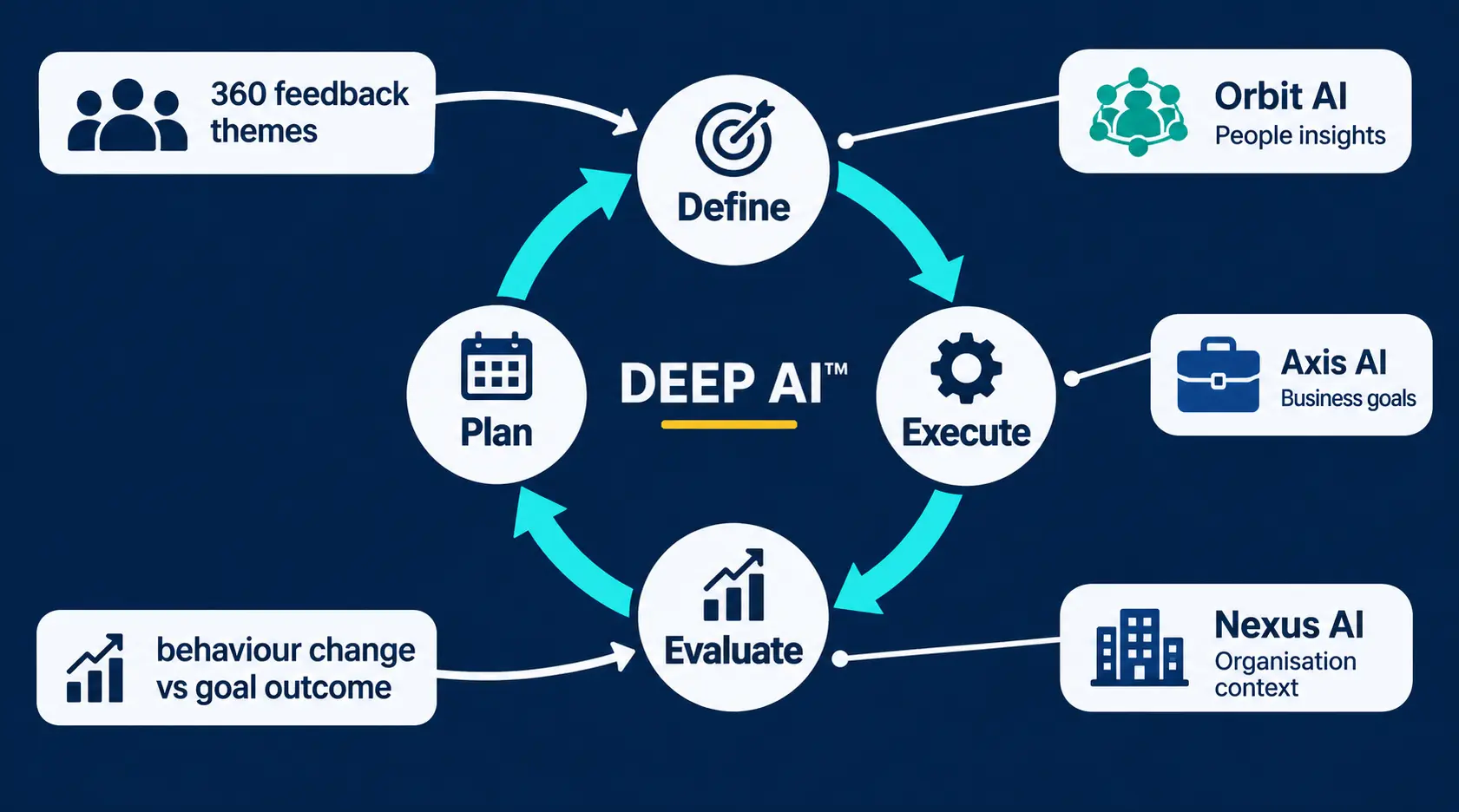
Want to see how AI changes performance management?
This ebook explains how AI reshapes feedback, reviews and people decisions, useful context before you commit to any 360 architecture.
A 90-day plan once you have chosen your standalone 360 feedback tool or PMS module
Whichever route you pick, this sequence protects the programme. I also recommend treating the first cycle as a pilot, because one completed cycle with honest follow-through is worth more than a full rollout nobody acts on.
| Phase | Weeks | What to do | Success signal |
|---|---|---|---|
| Frame | 1–2 | Write the purpose sentence, choose audience, confirm who sees raw comments | Purpose and anonymity rules signed off by HR and the leadership sponsor |
| Sensitise | 2–4 | Brief leaders and raters on why, what happens to results, and what is *not* used for ratings | Leaders can explain the purpose without notes |
| Pilot | 4–8 | Run with one leadership group of 15–30; cap raters at 6–8 each | Response rate holds above your target; no anonymity complaints |
| Act | 8–10 | Every manager has a debrief with two behavioural commitments | Each leader has two commitments and a check-in date |
| Review | 10–13 | Check response rate, gaps, follow-through; decide to scale | Go/no-go decision with evidence |
The brief step matters more than it looks. Ask this first: was this pushed, or was this chosen? A 360 programme announced with a go-live date and a login collapses in weeks four to six, not because people resist, but because nobody told them what is in it for them. A tool does not answer that question. Aligned HR and business leaders do, ahead of time.
If you want a baseline before you start, the Organization Performance Audit shows where your performance system is leaking, and it is a faster way to spot whether feedback is your problem or a symptom of unclear goals.
What I’d tell a client
My Take: For most organisations running continuous performance culture across all employees, a 360 module inside your PMS is the better default. One system, feedback that meets goals, lower admin. It wins on follow-through, and follow-through is what decides whether a 360 changes anything.
Choose standalone when the programme is narrow, senior and development-only, and you need a hard wall from ratings. Then budget honestly for the integration, because the handoff is where standalone programmes die.
Either way, three rules hold in every engagement I have run:
- Write the purpose before you open a vendor deck.
- Protect anonymity before you optimise reporting.
- Tie every 360 conversation to two commitments and a date.
Your talent head and CHRO will carry most of the decision. But the sponsor has to be the business, not HR alone. When HR owns a feedback programme in isolation, the business treats it as one more assessment. When a business leader sponsors it, it becomes a way to run better.
Pull quote: Alignment is agreement. You cannot set it in a tool. You can only display it once it exists, and a 360 is how you find out whether it does.
Next step: pick your path
Path 1, the platform. If you are ready to see how feedback, goals and reviews run together in one system, look at Worxmate’s performance management software, check pricing or book a demo.
Path 2, the consulting. If you suspect the tool is not your first problem, because leaders do not trust feedback or cannot turn it into action, our OKR consulting work is built for exactly that capability gap.
The software is the infrastructure. The coaching is the capability. You need both, and in the right order.


Written by
An OKR Coach with 20+ years of implementation experience, Madhusudan has guided over 50 organisations through successful OKR transformations, training more than 500 leaders. Learn more about Worxmate.