 WORXMATE
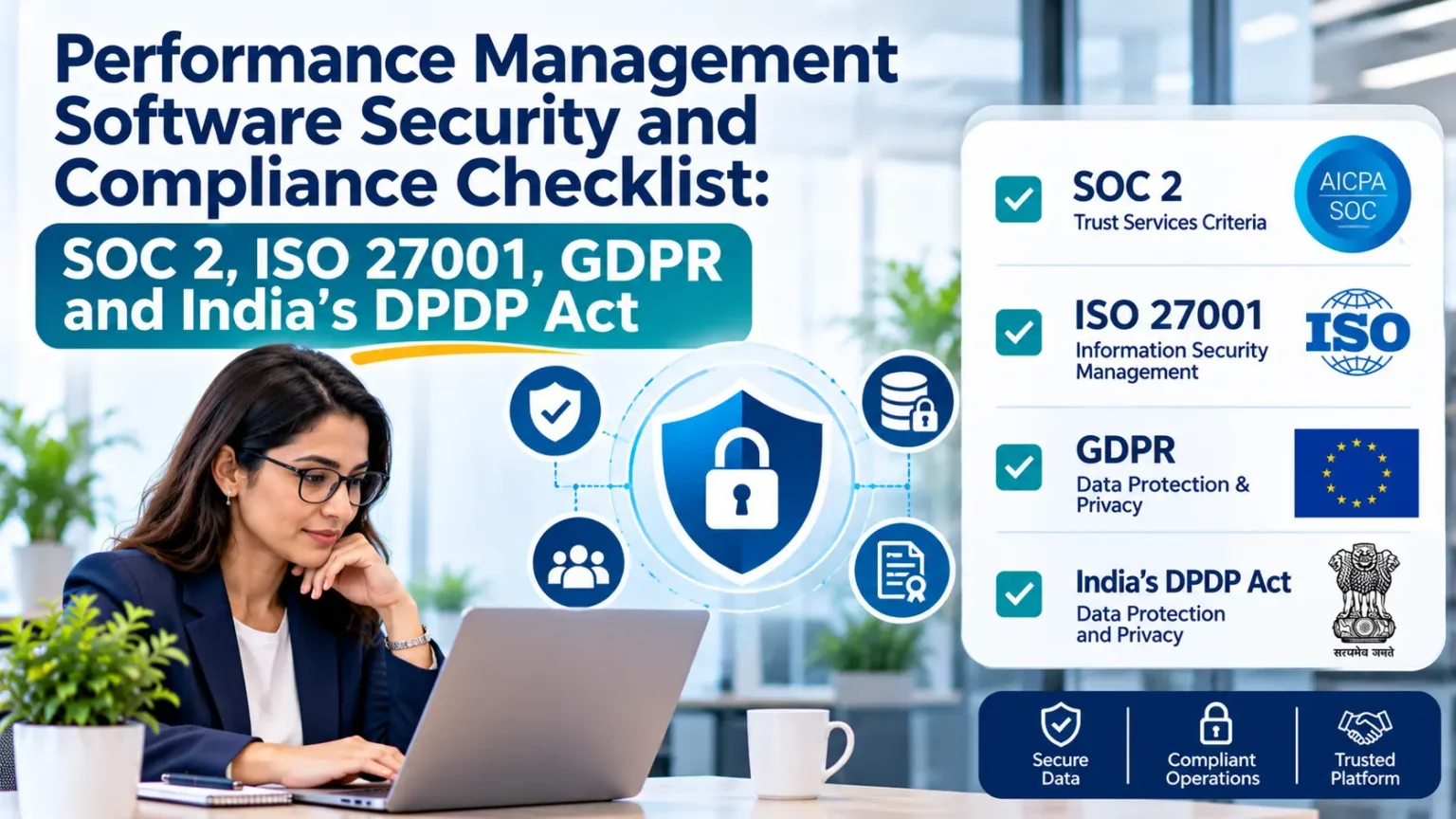
Performance management software security means proving four things before you sign: an independent audit (SOC 2 Type 2 or ISO 27001), a lawful data design (GDPR, UK GDPR or India’s DPDP Act), a contract that controls where employee data goes (data processing agreement, sub-processors, AI training), and configuration that limits who can see each review. A vendor with only a badge has passed one test of four. Use the 12-point performance management software security checklist below, and ask for evidence, not assurances.
Your performance management software holds the most uncomfortable sentences your company has ever written about its own people. Who is a flight risk. Who is on a PIP. Who got a 2, and why the manager thinks so. That is the file you least want on a stranger’s laptop.
And yet, of the 9 systemic failures I name in performance management, from unwritten verbal feedback to KRAs disconnected from business goals, not one is a security failure. Every one of them produces sensitive data. That gap is why performance management software security usually arrives as an IT form, after HR has already fallen for a demo.
I am Maddy: 20+ years in strategy execution, 10+ years implementing OKRs and performance management across 50+ organisations, and 135+ conversations with HR leaders behind this guide. This is the checklist I would put in front of a CHRO and a CISO at the same table, because the decision needs both. I am not a lawyer. Treat the legal sections as a map and take the final call to your counsel.
Performance management software security starts with the data you are protecting
Most vendor questionnaires ask about servers. Almost none ask about sentences. So start with an inventory of what a performance platform really holds: ratings and calibration notes, written manager feedback, PIPs and IDPs, 1:1 notes, 360 degree feedback, self-assessments, compensation links and, increasingly, inferences.
Inferences are the part people miss. When Orbit AI surfaces its six named signals (Burnout Risk, Attrition Trigger, Engagement Decline, Top Performer Flight Risk, Rating Inflation Drift and Skills Decay), it produces new data about a person that the person never typed. Burnout Risk sits close to health information. Attrition Trigger can end a promotion conversation before it starts. I treat each signal as a governed output with its own visibility rule, and I would ask any vendor, including us, to show that rule on screen.
That is what employee performance data security really means: protecting the record, and protecting what the record implies. It is also why a calibration discussion, a performance improvement plan and a 1:1 note should never share one permission level.
Performance data is not sensitive because of the software. It is sensitive because of what it can do to a career.
Performance management software compliance: SOC 2 vs ISO 27001 for HR software
The short answer: SOC 2 and ISO 27001 both prove that a vendor runs a managed security programme, but neither proves your employee data is handled lawfully. Certifications cover the vendor. Laws cover you. I think of trust in four layers: certification, law, contract and configuration. A vendor can hold the first and fail the other three.
| Framework | What it proves | What it does not prove | Ask the vendor for |
|---|---|---|---|
| SOC 2 Type 2 | Controls operated over an audit period, tested by an independent auditor | Lawful processing, or that the scope covers the module you are buying | Full report under NDA, audit period, exceptions |
| ISO 27001 | A managed security system certified by an accredited body | That every control is strong; the scope statement decides coverage | Certificate, scope, Statement of Applicability |
| GDPR and UK GDPR | Nothing. It is law, not a badge | Not available as a certificate | Signed DPA, sub-processor list, transfer mechanism |
| India’s DPDP Act | Nothing either. It places phased duties on the employer | A vendor cannot make you compliant on its own | Breach process, erasure support, hosting options |
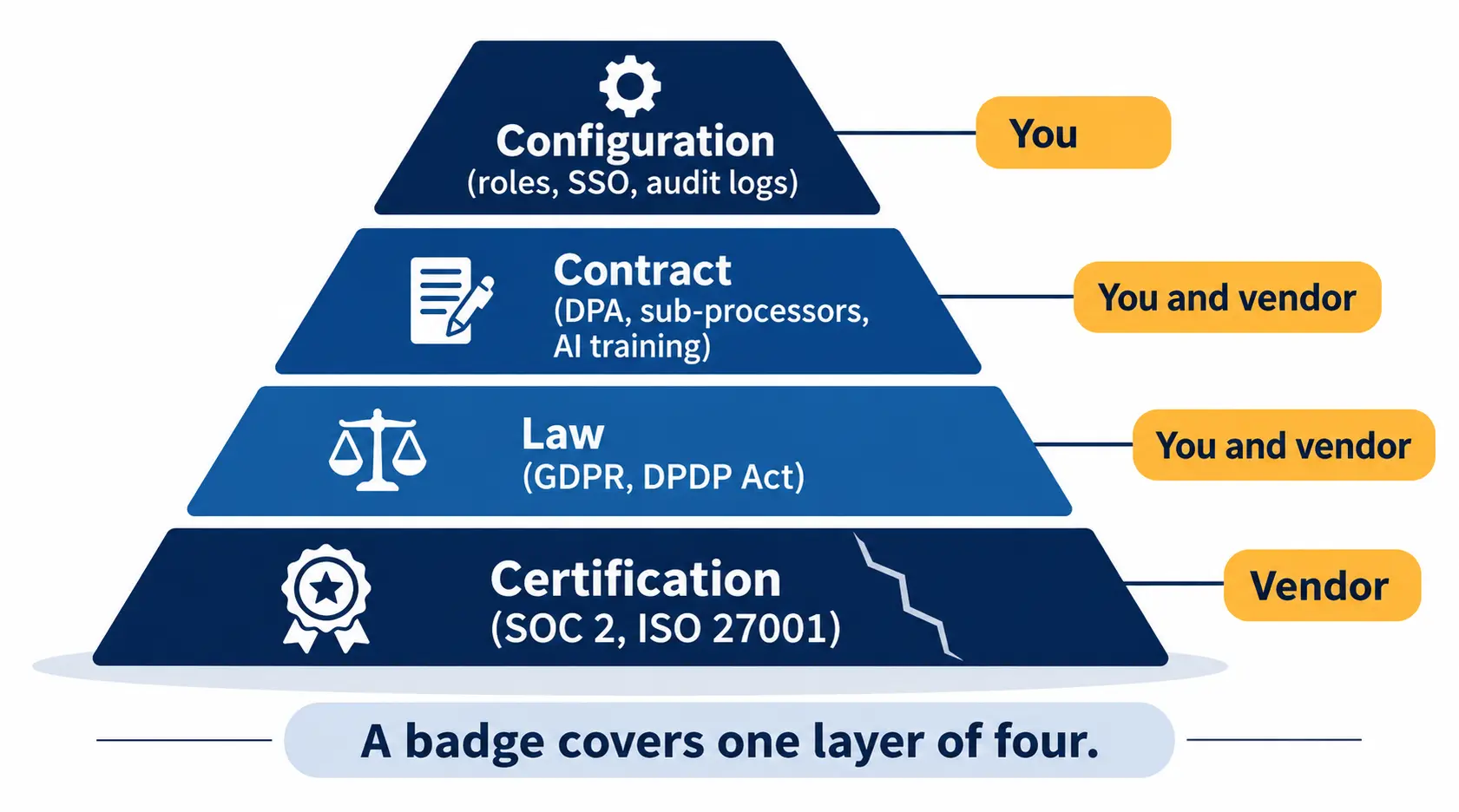
SOC 2 Type 1 vs Type 2 is the first distinction that matters. Type 1 says controls were designed properly on a single date. Type 2 says they operated over a period, usually several months. When a vendor claims to be SOC 2 compliant HR software, ask which type, which period and which Trust Services Criteria. Security is always in scope. Confidentiality and privacy are optional, and a performance platform needs both.
ISO 27001 certified HR software holds a certificate for its information security management system, and the scope statement matters more than the logo. A certificate that covers the head office and not the product is decoration.
So is performance management software SOC 2 compliant? Ask for the report, read the exceptions, and match the system description to the product you are buying. The same discipline applies to performance management software ISO 27001 claims. If you are asking what security certifications should performance management software have, my floor is one independent audit, either SOC 2 Type 2 or ISO 27001, plus a privacy commitment that maps to the laws you operate under.
Performance management software GDPR for UK and EU teams
Is performance review data personal data under GDPR? Yes. Any rating, feedback or note relating to an identifiable employee is personal data, so GDPR compliant performance management applies the day you load the first review. UK teams work under UK GDPR, which follows the same core logic, and our guide to employee appraisal tools for the UK covers the tooling.
GDPR employee data processing needs a lawful basis, and employee consent is weak because of the power imbalance at work. Most employers rely on legitimate interests, contract or legal obligation. Your vendor is a processor, so you need a data processing agreement HR software vendors will actually sign: processing only on your instructions, confidentiality, security measures, breach notice, and the same duties flowing down to sub-processors. Sub-processor disclosure SaaS vendors publish should be a live list with change notice, not a two-year-old PDF.
How long can employee performance data be stored under GDPR? There is no fixed number. The rule is storage limitation: keep data no longer than the purpose needs. Your data retention policy performance reviews section should name a period for each record type, and the software must be able to enforce it. Pair it with right to erasure employee data. Erasure is not absolute, because you may keep records needed for legal claims, but the vendor must delete or anonymise on instruction. Ask what performance management software data deletion on contract exit looks like: a written deletion window and a deletion confirmation.
Cross-border employee data transfer is the other trap. Where is performance management software data stored? Ask for the hosting region, the backup region and every location support staff can reach it from, then ask which transfer mechanism covers any leg outside the UK or EEA. That is the heart of HR data privacy compliance for multinational teams, and it connects to how you run global performance management across countries.
Performance management software security for Indian companies: the DPDP Act
India data protection law HR software buyers have a moving date to plan around. The Digital Personal Data Protection Rules were notified on 13 November 2025, and the main duties switch on in phases, most of them around mid May 2027. Check the official notifications for exact dates. Performance management software DPDP Act questions all reduce to one: who is accountable when employee data leaks?
Does DPDP Act apply to employee performance data? Yes, for digital personal data. As a DPDP Act data fiduciary employer, you decide why and how employee data is processed, and each employee is a data principal. The Act allows processing for employment purposes without consent as a legitimate use, but the boundary is real: it covers processing tied to the employment relationship, not every analytics idea a vendor can think of. I would not assume it stretches to an AI burnout score. Take advice.
For DPDP Act employee data, the practical duties are reasonable security safeguards, breach intimation to the Data Protection Board and affected employees, and erasure once the purpose is served. Penalties for failing on safeguards can reach ₹250 crore under the Act’s schedule, so DPDP Act compliance for HR is a board topic, not an IT ticket.
GDPR vs DPDP Act for HR software comes down to structure. GDPR offers six lawful bases and leans on legitimate interests. The DPDP Act offers consent plus a closed list of legitimate uses, and it permits transfers except to countries the government restricts. Data residency HR software demands therefore tend to come from sector regulators, auditors and customer contracts, not the statute alone.
My DPDP Act checklist for HR teams: name an owner, map where employee data flows, give employees a clear notice, check the vendor agreement, set retention and erasure rules, and rehearse breach reporting once. For the product side, see performance management software for Indian companies and employee performance management software in India.
The performance management software security checklist: 12 checks before you sign
This performance management software security checklist sits next to, not on top of, our feature-level checklist and our buying guide. Those cover what the product does. This covers what happens to your people’s data while it does it. Use it as your HR software security checklist and your HR software compliance requirements in one place.
| Check | What good looks like | Red flag |
|---|---|---|
| 1. Independent audit | SOC 2 Type 2 report or ISO 27001 certificate naming the performance product | A logo with no report |
| 2. Encryption at rest and in transit | Current TLS, strong encryption at rest, key management explained | “We encrypt everything,” no detail |
| 3. SSO, SCIM and multi-factor authentication | SSO via SAML, automated leaver removal via SCIM, admin-enforced MFA | Passwords only, manual leaver clean-up |
| 4. Role-based access | Roles by review type, team and field | One “manager” permission for all data |
| 5. Audit logs | Logs of views, edits and exports, kept long enough to investigate | Edits logged, views not |
| 6. Data processing agreement | Signed DPA with breach-notice window and audit rights | DPA offered only after contract |
| 7. Sub-processors | Live list, advance notice, right to object | List stale or unavailable |
| 8. Residency and transfers | Region choice, named transfer mechanism, support-access rules | “Global cloud,” no answer on support access |
| 9. Retention and erasure | Retention set per record type, deletion or anonymisation on instruction | Kept forever by default |
| 10. Penetration testing | Annual third-party test, summary shared, fixes tracked | Internal scans sold as pen tests |
| 11. Breach response | Tested plan, named contacts, timelines that fit GDPR and DPDP duties | “We will tell you when we can” |
| 12. AI use and training | Written no-training default, AI sub-processors listed, features switchable | AI on by default, data flow unclear |
Three rows deserve a note. SSO SAML SCIM HR software support matters because a leaver who keeps access to old calibration notes is your most avoidable incident. Multi-factor authentication HR software settings should be admin-enforced. And a penetration testing report HR software vendors will share, even as a summary, tells you more than any questionnaire answer. Audit logs HR software teams actually use record views and exports, not only edits.
Who can see performance reviews in HR software
HR data breach risk is rarely a hacker. It is usually an over-permissioned insider, a forgotten admin or an export to a spreadsheet. So who can see performance reviews in HR software deserves more care than any certificate.
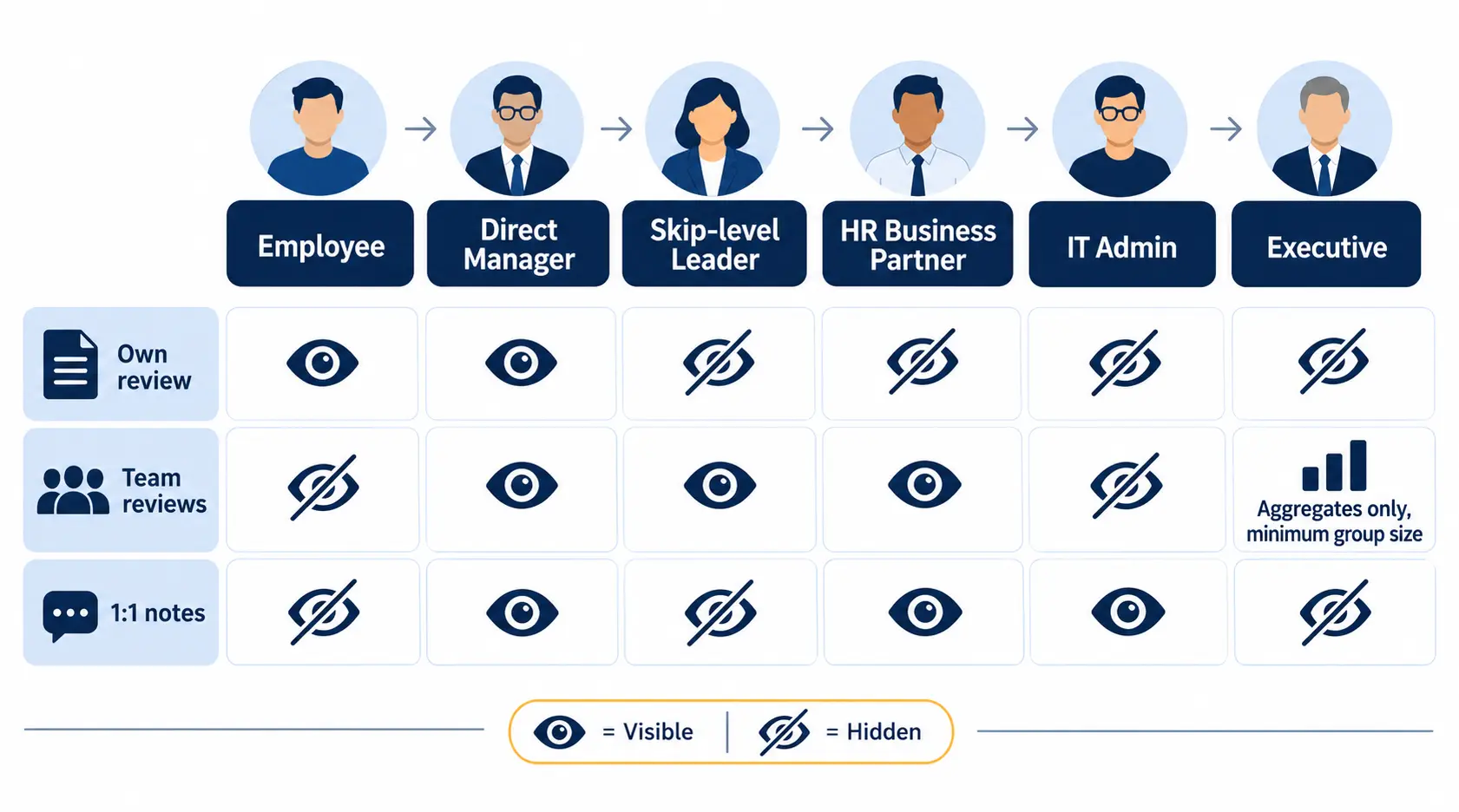
Role-based access control performance reviews should follow the reporting line, with logged exceptions. How to restrict access to performance review data? Design roles around what a person needs to do their job, not what the tool can show. Start from this table and tighten it.
| Role | Should see | Should not see by default |
|---|---|---|
| Employee | Own goals, reviews and written feedback | Anyone else’s ratings, calibration notes |
| Direct manager | Team reviews, 1:1 notes, goals | Other teams, pay outside their remit |
| Skip-level leader | Summaries and calibration inputs | Raw 1:1 notes |
| HR business partner | Reviews for assigned populations | The whole company |
| IT admin | SSO, settings, logs | Review content |
| Executive | Aggregated trends above a minimum group size | Individual drill-down without approval |
The AI layers raise the stakes. Axis AI joins individual KRA performance to OKR progress, and that join is where field-level scoping matters: a manager should see their team’s link between KRAs and goals, and should not inherit another team’s ratings because a goal is shared. Nexus AI works across teams and functions, so I want aggregated views that refuse to display a group below a minimum size. A team average of one person is a name.
How to audit access to employee performance data is simpler than most teams expect: review who opened which review each month, and alert on HR admins opening records outside their remit. Those same logs support your bias reviews, because you cannot fix what you cannot see.
Permissions only hold in a culture that trusts feedback
Access rules fail when managers work around them. See where your culture sits before you configure roles.
AI governance in performance management: the question vendors dodge
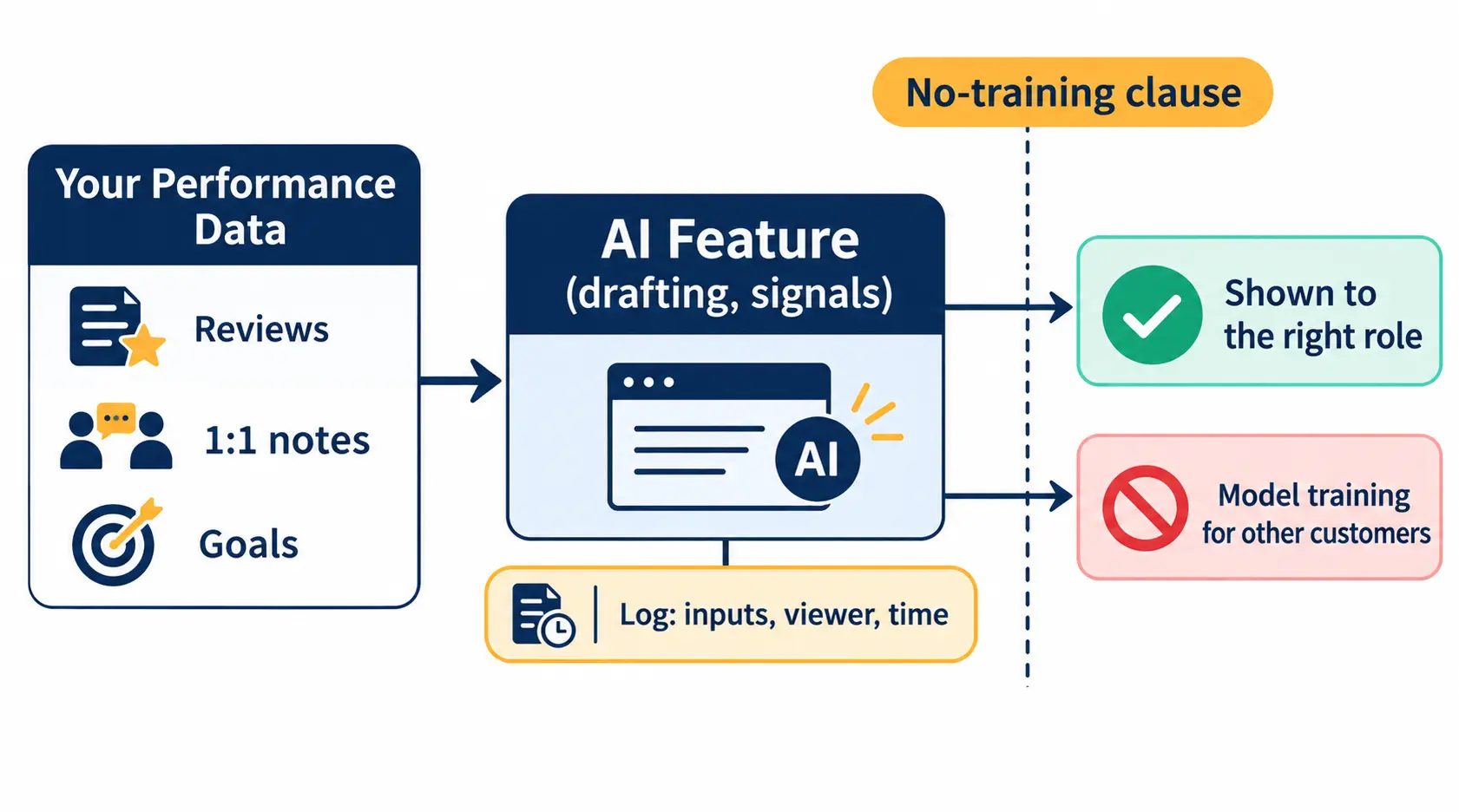
Does performance management software use employee data to train AI? It should not, unless you have said yes in writing. Ask for three commitments: your data does not train models for other customers, any model improvement is opt-in, and every AI sub-processor appears on the sub-processor list. The AI performance review privacy risks I see cluster in three places: drafting reviews from sensitive notes, scoring people on signals they cannot see, and sending text to a third-party model with no deletion path.
AI governance in performance management also has a legal clock. The EU AI Act employment high-risk category covers AI used to evaluate performance, allocate tasks, promote or terminate. After the Digital Omnibus, those obligations now apply from 2 December 2027. That is a delay, not a repeal. Our pieces on AI in performance management systems and AI-driven performance reviews cover how to use these tools fairly.
The Third Eye layer in Worxmate monitors rating drift before calibration, so unfair outcomes are caught early. That only works if its outputs are explainable and logged. The standard I want for any AI signal, ours included, is simple: show its inputs, show who saw it, show when.
Using AI on people data? Read this before you switch it on
Where AI genuinely helps performance, and where it needs a human and a log.
Security questions to ask before you buy performance management software
You want to buy performance management software that survives its first security review, not just its first demo. A vendor security assessment HR software teams run well takes days, not quarters, if you do three things.
First, pick your non-negotiables. I borrowed this from an engagement with an 8,000-person Middle East energy and utility company. They wanted a 4 to 8 week outside exercise to agree priorities. We went agile instead: one week, and agree on the 2 or 3 things that would hurt most if left undone. For software, choose your 3 before you open a SaaS vendor security questionnaire. Mine for performance data are independent audit evidence, a signed data processing agreement and a written no-training clause.
Second, run the review like a DEEP AI cycle. Define the data scope and your three non-negotiables (Define). Execute the questionnaire and collect evidence (Execute). Evaluate answers against red flags, not against the vendor’s confidence (Evaluate). Plan the re-review, because certificates expire and sub-processors change (Plan). This is the practical answer to how to evaluate performance management software security without a six-month project, and it pairs with our guide to evaluating a performance management system.
Third, make someone own it. A vendor due diligence checklist for HR software dies when HR owns it alone. It is the same mistake I see when HR owns a whole OKR programme: everyone else treats it as HR’s problem. Put IT security, legal and HR in one review, with a business sponsor on the hook.
Performance management software security requirements for enterprises
Larger buyers add regional hosting, customer-managed keys and contractual audit rights; see our notes on enterprise performance management rollouts. Security questions to ask performance management software vendors are the same at every size. Only the evidence you demand changes. If the performance module sits inside a wider suite, ask whether review data inherits suite-wide permissions, one reason I separate the two in performance management software vs HRIS.
Controls managers cannot use get bypassed, so the PMS adoption challenges quietly weaken access rules too. Settle permission models during implementation. When you are ready to compare vendors against my seven framework questions, use our performance management software shortlist.
HR tech security red flags
These HR tech security red flags make me walk away: a badge but no report, “we are compliant” with no named framework, a DPA offered only after signature, AI features with no off switch, and one permission level for all review data. Any single flag is fixable. Three together tell me the vendor has never been asked these questions.
My Take
In my OKR work, the Execution Maturity Rate sits at 5 to 15 percent in a typical first cycle and reaches 30 to 40 percent after 12 well-coached months. I would plan security the same way. In cycle one, your permissions will be too loose or too tight, because nobody has used them yet. Start strict, review access after the first calibration, and tighten each cycle. Software gives you the controls. Your managers decide whether they are used.
I will not use a blog post to tell you what certifications Worxmate holds. Ask us for the evidence in the demo, and put all 12 checks to us. A vendor that cannot answer its own checklist is not one I would trust, and that includes me. Security also sits inside a bigger design question, the link between people data and business goals, covered in performance management with OKRs.
Where to go from here
If you are ready to evaluate a platform, look at Worxmate performance management, check pricing, and book a demo with your security questions in hand. If the real problem is that nobody owns the performance process, the platform is not your first problem, and OKR consulting is where I would start. The software is the infrastructure. The coaching is the capability. You need both, and in the right order.


Written by
An OKR Coach with 20+ years of implementation experience, Madhusudan has guided over 50 organisations through successful OKR transformations, training more than 500 leaders. Learn more about Worxmate.