 WORXMATE
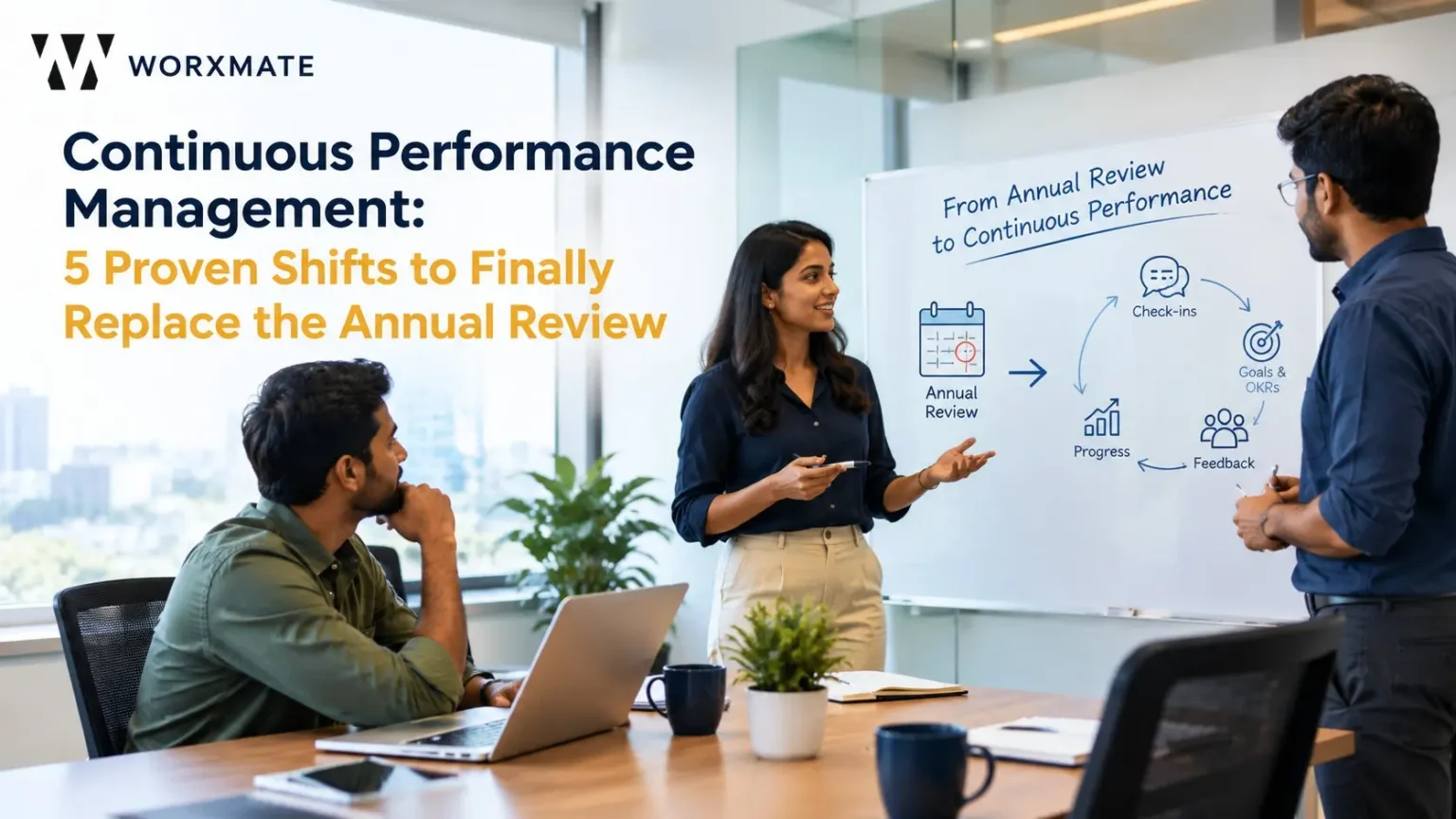
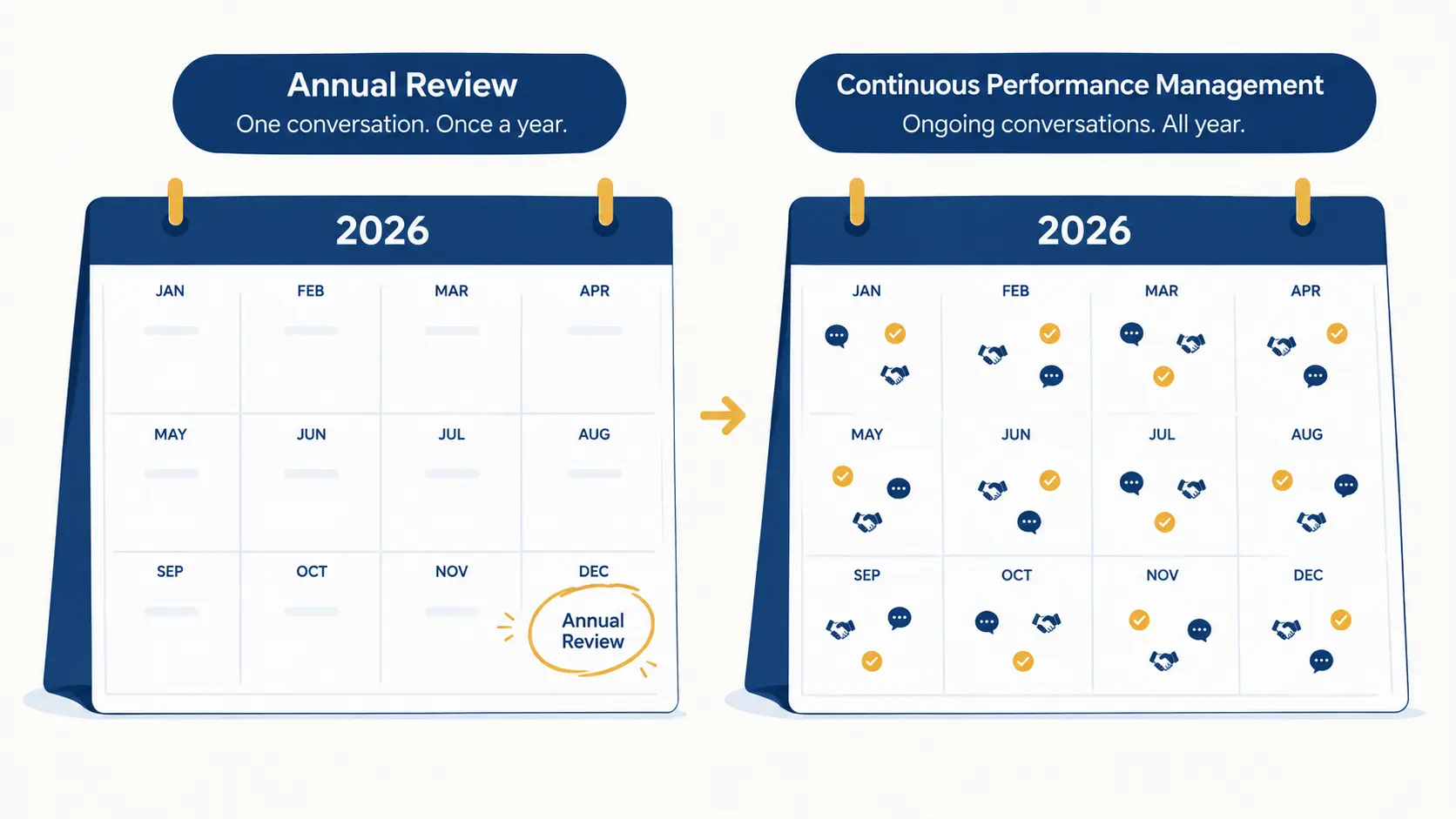
Continuous performance management is an approach to employee development that replaces the single annual review with ongoing 1:1s, real-time feedback, and goals that get revisited throughout the year instead of once. It works because it closes the gap between when a problem happens and when someone actually talks about it but the software alone doesn’t create that; the habit does.
Why the Annual Review Conversation Never Actually Happens
I sat in a room once with 35 leaders at a listed fintech company, sticky notes covering every wall, watching the MD walk goal by goal and realize that roughly 80% of what his leadership team had written down had nothing to do with where the business actually needed to go. Nobody had lied. Nobody had been lazy. They had simply gone a full year between real conversations about what mattered, and in that gap, everyone had quietly drifted toward whatever felt measurable rather than what was actually true.
That’s the failure mode continuous performance management exists to fix. Not the paperwork. The gap.
An annual review compresses twelve months of context into one conversation, and everyone in that room knows it’s mostly theater a manager reconstructing a year from a half-remembered Slack thread and a self-review the employee wrote defensively the night before. It’s not that annual reviews are evil. It’s that they’re structurally incapable of catching a problem while it’s still small enough to fix.
What Continuous Performance Management Actually Means
Continuous performance management is the practice of running performance conversations as an ongoing process rather than a once-a-year event — regular 1:1s, real-time feedback, and goals that stay visible and get revisited throughout the cycle instead of getting written in January and reviewed in December. It’s less a piece of software and more an operating rhythm, though the right platform makes that rhythm far easier to sustain.
The continuous performance management model isn’t complicated in theory. It’s just three things happening on a cadence instead of an anniversary: feedback happens close to the moment it’s earned, goals get checked against reality instead of memory, and managers coach instead of judge. What’s genuinely hard is the continuous performance management process required to make that rhythm survive contact with a busy quarter — which is the part most guides to this topic skip entirely.
If you’re comparing this model directly against the traditional cycle, our breakdown of quarterly vs. annual vs. continuous walks through the trade-offs by cadence, and annual reviews covers what the old model was actually trying, and mostly failing, to do.
The Continuous Performance Management Framework: Five Shifts, Not One Tool
Every continuous performance management framework I’ve seen actually work in the field comes down to five specific shifts away from the annual model. None of them require new software on their own. All five together are what the software should be built to support.
| Shift | From (Annual Model) | To (Continuous Model) |
|---|---|---|
| Feedback timing | Once a year, backward-looking | Close to the moment, forward-looking |
| Goal visibility | Written in January, reopened in December | Revisited every check-in cycle |
| Manager role | Evaluator delivering a verdict | Coach surfacing blockers early |
| Data source | Memory and a self-review | A running record of real conversations |
| Calibration input | A single rating meeting | Continuous signal gathered over the cycle |
This is the continuous performance management model in its simplest form, and it’s worth naming clearly because most vendor content skips straight to features without explaining what the features are actually replacing.
The Building Blocks: What “Continuous” Actually Consists Of
Continuous performance management benefits show up specifically because of what happens inside the cadence — not because the word “continuous” appears on a dashboard. Four things have to be genuinely present.
Real-time feedback, not scheduled feedback. The distinction matters more than it sounds like it should. Real-time feedback means a comment reaches someone within days of the thing it’s about, not at the next scheduled touchpoint. Ongoing feedback is the broader habit that real-time feedback lives inside. Peer-to-peer feedback matters here too a manager isn’t the only person with useful signal about how someone’s work is landing. If you want the mechanics of doing this well, effective feedback techniques and constructive feedback (with constructive feedback examples if you want to see it written out) are worth reading before you roll this out to a team that’s never done it before. Employee feedback examples is a useful companion for calibrating tone.
Structured 1:1s, not optional check-ins. One-on-one meetings are the single highest-leverage habit in any continuous performance management process, and they’re also the first thing that gets skipped when a quarter gets busy. Standardizing 1:1 meetings same structure, same cadence, notes that persist is what keeps them from becoming status updates. 1:1 meeting automation removes the friction of remembering to schedule them, which sounds minor until you’ve watched a program die because nobody owned the calendar invite.
Real-time performance dashboards, not year-end reports. If a manager can only see where a goal stands once a quarter, they’re not managing continuously, they’re managing quarterly with extra steps. Real-time performance dashboards are what actually let a manager coach in the moment instead of reconstructing a story after the fact.
Calibration that doesn’t ambush anyone. Continuous performance management should make the performance calibration process easier, not just faster, by feeding it a whole year of documented signal instead of one rating meeting. It also has real implications for reducing performance review bias when a manager has twelve months of notes instead of a single recent memory, recency bias has far less room to operate. And when a rating conversation does go badly, dealing with negative performance reviews is worth having in your back pocket, because continuous doesn’t mean conflict-free.
Where does your organization’s culture actually stand today?
Before you roll out a new cadence, it helps to know which of these five shifts your teams have already made — and which ones are still just aspirational.
Why Continuous Performance Management Programs Fail Anyway
Here’s the part most content on this topic skips entirely, because it’s uncomfortable: giving a team more frequent feedback opportunities does not automatically make the feedback better. It just makes bad conversations happen more often.
I’ve watched this play out directly. In the early stages of nearly every rollout I’ve been part of, there’s a fear nobody names out loud: if I commit to an ambitious goal and don’t deliver it, it’ll read as poor performance. That fear doesn’t go away because check-ins happen weekly instead of annually if anything, more frequent visibility can make it worse, because now there’s more surface area for someone to look like they’re falling short. Teams respond by writing safer, easier-to-complete goals and calling it agility. That’s not continuous performance management working. That’s the annual review’s worst instinct, just running on a faster clock.
The fix isn’t a feature. It’s making explicit, from the very first cycle, that this is a learning process and not a performance audit and then actually behaving that way when someone misses a stretch goal in month two. If leadership treats a missed ambitious goal the same way they’d treat a missed easy one, the fear compounds instead of dissolving, and the entire cadence becomes performative faster than an annual review ever was.
I saw the other side of this at a 70,000-person IT services organization I worked with, inside their Media, Entertainment and Telecom business unit. The leadership team reporting into the SBU Head genuinely didn’t have a shared read on what was blocking progress — every strategic review surfaced the same frustration, people in the room with no real visibility into where execution actually stood. What changed it wasn’t a dashboard. It was a live exercise using their own real business scenarios to separate output-led thinking from outcome-led thinking, followed by a structured “Thinking Process” where each leader derived their own goals in real time instead of being handed a template. Two to three quarters later, that same leadership team could name root causes fast, kill initiatives that were burning effort without producing outcomes, and give their own teams clarity that had never existed before. None of that came from more frequent check-ins alone. It came from teaching people what to actually say inside those check-ins.
Continuous Performance Management Frameworks and Where This Fits Organizationally
Continuous performance management doesn’t replace a strategic performance management system it’s the operating rhythm that makes one actually function day to day. Most organizations already have some version of performance management frameworks on paper; the performance management cycle is the structural skeleton, and continuous practices are what keep that skeleton from going dormant between formal moments.
This matters because outcome-driven performance management only happens when goals get revisited often enough to catch drift early a genuinely strategic performance management system treats continuous check-ins as the mechanism, not an add-on. Where I’ve seen this get most sophisticated is in predictive performance management — using the pattern of continuous signal to flag a problem before it shows up as a missed goal, rather than after.
The benefits of performance management system design that’s genuinely continuous compound over time in a way an annual cycle structurally cannot: global performance management programs running across time zones benefit enormously from asynchronous, continuous touchpoints instead of trying to synchronize one big annual moment across a dozen regions. And if your organization’s current system is more broken than you’d like to admit, fixing broken performance management systems is worth reading before you assume new software is the fix — a genuine performance management culture shift usually has to happen first, or the software just automates the old dysfunction faster. Watching performance management trends over the last several cycles, the organizations pulling ahead aren’t the ones with the newest tool — they’re the ones that got the cadence and the coaching right before they bought anything.
Continuous Performance Management vs. the Annual and 360 Models
It’s worth being precise about what continuous performance management is actually replacing, because the comparisons get conflated constantly. Continuous feedback vs. performance reviews is a different question from 360-degree appraisal vs. traditional performance review one is about frequency, the other is about who’s providing the input. Continuous performance management can incorporate 360 feedback; it doesn’t require it. The core shift is temporal, not structural: how often does a conversation happen, not how many people are in it.
For a full frequency-based breakdown across the whole spectrum, quarterly vs. annual vs. continuous is the resource I’d point you to rather than re-litigating it here.
How OKRs and Continuous Performance Management Connect
This is where most continuous performance management software gets the architecture wrong, and it’s worth understanding why before you evaluate anything.
Agile performance management and OKR execution are, in my experience, the same discipline wearing two names. OKRs and performance management work together because a goal that only gets reviewed once a year isn’t actually an OKR — it’s a KPI with better branding. The entire point of an Objective and Key Result is that it gets checked, adjusted, and coached against continuously. If your organization is deciding between dedicated tools for each function, OKR vs. PMS software covers that distinction directly — and it’s the reason platforms that treat goal-tracking and performance conversations as two separate systems create a translation tax nobody asked for.
This is where the DEEP AI™ framework — Define, Execute, Evaluate, Plan earns its place in this conversation, not as a pitch but as an architecture answer to a real structural problem. Define maps to writing a genuine outcome-driven goal instead of an output dressed up as one. Execute maps to the actual continuous check-in rhythm this whole article has been describing. Evaluate maps to calibration that draws on real signal instead of a single meeting’s memory. Plan maps to what the organization carries forward, cycle over cycle, instead of resetting to zero every January. Orbit AI (People Intelligence) exists specifically to catch the adoption and engagement signals a continuous program should be generating — burnout risk, disengagement drift — long before they show up in an exit interview. Axis AI (Business Performance Intelligence) does the same work on the execution side, surfacing leading indicators instead of the lagging ones most performance dashboards still default to. Nexus AI (Organisational Intelligence) checks the structural question underneath all of it: is the org chart actually built to carry the goals being cascaded through it.
One structural piece worth naming directly: continuous performance management works differently depending on seniority, and pretending otherwise is a common mistake. A Tiered Accountability Model — roughly 100% OKR weighting at the C-suite, 40% OKR / 60% KRA at middle management, and 20% OKR / 80% KRA for individual contributors reflects the reality that continuous, outcome-driven goal ownership concentrates at the top of an organization and needs to be earned gradually as execution maturity develops further down. Treating every level identically is one of the more common reasons continuous performance management programs stall in year one.
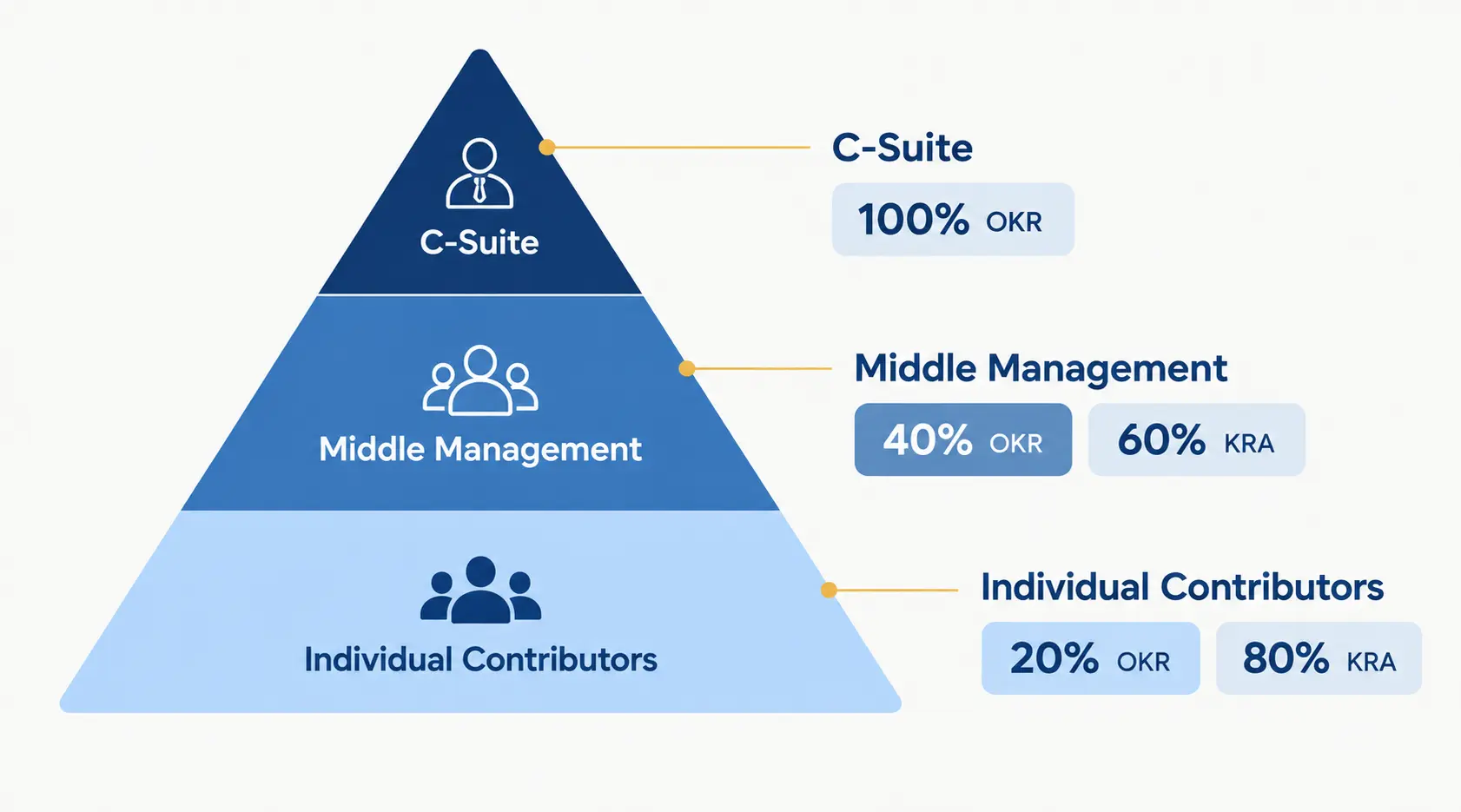
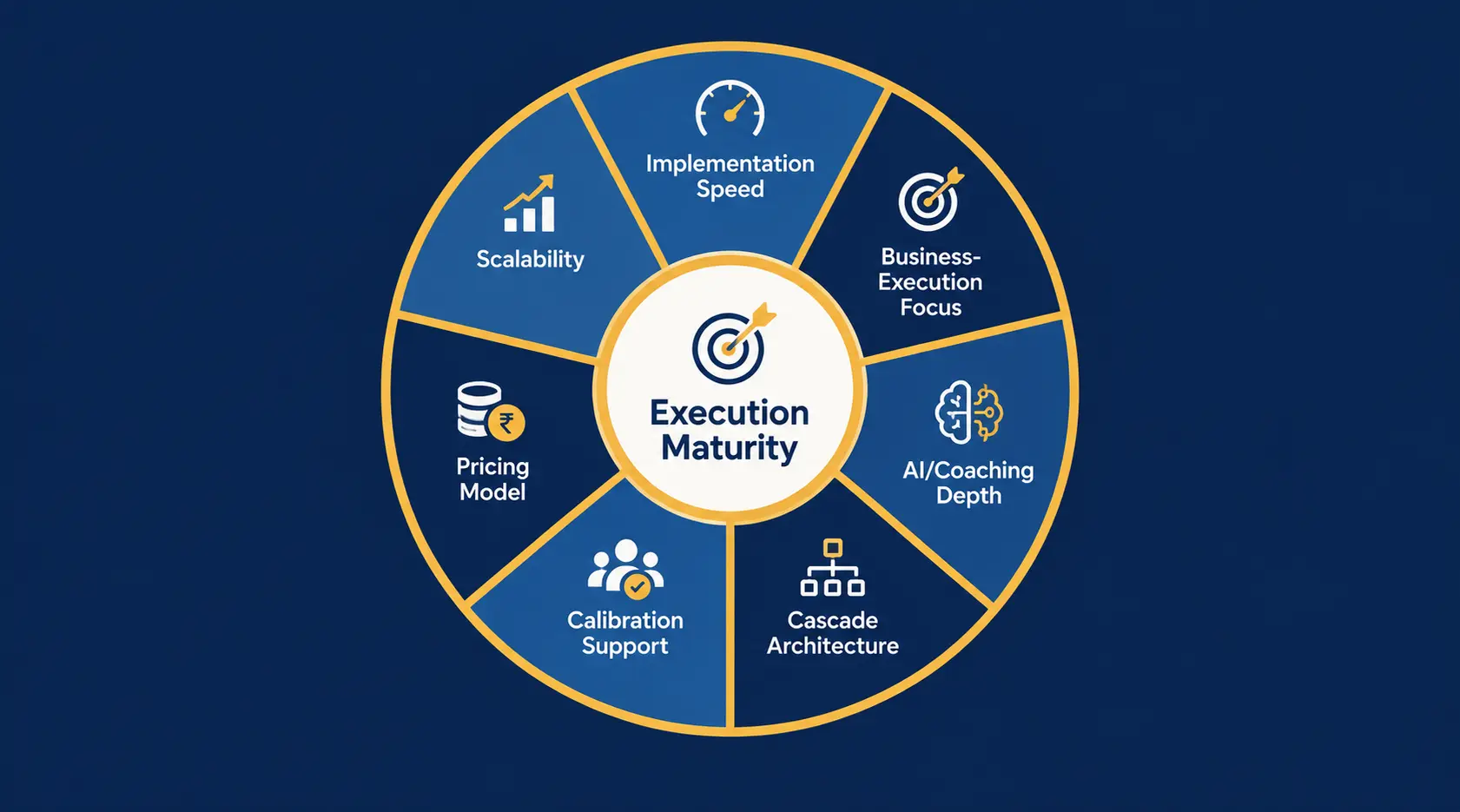
OKR Execution Maturity Framework 2026
This playbook covers how to get leadership buy-in and sequence the rollout so it doesn’t collapse in the first quarter.
Continuous Performance Management Examples in Practice
Concretely, what does this look like week to week? A manager and report run a 20-minute structured 1:1 every other week, using a standing agenda rather than starting from scratch. Between those, feedback gets logged close to the moment it happens rather than saved up for the next meeting a piece of peer feedback after a strong client call, a quick correction after a missed deadline. Goals stay visible on a shared dashboard that both people can see without asking, and get explicitly revisited, not just glanced at, every cycle. Calibration season arrives with a full record already assembled instead of a manager trying to remember March from October.
None of these continuous performance management examples require exotic tooling. They require the habit to survive a busy quarter, which is precisely the part software should make easier rather than the part it tries to replace.
Continuous Performance Management Best Practices
If you’re building this from scratch, the sequence matters more than any individual tactic:
- Name the fear before you launch. Tell the organization explicitly, in the first session, that this is a learning cycle and not a stealth performance audit.
- Start with structured 1:1s before anything else. Everything else in a continuous performance management process depends on that habit existing first.
- Keep goals visible, not just written. A goal nobody revisits isn’t continuous — it’s just an annual goal with a nicer dashboard.
- Coach managers before you coach individual contributors. The middle layer is where most programs actually die; equip it first.
- Let calibration draw on the full record, not a single meeting’s memory, and watch recency bias shrink as a direct result.
These continuous performance management best practices aren’t secrets — they’re just consistently skipped in favor of buying software first and figuring out the habit later, which is backward.
Ready to Evaluate the Software Itself?
Everything above describes the model and the discipline it takes to run it well. If you’re now at the point of comparing specific continuous performance management software — pricing, OKR integration depth, implementation speed that’s a separate decision with its own evaluation criteria, and we’ve built a full practitioner-led comparison of the leading platforms in our continuous performance management software guide.
Two Ways Forward
The Platform Path: If you’re ready to see what a continuous performance management platform built around this exact model looks like in practice, book a Worxmate demo or explore current pricing.
The Consulting Path: If the real gap is leadership alignment, goal quality, or getting managers coaching instead of just checking boxes, our OKR consulting work is built specifically for that. Most organizations that get lasting value from continuous performance management eventually need both the rhythm and the coaching that makes the rhythm mean something.

Written by
An OKR Coach with 20+ years of implementation experience, Madhusudan has guided over 50 organisations through successful OKR transformations, training more than 500 leaders. Learn more about Worxmate.